

.png) Agriculture
Agriculture Aerospace and Defense
 Automotive and Transportation
 Banking & Finance
 Biotechnology
 Chemicals and Materials
 Consumer Goods
 Energy and Power
 Food and Beverages
 Healthcare IT
 Information & Technology
 Machinery & Equipment
 Packaging
 Healthcare
 Electronics and Semiconductor
 Medical Devices
13.png)
Market Overview
The global central air conditioning market size was valued at USD 44.7 billion in 2025. The market is projected to grow from USD 46.5 billion in 2026 to USD 62.1 billion by 2033, exhibiting a CAGR of 4.2% during the forecast period.
Global Central Air Conditioning Market Comprehensive Data-Driven Market Analysis & Strategic Outlook
- Global central air conditioning market valued at USD 44.7 billion in 2025, growing at a CAGR of around 4.2% through 2033, with potential to exceed USD 62.1 billion.
- North America accounted for 24.6% of the central air conditioning market in 2025, with the United States leading the market share in 2026.
- The Split System segment accounts for 31.4% market share in 2025, supported by widespread deployment across residential and light commercial projects. Strong installer preference and favourable lifecycle economics are strengthening its position within the central air conditioning market.
- Key trends driving growth: Rising construction of commercial complexes, hospitals, and residential buildings, increasing adoption of centralized HVAC systems, and growing focus on energy-efficient, smart, and inverter-based air conditioning technologies will propel the central air conditioning market.
- Opportunities include growth in green building projects and district cooling systems across developing economies.
- Key insight: The central air conditioning market is positioned for significant value expansion over the next decade, with tightening efficiency regulations and lifecycle cost focus shaping procurement decisions. Rising urban heat stress, new commercial construction, and large-scale retrofit programs are likely to propel the adoption of advanced central systems over room-based solutions. Integration with smart controls and building management platforms unlocks increased service revenues and performance-linked contracting opportunities.
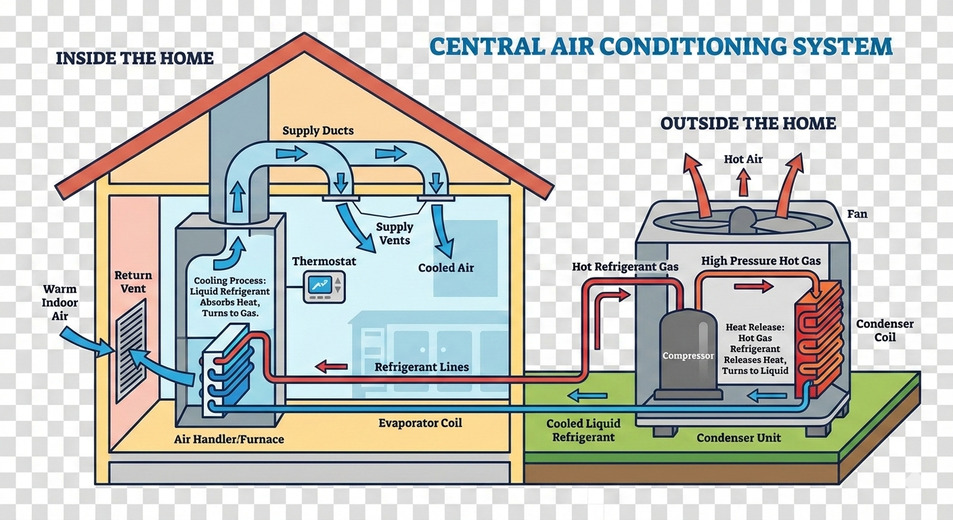
The central air conditioning is critical in commercial, institutional, industrial, and high-rise residential buildings, where cooling loads dominate peak electricity use and propel infrastructure planning. The International Energy Agency (IEA) estimated that around 2 billion air conditioning units are already in operation globally and is on a course to reach roughly 5.6 billion units by 2050, supported by rising penetration in emerging economies and hotter climates. Space cooling already accounts for 9% of global electricity consumption and ranks among the fastest-growing applications in the buildings sector, while operational energy use in buildings accounts for about 30% of global final energy demand. These growing trends place central systems at the center of discussions on grid capacity, building codes, and long-term climate resilience, specifically in dense urban corridors and large infrastructure projects.
The central air conditioning solutions are likely to shift towards higher-efficiency chillers, variable refrigerant systems, and integrated heat pump architectures that align with building decarbonisation targets in the coming decade. The International Energy Agency (IEA) estimates that electricity demand from air conditioners will reach three times the current levels by 2050. This rise in electricity demand underscores the importance of high-performance system design and advanced controls in the central air conditioning market, underscoring the role of industry professionals in shaping sustainable solutions. The policy initiatives, including the European Union Energy Performance of Buildings Directive and related heating and cooling strategies, aim to reduce projected building energy consumption by about 11.7 percent by 2030 and accelerate the deployment of efficient solutions. Operators and owners are increasingly focused on HVAC optimisation for better energy efficiency. Metastat analysis indicating that HVAC accounts for around 40% of energy use in commercial buildings, with commercial facilities reaching 70%, making efficient central plant and controls a critical lever for energy cost and emissions management in the central air conditioning market.
Market Dynamics
Growth Drivers:
Rising construction of commercial complexes, hospitals, & residential buildings, and increasing adoption of centralized HVAC systems.
The construction of office towers, malls, hospitals, data centers, airports, and high-rise residential projects is propelling the adoption of central air conditioning in both new construction and retrofit environments. Centralized HVAC solutions provide superior load management, comfort control, and lifecycle cost efficiencies for large built areas, owing to the higher specifications of chillers, VRF systems, and rooftop units in project designs.
Growing focus on energy-efficient, smart, and inverter-based air conditioning technologies.
The strict building energy codes, refrigerant regulations, and corporate decarbonisation targets are propelling investments toward high-efficiency central plants and intelligent control architectures. Inverter-driven compressors, variable-speed drives, and IoT-enabled monitoring platforms are expected to support lower operating expenditure and improved reliability, owing to optimized performance, data-driven maintenance, and integration with advanced building management systems.
Restraints and Challenges:
High Installation and Maintenance Costs limiting Penetration in Small-scale Applications.
High upfront investment in chillers, distribution networks, and integrated controls, along with specialized installation requirements, limits the central air conditioning market to medium and large-scale projects where payback is shorter. Smaller buildings often favour split or packaged units, which offer lower initial capital costs and restrain the wider adoption of centralized solutions in the central air conditioning market.
Environmental concerns over refrigerant emissions and power consumption.
High energy intensity and reliance on high global warming potential refrigerants in legacy plants places central air conditioning under increasing regulatory and stakeholder scrutiny. Building owners face pressure to reduce leakage, transition to low-GWP refrigerants, and adopt high-efficiency compressors and controls to limit direct and indirect emissions.
Opportunities:
Growing opportunities in green building projects and district cooling systems across developing economies.
The expansion of green building certifications, energy performance mandates, and sustainability-linked finance is creating an attractive market for high-efficiency central plants and low-GWP refrigerant platforms. District cooling networks in dense urban corridors, airports, industrial parks, and mixed-use developments are gaining traction in developing economies, propelling large-scale chiller and thermal storage deployments. Developers and utilities that align with advanced central air conditioning solutions are positioned to capture increased long-term service revenues and performance contracting opportunities.
Market Segmentation Analysis
The global central air conditioning market is classified based on Type, Technology, and Application.
By Type, the market is further segmented into:
- Split System
Split system installations account for a significant share of central air conditioning in commercial buildings and premium residential complexes. Modular design supports phased installation and flexible zoning for different occupancy patterns. Strong familiarity with installers and relatively adaptable layout options propel ongoing preferences in retrofit and small-project environments.
- Packaged Unit
Packaged units serve applications where rooftop or ground-mounted equipment with integrated components simplifies plant room requirements. These packaged units suit retail outlets, mid-sized office buildings, and small industrial facilities seeking compact solutions with shorter installation timelines. Replacing aging stock with higher-efficiency packaged systems is propelling energy-saving objectives for budget-conscious owners.
- Rooftop System
Rooftop systems are widely used in shopping centers, airports, logistics hubs, and large-format retail, where roof availability supports centralized cooling distribution. Elevation helps reduce the use of indoor space in mechanical rooms and facilitates maintenance access with minimal disruption to occupants. Increased focus on low noise operation and integration with advanced controls is reinforcing their role in contemporary commercial design.
- Others
Other segments include chillers with air cooling, district-cooling interfaces, water cooling, and specialized systems for industrial, healthcare, and data center environments. Greater adoption of thermal storage and heat pump-based architectures in this group is expected to propel long-term efficiency gains and service-led revenue pools.
By Technology, the market is divided into:
- Inverter
Inverter-based central air conditioning technologies modulate compressor speed to match real-time cooling loads, supporting efficient part-load operation in commercial and high-rise residential buildings. Energy savings, quieter operation, and stable temperature control strengthen their appeal in projects targeting green building certifications and tighter operating budgets. Integration with smart controls and variable-speed fans propels optimization performance across diverse climate conditions.
- Non-Inverter
Non-inverter systems are relevant in cost-sensitive environments where the initial capital outlay outweighs lifecycle efficiency. Fixed speed compressors deliver predictable performance for relatively stable load profiles in smaller commercial facilities and selected residential complexes. Replacement cycles provide opportunities for gradual migration toward higher-efficiency options, with policy pressure and increased awareness of operating costs over time, propelling greater adoption.
- Variable Refrigerant Flow (VRF) Systems
Variable Refrigerant Flow systems provide precise planning, high efficiency at part load, and strong design flexibility for offices, hotels, mixed-use developments, and complex retrofit projects. Integration with building management platforms and advanced diagnostics is strengthening their position in premium, comfort-focused, and energy-aware building portfolios, propelling the central air conditioning market.
By Application, the market is further divided into:
- Residential
Residential applications include premium apartments, villas, and high-rise complexes that require uniform comfort and integrated control across multiple zones. Developers favour the central air conditioning to support higher perceived asset value, quieter operation, and joint optimization with building envelopes and glazing. Retrofit opportunities in the urban housing stock, coupled with rising heat-stress events, are likely to propel the uptake of efficient centralized and VRF-based solutions in selected markets.
- Commercial
Commercial buildings such as offices, malls, hotels, airports, healthcare facilities, and educational campuses represent the primary demand hub for central air conditioning. Higher operating-hour intensity, corporate decarbonisation commitments, and regulatory pressure on performance standards propel continuous upgrades in chillers, rooftop units, and VRF networks.
- Industrial
Industrial applications span manufacturing plants, pharmaceuticals, clean rooms, data centres, and cold chain infrastructure, where process stability and equipment protection rely on robust central cooling. The expansion of electronics production, logistics hubs, and temperature-sensitive processing in emerging markets is propelling increased investment in high-performance central plants and service partnerships.
By Region:
- Based on geography, the global central air conditioning market is divided into North America, Europe, Asia-Pacific, South America, and the Middle East & Africa.
- The North American central air conditioning market is set to expand at a CAGR of 4.2% within the forecast period, reaching a market size (TAM) of USD 15.2 billion by the end of 2033.
- North America experiences a rise in retrofit activity across office towers, healthcare campuses, educational institutions, and data centers, where central air conditioning upgrades deliver measurable energy and reliability benefits.
- Asia Pacific presents a strong opportunity for the central air conditioning market, driven by rapid urbanization, large commercial real estate pipelines, and expanding transport and social infrastructure.
- Policy thrusts on efficient space cooling under national energy conservation plans in China, India, and Southeast Asia, combined with growth in data centers and high-rise mixed-use developments, are likely to propel the adoption of high-capacity, smart-controlled central systems across the region.
- The Middle East, Africa, and South America together present significant structural cooling needs, with hot climates, rising urbanization, and the growing penetration of organized retail and modern offices.
- District cooling schemes in Gulf countries, along with mall, airport, and hospitality projects, are strengthening demand for large-tonnage chiller plants, while Latin American and African cities are upgrading their commercial building stock to meet efficiency and comfort targets.
Competitive Landscape and Strategic Insights
Central air conditioning is catered by a group of major HVAC manufacturers alongside strong regional champions that collectively shape technology standards and pricing. Daikin Industries, Carrier Global Corporation, Johnson Controls through its YORK Commercial Solutions portfolio, Midea Group, Mitsubishi Electric, LG Electronics, Samsung Electronics, Gree, Haier, AUX Group, and Hisense HVAC provide extensive ranges of chillers, VRF systems, rooftop units, and controls for residential, commercial and industrial projects worldwide, supported by large manufacturing bases and service networks. Aermec, Blue Star Limited, Voltas Limited, SKM Air Conditioning, Dunham Bush, Fujitsu General, Panasonic Holdings Corporation, Rheem Manufacturing Company, Nortek Global HVAC, Bosch Home Comfort Group, and TICA reinforce competition in regional markets through climate-specific portfolios, local production partnerships, and long-standing presence with project specifiers and installers.
Strategic focus across these players increasingly centers on high-efficiency chillers, inverter-driven compressors, low-global-warming-potential refrigerants, and integration with digital building platforms to reduce lifecycle operating costs and emissions. Daikin, Carrier, Johnson Controls, and Midea highlight this direction through portfolios that emphasize energy-efficient central plants, smart controls, and support for environmentally responsible refrigerants. At the same time, regional leaders such as Blue Star, Voltas, SKM, and Aermec prioritize system customization for harsh climates, retrofit constraints, and local grid conditions. Service-centric models are gaining importance, with predictive maintenance, remote monitoring, and performance-linked contracts strengthening recurring revenue streams. Collaboration with developers, ESCOs, and utilities around green building projects, district cooling schemes, and policy-driven retrofit programs is expected to propel differentiation for manufacturers that align product roadmaps with long-term decarbonisation and resilience objectives.
Forecast and Statical Outlook
Market size is forecast to rise from USD 44.7 billion in 2025 to over USD 62.1 billion by 2033.
The central air conditioning market is projected to maintain steady expansion over the forecast period, supported by tightening energy performance regulations, urban heat stress, and expanding stock of commercial, healthcare, data center, and high-rise residential assets. Manufacturers and service providers are expected to prioritize high-efficiency chillers, VRF systems, advanced rooftop units, and smart control architectures that reduce lifecycle operating costs and align with low-GWP refrigerant transitions. Retrofits of aging building stock in North America and Europe, combined with Greenfield infrastructure in the Asia Pacific and district cooling rollouts in Gulf economies, are likely to propel sustained project pipelines for central plants and related services. Digitalization through IoT-enabled monitoring, predictive maintenance, and performance-based contracts is set to elevate recurring revenue shares and support closer collaboration with utilities and ESCOs. Heightened scrutiny on refrigerant leakage, peak load impacts, and resilience to extreme weather will shape design choices, pushing stakeholders toward integrated solutions that optimize comfort, reliability, and environmental performance in the central air conditioning market.
Central Air Conditioning Market Key Segments:
By Type:
- Split System
- Packaged Unit
- Rooftop System
- Others
By Technology:
- Inverter
- Non-Inverter
- Variable Refrigerant Flow (VRF) Systems
By Application:
- Residential
- Commercial
- Industrial
Key Global Central Air Conditioning Industry Players
- Aermec S.p.A.
- AUX Group
- Blue Star Limited
- Bosch Home Comfort Group
- Carrier Global Corporation
- DAIKIN Industries, Ltd.
- Dunham-Bush
- Fujitsu General Limited
- Gree Electric Appliances, Inc.
- Guangdong Chigo Air Conditioning Co., Ltd.
- Haier Inc.
- Hisense HVAC
- Johnson Controls International plc
- Lennox International Inc.
- LG Electronics Inc.
- Midea Group
- Mitsubishi Electric Corporation
- Nortek Global HVAC
- Panasonic Holdings Corporation
- Rheem Manufacturing Company
- Samsung Electronics Co., Ltd.
- SKM Air Conditioning
- Voltas Limited
- TICA
- YORK Commercial Solutions
Report Coverage
This research report categorizes the central air conditioning market based on key segments and regions, forecasts revenue growth, and analyses trends in each submarket. The report analyses the key growth drivers, opportunities, and challenges influencing the central air conditioning market. Recent market developments and competitive strategies such as expansion, type launch, development, partnership, merger, and acquisition have been included to draw the competitive landscape in the market.
The report strategically identifies and profiles the key market players and analyses their core competencies in each sub-segment of the central air conditioning market.
|
Report Attributes |
Details |
|
Study Period |
2021-2033 |
|
Base Year |
2025 |
|
Estimated Year |
2026 |
|
Forecast Period |
2026-2033 |
|
Historical Period |
2021-2025 |
|
Growth Rate |
CAGR 4.2% from 2026 to 2033 |
|
Revenue Unit |
USD billion |
|
Sales Volume Unit |
Thousand Units |
|
Segmentation |
By Type, Technology, Application, and Region |
|
By Type |
Split System |
|
Packaged Unit |
|
|
Rooftop System |
|
|
Others |
|
|
By Technology |
Inverter |
|
Non-Inverter |
|
|
Variable Refrigerant Flow (VRF) Systems |
|
|
By Application |
Residential |
|
Commercial |
|
|
Industrial |
|
|
By Region |
North America (By Type, Technology, Application, and Country) |
|
|
|
|
|
|
|
Europe (By Type, Technology, Application, and Country) |
|
|
|
|
|
|
|
|
|
|
|
|
|
|
|
|
Asia Pacific (By Type, Technology, Application, , and Country) |
|
|
|
|
|
|
|
|
|
|
|
|
|
|
|
|
South America (By Type, Technology, Application, and Country) |
|
|
|
|
|
|
|
|
Middle East and Africa (By Type, Technology, Application, and Country) |
|
|
|
|
|
|
|
|
WHAT REPORT PROVIDES
- Market Sales Volume in Thousand Units
- Insights on GWP (Global Warming Potential) and effect over the Central Air Conditioning market
- Detailed Landscape on HVAC-as-a-Service
- Key insights on use generative AI into predictive maintenance to reduce truck rolls and operational expenditure (OPEX)
- Impact of Labor shortages for skilled technicians
- Analysis of specialized cooling startups in the AI data center space
- Commercial HVAC decarbonization software ROI case studies
- Impact of 2025 U.S. DOE SEER2 mandates on non-compliant central AC inventory liquidation
- HVAC supply chain diversification strategies
- Full in-depth analysis of the parent Industry
- Important changes in market and its dynamics
- Segmentation details of the market
- Former, on-going, and projected market analysis in terms of volume and value
- Assessment of niche industry developments
- Market share analysis
- Key strategies of major players
- Emerging segments and regional growth potential

 US: +1 3023308252


