
Dec 26, 2025
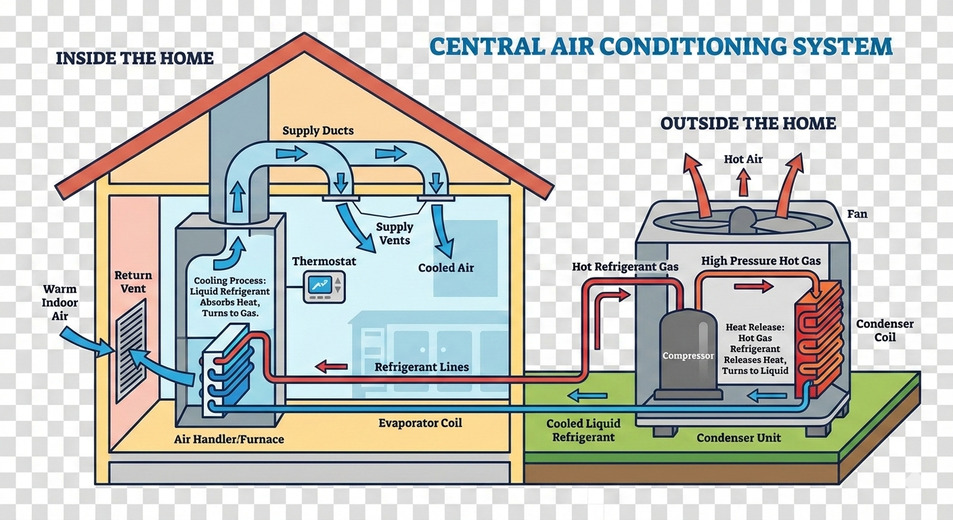
The newly launched report on the global central air conditioning market by Metastat Insight underscores a critical evolution in building infrastructure, where cooling systems are transitioning from passive utilities to active components of energy management strategies.
The global central air conditioning market was valued at USD 44.7 billion in 2025 and is projected to grow steadily at a CAGR of 4.2%, reaching USD 62.1 billion by 2033.
The growth trajectory is closely linked to global urbanization and rising ambient temperatures, as space cooling now accounts for about 9% of global final electricity consumption. The market is moving beyond simple temperature control to address the urgent need for grid stability and decarbonization in dense urban corridors where commercial and high-rise residential structures dominate energy demand.
The transformation is a technological migration toward high-efficiency architectures, specifically Variable Refrigerant Flow (VRF) systems and inverter-driven chillers. Regulations like the EU’s Energy Performance of Buildings Directive aim to curb consumption, and the market is shifting away from legacy non-inverter systems toward smart systems and load-responsive technologies. The International Energy Agency warns that cooling demand will triple by 2050, placing immense pressure on manufacturers to innovate. Consequently, the industry is prioritizing integrated heat pump architectures and advanced control platforms that optimize compressor speeds in real-time, thereby reducing operational costs and aligning with corporate net-zero targets.
The market structure remains anchored by the Split System segment, which held a 31.4% share in 2025 due to its widespread applicability in residential and light commercial retrofit projects. However, the commercial sector, encompassing office towers, hospitals, and data centers, is the primary engine for large-scale innovation. In these environments, rooftop systems and packaged units are being re-engineered to minimize physical footprints while maximizing thermal output. Simultaneously, the industrial segment is witnessing increased demand from pharmaceutical and data center facilities, where precise temperature stability is non-negotiable, driving investments in robust, heavy-duty cooling infrastructure that ensures process continuity and equipment protection.
Geographically, the market presents a dual narrative of retrofit optimization in mature economies and rapid infrastructure expansion in developing regions. North America, accounting for nearly a quarter of the market, is characterized by a surge in upgrading aging institutional and commercial stock to meet modern efficiency codes. Conversely, the Asia-Pacific region serves as a high-growth hub, driven by rapid urbanization and the construction of mixed-use developments in China, India, and Southeast Asia.
In the Middle East and Africa, extreme climatic conditions are accelerating the adoption of district cooling networks, which centralize thermal energy production to achieve economies of scale and reduce the strain on local power grids.
The competitive landscape is defined by a race to integrate hardware with digital intelligence, led by industry giants such as Daikin and Carrier. These entities are shifting their strategies from pure equipment sales to lifecycle service models, leveraging IoT-enabled monitoring to predict maintenance needs and optimize energy use. As the market progresses toward 2033, success will depend on balancing high upfront installation costs with demonstrable long-term savings. The future of central air conditioning lies in its integration into the broader smart building ecosystem, where cooling systems act as intelligent nodes that communicate with grid infrastructure to manage peak loads and ensure climate resilience.
Drop us an email at:
Call us on:
+1 214 613 5758
+91 73850 57479
 inquiry@metastatinsight.com
 US: +1 3023308252
UK: +44 2034116747APAC: +91 7385057479
US: +1 3023308252
UK: +44 2034116747APAC: +91 7385057479 Address





.png) Agriculture
Agriculture Aerospace and Defense
 Automotive and Transportation
 Banking & Finance
 Biotechnology
 Chemicals and Materials
 Consumer Goods
 Energy and Power
 Food and Beverages
 Healthcare IT
 Information & Technology
 Machinery & Equipment
 Packaging
 Healthcare
 Electronics and Semiconductor
 Medical Devices
