Global Embedded Finance Solutions Market Size, Share, By Financial Product (Embedded Payments, Merchant Acquiring and Payouts, Embedded Banking Accounts, Wallets and Treasury, Embedded Card Issuing and Processing, Embedded Lending, BNPL and Working Capital, Embedded Insurance), By Provider Type (Banks and Licensed Financial Institutions, Payment Processors and Merchant Acquirers, Banking-as-a-Service and Embedded Finance Platforms, Card Issuing and Processing Platforms, Specialist Lending and Insurance Providers), By Pricing and Commercial Model (Transaction-Based Pricing, Platform Subscription and Minimum Commitment, Account, Wallet and Ledger Fees, Card Issuance, Processing and Program Fees, Credit, Interest and Merchant Discount Fees, Revenue Share and Interchange), By End-use Platform (E-commerce and Online Marketplaces, Vertical SaaS, ERP and Business Management Platforms, Retail and Consumer Brands, Mobility, Travel and Hospitality Platforms, Gig Economy and Payroll), Industry Analysis, Growth, Trends, and Forecast, 2026-2033
Report ID
MSI-4834
Published
July 31, 2026
Pages
253 Pages
Format
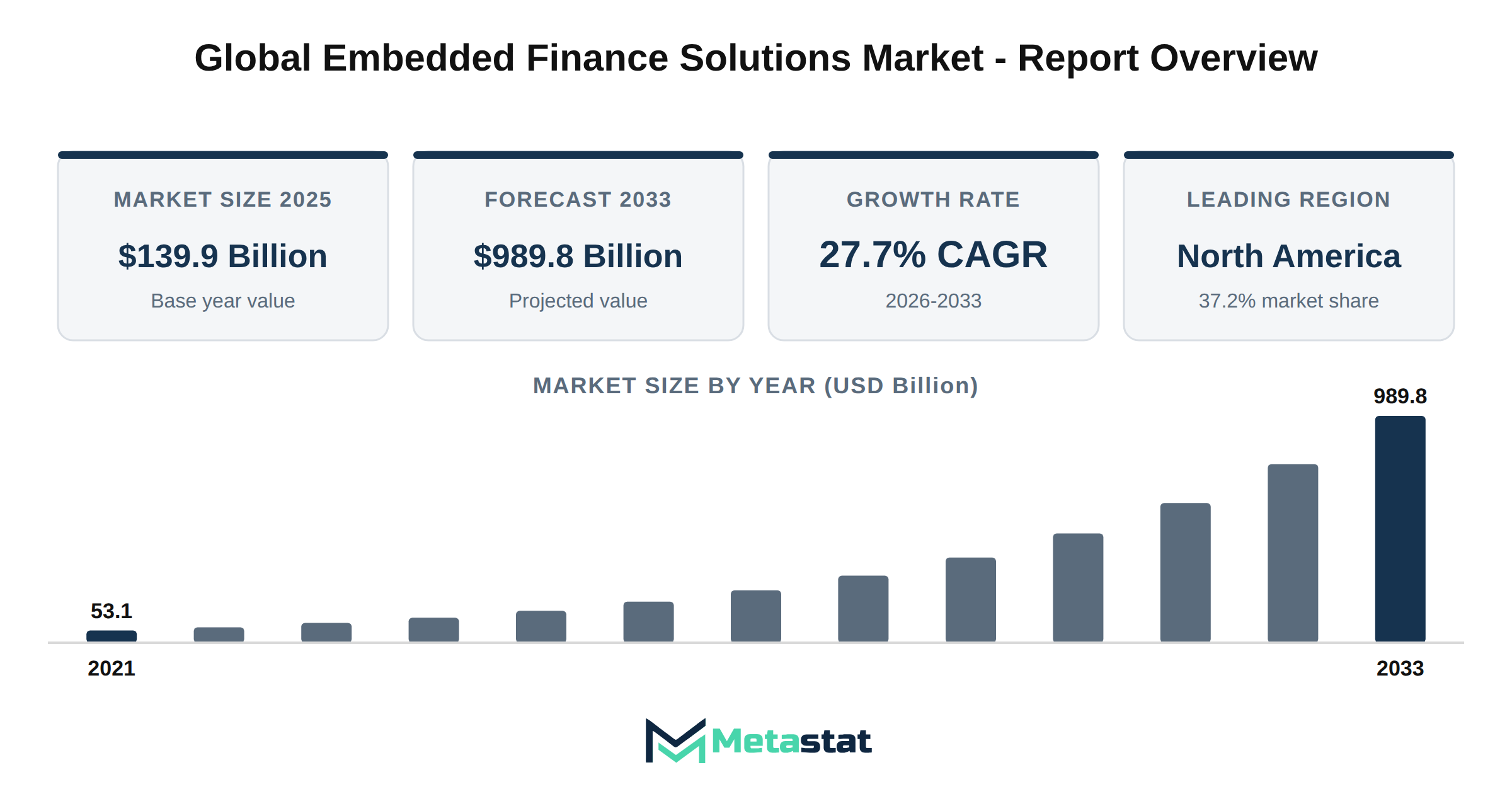
Market Size 2021
USD 53.1 Billion
Historical
Market Size 2025
USD 139.9 Billion
Base year
Market Size 2033
USD 989.8 Billion
Forecast
CAGR 2025-2033
27.7%
Forecast period
Report Details
Comprehensive Market Analysis And Insights
Market Overview
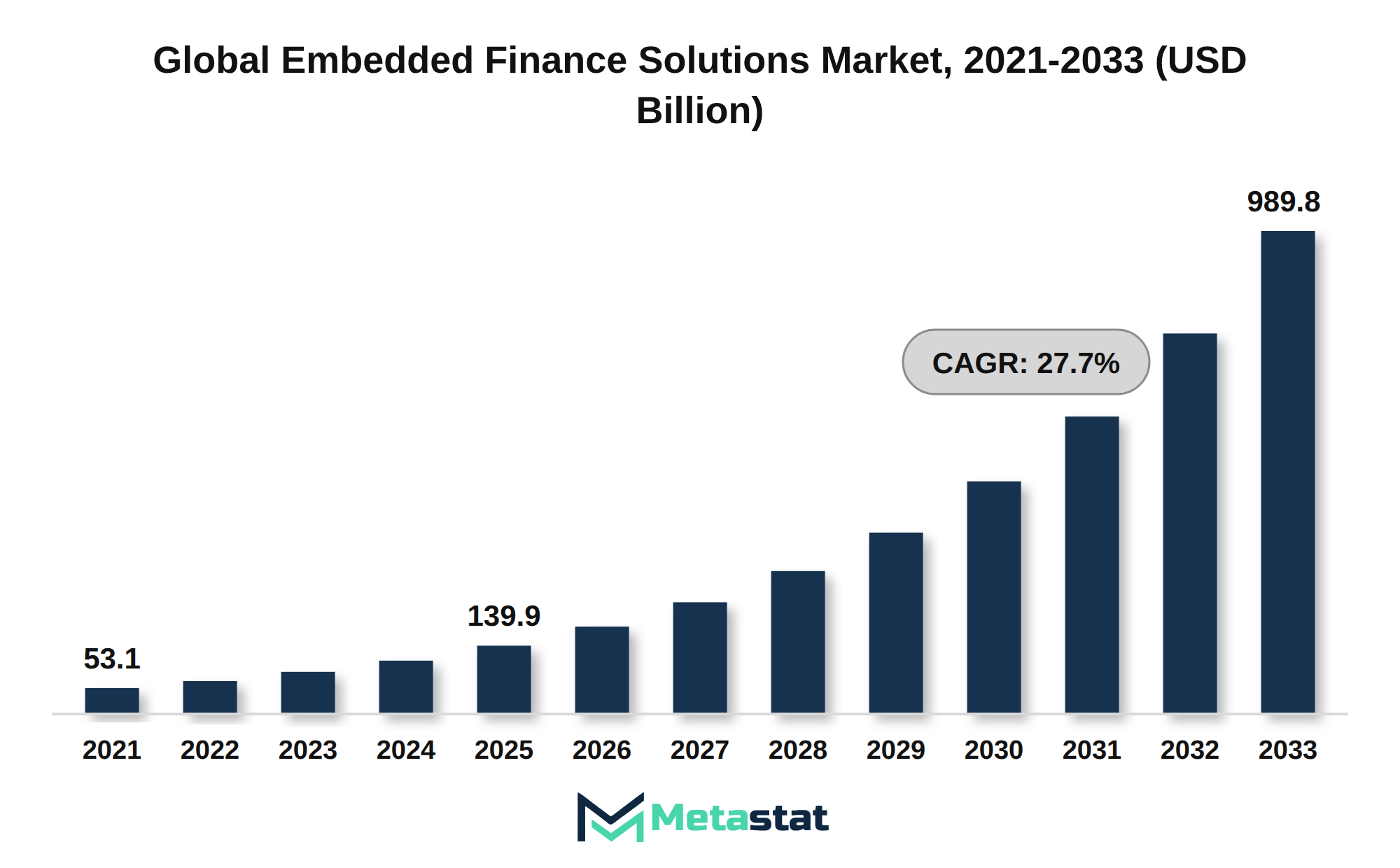
The global Embedded Finance Solutions market was valued at USD 139.9 billion in 2025 and is projected to grow at a CAGR of 27.7% during the forecast period, reaching USD 989.8 billion by 2033.
Embedded Finance Solutions Market Overview
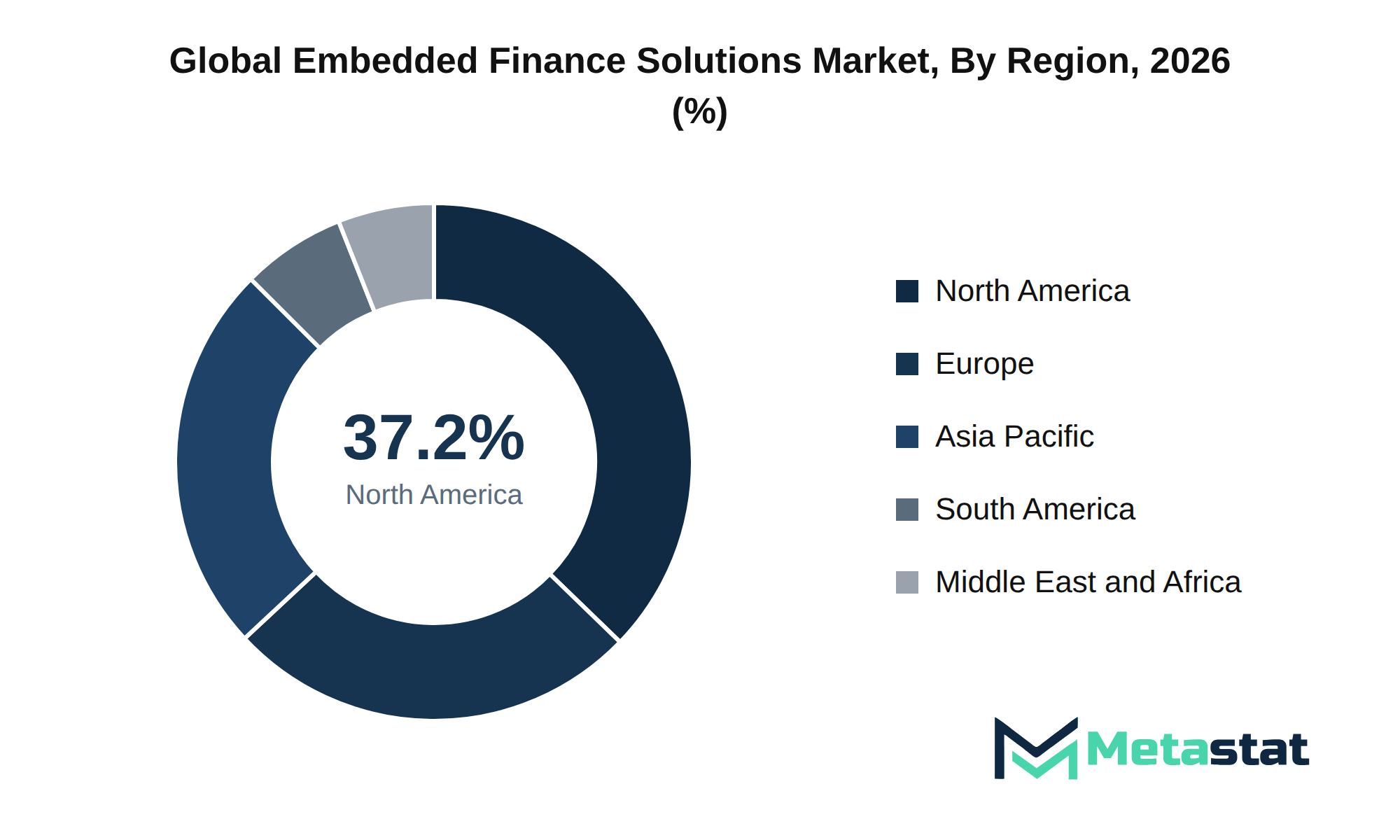
The Embedded Finance Solutions market demonstrates significant growth potential, projected to expand from USD 139.9 billion in 2025 to USD 989.8 billion by 2033, reflecting a compound annual growth rate (CAGR) of 27.7%. North America holds 37.2% in 2025, with the United States leading the market share in 2026. This regional dominance results from a robust fintech ecosystem that drives investment and innovation in embedded finance solutions.
Market growth is fueled by increasing demand for integrated financial services within digital platforms. E-commerce, banking, and consumer brands leverage embedded finance to enhance user experience and improve transactions. This trend influences various sectors, including retail, travel, and technology, because businesses seek to enhance customer engagement and operational efficiency.
Technological advancements in payment processing and banking-as-a-service platforms significantly contribute to the market's expansion. The rise of digital wallets, instant payments, and embedded lending solutions enables companies to offer personalized financial products directly within their applications. Consequently, this transformation encourages collaborations between traditional banks and fintech firms, enhancing service offerings and accessibility.
Market Dynamics and Strategic Developments in Embedded Finance Solutions
The Embedded Finance Solutions market experiences significant growth driven by evolving consumer preferences and technological advancements. Digitalization across industries, particularly in financial services, pushes the integration of financial capabilities into diverse platforms, enhancing user experience and operational efficiency.
Regulatory compliance significantly influences market dynamics. Financial institutions and technology providers face increasing scrutiny regarding data security and consumer protection. Adhering to these regulations demands substantial investment in compliance infrastructure, which impacts operational costs and market entry strategies.
Next-generation innovations, including artificial intelligence and blockchain technology, transform service delivery models within the market. These technologies enable enhanced security, faster transactions, and improved customer insights. Consequently, firms that embrace these innovations position themselves competitively, capturing larger market shares and building customer loyalty.
Supply chain dynamics in the Embedded Finance Solutions market require careful management. Providers navigate complexities related to partnerships and integrations, ensuring effective connectivity between financial services and end-user platforms. This landscape creates opportunities for collaboration among fintech companies, banks, and technology providers, creating a more interconnected ecosystem.
Macroeconomic factors, including inflationary pressures and currency volatility, challenge market stability. Companies adopt strategies to mitigate risks associated with fluctuating economic conditions. Proactive capital allocation and infrastructure investments play critical roles in enhancing resilience and sustaining growth in the face of economic uncertainties.
Overall, the Embedded Finance Solutions market is positioned for substantial expansion, driven by technological advancements, regulatory imperatives, and evolving consumer expectations. Stakeholders will prioritize innovation and strategic partnerships to thrive in this changing environment.
Market Dynamics
Capital investment environments drive growth in embedded finance solutions
Investment environments significantly influence the embedded finance solutions market. Factors including interest rates, GDP growth, and venture funding create a favorable climate for innovation and expansion. High levels of public-private spending power further stimulate market dynamics, encouraging businesses to adopt embedded finance solutions that enhance operational efficiency and customer experience.
Increased digital transformation efforts across various industries contribute to this market growth. Organizations prioritize technology integration, including automation, artificial intelligence, and software adoption, which enhances their ability to offer embedded finance solutions. This shift boosts productivity and allows companies to reach new customer segments, generating increased demand for these solutions.
Changing consumer behaviors and demographic patterns drive additional growth in the embedded finance solutions market. An aging population, urbanization, and evolving lifestyle choices create new expectations for efficient financial services. Companies that effectively adapt to these trends capture significant market share, increasing their revenue streams and overall competitiveness.
Operational productivity and cost-efficiency initiatives further support market expansion. Businesses focusing on labor optimization and process streamlining realize substantial savings, enabling greater investment in embedded finance solutions. The trend toward enhanced efficiency reflects a commitment to balancing costs while providing superior customer service.
Overall, the embedded finance solutions market experiences growth driven by supportive macro-economic factors, shifting consumer behaviors, and technological advancements. Continued investment in these areas will further enhance market opportunities and encourage widespread adoption of embedded finance solutions across various sectors.
Technological integration significantly drives the growth of the Embedded Finance Solutions market by improving operations and enhancing user experiences. Adoption of automation and artificial intelligence contributes to more efficient processing and analysis of financial transactions. This integration allows businesses to digitize legacy processes, which results in reduced operational costs and improved service delivery.
The drive toward digital transformation influences various industries, spurring demand for embedded finance solutions. Companies increasingly recognize the importance of integrating financial services into their existing platforms, which facilitate a smooth customer experience. Industries including e-commerce and retail benefit from this shift, leading to increased revenue streams and customer satisfaction.
The market experiences a surge in demand for innovative financial products and services that cater to evolving consumer behaviors and preferences. Businesses that embed financial solutions within their platforms differentiate themselves, capturing more market share. The market is projected to grow from USD 139.9 billion in 2025 to USD 989.8 billion by 2033, achieving a compound annual growth rate of 27.7 percent.
The integration of these technologies not only enhances operational productivity but addresses key sustainability and governance concerns. Consumers show a preference for solutions that support ethical practices and resource stewardship. The shift towards more responsible business models increases the demand for embedded finance solutions, positioning them because essential components in modern financial ecosystems.
Increased regulatory compliance requirements significantly impact the Embedded Finance Solutions market. Financial institutions face heightened scrutiny and navigate complex legal frameworks that demand rigorous adherence to standards. These compliance hurdles often result in increased operational costs and extended timelines for product deployment.
Macroeconomic headwinds including inflationary pressures contribute to financial constraints for businesses seeking to invest in embedded finance solutions. Rising costs of materials and labor create uncertainty, impeding new investments and stalling growth. Geopolitical instability and supply chain disruptions exacerbate these issues. Such factors compel organizations to reconsider their strategic initiatives, leading to potential delays in adopting embedded finance solutions.
The necessity for high capital investments further restricts market expansion. Companies require substantial upfront funding for infrastructure development, technology integration, and talent acquisition. This financial burden deters smaller firms from competing effectively, thereby reducing market competition and limiting innovation within the Embedded Finance Solutions market.
Concerns surrounding data security and privacy have grown because technology evolves. Organizations entering the market face the risk of data breaches and intellectual property theft, which undermines trust among users. This apprehension slows adoption rates, because potential clients weigh the benefits against the risks associated with embedded finance solutions.
Market fragmentation poses additional challenges. Diverse regional regulations and varying customer needs complicate the standardization of offerings. This fragmentation leads to inefficiencies and increased competition among providers, which dilute brand loyalty and reduce overall market penetration.
Overall, these constraints highlight the complexities faced by stakeholders in the Embedded Finance Solutions market. Addressing these issues will be critical for supporting growth and ensuring the long-term sustainability of embedded finance solutions.
Geopolitical fragmentation presents a significant challenge for the Embedded Finance Solutions market. Increasing trade deficits and tariff friction disrupt global supply chains, leading to rising operational costs for businesses involved in embedded finance. Companies face difficulties in sourcing materials and components due to trade barriers, which complicate product development and market entry strategies.
Technological disruptions, driven by rapid advancements in digital finance, require continuous investment in research and development. This necessity for complex integrations strains resources and hinders smaller players who lack the capital for extensive R&D efforts. Consequently, larger firms consolidate their positions, impacting competition within the market.
Interoperability friction further complicates the landscape, because firms struggle to integrate diverse systems and platforms. This lack of effective communication among different financial technologies delays the deployment of new services, affecting customer satisfaction and retention rates. Businesses within the market face pressure to address these integration challenges swiftly to maintain competitiveness.
Supply chain instability and logistics disruptions create additional hurdles. The reliance on global networks exposes firms to risks associated with geopolitical tensions and natural disasters. These issues result in delays and increased costs, ultimately affecting pricing strategies and profit margins.
Heightened global regulatory standards add layers of complexity. Compliance overhead increases operational burdens, particularly for smaller entities lacking the infrastructure to navigate evolving legal landscapes. This regulatory environment limits innovation, because firms focus on compliance rather than developing new offerings within the Embedded Finance Solutions market.
Finally, rising input costs and workforce skill gaps contribute to pressure on profit margins. Talent retention challenges, driven by the competitive labor market for skilled workers, exacerbate operational difficulties. In light of these challenges, businesses adapt to evolving demands while maintaining profitability in the rapidly expanding embedded finance sector.
Rapid growth in the Embedded Finance Solutions market stems from emerging regional demands driven by digital transformation and evolving consumer expectations. Various industries, particularly within e-commerce and financial services, require integrated financial products that simplify transactions and enhance user experiences. North America leads with a substantial market share of 37.2%, followed by Europe and Asia Pacific at 25.8% and 24.4%, respectively. This geographical disparity highlights the rise of regional players adapting offerings to local consumer preferences.
Infrastructure modernization supports the increasing adoption of embedded finance solutions. Companies invest in upgrading their digital capabilities to facilitate integration of financial services into existing platforms. Firms achieve operational efficiencies and enhanced customer engagement, propelling revenue growth. The overall market is projected to reach USD 989.8 billion by 2033, reflecting a compound annual growth rate (CAGR) of 27.7% during the forecast period.
Technological disruptions continue to reshape the competitive landscape, with advancements in artificial intelligence and machine learning driving innovative service delivery models. These technologies enable businesses to personalize financial services, thereby improving customer satisfaction and loyalty. The market experiences significant interest in Banking-as-a-Service and embedded finance platforms, which cater to diverse financial needs while promoting cross-industry collaborations.
Sustainability imperatives influence market dynamics, prompting companies to align offerings with environmental, social, and governance (ESG) standards. Organizations that prioritize eco-friendly processes and integrate sustainable practices into their business models capture the attention of environmentally conscious consumers. This trend creates additional opportunities for growth within niche markets focused on sustainability.
Shifts in buying behaviors, particularly the transition to digital procurement methods, are reshaping purchasing strategies across industries. Businesses increasingly seek integrated solutions that streamline financial transactions while enhancing operational capabilities. The Embedded Finance Solutions market stands to benefit from these trends because firms adapt their offerings to meet evolving customer demands.
Strategic consolidation through mergers and acquisitions accelerates growth, allowing firms to expand their service portfolios and improve market reach. The pursuit of synergies between financial service providers and technology companies accelerates innovation and creates comprehensive solutions that address diverse consumer needs. This collaborative approach strengthens the competitive position of participants across the market.
Market Segmentation Analysis
The Global Embedded Finance Solutions market is segmented based on Financial Product, Provider Type, Pricing and Commercial Model, and End-use Platform.
By Financial Product, the market is further segmented into:
Embedded Payments, Merchant Acquiring and Payouts
Embedded Banking Accounts, Wallets and Treasury
Embedded Card Issuing and Processing
Embedded Lending, BNPL and Working Capital
Embedded Insurance
Others
Embedded Payments, Merchant Acquiring and Payouts
Projected growth in the Embedded Payments, Merchant Acquiring and Payouts segment reflects the increasing demand for efficient transactional experiences within various platforms. Valued at USD 66.9 billion in 2026, this segment is anticipated to reach USD 346.4 billion by 2033, representing a compound annual growth rate (CAGR) of 26.5%. This robust expansion stems from heightened consumer expectations for instant payment solutions and the growing shift towards digital transactions across multiple sectors.
Technological maturation facilitates the integration of advanced payment systems, enabling businesses to streamline payment processes and enhance customer satisfaction. Adoption of contactless and mobile payment methods contributes significantly to segment growth, because businesses across e-commerce, retail, and service industries leverage these technologies. The consumer preference for faster and more convenient payment options drives merchants to adopt innovative solutions that cater to these demands.
Regulatory compliance standards further shape the market dynamics, prompting businesses to integrate secure payment systems while adhering to government mandates. Institutions that excel in navigating these regulations gain competitive advantages, leading to increased market penetration. The market of embedded finance solutions continues to evolve because companies innovate and adapt to shifting consumer behaviors and regulatory environments.
Cost structures within the segment reflect the investments required for advanced technologies and compliance measures. While initial implementation costs present challenges, the long-term benefits in efficiency and customer retention outweigh these expenditures. Pricing volatility emerges from fluctuating demand and technological advancements, influencing profit margins and competitive positioning.
Strategic opportunity windows arise from the continuous evolution of consumer preferences, particularly in the area of digital payments. While businesses strive to differentiate themselves in an increasingly crowded marketplace, innovative payment solutions and enhanced customer experiences emerge because critical factors for success. Investment in advanced technologies and partnerships will likely drive further growth in the embedded finance solutions market, reinforcing its important role in the broader financial ecosystem.
Embedded Banking Accounts, Wallets and Treasury
The significant increase in digital financial transactions fuels demand for Embedded Banking Accounts, Wallets and Treasury solutions. Increased adoption by consumers and businesses reflects a shift towards cashless transactions, enhancing operational efficiency for users. Key industries driving this segment include e-commerce, retail, and fintech, where financial integration simplifies payment processes and improves user experience.
Technological maturation supports segment expansion, with advancements in mobile banking and payment processing technologies streamlining operations. Next-generation upgrades, including enhanced security features and user interfaces, drive customer engagement and satisfaction. Regulatory compliance standards, including data protection regulations, require platforms to implement robust security measures, building trust among users.
Cost structures in this segment demonstrate a trend towards transaction-based pricing models, which align provider revenues with user engagement. Pricing volatility impacts established firms and emerging players in the market, necessitating strategic adjustments to maintain competitive advantage. The Embedded Banking Accounts, Wallets and Treasury segment is estimated to reach USD 203.9 billion by 2033, at a CAGR of 28.1% during the forecast period.
Supply chain resilience and the sourcing of raw materials for technology infrastructure significantly influence the segment's growth. Disruptive alternatives, including cryptocurrencies and decentralized finance platforms, present both challenges and opportunities for traditional banking infrastructures. Strategic opportunity windows arise from the need for innovation, allowing firms to enhance their service offerings and capture market share.
End-use dynamics reflect a growing preference for integrated financial solutions, with businesses increasingly seeking comprehensive platforms that streamline operations. Consumption shifts towards digital solutions emphasize the need for providers to adapt and offer flexible services tailored to customer demands. Investment outlook remains positive, driven by ongoing advancements in technology and increasing consumer expectations for effective financial services.
Embedded Card Issuing and Processing
Strong growth in the Embedded Card Issuing and Processing segment reflects the increasing demand for digital payment solutions and the ongoing shift towards cashless transactions. The proliferation of e-commerce platforms and the rise of fintech companies drive this demand, because they seek to offer integrated financial services to enhance customer experiences. Rapid technological advancements facilitate the development of innovative card processing systems, enabling efficient transactions for consumers and businesses alike.
Investment in next-generation card issuing platforms supports the evolution of services, allowing companies to offer customized solutions tailored to specific market needs. This segment benefits from increasing consumer expectation for efficient payment methods, which influences business strategies across various industries, including retail, hospitality, and e-commerce. Emerging market players adopt competitive pricing strategies and leverage partnerships to enhance their offerings and capture greater market share.
Regulatory compliance requirements influence operational standards, prompting companies to invest in secure and reliable processing solutions. The segment faces pricing volatility and margin pressures due to competition and technological obsolescence, compelling providers to continually improve their services. By 2033, the Embedded Card Issuing and Processing segment is expected to reach USD 154.9 billion, driven by these factors and the overall expansion of the Embedded Finance Solutions market.
Embedded Lending, BNPL and Working Capital
Projected growth in the Embedded Lending, BNPL and Working Capital segment indicates a strong trajectory, expanding at a CAGR of 29.8% during the forecast period. Rising demand for flexible payment solutions drives adoption among both consumers and businesses, increasing cash flow management. A surge in e-commerce and the gig economy significantly influences this demand, because consumers increasingly prefer integrated financial services that enhance their buying experiences.
Technological advancements play a crucial role in segment expansion, with innovations in fintech enabling efficient lending processes and streamlined BNPL offerings. Enhanced user interfaces and automated underwriting systems reduce friction for borrowers, resulting in higher transaction volumes. Partnerships between traditional financial institutions and emerging fintech players create a competitive ecosystem that enhances service offerings, promoting market growth.
Regulatory compliance standards continue to shape the Embedded Finance Solutions market, particularly within the lending sector. Adherence to consumer protection regulations and data security requirements builds trust among users, encouraging wider adoption. Changes in policy frameworks facilitate the entry of new players, intensifying competition and driving innovations in product offerings.
Investments in embedding financial solutions within digital platforms enhance operational efficiency for businesses. This integration allows companies to offer financing options directly at the point of sale, significantly improving conversion rates. The trend toward embedded finance solutions reshapes the competitive environment, positioning firms that prioritize these services for substantial growth opportunities.
Financial institutions focus on strategic opportunity windows that allow them to leverage advancements in data analytics and machine learning. These technologies support better risk assessment and personalization in lending practices, which lead to improved profitability. Continuous innovation and responsiveness to consumer needs will dictate the success of players within the Embedded Finance Solutions market because the market evolves.
Embedded Insurance
Growth in the Embedded Insurance segment stems from increasing consumer interest in comprehensive financial products that integrate seamlessly with existing services. This trend aligns with rising demand for personalized insurance solutions, driven by advancements in data analytics and customer insights. Businesses prioritize embedding insurance products into their offerings to enhance customer experience and increase retention rates.
Technological maturation in InsurTech contributes significantly to the evolution of this segment. Innovations including artificial intelligence, machine learning, and blockchain facilitate the development of tailored insurance products, making them more accessible and user-friendly. These advancements enable companies to streamline underwriting processes and improve risk assessment, resulting in enhanced efficiency and profitability.
Regulatory compliance standards impact Embedded Insurance by necessitating adherence to local and international regulations. Companies investing in compliance strategies benefit from reduced risk exposure and improved trust among consumers, creating a competitive advantage in the market. This focus on compliance supports segment expansion by encouraging investment in innovative solutions that align with regulatory requirements.
Pricing volatility and margin pressures represent challenges within this space. Fluctuations in underwriting costs and external economic factors influence pricing strategies, making it essential for companies to adopt flexible pricing models. Businesses leveraging data analytics adjust pricing dynamically, ensuring competitiveness while maintaining profitability.
Supply chain resilience is crucial in the delivery of Embedded Insurance solutions. Companies that establish strong partnerships with key stakeholders, including insurers and technology providers, enhance their ability to deliver integrated offerings promptly. This collaborative approach encourages innovation and strengthens market positioning.
Strategic opportunity windows exist for companies looking to capture emerging markets and customer segments. Identifying white-space opportunities allows businesses to develop niche products tailored to specific demographics or industries. Companies investing in research and development to create unique insurance solutions experience increased market share and revenue growth.
The Embedded Finance Solutions market continues to evolve, driven by changing consumer expectations and technological advancements. Companies prioritizing innovation and compliance are well-positioned to thrive in this dynamic environment, ensuring sustained growth and profitability within the Embedded Insurance segment.
Others
Segment dynamics in the Embedded Finance Solutions market reflect distinct primary demand drivers influenced by changing consumer preferences and increasing integration of financial services into various platforms. Adoption of innovative financial solutions continues to flourish, driven by factors including the need for efficient transactions and enhanced user experiences across digital touchpoints. Emerging technology facilitates the expansion of this segment, offering opportunities for next-generation upgrades that improve functionality and security.
Product evolution remains critical, with advancements in features and applications tailored to diverse end-use dynamics. Industries spanning e-commerce, retail, and digital platforms actively embrace these solutions, recognizing their potential to improve operational efficiency and customer engagement. Regulatory compliance standards exert influence over the market, compelling stakeholders to adapt to changing requirements and ensure sustainable practices.
Cost structures in this segment reflect the intricacies of pricing volatility, because firms navigate dynamics that impact margins. Fluctuations in raw material sourcing and market demand introduce challenges but simultaneously create strategic opportunity windows for agile providers. With technological obsolescence presenting risks, firms are incentivized to invest in innovative solutions to maintain competitiveness.
Capital investment outlooks indicate a strong environment for growth, because players in the market recognize the potential for long-term returns. The sector's resilience in the face of disruptive alternatives underlines the necessity of ongoing innovation and adaptation. Overall, the Others segment in the Embedded Finance Solutions market highlights the importance of strategic positioning and flexibility in responding to changing consumer and regulatory landscapes.
By Provider Type, the market is further segmented into:
Banks and Licensed Financial Institutions
Payment Processors and Merchant Acquirers
Banking-as-a-Service and Embedded Finance Platforms
Card Issuing and Processing Platforms
Specialist Lending and Insurance Providers
Others
Banks and Licensed Financial Institutions
Valued at USD 51.1 billion in 2026, the Banks and Licensed Financial Institutions segment is projected to reach USD 262.5 billion by 2033, representing a CAGR of 26.3% during the forecast period. A significant driver of growth in this segment stems from the increasing integration of financial services into various platforms, enhancing customer experiences and expanding operational capabilities. Financial institutions increasingly adopt embedded finance solutions to streamline processes and deliver tailored services, aligning with evolving consumer expectations.
The technological maturation of financial services significantly influences the segment's expansion. Innovations in digital banking, payment processing, and risk management enable banks and licensed institutions to enhance their service offerings. This trend yields competitive advantages, attracting a broader customer base and driving revenue growth.
Regulatory compliance standards shape operational frameworks within the segment. Banks and licensed financial institutions prioritize adherence to evolving regulations, ensuring secure and compliant financial transactions. This focus on regulatory alignment builds consumer trust and positions institutions favorably in a competitive landscape.
Cost structures and pricing volatility present challenges for the segment because well. Banks navigate fluctuations in operational costs while maintaining profitability. Maintaining robust risk management systems becomes essential to mitigate potential financial impacts from unforeseen economic shifts. Strategic opportunity windows arise from these challenges, allowing proactive players to invest in next-generation upgrades that enhance service delivery and operational efficiency.
With a growing emphasis on capital investment, banks and licensed financial institutions are increasingly exploring strategic partnerships with technology providers. Such collaborations provide access to advanced solutions, driving innovation and expanding market reach. The pursuit of embedded finance solutions is expected to reshape traditional banking models, enhancing competitive positioning and driving growth within the broader Embedded Finance Solutions market.
Payment Processors and Merchant Acquirers
Significant growth in the Payment Processors and Merchant Acquirers segment reflects increasing demand for efficient payment solutions across diverse industries. Rapid technological advancements enhance operational efficiency, enabling providers to offer innovative services that adapt to evolving consumer preferences. The expansion of e-commerce and digital transactions drives this segment, with businesses seeking integrated payment solutions that create positive customer experiences and build loyalty.
Regulatory compliance influences the competitive landscape. Adhering to financial regulations necessitates investment in secure and reliable systems, compelling payment processors and merchant acquirers to enhance their offerings. The anticipated growth in this segment aligns with broader trends in the Embedded Finance Solutions market, where integration with other digital services emerges because a critical factor for success.
Payment Processors and Merchant Acquirers segment is estimated to reach USD 223.8 billion by 2033, at a CAGR of 26.8% during the forecast period. This expansion signifies the increasing reliance on embedded finance solutions for payment processing. Providers that leverage advanced technologies, including artificial intelligence and machine learning, position themselves favorably to meet emerging market demands and capitalize on strategic opportunity windows.
Investment in next-generation upgrades ensures these providers remain competitive. The focus on user-friendly interfaces and enhanced security measures builds trust and encourages adoption among consumers. While the payment landscape continues to evolve, market players stay agile, addressing the shifting requirements of businesses and consumers alike while navigating potential challenges posed by disruptive alternatives.
Banking-as-a-Service and Embedded Finance Platforms
Growth in the Banking-as-a-Service and Embedded Finance Platforms segment reflects the increasing integration of financial services across various industries. This integration stems from the rising demand for user-friendly financial solutions that enhance customer experiences. Industries including e-commerce, retail, and technology adopt these platforms to streamline transactions and improve operational efficiency. The convenience of embedded finance solutions contributes to increased customer satisfaction, driving further demand.
Technological advancements play a significant role in shaping this segment, with innovations in API integrations and cloud-based services facilitating rapid deployment and scalability. These advancements create opportunities for companies to develop next-generation financial products that cater to evolving consumer expectations. Enhanced security measures and compliance with regulatory standards remain critical factors influencing adoption rates among businesses.
The market for Banking-as-a-Service and Embedded Finance Platforms is projected to reach USD 232.7 billion by 2033, reflecting the segment's growth trajectory. Pricing models, including transaction-based fees and subscription services, provide flexibility for businesses seeking to leverage these platforms while managing costs effectively.
Investment in marketing and customer education is essential for expanding market reach and increasing penetration. Strategic partnerships between technology providers and financial institutions strengthen service offerings and enhance competitive positioning. A focus on user experience and continuous product evolution will drive sustained interest and engagement in the market.
Card Issuing and Processing Platforms
Growth in the Embedded Finance Solutions market reflects a surge in consumer demand for efficient financial services. Increased reliance on digital payment methods drives adoption across various sectors, leading to heightened investment in innovative solutions. Card Issuing and Processing Platforms contribute significantly to this trend, providing essential infrastructure for payment processing and card issuance.
Technological advancements enhance the capabilities of these platforms, enabling them to support next-generation payment solutions. Integration with fintech ecosystems allows organizations to launch customized financial products, expanding their service offerings and reaching a broader customer base. The projected growth rate of 28.1% CAGR during the forecast period emphasizes the increasing significance of this sub-segment in the overall market.
Regulatory compliance standards and evolving consumer expectations further stimulate demand for sophisticated card issuing and processing solutions. Financial institutions and technology providers recognize the necessity of adapting to these changing landscapes, promoting innovation and collaboration within the embedded finance ecosystem. This adaptation is crucial for capturing market share and maintaining competitive advantages.
Investment in robust cybersecurity measures remains a priority, addressing consumer concerns regarding data privacy and transaction security. The potential for disruptive alternatives, including decentralized finance solutions, challenges traditional models while prompting existing providers to enhance their offerings. Strategic opportunity windows emerge for players willing to innovate and refine their services, positioning them favorably in the changing landscape.
Consumers increasingly favor efficient payment experiences, prompting businesses to integrate embedded finance solutions into their operations. Companies that leverage card issuing and processing platforms gain a competitive edge by delivering superior customer experiences and operational efficiencies. This alignment with consumer expectations is vital for sustained growth in the market.
Specialist Lending and Insurance Providers
Growth in the Specialist Lending and Insurance Providers segment directly correlates with heightened demand for flexible financing options and tailored insurance solutions. Factors influencing this growth include advancements in technology, which enhance the accessibility and efficiency of financial services. Financial institutions increasingly recognize the potential of integrating embedded finance solutions to improve offerings and enhance customer experience.
Consumer preferences shift towards platforms that provide integrated financial services, prompting an expansion of offerings in this segment. The rise of digital platforms facilitates access to lending and insurance options, driving adoption across diverse industries. Regulatory compliance remains crucial, influencing how providers position their services and manage risk.
Technological maturation within the embedded finance ecosystem allows for the development of innovative products that cater to specific consumer needs. Continuous upgrades and enhancements in technology lead to more efficient processes, reducing costs associated with service delivery. This evolution encourages firms to invest in next-generation solutions that align with market demands.
The segment faces challenges related to pricing volatility and margin pressures, which impact service profitability. Strategic opportunities exist for providers that invest in agile operational models, enabling them to respond swiftly to market changes. Capital investment outlooks remain positive, because market players leverage emerging trends to capture unmet needs in the embedded finance solutions market.
Overall, the Specialist Lending and Insurance Providers segment exemplifies a dynamic area within the broader embedded finance solutions market, characterized by adaptation and innovation driven by consumer and technological trends.
Others
Consumer demand continues to drive innovation within the Others sub-segment of the Embedded Finance Solutions market. Increasingly diverse financial needs push companies to integrate new solutions that cater to niche markets, enabling specific services for unique customer segments. Technological advancements facilitate rapid integration and deployment, allowing for tailored offerings that align with emerging consumer preferences.
The expansion of digital ecosystems encourages collaboration among various service providers, creating an environment where unconventional financial solutions thrive. This environment stimulates investment in next-generation technologies aimed at enhancing user experiences and operational efficiencies. Companies focusing on product evolution enhance their portfolios by incorporating advanced features that align with consumer expectations.
Regulatory compliance remains a critical consideration, influencing product development and market entry strategies. Adhering to evolving standards ensures that providers maintain trust and credibility with consumers. Simultaneously, cost structures and pricing models adapt to reflect competitive pressures and customer value propositions, prompting adjustments in service delivery methods.
Supply chain resilience becomes essential in mitigating risks associated with raw material sourcing and logistics vulnerabilities. Strategic opportunity windows emerge because firms identify gaps in service delivery that present avenues for innovative financial solutions. Ongoing capital investment in technological maturation supports sustained growth and adaptability within this segment of the market.
By Pricing and Commercial Model, the market is further segmented into:
Transaction-Based Pricing
Platform Subscription and Minimum Commitment
Account, Wallet and Ledger Fees
Card Issuance, Processing and Program Fees
Credit, Interest and Merchant Discount Fees
Revenue Share, Interchange and Commission-Based Pricing
Others
Transaction-Based Pricing
Valued at USD 56.5 billion in 2026, the Transaction-Based Pricing segment is projected to reach USD 296.3 billion by 2033, reflecting a compound annual growth rate (CAGR) of 26.7% during the forecast period. The increasing volume of digital transactions drives demand for transaction-based pricing across various sectors, particularly in e-commerce and financial services. Enhanced digital infrastructure and the growing acceptance of online payments underpin this expansion, enabling businesses to adopt flexible pricing models that directly correlate with transaction volumes.
Technological advancements play a significant role in the evolution of transaction-based pricing models. The integration of embedded finance solutions streamlines payment processes, enhancing user experience and encouraging businesses to transition to these models. This shift improves transaction efficiency and reduces operational costs associated with traditional pricing structures. Firms adopting transaction-based pricing benefit from improved cash flow and revenue predictability, leading to increased competitiveness in the market.
Demand dynamics within the market reflect a strong preference for performance-based pricing strategies. Businesses aim to minimize fixed costs while maximizing revenue potential linked to actual transaction activity. This trend is particularly evident among small and medium-sized enterprises (SMEs) seeking to optimize their financial operations. The focus on consumer-centric services drives the adoption of transaction-based pricing, allowing companies to charge fees based on actual usage rather than flat rates.
Regulatory compliance standards influence the adoption of transaction-based pricing models. Financial institutions and payment processors face increasing scrutiny regarding pricing practices, necessitating transparency and fairness in fee structures. This regulatory environment compels firms to enhance their pricing strategies, ensuring they align with industry standards while remaining competitive. Transaction-based pricing models that provide clarity and value to customers are likely to gain traction in the market.
Investment in technological infrastructure remains a strategic opportunity for players within the embedded finance ecosystem. Companies that enhance their capabilities for managing transaction-based pricing will likely see significant growth. This investment enables firms to leverage data analytics for better decision-making, optimizing pricing strategies based on transaction trends and consumer behavior. Overall, the Transaction-Based Pricing segment stands poised for substantial growth within the Embedded Finance Solutions market.
Platform Subscription and Minimum Commitment
Rapid growth drives the Platform Subscription and Minimum Commitment segment in the Embedded Finance Solutions market. A significant shift towards subscription-based models enhances revenue predictability for providers and simplifies access to financial services for consumers. The increasing demand for integration of financial solutions into various platforms drives this segment's expansion, attracting a diverse range of industries seeking efficiency and cost-effectiveness. Technological advancements play an essential role in allowing providers to offer flexible subscription plans, catering to the varying needs of businesses, from startups to large enterprises.
By focusing on customer experience and operational efficiency, firms better position themselves in a competitive environment. The segment is estimated to reach USD 179.9 billion by 2033, at a CAGR of 28.6% during the forecast period. While regulatory frameworks evolve, compliance costs and standards influence pricing strategies, necessitating adaptability from providers. These dynamics create opportunities for growth and innovation, further emphasizing the importance of this pricing model within the market.
Account, Wallet and Ledger Fees
Account, Wallet and Ledger Fees contribute significantly to the Embedded Finance Solutions market by providing essential services related to managing financial transactions. Increasing adoption of digital wallets and financial applications drives demand for services that facilitate account management, transaction tracking, and ledger maintenance. The growth in e-commerce and the rising trend of digital payments further strengthen the need for these solutions, because businesses seek to enhance customer experiences through efficient financial interactions.
Technological maturation enables providers to develop more sophisticated features that appeal to both businesses and consumers. Next-generation upgrades, including advanced analytics and integration capabilities, enhance the overall value proposition of Account, Wallet and Ledger Fees. Consumers increasingly favor platforms that offer comprehensive financial management tools, contributing to the segment's growth.
Regulatory compliance standards shape the pricing structures within this segment. Compliance with financial regulations requires firms to invest in robust security and data management systems, influencing operational costs. Pricing volatility stemming from market dynamics and competitive pressures impacts the profit margins of service providers, necessitating innovative strategies to maintain profitability.
By 2033, the Account, Wallet and Ledger Fees segment is expected to reach USD 132.5 billion, reflecting its importance in the evolving landscape of embedded finance. The ongoing digital transformation across industries underlines the segment's significance in ensuring efficient and secure financial transactions. This forecast emphasizes the segment's potential for significant revenue generation in the coming years, because businesses continue to prioritize integrated financial solutions.
Card Issuance, Processing and Program Fees
Significant growth in the Card Issuance, Processing and Program Fees segment of the Embedded Finance Solutions market stems from the increasing demand for integrated payment solutions across various industries. Organizations seek to streamline operations and enhance customer experience, driving the adoption of card issuance and processing services. This segment is projected to grow at a CAGR of 27.4% during the forecast period.
Demand for these solutions arises from the need for businesses to provide efficient payment options to their customers. The trend towards digital payments and contactless transactions reinforces the necessity for robust card issuance services. Companies across e-commerce, retail, and financial sectors are integrating these services to offer tailored payment solutions, supporting customer engagement and loyalty.
Technological advancements contribute to the expansion of this segment, with innovations in card technology and secure processing methods enhancing user experience. Companies investing in next-generation payment systems position themselves advantageously within the market. While organizations prioritize digital transformation, the emphasis on effective payment experiences drives competition and investment in this area.
Regulatory compliance and security standards shape the landscape for card issuing and processing. Companies that align their services with evolving regulations and security protocols enhance their credibility, attracting more clients. This regulatory environment creates both challenges and opportunities, influencing pricing structures and profitability across the segment.
Overall, the Card Issuance, Processing and Program Fees segment within the Embedded Finance Solutions market reflects a dynamic combination of demand drivers, technological maturation, and regulatory compliance, positioning it for substantial growth in the coming years.
Credit, Interest and Merchant Discount Fees
Pricing structures within the Embedded Finance Solutions market reflect significant complexity, particularly in the credit, interest, and merchant discount fees. Key demand drivers include the increasing reliance on digital transactions and the growing need for effective payment solutions across various platforms. Adoption trends highlight a shift towards integrated financial services, because businesses look to enhance user experiences and streamline operations.
Segment expansion catalysts include advancements in payment technologies and a changing regulatory environment. These factors enable providers to offer competitive credit solutions tailored to diverse customer requirements. The maturation of technology supports next-gen upgrades, enhancing the overall efficiency and effectiveness of financial solutions.
Product evolution in this segment emphasizes the integration of innovative pricing models, attracting a broader customer base. Downstream applications highlight the role of embedded finance in various industries, including e-commerce, retail, and travel. Consumption shifts towards digital-first experiences correlate with increased demand for flexible payment options, reflecting changing consumer preferences.
Regulatory compliance standards exert influence on pricing volatility and margin pressures specific to this sub-segment. Adhering to these standards ensures market players maintain credibility while navigating the complexities of financial legislation. Cost structures evolve, driven by competitive pressures and the need for operational efficiency, ultimately impacting pricing strategies.
Supply chain resilience remains essential, particularly in addressing logistics vulnerabilities and substitution risks. Providers actively seek to mitigate these challenges by diversifying their offerings and enhancing technological capabilities. Disruptive alternatives continue to emerge, compelling existing players to innovate and adapt in response to shifting market dynamics.
Strategic opportunity windows arise from ongoing technological advancements and changes in consumer behavior, leading to enhanced capital investment outlooks. Market participants are positioned to capitalize on these trends by aligning their strategies with emerging opportunities. Overall, this sub-segment of credit, interest, and merchant discount fees contributes significantly to the growth trajectory of the Embedded Finance Solutions market.
Revenue Share, Interchange and Commission-Based Pricing
Revenue share, interchange, and commission-based pricing in the Embedded Finance Solutions market reflect evolving dynamics driven by increasing digital transactions and consumer preferences for accessible financial services. Stakeholders, including fintech companies and traditional financial institutions, actively explore these pricing models to enhance profitability while ensuring customer satisfaction.
Technological maturation facilitates the adoption of advanced payment systems, leading to more efficient processing and lower operational costs. Adoption rates for these pricing models increase because businesses seek to integrate financial services directly into their platforms, reflecting a shift towards embedded finance solutions. This integration meets the demands of modern consumers who prefer user-friendly experiences.
Downstream applications of revenue share and commission-based pricing strategies demonstrate their effectiveness in various sectors including e-commerce, fintech, and SaaS platforms. Understanding the end-use dynamics within these industries allows providers to tailor their offerings and pricing strategies effectively, leading to increased market penetration and consumer loyalty.
Regulatory compliance standards and policy headwinds significantly impact pricing structures within the market. Adherence to these standards ensures that pricing models remain competitive while building trust and transparency between providers and consumers. Strategic opportunity windows emerge because firms adapt their pricing strategies to meet evolving regulatory requirements.
Cost structures and pricing volatility represent additional considerations for market participants. Providers navigate these challenges to maintain profit margins while offering competitive pricing. Strategic investments in technology and customer engagement mitigate risks associated with pricing pressures, enabling sustained growth within this sub-segment of the market.
Others
Demand for innovative financial products stimulates growth within the Others sub-segment of the Embedded Finance Solutions market. Emerging technologies and changing consumer preferences create opportunities for new offerings that enhance customer experiences and streamline transactions. Financial service providers increasingly adopt integrated solutions that incorporate various financial functionalities, which drives expansion in this segment.
Technological maturation supports the introduction of advanced features, improving user engagement and satisfaction. Companies recognize the importance of adapting to changing market dynamics and consumer demands, leading to diversified product portfolios. Heightened competition among service providers pushes for continuous innovation, resulting in product offerings that evolve quickly.
Shifts in end-user consumption patterns influence demand within the Others sub-segment. Businesses across various industries seek financial solutions that integrate seamlessly into their operations, enhancing efficiency while providing a better experience for customers. Regulatory compliance standards affect the development of new financial offerings, compelling providers to adjust their strategies accordingly.
Cost structures and pricing volatility play significant roles in shaping the competitive landscape of the market. Providers strategize to maintain profitability while offering competitive pricing, which encourages standardization and transparency in pricing models. This dynamic creates an environment conducive to growth and innovation, which is expected to continue through 2033.
Strategic opportunity windows emerge because companies explore new applications and markets within the Others sub-segment. Investment in research and development enables the creation of disruptive alternatives that challenge traditional financial services. While the landscape evolves, players in the Embedded Finance Solutions market remain agile and responsive to capitalize on these opportunities.
By End-use Platform, the market is further segmented into:
E-commerce and Online Marketplaces
Vertical SaaS, ERP and Business Management Platforms
Retail and Consumer Brands
Mobility, Travel and Hospitality Platforms
Gig Economy, Payroll and Workforce Platforms
Others
E-commerce and Online Marketplaces
E-commerce and Online Marketplaces exhibit substantial growth within the Embedded Finance Solutions market, valued at USD 54.9 billion in 2026. This segment is projected to reach USD 289 billion by 2033, reflecting a CAGR of 26.8% during the forecast period. The rapid expansion of online shopping and digital commerce drives increased demand for embedded finance solutions, enabling payment processing and financial transactions directly within e-commerce platforms.
Adoption of innovative payment methods and technologies drives expansion in this segment. Various industries, including retail and service sectors, benefit from integrating these solutions into their operations, enhancing customer experience and streamlining payment processes. Improved operational efficiency and customer satisfaction emerge because key benefits, leading to higher revenue growth and market penetration.
Technological advancements play a critical role in the evolution of embedded finance solutions. The rise of mobile wallets, digital payment systems, and API integrations enables e-commerce platforms to offer a diverse range of financial services. This evolution supports the need for businesses to remain competitive and agile in a rapidly changing market.
Consumer behavior shifts towards convenience and speed in online transactions contribute to the segment's growth. Expectations for frictionless payment experiences compel businesses to adopt embedded finance solutions, enhancing overall customer engagement and loyalty. Compliance with regulatory standards and evolving consumer protection laws ensures that these platforms operate securely and transparently, building trust with users.
While the market matures, strategic opportunity windows arise for providers to innovate and differentiate their offerings. Investment in next-gen upgrades and product evolution becomes a priority for businesses aiming to capture market share and address emerging consumer demands. This evolving environment drives the E-commerce and Online Marketplaces segment forward, positioning it for sustained growth within the broader Embedded Finance Solutions market.
Vertical SaaS, ERP and Business Management Platforms
Growth within the Vertical SaaS, ERP and Business Management Platforms segment reflects a robust demand for integrated financial solutions tailored to specific industries. This segment benefits from increasing digital transformation efforts among businesses looking to optimize operations and enhance customer experiences. Adoption is driven by the necessity for financial services embedded within existing business management systems, enabling organizations to streamline processes and reduce friction in transactions.
Technological maturation significantly influences this segment's expansion, with next-generation upgrades providing enhanced features including real-time analytics, automated workflows, and improved regulatory compliance capabilities. End-use dynamics indicate a shift towards platforms that support various business functions, allowing organizations to manage finance, operations, and customer relations from a single interface. This trend caters to businesses seeking operational efficiency and strategic advantages in competitive markets.
Valued at USD 243.2 billion by 2033, at a CAGR of 29.2% during the forecast period, this segment demonstrates significant potential for growth. Consumption shifts towards integrated solutions that encompass multiple aspects of business management have led to increased investment in vertical SaaS applications. Capital investment outlook remains positive because organizations prioritize digital solutions to adapt to evolving market demands, particularly in sectors including retail, healthcare, and logistics.
The Embedded Finance Solutions market continues to support innovation in this segment, with strategic opportunity windows emerging because businesses seek to leverage financial services for enhanced operational capabilities. Regulatory compliance standards further influence the adoption of embedded solutions, ensuring businesses meet necessary guidelines while optimizing their financial processes. Overall, the Vertical SaaS, ERP and Business Management Platforms segment is poised for sustained growth, driven by a convergence of technology, market demand, and regulatory alignment.
Retail and Consumer Brands
Growth within the Retail and Consumer Brands segment reflects increasing consumer expectations for integrated financial services within shopping experiences. The rise of e-commerce and digital platforms drives demand for embedded finance solutions that enhance transaction efficiency and customer engagement. Major retailers and consumer brands adopt these solutions to streamline payment processes, improve cash flow management, and offer innovative financial products directly within their platforms. This segment is expected to reach USD 164.6 billion by 2033, illustrating its significant impact within the broader embedded finance solutions market.
Technological advancements in payment processing and security continue to fuel adoption among retail and consumer brands. With the increasing prevalence of mobile and digital wallets, businesses invest in embedded finance to offer personalized payment options and loyalty programs that enhance customer retention. The competitive landscape encourages brands to seek differentiated financial offerings that improve customer experience and drive revenue growth. While these solutions evolve, brands increasingly leverage data analytics to understand consumer behavior, enabling more targeted financial services.
Regulatory compliance and security standards play a crucial role in shaping the segment. Retail and consumer brands prioritize integrating solutions that align with evolving regulations while ensuring customer data protection. This focus on compliance helps build consumer trust, further encouraging the adoption of embedded finance solutions. In response to these dynamics, the segment anticipates significant growth, contributing to the overall expansion of the embedded finance solutions market.
Mobility, Travel and Hospitality Platforms
Growth within the Mobility, Travel and Hospitality Platforms segment reflects a significant increase in demand for integrated financial services tailored to enhance the customer experience. Digital transformation in these sectors drives the need for efficient payment solutions and embedded finance options, improving customer loyalty and operational efficiency. Consumers increasingly expect convenient, user-friendly financial transactions during their journeys, leading to the adoption of advanced payment systems and personalized financial products.
Technological advancements play a crucial role in the segment's expansion. Innovations in mobile payment solutions, artificial intelligence, and data analytics enhance the customer experience and facilitate targeted marketing strategies. The integration of services including travel insurance or flexible payment options for bookings aligns with consumer preferences, strengthening loyalty and retention. Competition among service providers intensifies, compelling firms to innovate continuously and offer differentiated products.
Regulatory compliance standards influence operational structures within the segment. Maintaining adherence to regulations while delivering reliable financial services ensures consumer trust and mitigates reputational risks. While compliance incurs costs, it functions because a catalyst for investment in robust systems that enhance overall service delivery.
Pricing volatility, driven by market changes and evolving consumer behaviors, poses challenges. Strategic partnerships between platforms and financial institutions stabilize pricing structures and broaden service offerings. Consequently, players operating within the Mobility, Travel and Hospitality Platforms segment are well-positioned for growth, supported by a projected CAGR of 27.9% during the forecast period.
Overall, the Mobility, Travel and Hospitality Platforms segment represents a significant opportunity within the Embedded Finance Solutions market, with ongoing technological maturation and evolving consumer expectations driving demand for tailored financial products and services.
Gig Economy, Payroll and Workforce Platforms
Growth in gig economy platforms and workforce management solutions reflects increased reliance on flexible work arrangements and the demand for efficient payroll systems. This trend results from a shift toward remote work and freelance opportunities, prompting organizations to seek solutions that streamline payroll processing and compliance with tax regulations. Industries including technology, retail, and hospitality exhibit notable adoption of these platforms, enabling them to efficiently manage a diverse and mobile workforce. Enhanced payroll capabilities reduce operational costs and improve employee satisfaction, driving broader acceptance across sectors.
Technological advancements, including automation and artificial intelligence, facilitate the evolution of payroll and workforce solutions, allowing for improved data analytics and real-time reporting. These enhancements support businesses in making informed decisions and optimizing their workforce management strategies. The trend toward next-generation upgrades indicates a growing focus on user-friendly interfaces and integration capabilities, allowing businesses to adopt solutions that align with their existing systems. This focus on usability enhances overall operational efficiency.
Regulatory compliance continues to shape the landscape for gig economy platforms. Stricter regulations regarding worker classifications, payroll taxes, and benefits influence the development of tailored solutions that ensure compliance while minimizing risks. This environment drives innovation among providers, who develop features that address industry-specific requirements. While companies navigate these complexities, demand for comprehensive solutions that support regulatory adherence and streamline operations increases.
The Embedded Finance Solutions market exhibits a strong emphasis on capital investment opportunities within the gig economy, with many firms seeking to enhance their service offerings. Strategic partnerships and collaborations between fintech companies and traditional financial institutions enable the delivery of integrated solutions that enhance user experience and establish competitive advantages. These developments create strategic opportunity windows for firms that invest in technological advancements and expand their service portfolios, driving growth in the sector.
Others
Demand for embedded finance solutions in the Others segment experiences significant growth, driven by evolving consumer expectations and the adoption of innovative financial technologies. Industries including health care, real estate, and telecommunications increasingly recognize the benefits of integrating financial services into their existing platforms, improving customer engagement and retention.
Adoption of alternative financial products, including embedded insurance and niche lending solutions, expands within this segment, addressing unique market needs. The focus on personalization and convenience aligns with shifting consumer preferences, prompting organizations to seek embedded finance solutions that simplify transactions and enhance user experiences.
Technological maturation plays a critical role in shaping this sub-segment. Advanced APIs and automation enable integrations, allowing businesses to implement embedded finance features with minimal disruption. Investments in next-generation upgrades and product evolution enhance the capabilities of embedded finance solutions, enabling firms to stay competitive in a rapidly changing market.
Regulatory compliance standards and policy headwinds influence operational strategies. Organizations navigate a complex regulatory landscape while striving to balance innovation with risk management. Robust compliance frameworks become essential to mitigate potential challenges and ensure alignment with evolving legislation.
Cost structures and pricing volatility present considerations for companies operating within the segment. Fluctuations in operational costs and market dynamics require businesses to adopt flexible pricing models to maintain profitability. The ongoing focus on supply chain resilience and raw material sourcing underlines the importance of strategic planning in a competitive environment.
Strategic opportunity windows arise because firms leverage technological advancements to explore new applications for embedded finance solutions. Capital investment outlook appears positive, with increased funding directed towards developing innovative products and expanding market reach. This momentum positions the Others segment for sustained growth within the broader embedded finance solutions market.
By Region
Based on geography, the Global Embedded Finance Solutions market is divided into North America, Europe, Asia-Pacific, South America, Middle East, and Africa.
North America
North America represents a significant portion of the global Embedded Finance Solutions market, contributing 37.2% of the overall market share in 2025. The region is set to expand at a CAGR of 27.7% within the forecast period, reaching a market size (TAM) of USD 342 billion by the end of 2033. Key drivers of growth include the increasing adoption of innovative financial technologies across various sectors, particularly in the United States, Canada, and Mexico.
The rapid modernization of infrastructure within this region facilitates the implementation of embedded finance solutions, promoting higher efficiency and improved customer experiences. Organizations across diverse industries are leveraging these solutions to enhance their service offerings, thereby driving demand for more integrated financial products.
Emerging market front-runners including fintech startups alongside established banks and financial institutions contribute to the competitive landscape. These players are continuously innovating to meet evolving consumer preferences and regulatory requirements, which stimulates further investment in the market. Regional compliance mandates play a crucial role in shaping the strategies of domestic market leaders.
Localized procurement dynamics, along with cultural nuances in B2B buying behaviors, further influence the growth trajectory of the market. The expansion and acceptance of embedded finance solutions reflect a shift in consumer expectations toward integrated financial services, which drives demand among businesses seeking to enhance their operations.
Overall, the North America Embedded Finance Solutions market is poised for considerable growth, supported by a combination of technological advancements, strong investment flows, and a favorable regulatory environment. The continuous evolution of consumer needs and the push for digital transformation across industries will play an important role in shaping the future of the market.
Europe
Europe represents a significant share of the global Embedded Finance Solutions market. Growth in this region is driven by the increasing adoption of digital financial services across various sectors, particularly in Germany, France, the UK, Italy, Spain, and Russia. These countries exhibit strong demand for innovative financial products and services, supported by advancements in technology and a shift towards online transactions.
The presence of established financial institutions enhances market growth, with banks and licensed financial entities leading the way in offering embedded finance solutions. Consumer preferences for convenience and effective experiences drive the integration of financial services into digital platforms, particularly in e-commerce and online marketplaces. This trend indicates a robust trajectory for the market, with a focus on enhancing buyer experiences through streamlined payment processes and financial management tools.
Investment in infrastructure modernization supports the expansion of embedded finance services, enabling firms to offer more comprehensive and efficient solutions. The ongoing digital transformation across industries creates a conducive environment for embedded finance, with localized manufacturing and nearshoring initiatives further strengthening supply chain resilience. Competition among key players intensifies because they strive to capture market share and establish dominant positions within the region.
Regulatory frameworks and local compliance mandates shape the competitive landscape, influencing how firms develop and deliver their offerings. Companies operating in Europe navigate a complex array of regulations while meeting consumer demands for privacy and security. This evolving landscape presents both challenges and opportunities, because organizations adapt their strategies to align with localized procurement dynamics and cultural nuances. Overall, the Embedded Finance Solutions market in Europe is poised for sustained growth, reflecting the region's strategic importance in the global financial ecosystem.
Asia-Pacific
The Asia-Pacific region represents a significant share of the global Embedded Finance Solutions market, accounting for 24.4% of the total in 2025. The increasing adoption of digital financial solutions across diverse sectors fuels demand, particularly in high-growth economies including China, India, and Southeast Asia. Advances in technology, driven by infrastructure modernization and investment in local compliance mandates, enhance the region's capability to host embedded finance services.
China and India emerge because front-runners in the adoption of embedded finance solutions, with strong growth in digital payments and e-commerce platforms. South Korea and Japan demonstrate strong investment in fintech innovations, leading to a competitive environment for service providers. Australia features a mature market characterized by high-value replacement cycles and the need for incremental growth vectors, ensuring sustained demand for advanced financial solutions.
Localized procurement dynamics and cultural nuances play important roles in shaping the B2B buying behaviors in the region. Cross-border trade corridors and geopolitical fragmentation influence market dynamics, driving firms to adapt their strategies for compliance and market entry. The competitive landscape features various players, including established banks and emerging fintech companies, collaboratively reshaping the financial services ecosystem.
Investment in foreign direct investment (FDI) flows continues to rise, presenting opportunities for geographic expansion within the region. Strategic entry barriers faced by new entrants highlight the need for localized understanding and compliance with regional regulations. The projected growth of the Embedded Finance Solutions market in Asia-Pacific indicates a favorable trajectory, driven by the region's adaptability and innovation in financial services.
South America
South America exhibits a notable presence in the Embedded Finance Solutions market. Brazil and Argentina serve because key players, driving demand through the adoption of innovative financial solutions across various sectors. The increasing incorporation of embedded finance in e-commerce, retail, and mobile applications enhances customer experiences and streamlines transactions. Infrastructure modernization and the expansion of digital banking capabilities support the growth of embedded finance. Local compliance mandates and regulatory frameworks necessitate tailored solutions, creating competition among market participants.
Emerging companies in the region focus on developing localized products that cater to the specific needs of consumers and businesses. Financial institutions and payment processors invest significantly in technology to improve service delivery and expand their offerings. The market benefits from cross-border trade corridors, facilitating financial transactions across nations. Geopolitical factors influence regional dynamics, creating opportunities for partnerships and collaborations between local and international players. The potential for high-value replacement cycles and incremental growth vectors positions South America because a promising territory within the global embedded finance landscape.
Middle East and Africa
The Embedded Finance Solutions market in the Middle East and Africa is projected to capture a 6.00% share of the global market by 2025. Rapid growth in the region results from evolving digital payment infrastructures and increasing adoption of innovative financial solutions among various sectors, including retail and e-commerce. Countries including Saudi Arabia and the UAE lead in implementing embedded finance due to their advanced technological ecosystems and supportive regulatory frameworks.
South Africa demonstrates significant potential, driven by a growing fintech sector and increasing smartphone penetration, which facilitates access to embedded finance services. The broader Middle East and Africa region remains underpenetrated, offering opportunities for new entrants and existing players to expand their offerings. Investment in local compliance and adaptation to regional cultural nuances enhances market penetration strategies.
Infrastructure modernization in Saudi Arabia and the UAE, supported by government initiatives, promotes digital financial services. The rise in cross-border trade corridors further enhances the demand for embedded finance solutions, aligning with shifting consumer behaviors and regional purchasing patterns. Regional players emphasize localized procurement dynamics to strengthen connections with end-users, enhancing competitive positioning in the market.
Competitive Landscape and Strategic Insights
Competitive Landscape
The Embedded Finance Solutions market features significant strategic behaviors among leading players. Key players including JPMorgan Chase & Co., Stripe, Inc., and PayPal Holdings, Inc. engage in various forms of mergers and acquisitions to enhance their market position and expand their product offerings. This consolidation increases market share and allows these firms to leverage economies of scale, positively impacting pricing structures and overall profitability.
Strategic alliances and partnerships play a vital role in market dynamics. Companies like Adyen N.V. and Global Payments Inc. / Worldpay for Platforms establish collaborations with technology providers and industry disruptors to create integrated solutions that cater to diverse customer needs. This collaboration enhances service offerings and allows for innovation in product differentiation, leading to a competitive edge.
Market Outlook
The competitive outlook in the market remains robust, with continuous investment in research and development. Firms including Fiserv, Inc. and Checkout.com focus on developing proprietary technologies that establish strong barriers to entry. Intellectual property portfolios and technological defensibility contribute to sustained market advantages, ensuring long-term growth potential.
Customer retention strategies hold increasing importance in this competitive environment. Players like Wise plc - Wise Platform and Airwallex emphasize brand equity and customer loyalty, creating switching costs that promote long-term relationships with clients. Such strategies enhance overall market stability and encourage sustained investment in innovative solutions.
Forecast and Future Outlook
The Embedded Finance Solutions market size is forecast to rise from USD 139.9 billion in 2025 to over USD 989.8 billion by 2033, reflecting a compound annual growth rate (CAGR) of 27.7%. This growth will stem from various factors, including increased integration of financial services into digital ecosystems and rising consumer demand for efficient transaction experiences across platforms.
In a bull case scenario, advancements in next-generation technologies, including artificial intelligence and blockchain, will accelerate the adoption of embedded finance solutions. Companies that successfully integrate these technologies will capture a larger market share, driving higher revenue growth across financial product segments. Conversely, a bear case could involve regulatory challenges and geopolitical factors that hinder market expansion, resulting in slower growth than anticipated.
Core industry maturation continues to influence downstream demand, with businesses seeking innovative solutions to enhance operational efficiency and customer engagement. Strategic capital allocation focusing on infrastructure commitments will support the market's growth trajectory and create high-growth pockets for emerging players.
Regulatory evolution will impact compliance timelines and shape market dynamics. While regulations adapt to new financial technologies, companies prioritize compliance to maintain competitiveness. This necessity will drive investments in research and development, allowing firms to innovate while meeting regulatory standards.
Geopolitical realignments and evolving trade corridors will reshape global supply chains. Companies navigate these shifts to optimize their operations and enhance service delivery. Strategic imperatives will guide executive-level decision-making, ensuring that firms adapt to changing market conditions effectively.
Embedded Finance Solutions Market Key Segments
By Financial Product:
Embedded Payments, Merchant Acquiring and Payouts
Embedded Banking Accounts, Wallets and Treasury
Embedded Card Issuing and Processing
Embedded Lending, BNPL and Working Capital
Embedded Insurance
Others
By Provider Type:
Banks and Licensed Financial Institutions
Payment Processors and Merchant Acquirers
Banking-as-a-Service and Embedded Finance Platforms
Card Issuing and Processing Platforms
Specialist Lending and Insurance Providers
Others
By Pricing and Commercial Model:
Transaction-Based Pricing
Platform Subscription and Minimum Commitment
Account, Wallet and Ledger Fees
Card Issuance, Processing and Program Fees
Credit, Interest and Merchant Discount Fees
Revenue Share, Interchange and Commission-Based Pricing
Others
By End-use Platform:
E-commerce and Online Marketplaces
Vertical SaaS, ERP and Business Management Platforms
Retail and Consumer Brands
Mobility, Travel and Hospitality Platforms
Gig Economy, Payroll and Workforce Platforms
Others
By Region:
North America
Europe
Asia-Pacific
South America
Middle East and Africa
Key Global Embedded Finance Solutions Industry Players
The report strategically identifies and profiles the key market players and analyses their core competencies in each sub-segment of the Embedded Finance Solutions market.
Report Attributes
Details
Study Period
2021-2033
Base Year
2025
Estimated Year
2026
Forecast Period
2026-2033
Historical Period
2021-2025
Growth Rate
CAGR 27.7% from 2026 to 2033
Revenue Unit
USD billion
Segmentation
By Financial Product, Provider Type, Pricing and Commercial Model, End-use Platform, and Region
By Region
North America (By Financial Product, Provider Type, Pricing and Commercial Model, End-use Platform, and Country)
United States
Canada
Mexico
Europe (By Financial Product, Provider Type, Pricing and Commercial Model, End-use Platform, and Country)
Germany
France
UK
Italy
Spain
Russia
Rest of the Europe
Asia Pacific (By Financial Product, Provider Type, Pricing and Commercial Model, End-use Platform, and Country)
China
Japan
India
South Korea
Australia
Southeast Asia
Rest of Asia Pacific
South America (By Financial Product, Provider Type, Pricing and Commercial Model, End-use Platform, and Country)
Brazil
Argentina
Rest of South America
Middle East and Africa (By Financial Product, Provider Type, Pricing and Commercial Model, End-use Platform, and Country)
Saudi Arabia
UAE
South Africa
Rest of Middle East and Africa
WHAT REPORT PROVIDES
Key Company Market Share, Revenue, and Ranking for Embedded Finance Solutions
Key Market Leaders in Embedded Finance Solutions Industry
Full In-Depth Analysis of the Parent Industry Dynamics
Industry Statistics and Important Changes in Market Trends
Segmentation Details of the Embedded Finance Solutions Market
Historical, Ongoing, and Projected Market Analysis
Assessment of Niche Industry Developments and Opportunities
Key Strategies of Major Players in Embedded Finance Solutions
Find answers to common questions about this report
The Embedded Finance Solutions market size was valued at USD 139.9 billion in 2025.
The Embedded Finance Solutions market is projected to grow at a CAGR of 27.7% during the forecast period from 2026 to 2033.
The North America Embedded Finance Solutions market size is estimated to reach USD 342 billion by 2033.
The segment "Embedded Payments, Merchant Acquiring and Payouts" leads the Embedded Finance Solutions market, with a projected value of USD 346.4 billion by 2033. This segment experiences a compound annual growth rate of 26.5 percent.
Investment environments significantly influence the Embedded Finance Solutions market. Factors including interest rates, GDP growth, and venture funding create a favorable climate for innovation and expansion. High levels of public-private spending power stimulate market dynamics, encouraging businesses to adopt embedded finance solutions that enhance operational efficiency and customer experience. Increased digital transformation efforts across various industries contribute to market growth.
North America holds the dominant share of the Embedded Finance Solutions market, accounting for 37.2 percent in 2025. This position reflects the region's significant adoption and investment in embedded finance technologies.
Increased regulatory compliance requirements and heightened scrutiny create operational challenges, leading to higher costs and extended product deployment timelines. macroeconomic headwinds, including inflation and geopolitical instability, hinder investment and growth in the Embedded Finance Solutions market. Concerns over data security and market fragmentation further complicate adoption efforts.
Investment environments, increased digital transformation efforts, and changing consumer behaviors favor product adoption in the embedded finance solutions market. Companies prioritize technology integration and operational efficiency, which enhances customer experiences and drives demand for innovative financial products and services.
The Embedded Finance Solutions market is estimated to reach a valuation of USD 989.8 billion by 2033.
Key players operating in the Embedded Finance Solutions market include JPMorgan Chase & Co., Stripe, Inc., PayPal Holdings, Inc., Fiserv, Inc., Global Payments Inc. / Worldpay for Platforms, Visa Inc., and Mastercard Incorporated.
Australia Parametric Insurance Market Size, Share, Trends, 2033
Australia Parametric Insurance market size is valued at USD 286.4 million in 2025 and is projected to reach USD 720.9 million in 2033, at a CAGR of 12.2% from 2026 to 2033.
Australia Parametric Insurance Market, Australia Parametric Insurance Market Size, Australia Parametric Insurance Market Share, Australia Parametric Insurance Market Analysis, Australia Parametric Insurance Market Growth, Australia Parametric Insurance Market Trends, Australia Parametric Insurance Market Research Report, Australia Parametric Insurance Market Forecast, Australia Parametric Insurance, Australia Parametric Insurance Market Research, Australia Parametric Insurance Industry, Australia Parametric Insurance Industry Report, Australia Parametric Insurance Market Data, Australia Parametric Insurance Statistics, Australia Parametric Insurance Market Statistics, Australia Parametric Insurance Industry Trends, Australia Parametric Insurance Market Report, Australia Parametric Insurance Market Trends, Australia Parametric Insurance Market News, Australia Parametric Insurance Forecasts, Australia Parametric Insurance Market Intelligence Report
Merchant Banking Services market size is valued at USD 68.3 billion in 2025 and is projected to reach USD 260.7 billion in 2033, at a CAGR of 18.3% from 2026 to 2033.
Global Debt Management Solutions market size is valued at USD 41.8 billion in 2025 and is projected to reach USD 72.8 billion in 2033, at a CAGR of 7.2% from 2026 to 2033
Global Corporate Treasury Management Software market size is valued at USD 6,964.9 million in 2025 and is projected to reach USD 10,763.8 million in 2033, at a CAGR of 5.6% from 2026 to 2033