Global Robotic Combat Vehicle (RCV) Market Size, Share, By Type (RCV-L, RCV-M, and RCV-H), By Mobility (Tracked, Wheeled, and Hybrid), By Mode of Operation (Remote-Controlled, Autonomous, and Semi-Autonomous), By End-Use (Defense, Homeland Security, and Others), Industry Analysis, Growth, Trends, and Forecast, 2026-2033
Report ID
MSI-4784
Published
May 28, 2026
Pages
313 Pages
Format
Report Details
Comprehensive Market Analysis And Insights
Market Overview
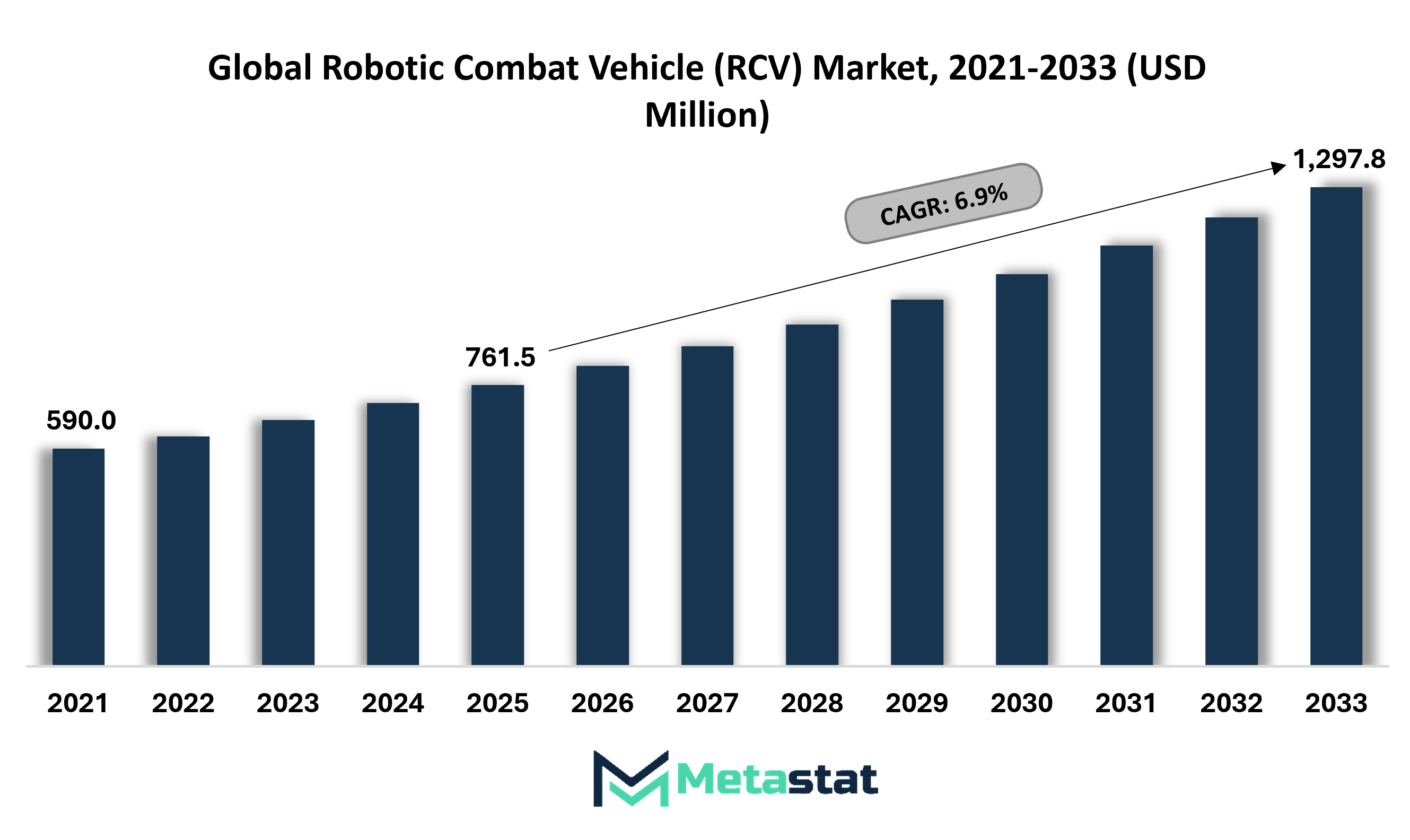
Global Robotic Combat Vehicle (RCV) market size is valued at USD 761.5 million in 2025 and projected to grow at a CAGR of 6.9% during the forecast period, reaching USD 1,297.8 million by 2033.
Global Robotic Combat Vehicle (RCV) Market: Comprehensive Data-Driven Market Analysis and Strategic Outlook
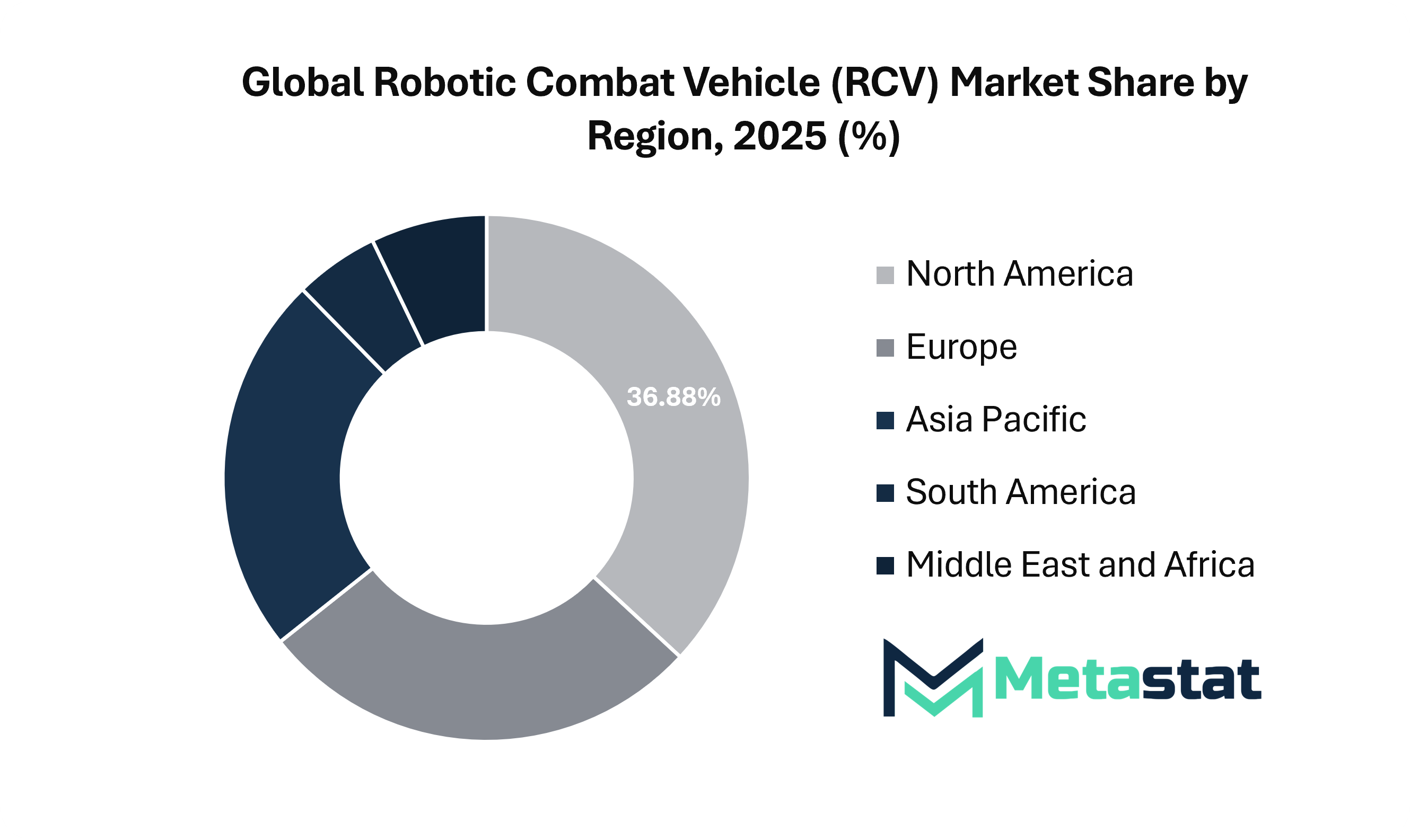
North America holds 36.9% in 2025 with US leading the market share in 2025.
RCV-L (Light) segment account for a market share of 47.5% in 2025.
Key trends driving growth: Rising military focus on manned-unmanned teaming and soldier risk reduction, along with growing need for remote reconnaissance, fire support, and multi-mission battlefield flexibility.
Opportunities include retrofit autonomy kits and modular mission payloads for existing armored vehicle fleets.
Key insight: The Global Robotic Combat Vehicle (RCV) market is evolving from experimental deployment to operational battlefield integration, reshaping modern warfare strategies.
The Global Robotic Combat Vehicle (RCV) Market is gaining traction as armed forces focus on reducing personnel exposure in high-risk combat scenarios. These systems offer tactical advantages by extending operational reach, improving situational awareness, and enabling persistent surveillance in contested environments.
Technological advancements in sensors, artificial intelligence, and secure communication systems are accelerating adoption, while defense organizations are prioritizing unmanned platforms for future combat readiness. Advancements in secure connectivity and resilient battlefield networks will further improve system reliability. The Global Robotic Combat Vehicle (RCV) Market is positioned to become a critical component of modern defense ecosystems.
Market Dynamics
Growth Drivers:
Rising Military Focus on Manned-Unmanned Teaming and Soldier Risk Reduction.
The Global Robotic Combat Vehicle (RCV) Market will expand as defense strategies increasingly prioritize coordination between crewed platforms and autonomous systems. Operational doctrines will emphasize reduced human exposure in hostile zones, with robotic units handling high-risk tasks. Safer mission execution, improved survivability, enhanced situational awareness, and controlled engagement will strengthen adoption across complex combat environments.
Growing Need for Remote Reconnaissance, Fire Support, and Multi-Mission Battlefield Flexibility
The Global Robotic Combat Vehicle (RCV) Market will gain momentum with rising need for flexible platforms capable of surveillance, target acquisition, and precision fire support. Armed forces will seek adaptable systems that support multiple mission profiles. Rapid deployment capability, terrain adaptability, and continuous monitoring will strengthen battlefield efficiency and decision-making accuracy under dynamic operational conditions.
Restraints and Challenges:
Electronic Warfare Vulnerability, Secure Communications Burden, and Autonomy Assurance Challenges
The Global Robotic Combat Vehicle (RCV) Market will face constraints linked to electronic warfare risks and secure communication requirements. Adversarial jamming and cyber threats will disrupt command-and-control links. Reliable autonomy validation will remain complex, requiring rigorous testing frameworks, secure data transmission systems, and resilient architectures to maintain operational integrity during contested battlefield scenarios.
High Development Cost, Long Procurement Cycles, and Complex Integration with Legacy Combat Fleets
The Global Robotic Combat Vehicle (RCV) Market will face barriers driven by high investment requirements and extended acquisition timelines. Integration with existing armored fleets will require technical compatibility and system alignment. Budget constraints, regulatory procedures, and infrastructure readiness will slow adoption rates across defense programs and procurement cycles.
Opportunities:
Retrofit Autonomy Kits and Modular Mission Payloads for Existing Armored Vehicle Fleets
The Global Robotic Combat Vehicle (RCV) Market will present strong potential through retrofit solutions for legacy military vehicles. Modular autonomy kits and interchangeable payload systems will enable cost-efficient upgrades. Defense forces will extend the operational life of existing fleets while incorporating advanced capabilities, supporting scalable deployment and flexible mission customization across diverse combat requirements.
Market Segmentation Analysis
The Global Robotic Combat Vehicle (RCV) market is classified based on Type, Mobility, Mode of Operation, and End-Use.
By Type, the market is further segmented into:
RCV-L (Light)
RCV-L (Light) segment is valued at USD 385.9 million in 2026 and is projected to reach USD 589.1 million by 2033, at a CAGR of 6.2% during the forecast period.
RCV-L (Light) robotic combat vehicles will support rapid deployment missions with improved agility and lower operational weight. Future demand will rise from urban conflict scenarios where compact design enables navigation through confined spaces. Integration of advanced sensors and lightweight armor will strengthen reconnaissance capabilities and tactical responsiveness.
RCV-M (Medium)
RCV-M (Medium) segment is valued at USD 275.1 million in 2026 and is projected to reach USD 437.8 million by 2033, at a CAGR of 6.9% during the forecast period.
RCV-M (Medium) robotic combat vehicles will balance firepower and mobility in the Global Robotic Combat Vehicle (RCV) Market, enabling flexible battlefield roles. Deployment will increase across missions requiring moderate protection and operational endurance. Future systems will integrate modular payloads, enabling adaptation across surveillance, logistics support, and combat support with improved operational performance.
RCV-H (Heavy)
RCV-H (Heavy) segment is valued at USD 152.3 million in 2026 and is projected to reach USD 271.0 million by 2033, at a CAGR of 8.6% during the forecast period.
RCV-H (Heavy) robotic combat vehicles will support high-risk combat operations in the Global Robotic Combat Vehicle (RCV) Market through advanced armor and weapon systems. Growth will be driven by increasing demand for unmanned frontline engagement platforms. Future development will focus on enhanced survivability, long-range firepower, and integration with armored units for coordinated battlefield execution.
By Mobility, the market is divided into:
Tracked
Tracked segment is projected to reach USD 615.2 million by 2033, at a CAGR of 6.2% during the forecast period.
Tracked mobility systems will ensure stability across rugged terrains and hostile environments. Adoption will increase in areas with uneven landscapes and combat zones requiring high traction. Future advancements will include improved suspension systems and energy-efficient propulsion to support extended missions under severe operational conditions.
Wheeled
Wheeled segment is projected to reach USD 483.2 million by 2033, at a CAGR of 6.7% during the forecast period.
Wheeled robotic combat vehicles will gain traction in the Global Robotic Combat Vehicle (RCV) Market owing to speed, cost efficiency, and easier maintenance. Usage will expand across patrol and rapid response operations. Future improvements will enhance durability, terrain adaptability, and integration of intelligent navigation systems for advanced maneuverability in diverse environments.
Hybrid
Hybrid segment is projected to reach USD 199.5 million by 2033, at a CAGR of 9.7% during the forecast period.
Hybrid mobility solutions will combine the advantages of tracked and wheeled systems, offering operational flexibility. Adoption will grow for missions requiring adaptability across diverse terrains. Future systems will incorporate intelligent switching mechanisms, enabling seamless transition between mobility modes while maintaining efficiency and operational performance.
By Mode of Operation, the market is further divided into:
Remote-Controlled
Remote-Controlled segment is projected to reach USD 517.4 million by 2033.
Remote-controlled systems in the Global Robotic Combat Vehicle (RCV) Market will remain critical for missions requiring human oversight in high-risk zones. Growth will continue with advancements in secure communication networks. Future developments will enhance signal reliability, reduce latency, and support real-time decision-making through improved control interfaces and situational awareness tools.
Autonomous
Autonomous segment is projected to reach USD 328.0 million by 2033.
Autonomous robotic combat vehicles will transform the Global Robotic Combat Vehicle (RCV) Market through independent decision-making capabilities. Adoption will rise with advancements in artificial intelligence and machine learning. Future systems will execute complex missions with minimal human intervention, supported by predictive analytics, threat detection systems, and adaptive operational behavior.
Semi-Autonomous
Semi-Autonomous segment is projected to reach USD 452.4 million by 2033.
Semi-autonomous systems will bridge operational control and automation in the Global Robotic Combat Vehicle (RCV) Market. Adoption will increase for missions requiring both human judgment and automated support. Future advancements will enhance collaborative control frameworks, enabling efficient interaction between operators and systems while maintaining precision, safety, and mission effectiveness.
By End-Use, the Global Robotic Combat Vehicle (RCV) market is divided as:
Defense
Defense segment is projected to grow at a CAGR of 6.6% during the forecast period.
Defense applications will dominate the Global Robotic Combat Vehicle (RCV) Market, supported by increasing focus on unmanned combat solutions. Military forces will adopt advanced robotic systems to reduce personnel risk and enhance operational capability. Future investments will prioritize integration with network-centric warfare strategies and advanced combat ecosystems.
Homeland Security
Homeland Security segment is projected to grow at a CAGR of 9.0% during the forecast period.
Homeland security agencies will expand adoption in the Global Robotic Combat Vehicle (RCV) Market for surveillance, border patrol, and threat response. Adoption will increase with rising security concerns and the need for rapid deployment solutions. Future systems will emphasize real-time monitoring, data integration, and advanced situational awareness for effective domestic security operations.
Others
Others segment is projected to grow at a CAGR of 7.2% during the forecast period.
Other applications will include disaster response, search and rescue, and critical infrastructure protection. Growth will emerge from expanding use cases beyond conventional combat roles. Future development will focus on multi-functional capabilities, enabling deployment across civilian and emergency scenarios with advanced operational adaptability.
By Region:
Based on geography, the Global Robotic Combat Vehicle (RCV) market is divided into North America, Europe, Asia-Pacific, South America, Middle East, and Africa.
In North America, strong defense budgets and continuous investment in next-generation combat technologies are driving RCV adoption.
Active military programs focused on unmanned ground vehicle deployment are accelerating technological advancements across North America.
Europe will remain a significant region in the Robotic Combat Vehicle (RCV) Market, supported by rising defense modernization programs, NATO-aligned capability development, and increased focus on unmanned ground systems for high-risk land operations.
Rising geopolitical tensions are increasing demand for advanced defense systems across Asia Pacific.
Growing defense modernization initiatives across Asia Pacific, including India, China, and South Korea, are creating strong expansion opportunities.
Increasing focus on border security, counter-terrorism operations, and gradual adoption of unmanned defense technologies will contribute to steady market growth across South America, the Middle East, and Africa.
Competitive Landscape and Strategic Insights
The Global Robotic Combat Vehicle (RCV) Market will see steady interest as defense forces seek safer and more efficient approaches to execute missions. These vehicles are designed to operate without onboard crews, reducing risk to soldiers during high-threat operations. Armed forces are focusing on systems that support surveillance, logistics, and direct combat roles through remote-controlled or autonomous operation. Rising geopolitical tensions and the need for rapid response are encouraging countries to increase investments in robotic combat technologies, supporting long-term defense demand.
Technology will play a central role in shaping how these vehicles perform. Improvements in artificial intelligence, sensors, and communication systems will allow RCVs to make faster decisions and operate in complex environments. Better connectivity will help these systems work alongside manned vehicles, creating a coordinated battlefield approach. Developers are also focusing on improving reliability in harsh conditions, since real-world deployment requires durability and consistent performance.
Key competitors in the Global Robotic Combat Vehicle (RCV) industry include Rheinmetall AG, Milrem Robotics AS, Textron Systems Corporation, General Dynamics Land Systems, Inc., Oshkosh Defense, LLC, QinetiQ Group plc, BAE Systems plc, Elbit Systems Ltd., Israel Aerospace Industries Ltd., Hyundai Rotem Company, Hanwha Aerospace Co., Ltd., KNDS N.V., ASELSAN A.Ş., FNSS Savunma Sistemleri A.Ş., Otokar Otomotiv ve Savunma Sanayi A.Ş., Singapore Technologies Engineering Ltd., Teledyne FLIR Defense, Inc., Kongsberg Defence & Aerospace AS, HDT Global, Inc., EDGE Group, and Pearson Engineering. These companies are focusing on research, testing, and partnerships to improve product capabilities and expand their global presence.
Looking ahead, the market will continue to grow as defense strategies shift toward automation and reduced human presence in war zones. Collaboration between governments and private companies will increase, helping accelerate innovation and deployment. Over time, robotic combat vehicles will become increasingly common in military operations, not as replacements for soldiers, but as support systems that enhance performance and safety on the ground.
Forecast and Future Outlook
Market size is forecast to rise from USD 761.5 million in 2025 to over USD 1,297.8 million by 2033.
The Global Robotic Combat Vehicle (RCV) market is expected to witness sustained growth driven by increasing adoption of autonomous systems and evolving battlefield strategies. Future developments will focus on enhanced autonomy, AI-driven combat decision systems, and integration with multi-domain operations involving air, land, and cyber platforms.
Robotic Combat Vehicle (RCV) Market Key Segments:
By Type:
RCV-L (Light)
RCV-M (Medium)
RCV-H (Heavy)
By Mobility:
Tracked
Wheeled
Hybrid
By Mode of Operation:
Remote-Controlled
Autonomous
Semi-Autonomous
By End-Use:
Defense
Homeland Security
Others
Key Global Robotic Combat Vehicle (RCV) Industry Players
This research report categorizes the Robotic Combat Vehicle (RCV) Market based on key segments and regions, forecasts revenue growth, and analyzes trends across each submarket. The report evaluates key growth drivers, opportunities, and challenges influencing the Robotic Combat Vehicle (RCV) Market. Recent market developments and competitive strategies such as expansions, product launches, partnerships, mergers, and acquisitions have been included to define the competitive landscape.
The report strategically identifies and profiles key market players and analyzes their core competencies across each sub-segment of the Robotic Combat Vehicle (RCV) Market.
Report Attributes
Details
Study Period
2021-2033
Base Year
2025
Estimated Year
2026
Forecast Period
2026-2033
Historical Period
2021-2025
Growth Rate
CAGR 6.9% from 2026 to 2033
Revenue Unit
USD million
Sales Volume Unit
Units
Segmentation
By Type, Mobility, Mode of Operation, End-Use, and Region
By Region
North America (By Type, Mobility, Mode of Operation, End-Use, and Country)
United States
Canada
Mexico
Europe (By Type, Mobility, Mode of Operation, End-Use, and Country)
Germany
France
UK
Italy
Spain
Russia
Rest of Europe
Asia Pacific (By Type, Mobility, Mode of Operation, End-Use, and Country)
China
Japan
India
South Korea
Australia
Southeast Asia
Rest of Asia Pacific
South America (By Type, Mobility, Mode of Operation, End-Use, and Country)
Brazil
Argentina
Rest of South America
Middle East and Africa (By Type, Mobility, Mode of Operation, End-Use, and Country)
Saudi Arabia
UAE
South Africa
Rest of Middle East and Africa
WHAT REPORT PROVIDES
Key Company Market Share, Revenue, and Position/Ranking
Key Market Leaders
Full In-Depth Analysis of the Parent Industry
Industry Statistics
Important Changes in Market and Its Dynamics
Segmentation Details of the Market
Historical, On-Going, and Projected Market Analysis
Assessment of Niche Industry Developments
Market Share Analysis
Key Strategies of Major Players
Company Profiles of Key Players
Unique Selling Prepositions of Leading Market Players
Global Defense Radar market size is valued at USD 14.9 billion in 2025 and is projected to reach USD 22.9 billion in 2033, at a CAGR of 5.5% from 2026 to 2033
Global Autonomous Drone Market size was USD 22.7 billion in 2025 and is projected to reach USD 92.8 billion in 2033, at a CAGR of 19.3% from 2026 to 2033.
US Aerospace Material Testing Service Market Size, Share by 2030
US Aerospace Material Testing Service Market valued at $126.8 million in 2023 and projected to reach $201.0 million by 2030
US Aerospace Material Testing Service Market, US Aerospace Material Testing Service Market Size, US Aerospace Material Testing Service Market Share, US Aerospace Material Testing Service Market Analysis, US Aerospace Material Testing Service Market Growth, US Aerospace Material Testing Service Market Trends, US Aerospace Material Testing Service Market Research Report, US Aerospace Material Testing Service Market Forecast, US Aerospace Material Testing Service, US Aerospace Material Testing Service Market Research, US Aerospace Material Testing Service Industry, US Aerospace Material Testing Service Market Segmentation, US Aerospace Material Testing Service Market Companies, United States Aerospace Material Testing Service Market