Plant-Based Sports Nutrition Market Size, Share, By Product Type (Plant Protein Powders, Ready-to-Drink (RTD) Plant-based Sports Beverages, Plant-Based Sports Bars, Plant-Based Hydration, Electrolytes, and Others (Plant-Based Energy Gels, Chews, Plant-Based Pre and Post Workout), By Protein Source (Pea Protein, Rice Protein, Soy Protein, Oat Protein, Hemp Protein, Quinoa Protein, Algae Protein, and Others), By Application (Muscle Building, Strength, Hydration, Replenishment, Endurance, Stamina, Weight Management, Recovery, Muscle Repair, General Fitness & Wellness, and Others), By Distribution Channel (Online, e-commerce Channels, Supermarkets, Hypermarkets, Specialty Health, Nutrition Stores, Gyms, Fitness Outlets, Convenience, and Retail Stores), Industry Analysis, Growth, Trends, and Forecast, 2026-2033
Report ID
MSI-4589
Published
April 10, 2026
Pages
320 Pages
Format
Report Details
Comprehensive Market Analysis And Insights
Market Overview
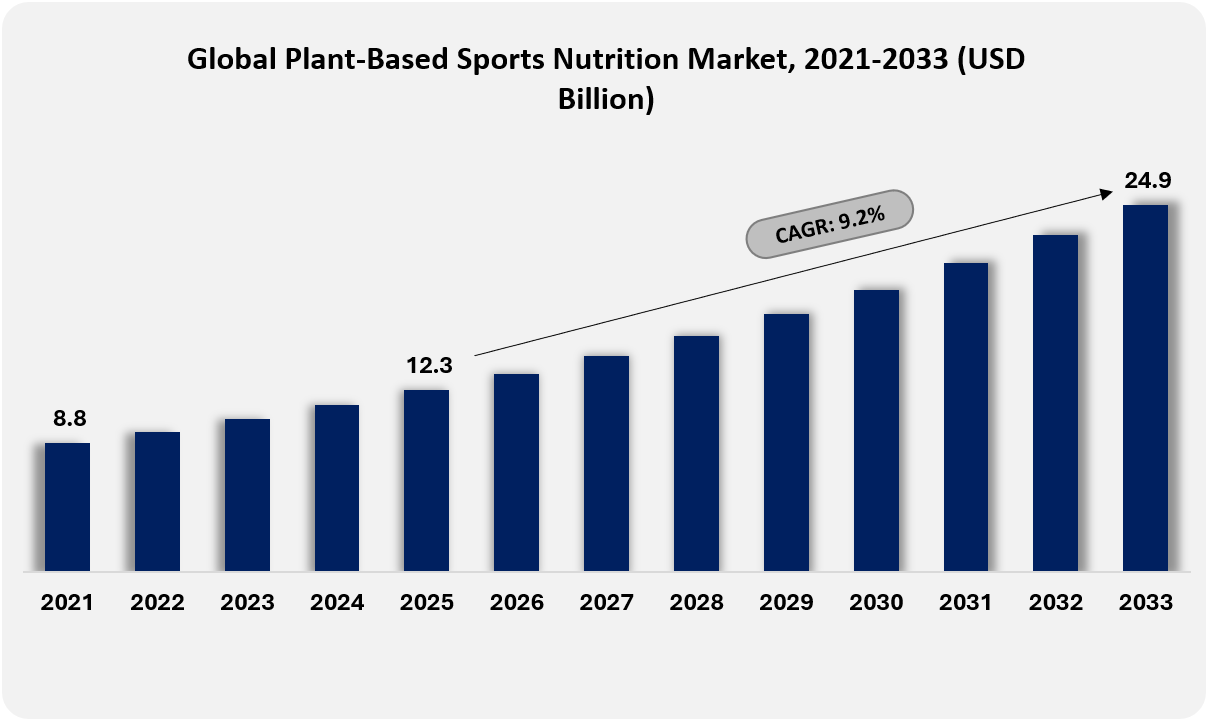
The Global Plant-Based Sports Nutrition market size was valued at USD 12.3 billion in 2025 and projected to grow at a CAGR of 9.2% during the forecast period, reaching USD 24.9 billion by 2033.
Global Plant-Based Sports Nutrition Market: Comprehensive Data-Driven Market Analysis and Strategic Outlook
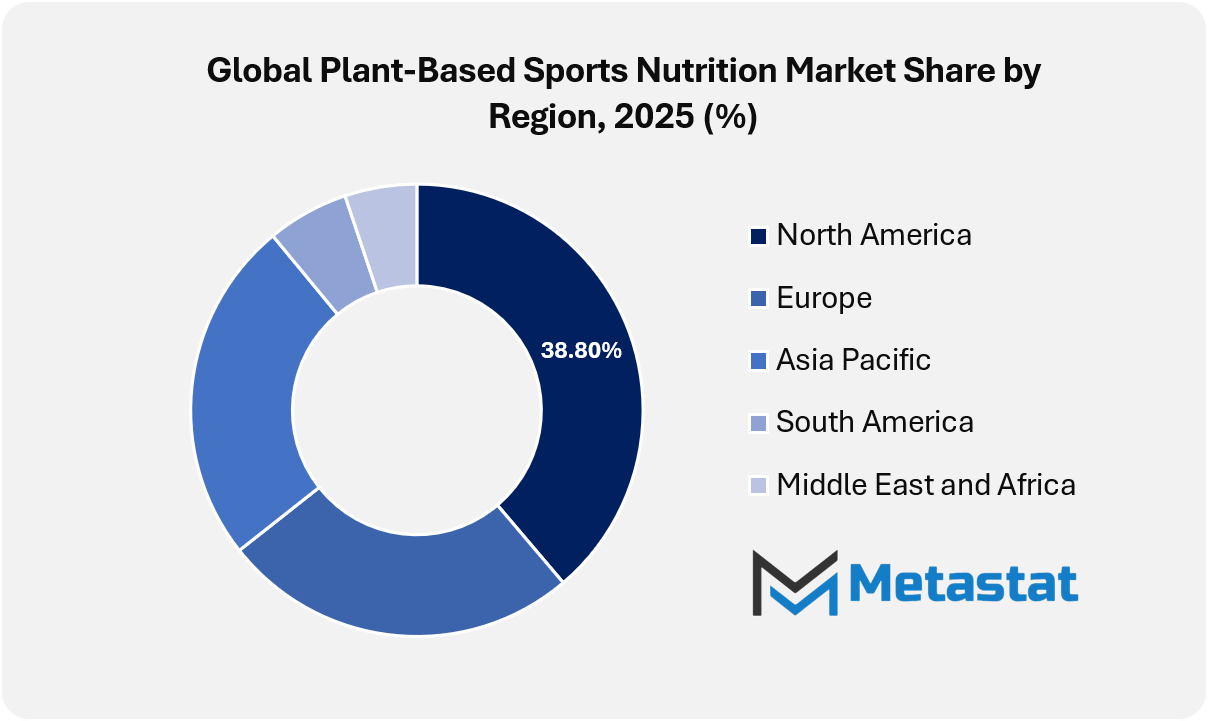
North America holds 38.8% share in 2025, with the U.S. leading regional revenue.
Plant Protein Powders segment accounts for a market share of 43.1% in 2025.
Key trends driving growth include increased adoption of flexitarian and vegan lifestyles across fitness communities and rising demand for clean-label, allergen-friendly, and sustainable performance nutrition.
Opportunities include Innovation in precision-blended plant proteins, fermentation-derived inputs, and functional bioactives for performance and recovery
Key insight: Global Plant-Based Sports Nutrition market shows strong momentum driven by ethical consumption trends, performance-focused formulations, and widening acceptance among mainstream fitness users.
The global plant-based sports nutrition market is set to move beyond product substitution and enter a phase defined by functional depth and category expansion. In the coming years, the category is set to align more closely with performance science, where plant-derived inputs are engineered for targeted outcomes such as endurance, speed, recovery modulation, and muscle function. Product development is set to expand beyond powders and bars into hybrid formats, including ready-to-drink mixes, condition-specific pouches, and modular nutrition systems designed for different training cycles.
Future offerings are set to leverage bioavailability research, fermentation strategies, and amino acid optimization using legumes, algae, and seed proteins, with clinical validation supporting stronger brand credibility. Innovation is set to lean toward personalization, where data from wearables and virtual coaching platforms influence nutrient proportions and intake timing. Sustainability is set to extend into packaging and supply-chain transparency, with material alternatives and traceability becoming integral parts of brand positioning.
Market Dynamics
Growth Drivers:
Increased adoption of flexitarian and vegan lifestyles across fitness communities.
Rising attention on ethical, long-term wellbeing is influencing nutrition decisions within athletic circles. Fitness communities increasingly favor plant-focused diets linked with recovery support and endurance benefits. Such momentum is propelling uptake as brands align performance consistency with environmentally conscious consumption patterns.
Rising demand for clean-label, allergen-friendly, and sustainable performance nutrition
Heightened scrutiny of ingredient transparency reshapes shopping conduct across sports activities and nutrition classes. Products offering recognizable assets, minimum processing, and hypersensitive reaction-conscious formulations attract informed purchasers. Sustainability-linked sourcing strengthens credibility, encouraging broader recognition. Such purchasing patterns support expansion across professional training environments and recreational fitness segments seeking dietary reliability without synthetic components.
Restraints and Challenges:
Perceived taste, texture, and mixability limitations compared with whey-based alternatives
Sensory expectations shaped by legacy dairy proteins continue to influence perception within performance nutrition. Certain plant-based formulations face resistance linked with grainy textures or inconsistent solubility. Overcoming entrenched preferences calls for continued refinement of sensory profiles, consumer education, and repeated exposure within training routines tied to measurable outcomes.
Formulation challenges in matching complete amino-acid profiles and digestibility across plant proteins
Balancing amino-acid completeness across diverse botanical sources adds technical complexity across product development. Digestibility variation across legumes, grains, and seeds complicates formulation performance. Scientific validation and processing innovation remain critical for parity with established protein benchmarks, particularly across high-intensity training and recovery-focused nutrition frameworks.
Opportunities:
Innovation in precision-blended plant proteins, fermentation-derived inputs, and functional bioactives for performance and recovery
Advanced blending strategies enable targeted amino acid delivery aligned with athletic goals. Fermentation-derived inputs improve bioavailability while supporting consistent flavor and texture. Functional bioactives addressing inflammation, endurance, and muscle repair create premium value pools. Such innovation positions the global plant-based sports nutrition market for sustained relevance across performance nutrition ecosystems.
Market Segmentation Analysis
The global plant-based sports nutrition market is segmented by Product Type, Protein Source, Application, and Distribution Channel.
By Product Type, the market is further segmented into:
Plant Protein Powders
Plant Protein Powders segment is estimated at USD 5.8 billion in 2026 and is projected to reach USD 10 billion by 2033, at a CAGR of 8.2% during the forecast period.
Plant protein powders will gain prominence through improved texture, faster absorption profiles, and clean formulations aligned with performance nutrition goals. Advances in processing methods will increase amino acid retention while maintaining the natural state. Demand will grow among power-focused users seeking sustainable protein solutions without reliance on animal-derived inputs.
Ready-to-Drink (RTD) Plant-based Sports Beverages
Ready-to-Drink (RTD) Plant-based Sports Beverages segment is estimated at USD 3 billion in 2026 and is projected to reach USD 6 billion by 2033, at a CAGR of 10.6% during the forecast period.
RTD plant-based sports beverages will expand through convenience-driven consumption patterns and on-the-go recovery needs. Functional blends containing electrolytes, plant proteins, and natural flavor systems will support hydration and energy balance. Shelf-stable innovation and smart packaging will strengthen retail and digital visibility in urban fitness communities.
Plant-Based Sports Bars
Plant-Based Sports Bars segment is estimated at USD 2.1 billion in 2026 and is projected to reach USD 3.9 billion by 2033, at a CAGR of 9.3% during the forecast period.
Plant-based sports bars will evolve toward balanced macronutrient delivery while supporting training routines and recovery windows. Ingredient simplification and a low sugar profile will meet performance nutrition expectations. The growth will be driven by increasing demand for portable nutrition formats suitable for structured workouts, endurance activities, and controlled calorie intake plans.
Plant-Based Hydration and Electrolytes
Plant-Based Hydration and Electrolytes segment is estimated at USD 1.4 billion in 2026 and is projected to reach USD 2.6 billion by 2033, at a CAGR of 9.4% during the forecast period.
Plant-based hydration and electrolyte products will lead through mineral-rich botanical sources supporting fluid balance and muscle function. The clean-label formulation will appeal to stamina-focused consumers looking for an alternative to synthetic hydration solutions. Scientific validation of absorption efficiency will increase credibility in competitive and recreational sporting environments.
Others (Plant-Based Energy Gels and Chews, Plant-Based Pre and Post Workout)
Others (Plant-Based Energy Gels and Chews, Plant-Based Pre and Post Workout) segment is estimated at USD 1.2 billion in 2026 and is projected to reach USD 2.3 billion by 2033, at a CAGR of 10.2% during the forecast period.
Plant-based energy gels, chews, and pre-workout solutions will address fast energy delivery and recovery optimization. Innovation will focus on digestibility, natural stimulants, and nutrient-timing compatibility. Adoption is set to rise among endurance athletes and high-intensity training segments prioritizing plant-based functional nutrition.
By Protein Source, the market is divided into:
Pea Protein
Pea Protein segment is projected to reach USD 9.3 billion by 2033, at a CAGR of 9.1% during the forecast period.
Pea protein will remain a dominant protein source owing to its favorable amino acid composition and broad allergen acceptance. Ongoing refinement will enhance solubility and flavor neutrality. Application across powders, liquids, and bars will support scalable growth aligned with performance and sustainability benchmarks.
Rice Protein
Rice Protein segment is projected to reach USD 3.7 billion by 2033, at a CAGR of 8.6% during the forecast period.
Rice protein will assist hypoallergenic nutrition strategies within sports supplementation. Blending techniques will enhance amino acid stability for muscle support applications. Demand will strengthen among consumers prioritizing digestive comfort and clean sourcing, particularly within weight management and endurance-focused nutrition formats.
Soy Protein
Soy Protein segment is projected to reach USD 4.1 billion by 2033, at a CAGR of 6.8% during the forecast period.
Soy protein will retain relevance through high protein density and established functional performance. Non-GMO sourcing and transparency projects will affect future popularity. Product builders will role soy protein within advanced formulations focused on electricity development and restoration performance throughout established schooling regimens.
Oat Protein
Oat Protein segment is projected to reach USD 3 billion by 2033, at a CAGR of 11.8% during the forecast period.
Oat protein will gain traction through energy-supportive carbohydrate synergy and fiber contribution. Integration within endurance and wellness-focused products will expand usage. Mild taste characteristics will assist formulation flexibility, encouraging adoption within bars, drinks, and hybrid nutrition products aligned with sustained performance needs.
Hemp Protein
Hemp Protein segment is projected to reach USD 1.4 billion by 2033, at a CAGR of 8.7% during the forecast period.
Hemp protein will appeal due to its abundance of micronutrients and omega fatty acid content. Use of holistic sports nutrition products will increase, with an emphasis on joint support and recovery balance. Regulatory clarity and standardized processing will enhance scalability in mainstream performance nutrition channels.
Others (Quinoa Protein, Algae Protein)
Others (Quinoa Protein, Algae Protein) segment is projected to reach USD 3.2 billion by 2033, at a CAGR of 11.9% during the forecast period.
Quinoa and algae proteins will represent innovation-driven areas providing complete amino acid profiles and functional benefits. Technological advances will reduce cost barriers and improve sensory acceptance. The strategic positioning will target specific performance nutrition and environmentally conscious consumer segments looking for differentiated protein sources.
By Application, the market is further divided into:
Muscle Building and Strength
Muscle Building and Strength segment is projected to reach USD 7.3 billion by 2033.
Muscle building and strength applications will focus on protein density and amino acid optimization. Plant-based blends will meet healthy performance benchmarks historically related to animal proteins. Education-led marketing will support appeal among resistance training communities and professional athletic environments.
Hydration and Replenishment
Hydration and Replenishment segment is projected to reach USD 5.2 billion by 2033.
Hydration and replenishment packages will emphasize mineral balance, fluid retention, and fast absorption. Plant-derived electrolytes will replace synthetic alternatives in endurance sports. Product positioning will align with climate-driven training needs and extended workout durations.
Endurance and Stamina
Endurance and Stamina segment is projected to reach USD 4.7 billion by 2033.
Endurance and Stamina packages will prioritize sustained power launch and metabolic performance. Carbohydrate-protein synergy from plant assets will assist long-term activity. Market traction is set to rise with increased participation in marathons, cycling events, and outdoor fitness disciplines.
Weight Management
Weight Management segment is projected to reach USD 2.9 billion by 2033.
Weight control applications will take advantage of satiety support, managed calorie distribution, and metabolic balance. Plant-based sports nutrition products will combine fiber-rich proteins that assist lean frame dreams. Demand is set to rise among health-focused consumers seeking to balance performance and body composition targets.
Others (Recovery and Muscle Repair, General Fitness and Wellness)
Others (Recovery and Muscle Repair, General Fitness and Wellness) segment is projected to reach USD 4.8 billion by 2033.
Recovery, muscle repair, and general fitness applications are set to expand through anti-inflammatory botanical ingredients and antioxidant support. Post-exercise nutrition will emphasize tissue restoration and fatigue reduction. The broader wellbeing alignment will entice lifestyle customers beyond aggressive sports activities participation.
By Distribution Channel, the global plant-based sports nutrition market is divided into:
Online / e-commerce Channels
Online / e-commerce Channels segment is projected to grow at a CAGR of 10.4% during the forecast period.
Online and e-commerce channels will lead distribution growth through personalized nutrition access and subscription models. Data-driven recommendations will enhance product discovery. Digital platforms will support direct brand engagement and global reach to performance-oriented consumers.
Supermarkets & Hypermarkets
Supermarkets & Hypermarkets segment is projected to grow at a CAGR of 8.1% during the forecast period.
Supermarkets and hypermarkets will strengthen their presence through expanded health-focused aisles and private label offerings. Visibility and competitive pricing will encourage test adoption. Strategic shelf placement will support mainstream acceptance of plant-based sports nutrition products.
Specialty Health & Nutrition Stores
Specialty Health & Nutrition Stores segment is projected to grow at a CAGR of 9% during the forecast period.
Specialty health and nutrition stores remain influential through expert guidance and curated product selection. Consumer education will drive premium positioning. Partnerships with fitness professionals will strengthen credibility and trust in targeted athletic areas.
Gyms & Fitness Outlets
Gyms & Fitness Outlets segment is projected to grow at a CAGR of 9.4% during the forecast period.
Gyms and fitness outlets will serve as experiential delivery points linking performance outcomes with nutrition solutions. On-site availability will support immediate recovery needs. Branded collaboration and sampling initiatives will increase engagement in the training environment.
Convenience & Retail Stores
Convenience & Retail Stores segment is projected to grow at a CAGR of 7.6% during the forecast period.
Convenience and retail stores will capture impulse-driven demand through ready-to-consume formats. Compact packaging and extended shelf life will support placement efficiency. Urban mobility trends will continue to drive demand for accessible plant-based sports nutrition options.
By Region:
Based on geography, the global plant-based sports nutrition market is divided into North America, Europe, Asia Pacific, South America, and the Middle East and Africa.
North America Plant-Based Sports Nutrition Market is set to expand at a CAGR of 9.2% within the forecast period, reaching a market size (TAM) of USD 9.1 billion by the end of 2033.
North America benefits from growing health participation and strong retail penetration of plant-based sports nutrition products.
North America is seeing rising uptake linked with lactose intolerance awareness and preference for clean-label performance nutrition.
Asia Pacific offers growth potential through expanding gym culture and increased adoption of plant-based diets among younger consumers.
Asia Pacific presents an opportunity linked with rapid e-commerce growth and affordability-focused innovation in pea and soy protein formats.
South America and the Middle East and Africa show gradual market uptake supported by urbanization, rising sports participation, and improving access to plant-based sports nutrition supplements.
Competitive Landscape and Strategic Insights
The global plant-based sports nutrition market continues to gain traction owing to evolving health behaviors, cleaner eating choices, and rising interest in natural performance support. Athletes and active consumers now choose products made from plant resources that support strength, stamina and health benefits without relying on animal inputs. These products are compatible with daily exercise, endurance training and modern health goals while being consistent with ethical and environmental concerns.
Key competitors shape category direction through innovation, branding, and broad distribution reach. Garden of Life, Optimum Nutrition, BPI Sports, bGREEN, Green Protein, Fastandup, and Nakpro Nutrition focus on protein blends, recovery formulas, and clean-label supplements designed for diverse training needs. THG plc (Myprotein), Vega, Sunwarrior LLC, PlantFusion, Huel Limited, Ghost LLC, OWYN and WorldPantry.com LLC and REBBL, Inc. build consumer trust through lifestyle-centered nutrition that blends performance support with daily convenience.
Several brands expand the market through niche positioning and ingredient specialization. Laird Superfood, Sprout Living, No Cow Inc., Mondelez International group (CLIF), Sports Supplements Limited (Bulk), KAGED, NOW Foods, Nutrition X, YAPHEON, Raw Sport, Momentous and 226ers cater to endurance athletes, gym-centered users, and clean-nutrition consumers. These businesses emphasize functional benefits like muscle restore, energy assist, hydration balance, and digestive consolation via thoughtfully sourced plant components.
Regional and digital-first brands deepen competition while supporting market expansion. AS-IT-IS Nutrition, MyPro Sport Nutrition, and Nutrabay attention on affordability, direct-to-customer get admission to, and locally adapted formulations that match evolving fitness cultures. Strong online presence, instructional marketing, and product transparency guide constant client engagement. Together, these organizations force steady development throughout the global plant-based totally sports nutrients market by way of meeting overall performance needs while staying aligned with health-focused lifestyles.
Forecast and Future Outlook
Market size is forecast to rise from USD 12.3 billion in 2025 to over USD 24.9 billion by 2033.
The global plant-based sports nutrition market is set to impact adjacent segments such as clinical recovery nutrition and workplace wellness programs for physically demanding occupations. Competitive differentiation is set to depend less on flavor innovation and more on functional precision, traceability, and measurable performance alignment, shaping an industry narrative focused on disciplined nutritional engineering rather than lifestyle positioning.
Plant-Based Sports Nutrition Market Key Segments:
By Product Type:
Plant Protein Powders
Ready-to-Drink (RTD) Plant-based Sports Beverages
Plant-Based Sports Bars
Plant-Based Hydration and Electrolytes
Others (Plant-Based Energy Gels and Chews, Plant-Based Pre and Post Workout)
By Protein Source:
Pea Protein
Rice Protein
Soy Protein
Oat Protein
Hemp Protein
Others (Quinoa Protein, Algae Protein)
By Application:
Muscle Building and Strength
Hydration and Replenishment
Endurance and Stamina
Weight Management
Others (Recovery and Muscle Repair, General Fitness and Wellness)
By Distribution Channel:
Online / e-commerce Channels
Supermarkets & Hypermarkets
Specialty Health & Nutrition Stores
Gyms & Fitness Outlets
Convenience & Retail Stores
Key Global Plant-Based Sports Nutrition Industry Players
This research report categorizes the Plant-Based Sports Nutrition market based on key segments and regions, forecasts revenue growth, and analyses trends in each submarket. The report analyzes the key growth drivers, opportunities, and challenges influencing the Plant-Based Sports Nutrition market. Recent market developments and competitive strategies such as expansion, product launch, partnership, merger, and acquisition have been included to draw the competitive landscape in the market.
The report strategically identifies and profiles the key market players and analyzes their core competencies in each sub-segment of the Plant-Based Sports Nutrition market.
Report Attributes
Details
Study Period
2021-2033
Base Year
2025
Estimated Year
2026
Forecast Period
2026-2033
Historical Period
2021-2025
Growth Rate
CAGR 9.2% from 2026 to 2033
Revenue Unit
USD billion
Sales Volume Unit
Kilotons
Segmentation
By Product Type, Protein Source, Application, Distribution Channel, and Region
By Region
North America (By Product Type, Protein Source, Application, Distribution Channel, and Country)
United States
Canada
Mexico
Europe (By Product Type, Protein Source, Application, Distribution Channel, and Country)
Germany
France
UK
Italy
Spain
Russia
Rest of Europe
Asia Pacific (By Product Type, Protein Source, Application, Distribution Channel, and Country)
China
Japan
India
South Korea
Australia
Southeast Asia
Rest of Asia Pacific
South America (By Product Type, Protein Source, Application, Distribution Channel, and Country)
Brazil
Argentina
Rest of South America
Middle East and Africa (By Product Type, Protein Source, Application, Distribution Channel, and Country)
Saudi Arabia
UAE
South Africa
Rest of Middle East and Africa
WHAT REPORT PROVIDES
Key Company Market Share and Revenue
Key Market Leaders
Full In-Depth Analysis of the Parent Industry
Industry Statistics
Important Changes in Market and Its Dynamics
Segmentation Details of the Market
Historical, On-Going, and Projected Market Analysis
Assessment of Niche Industry Developments
Market Share Analysis
Key Strategies of Major Players
Company Profiles of Key Players
Unique Selling Propositions of Leading Market Players
Kazakhstan Frozen Potato Products market size is valued at USD 26.4 million in 2025 and is projected to reach USD 53.0 million in 2033, at a CAGR of 9.0% from 2026 to 2033.
Switzerland Poke Food market size is valued at USD 29.2 million in 2025 and is projected to reach USD 44.5 million in 2033, at a CAGR of 5.5% from 2026 to 2033.
Netherlands Food and Beverages QA, QC, and Compliance Software Solutions Market Size, Share, Trends, 2033
Netherlands F&B QA, QC, and Compliance Software Solutions market size is valued at USD 272.5 million in 2025 and is projected to reach USD 421.3 million in 2033, at a CAGR of 5.6% from 2026 to 2033.
Netherlands F&B QA, QC, and Compliance Software Solutions Market, Netherlands F&B QA, QC, and Compliance Software Solutions Market Size, Netherlands F&B QA, QC, and Compliance Software Solutions Market Share, Netherlands F&B QA, QC, and Compliance Software Solutions Market Analysis, Netherlands F&B QA, QC, and Compliance Software Solutions Market Growth, Netherlands F&B QA, QC, and Compliance Software Solutions Market Trends, Netherlands F&B QA, QC, and Compliance Software Solutions Market Research Report, Netherlands F&B QA, QC, and Compliance Software Solutions Market Forecast, Netherlands F&B QA, QC, and Compliance Software Solutions, Netherlands F&B QA, QC, and Compliance Software Solutions Market Research, Netherlands F&B QA, QC, and Compliance Software Solutions Industry, Netherlands F&B QA, QC, and Compliance Software Solutions Industry Report, Netherlands F&B QA, QC, and Compliance Software Solutions Market Data, Netherlands F&B QA, QC, and Compliance Software Solutions Statistics, Netherlands F&B QA, QC, and Compliance Software Solutions Market Statistics, Netherlands F&B QA, QC, and Compliance Software Solutions Industry Trends, Netherlands F&B QA, QC, and Compliance Software Solutions Market Report, Netherlands F&B QA, QC, and Compliance Software Solutions Market Trends, Netherlands F&B QA, QC, and Compliance Software Solutions Market News, Netherlands F&B QA, QC, and Compliance Software Solutions Forecasts, Netherlands F&B QA, QC, and Compliance Software Solutions Market Intelligence Report
Global Antibiotic-Free Pork market size is valued at USD 25,430.6 million in 2025 and is projected to reach USD 42,528 million in 2033, at a CAGR of 6.6% from 2026 to 2033