
LEAD ANALYST
Utkarsh Khirodkar is a Lead Market Research Analyst at MetaStat Insight, specializing in market intelligence, technology sector assessments, and competitive strategy.

Global Advanced Robotics for Industrial Automation Market Size, Share, By Robot Type (Articulated Robots, SCARA Robots, Cartesian and Gantry Robots, Delta and Parallel Robots, Others), By Technology (Machine Vision and Robotic Vision, Artificial Intelligence and Machine Learning, Force/Torque Sensing and Haptic Control, Digital Twin and Simulation, Advanced Motion Control and Path Planning, Industrial Internet of Things (IIoT) Connectivity, Cloud and Edge Robotics, Others), By Application (Material Handling and Machine Tending, Welding and Soldering, Assembly and Disassembly, Painting, Coating, and Dispensing, Cutting, Grinding, Deburring, and Polishing, Inspection, Testing, and Measurement, Others), By End-Use Industry (Automotive, Electrical and Electronics, Metal and Machinery, Plastics and Chemicals, Food and Beverage, Pharmaceuticals and Medical Devices, Aerospace and Defense, Others), Industry Analysis, Growth, Trends, and Forecast, 2026-2033
Report ID
MSI-3644
Published
October, 2026
Pages
292 Pages
Format
Historical
Base year
Forecast
Forecast period
Report Details
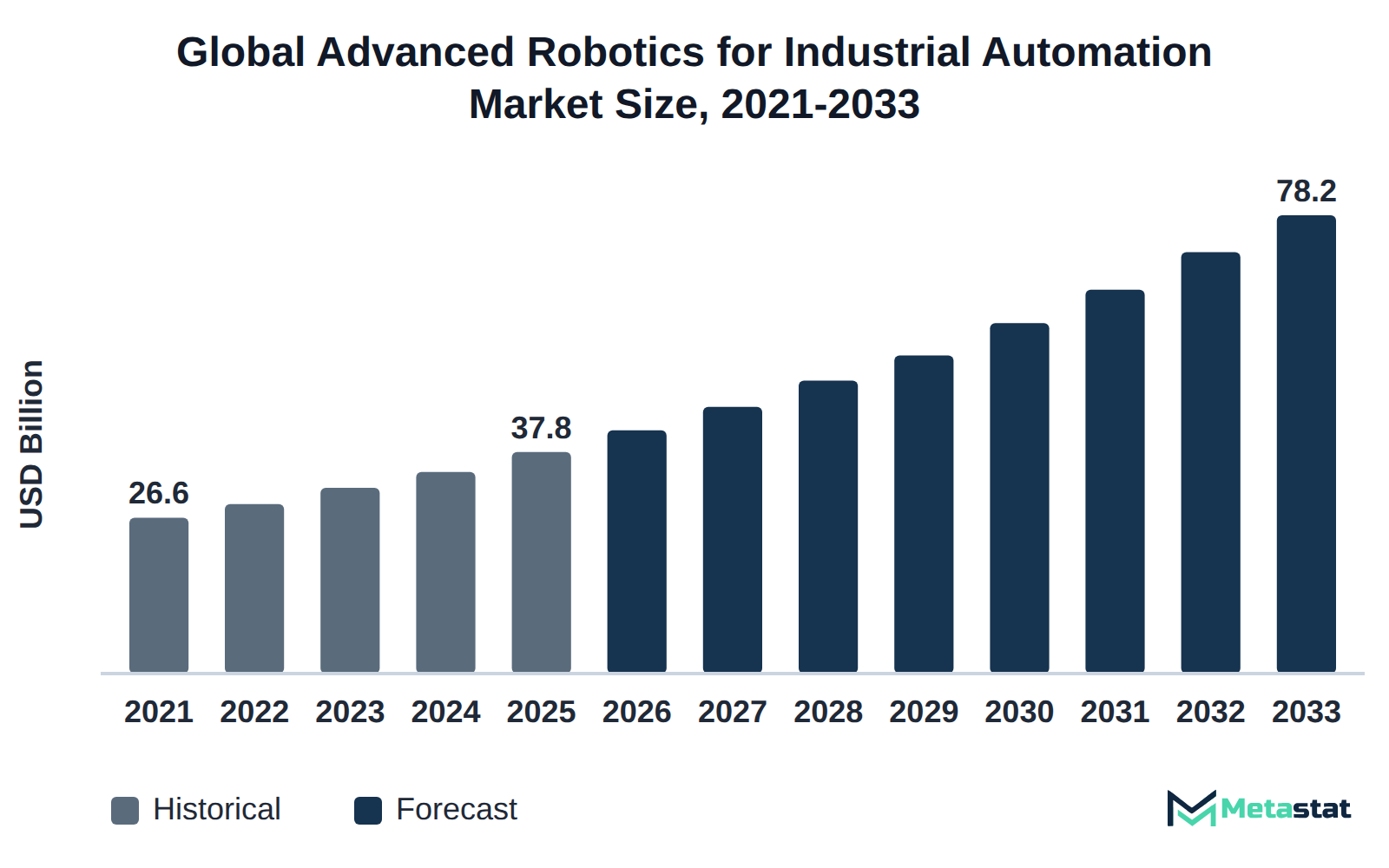
Market Valuation: Valued at $37.8 Billion in 2025, projected to reach $78.2 Billion by 2033 at a 9.5% CAGR.
Dominant Segment: Articulated robots lead the Advanced Robotics for Industrial Automation market, driven by their versatility in tasks such as assembly and material handling, which are essential for high-volume production.
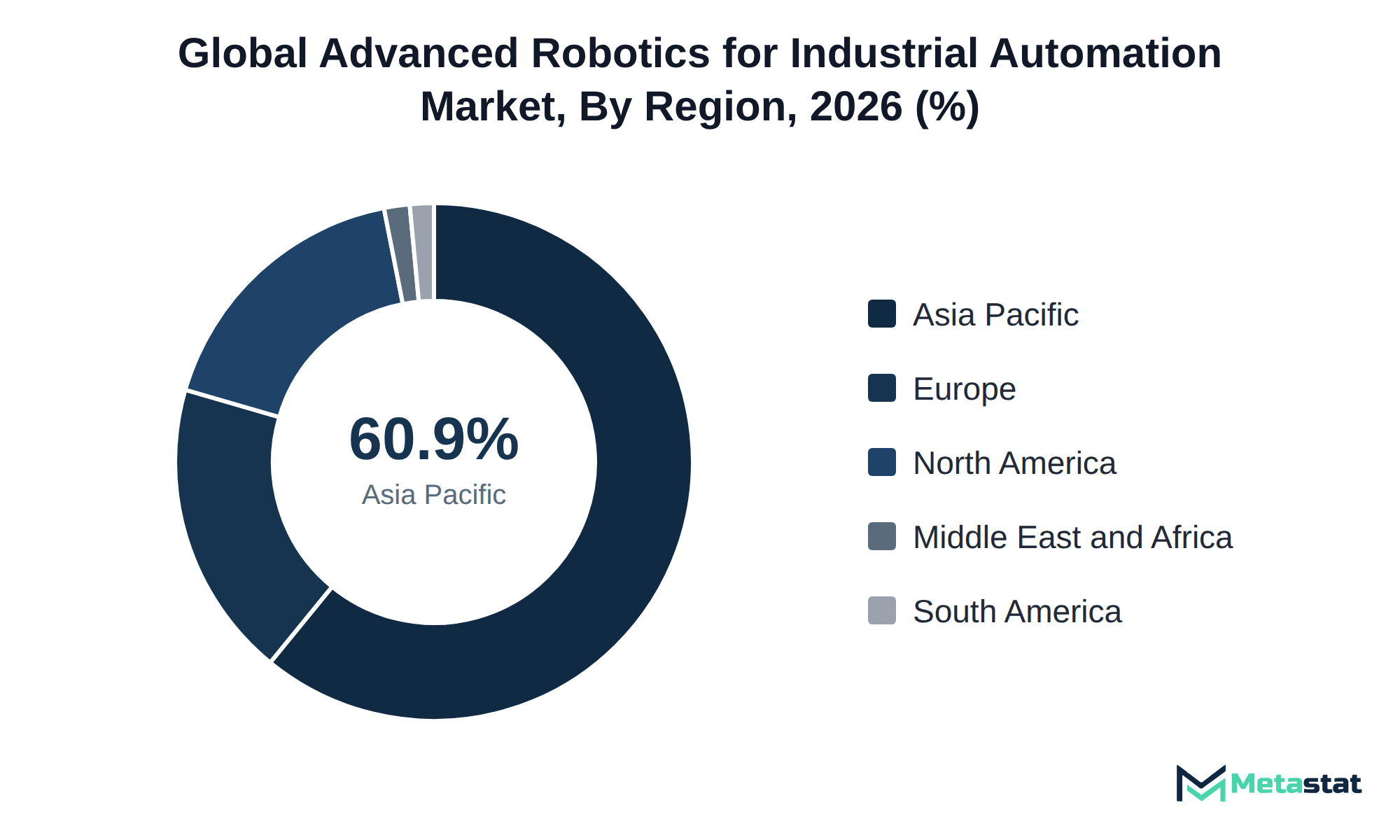
Geographic Lead: Asia Pacific dominates the market with a share of 60.9% in 2025, fueled by rapid industrialization and a robust manufacturing base, particularly in countries like China.
What's Inside: The report provides a comprehensive analysis of the market, including competitive coverage, detailed segmentation by robot type, technology, application, and end-use industry, along with growth trends and forecasts from 2026 to 2033.
Growing Demand for AI-Driven Solutions: The integration of artificial intelligence and machine learning in robotics is projected to grow at a CAGR of 13.4% through 2033, reflecting the increasing need for intelligent automation across various industries.
Investment Trends: Collaborative robots are reshaping automation strategies, particularly in small and medium factories, by offering flexible and cost-effective solutions that enable these businesses to compete effectively.
Choose Your License
Global Advanced Robotics for Industrial Automation Market
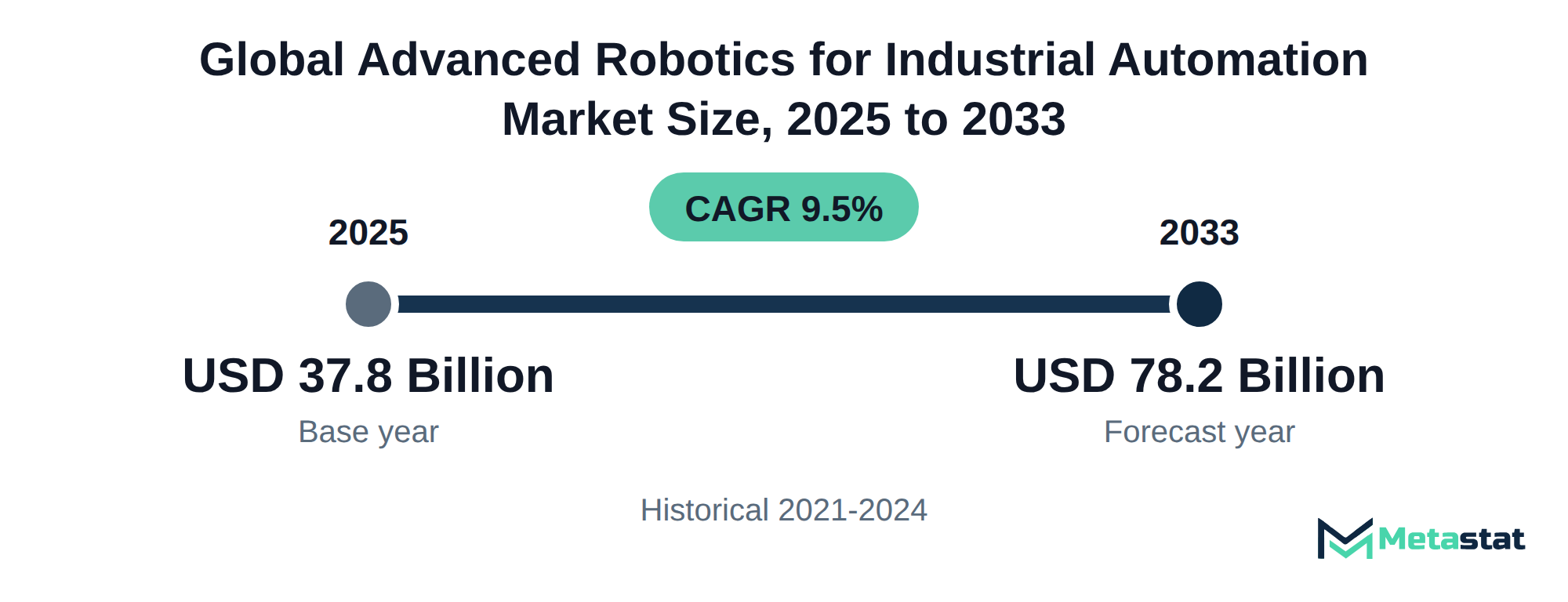
The global Advanced Robotics for Industrial Automation market was valued at USD 37.8 billion in 2025 and is projected to reach USD 78.2 billion by 2033, growing at a CAGR of 9.5% over the forecast period.
The Advanced Robotics for Industrial Automation market covers many types of robotic systems designed to automate industrial processes. Buyers invest in these advanced solutions to enhance operational efficiency, reduce labor costs, and improve product quality. The growing emphasis on automation across various sectors, particularly in manufacturing, drives the adoption of robotics, making it a crucial component in modern industrial operations.
Growth in the market is propelled by the increasing demand for efficiency and productivity within industries. The segment representing the highest value includes articulated robots, which are essential for tasks including assembly and material handling. Asia Pacific captures the largest market share at 60.9%, significantly outpacing other regions, with North America holding 17.4% of the market in 2025, with the US leading in 2026.
Technological advancements in robotics, particularly in artificial intelligence and machine learning, enhance the capabilities of these systems. These innovations allow for greater flexibility and adaptability in industrial applications, further fueling market expansion. Continued advances in robotic technologies help meet rising demand for automation across end-use industries.
The Advanced Robotics for Industrial Automation market addresses the increasing demand for efficient and precise automation solutions across various industries. Buyers invest in advanced robotics to enhance productivity, reduce operational costs, and improve product quality. The need for automation in sectors including automotive, electrical, and electronics drives spending, with companies seeking to remain competitive in a changing technological landscape.
Articulated robots dominate the market, reflecting their versatility and effectiveness across many applications. Asia Pacific holds the largest share of the market, accounting for 60.9% in 2025, with significant growth attributed to industrialization and a strong manufacturing base.
One primary growth driver stems from the increasing adoption of artificial intelligence and machine learning technologies in robotics. This integration enhances the capabilities of robotic systems, allowing for smarter and more adaptable automation solutions that address the evolving needs of the manufacturing sector. Continuous advancements in technology will contribute to the sustained expansion of the market.
AI-powered machine vision significantly enhances the capabilities of industrial robotics, particularly in precision assembly applications. This technology employs advanced algorithms and imaging techniques to enable robots to identify, inspect, and manipulate components with high accuracy. Machine vision cameras supply the image data that robots use for inspection and guidance. The integration of machine vision into robotics responds to increasing demand for quality control and efficiency in manufacturing processes, especially in sectors including automotive and electronics.
In the Advanced Robotics for Industrial Automation market, the segment of machine vision and robotic vision is projected to grow from USD 10.1 billion in 2026 to USD 17.3 billion by 2033, reflecting a compound annual growth rate (CAGR) of 8.1%. Such growth indicates a strong trend toward automation with enhanced visual capabilities, which allows robots to adapt to varying tasks without extensive reprogramming.
This technological shift leads to operational efficiencies, reducing production times and costs while improving product quality. Manufacturers adopting machine vision-equipped robots achieve greater flexibility in assembly lines, enabling quicker responses to market changes and custom demands. This transformation positions companies competitively within the market, driving innovation and overall growth in the industrial automation sector.
Investment in collaborative robots significantly enhances automation strategies in small and medium factories. This trend reflects a shift towards flexible solutions that allow smaller operations to compete with larger entities. Collaborative robots, or cobots, require lower upfront capital compared to traditional industrial robots, making them accessible for these smaller businesses. For example, the Advanced Robotics for Industrial Automation market anticipates that articulated robots will expand from USD 27.8 billion in 2026 to USD 53.3 billion by 2033, demonstrating increasing adoption in various settings.
Financing options for these technologies vary, with manufacturers and distributors offering flexible payment plans, leasing arrangements, and performance-based contracts. Such models enable smaller factories to allocate resources effectively while minimizing risk. By adopting these financial frameworks, small and medium enterprises invest in automation without facing overwhelming initial costs, ensuring they remain agile and competitive. Competitive pricing structures and financing options are expected to drive growth in the Advanced Robotics for Industrial Automation market and encourage innovation.
The growth of the battery manufacturing sector significantly influences the Advanced Robotics for Industrial Automation market, particularly in high-precision robotic handling applications. The demand for efficient and precise automation solutions stems from the increasing complexity and volume of battery production processes. For instance, the market for articulated robots, essential for handling delicate battery components, is projected to expand from USD 27.8 billion in 2026 to USD 53.3 billion by 2033, reflecting a compound annual growth rate (CAGR) of 9.8%. This expansion highlights the rising need for automation technology capable of meeting stringent quality standards and operational efficiency.
Manufacturers in the battery industry seek automation solutions that enhance productivity while maintaining precision in handling sensitive materials. The integration of robotic systems reduces operational costs and minimizes errors associated with manual handling, leading to costly defects. The increasing adoption of advanced robotics for battery manufacturing aligns with broader industry trends towards automation, ultimately driving competitive advantage and increasing profitability. The market stands to benefit from these evolving demands, which reinforce the importance of innovation in robot technology tailored for battery production.
The return on investment in industrial robotics significantly hinges on the type of robot deployed and its application. Robots' versatility in tasks such as welding, material handling, and assembly enhances their value proposition for manufacturers.
The integration of advanced technologies, including artificial intelligence and machine learning, significantly optimizes robotic performance. With an anticipated value reaching USD 20 billion by 2033, these technologies facilitate improved operational efficiency and adaptability in dynamic production environments. Consequently, organizations investing in these systems experience substantial cost savings and productivity gains, which contribute positively to their bottom line.
Ultimately, businesses evaluating investments in robotics benefit from understanding which robot types and technologies align best with their operational objectives. The Advanced Robotics for Industrial Automation market offers many options, so manufacturers can select solutions tailored to their requirements.
Shifts in buyer preferences drive increased investment in advanced robotics, particularly within the manufacturing sector. Companies seeking efficiency and productivity enhancements prioritize automation to remain competitive in a dynamic market. This transition is evident in industries including automotive and electronics, where production processes require greater precision and speed. In 2026, the market is projected to reach USD 41.5 billion, reflecting the growing recognition of automation's benefits. Enhanced operational efficiency and reduced labor costs further incentivize businesses to adopt advanced robotics technologies. By integrating these solutions, firms achieve higher output rates and improved product quality, meeting the demands of a sophisticated consumer base. These evolving dynamics support significant growth in the advanced robotics for industrial automation market.
Technological advancements drive machine vision integration.
Technological innovations drive the integration of machine vision within the advanced robotics for industrial automation market. Enhanced imaging capabilities allow robots to perform complex tasks with greater accuracy and efficiency, creating opportunities in sectors including manufacturing and logistics. Buyers increasingly recognize the value of these improvements, leading to higher adoption rates across various applications. The anticipated growth of machine vision technology, with a projected value of USD 17.3 billion by 2033, highlights its significance in optimizing processes and reducing errors. By implementing machine vision solutions, companies experience increased productivity and reduced operational costs, further reinforcing their competitive positioning in a dynamic marketplace.
Innovations in robotics technology significantly influence the Advanced Robotics for Industrial Automation market. The integration of artificial intelligence and machine learning into robotic systems drives improvements in precision, efficiency, and adaptability. Enhanced capabilities enable robots to perform complex tasks, including material handling and machine tending, with increased accuracy. Consequently, manufacturers invest in these advanced systems to streamline operations and reduce labor costs.
Advancements in machine vision and robotic vision provide systems with the ability to interpret visual information in real-time, improving quality control and inspection processes. These developments attract various industries, including automotive and electronics, which require heightened efficiency and consistent quality in production lines. The resulting demand for high-performing robotic solutions drives growth in the market, supporting expansion across multiple sectors.
Growth in the market aligns with the increasing need for automation to address labor shortages and rising operational costs. Enhanced robotics technology supports producers in maintaining competitive advantages while responding to evolving production demands effectively.
High costs associated with advanced robotics present a significant barrier for manufacturers, particularly among small and medium enterprises. These businesses operate under tighter budgets, resulting in slower uptake of new automation technologies. The substantial initial investment required for advanced robotics systems, including installation and maintenance, leads to smaller orders and delayed replacements. Consequently, this price sensitivity impacts decision-making processes, hindering growth potential within the market. Industries including automotive and electrical face heightened scrutiny when considering upgrades to their automation solutions, particularly in regions where budget constraints are prevalent. With ongoing price fluctuations in components and labor, maintaining competitive pricing structures becomes essential for vendors to stimulate demand in the Advanced Robotics for Industrial Automation market. Understanding these financial limitations helps stakeholders develop strategies that fit the purchasing power of different buyer groups.
Input and material costs challenge suppliers in the Advanced Robotics for Industrial Automation market. Rising prices for critical components, including sensors and processors, exert pressure on profit margins. Suppliers increasingly seek alternative sourcing strategies and invest in local manufacturing capabilities to mitigate these cost impacts. Enhancing operational efficiency and exploring automation in their own production processes offsets the rising expenses associated with inputs.
This challenge particularly affects smaller companies lacking significant financial resources, limiting their ability to compete with larger players. To address these pressures, suppliers focus on value engineering and innovative design solutions that reduce material usage while maintaining product quality. The shift toward smart manufacturing and digital solutions allows for more precise cost management and resource allocation, contributing positively to profitability. Adapting to input cost fluctuations remains crucial for suppliers striving for sustainability and growth in the competitive environment of advanced robotics.
The increasing integration of artificial intelligence into robotic systems presents a significant growth opportunity in the Advanced Robotics for Industrial Automation market. The segment focused on artificial intelligence and machine learning is projected to achieve a compound annual growth rate (CAGR) of 13.4% through 2033. This surge results from heightened demand for intelligent automation across various industries, particularly in sectors requiring advanced analytics and decision-making capabilities. Industries including electrical and electronics have begun to adopt AI-enhanced robotics to streamline operations and improve efficiency, driving higher levels of investment in these innovative solutions. The emergence of AI-driven robotics addresses critical operational challenges, including optimizing production processes and reducing downtime. This trend positions businesses to enhance productivity and competitiveness within the market, creating a favorable environment for further advancements in robotic technology.
The Global Advanced Robotics for Industrial Automation market is segmented based on Robot Type, Technology, Application, and End-Use Industry.
These robots find application in various tasks including welding, painting, and material handling, serving industries like automotive and electronics. The growing demand for automation in manufacturing processes drives this segment, particularly in high-volume production environments where precision and flexibility are essential. Compared to other robot types, articulated robots exhibit a higher growth rate, driven by advancements in robotics technology and increasing adoption among manufacturers. Their ability to perform complex tasks with agility differentiates them from segments including SCARA and Cartesian robots, which serve more specialized roles and demonstrate lower growth rates.
SCARA Robots segment is estimated to reach USD 12.9 billion by 2033, at a CAGR of 9.9% during the forecast period. These robots serve primarily in applications including assembly, material handling, and dispensing, particularly within sectors like electronics and automotive manufacturing. The increased demand for precision and efficiency drives the growth of this segment, with manufacturers seeking solutions that enhance productivity while minimizing labor costs. In this context, SCARA Robots differentiate themselves by offering faster cycle times and greater flexibility compared to traditional robotic systems. Their competitive pricing further attracts buyers seeking cost-effective automation solutions. This segment's growth trajectory stands out, with a higher CAGR relative to other robotic types, reflecting its specific application advantages and market appeal.
Cartesian and Gantry Robots segment is expected to reach USD 6.1 billion by 2033. These robotic systems excel in high-speed pick-and-place applications and precise positioning tasks, serving industries including manufacturing and logistics. The growing demand for automation in material handling acts as a significant driver for this segment. Cartesian and Gantry Robots offer advantages in terms of speed and flexibility compared to other robot types, providing a compound annual growth rate (CAGR) of 10.4%. This growth surpasses that of SCARA Robots, which has a CAGR of 9.9%. The segment's unique capability to handle heavy loads with precision differentiates it, appealing particularly to sectors where space is a constraint and accurate movement is essential. Industries that are increasingly adopting automation solutions will drive demand for Cartesian and Gantry Robots significantly in the coming years.
Delta and Parallel Robots segment is projected to grow at a CAGR of 10.4% during the forecast period. These robotic systems find extensive use in high-speed pick-and-place applications, particularly in sectors including electronics and food processing. Adoption rises due to their speed and efficiency in handling delicate components, which appeals to manufacturers focused on reducing operational cycles. This segment is distinguished by its faster projected growth relative to others, driven by increasing demand for automation solutions that enhance throughput and precision. Advancements in technologies including force/torque sensing and haptic control enhance the functionality of these robots, making them suitable for tasks requiring a high degree of dexterity and accuracy. The market anticipates significant investments aimed at upgrading existing systems to meet evolving production needs.
Cylindrical and Polar Robots serve specific applications that include assembly, material handling, and precise positioning tasks. These robotic systems find a foothold primarily in industries including automotive and electronics, where their unique capabilities enhance operational efficiency. The rising demand for process automation and precision in manufacturing fuels growth in this segment. Compared to articulated and SCARA robots, this group typically experiences slower growth due to specialized applications, which limit broader adoption. However, their pricing remains competitive against more advanced robotic types, allowing smaller manufacturers access to automation solutions. The rising trend toward automation in various industries positions this segment positively, encouraging further exploration of its capabilities while maintaining a balance with the market's overall technological advancements.
This technology facilitates automation in various applications, including quality inspection and precision measurements, primarily serving industries including automotive, electronics, and pharmaceuticals. A key driver for this segment involves the increasing need for enhanced accuracy and efficiency in manufacturing processes, pushing companies to adopt advanced robotic technologies. Compared to other segments, this area experiences moderate growth, with its CAGR of 8.1% outpacing certain other technologies influenced by different factors. The rising integration of artificial intelligence enhances the capabilities of machine vision, thereby expanding its applicability in increasingly complex tasks and reinforcing its role in the advanced robotics ecosystem.
Artificial Intelligence and Machine Learning segment is estimated to reach USD 20 billion by 2033, at a CAGR of 13.4% during the forecast period. This segment automates complex processes and improves decision-making and operational efficiency. Industries including automotive, electrical and electronics, and manufacturing apply these technologies to improve productivity and reduce human error. Rapid advancements in AI and machine learning significantly drive this segment, allowing for intelligent robotic systems that adapt to various tasks. Compared to other technology segments, this segment grows faster, driven by increasing demand for automation solutions that use data analytics and real-time processing. The focus on smart manufacturing and Industry 4.0 initiatives further supports the expansion of the Artificial Intelligence and Machine Learning segment in the Advanced Robotics for Industrial Automation market.
Force/Torque Sensing and Haptic Control segment is expected to reach USD 7.6 billion by 2033. This technology enables robots to detect and respond to forces acting on them, enhancing precision in tasks including assembly, welding, and material handling. Industries including automotive and electronics rely on this technology to ensure high-quality and safe operations. Increasing demand for automation solutions that improve operational efficiency fuels growth in this segment. With a CAGR of 10.4%, the segment's growth outpaces others in the technology classification, reflecting a heightened focus on advanced robotic capabilities. Its specialized applications distinguish Force/Torque Sensing and Haptic Control from broader technologies in the market, attracting buyers seeking enhanced performance in complex tasks.
Digital Twin and Simulation segment is projected to grow at a CAGR of 11.5% during the forecast period. Digital twin technology uses virtual representations of physical systems, allowing for real-time monitoring, simulation, and optimization. Industries including manufacturing and logistics apply this technology to enhance efficiency, reduce downtime, and improve decision-making processes. The increasing demand for predictive maintenance and operational efficiency drives this segment's growth. Compared to other technologies in this market, Digital Twin and Simulation experiences faster growth due to its ability to integrate with various robotic systems and provide insights that traditional methods cannot. Investment in this technology leads to significant cost savings and enhanced productivity, supporting broader adoption across different sectors.
Advanced Motion Control and Path Planning focuses on enhancing the precision and efficiency of robotic movements, allowing robots to navigate complex paths and perform intricate tasks with high accuracy. This technology primarily serves manufacturing and assembly applications, where operational efficiency and precision are crucial for productivity. Significant demand arises from industries including automotive and electronics, where tasks require intricate coordination. Technological advancements drive this segment, particularly in sensors and algorithms that improve motion accuracy and adaptability. Compared to other technologies in the market, this segment experiences a slower growth trajectory, influenced by the higher complexity of implementation and integration into existing systems. The advanced robotics for industrial automation market continues to evolve, with ongoing innovations enhancing capabilities and reducing operational limitations, ultimately increasing demand for advanced motion control solutions.
Industrial Internet of Things (IIoT) Connectivity enhances the capabilities of robotic systems in industrial automation. Integration of IIoT enables real-time data exchange between machines, leading to improved efficiency, predictive maintenance, and optimized workflows. Industries including manufacturing, logistics, and supply chain management apply IIoT technology to streamline operations and reduce downtime. Rapid advancements in connectivity and data analytics drive demand for this technology, particularly among manufacturers seeking to improve productivity. Compared to other technologies, IIoT Connectivity evolves at a significant pace, with buyers increasingly valuing its ability to enhance overall system performance. This segment supports the broader trend of automation and smart manufacturing, reinforcing growth dynamics in the Advanced Robotics for Industrial Automation market.
Cloud and Edge Robotics encompass technologies that enable data processing and analytics at the edge of networks, integrating with robotic systems for enhanced functionality. Industries including manufacturing and logistics use these technologies for real-time decision-making and automation, improving efficiency and productivity. Rapid advancements in communication technologies and the growing demand for real-time analytics drive this segment's growth. Compared to other technology segments, Cloud and Edge Robotics exhibit a different adoption rate due to varying buyer requirements and integration complexities. While several segments focus on traditional automation processes, this segment caters to industries seeking more agile and responsive solutions to operational challenges. The Advanced Robotics for Industrial Automation market highlights the increasing significance of such technologies, reflecting a broader trend toward digital transformation in industrial applications.
Specialized Robot Programming and Control Technologies encompass advanced software solutions that facilitate the programming and control of robotic systems. This segment primarily serves manufacturers and system integrators requiring tailored solutions for complex automation tasks. The increasing demand for customization in robotic applications drives innovation, enhancing the ability to program robots for specific functions. This segment operates at a unique price point compared to others in the technology category, often characterized by higher development and implementation costs due to its specialized nature. Such dynamics influence purchasing decisions, particularly among industries focused on precision and adaptability. Growth in sectors requiring high levels of automation, including electronics and automotive, supports the expansion of these technologies. The Advanced Robotics for Industrial Automation market highlights the segment's importance in shaping the future of robotics applications.
Material Handling and Machine Tending segment is valued at USD 17.6 billion in 2026 and is projected to reach USD 33.8 billion by 2033, at a CAGR of 9.7% during the forecast period. This segment is significant in the automation of tasks involving the movement and handling of materials, serving industries including manufacturing, logistics, and warehousing. The growing emphasis on operational efficiency and the need for reduced labor costs drive demand for advanced robotics in this area. Compared to other application segments, including Welding and Soldering, which has a slower growth rate with a CAGR of 7.9%, Material Handling and Machine Tending stands out due to its broader applicability and higher demand across various sectors. The integration of advanced technologies, including Artificial Intelligence and Machine Learning, enhances the capabilities of these robots, resulting in increased efficiency and productivity within the market.
Welding and Soldering segment is estimated to reach USD 16.2 billion by 2033, at a CAGR of 7.9% during the forecast period. This segment primarily serves industries including automotive and electronics, where precision and reliability in joining materials are critical. The increasing demand for automation in production processes drives growth in this segment, with companies seeking improved efficiency and reduced human error. Unlike other applications, Welding and Soldering experiences a moderate growth rate compared to segments like Material Handling and Machine Tending, which has a higher CAGR of 9.7%. The focus on enhancing automation capabilities drives investments in advanced robotic welding technologies, aiming to optimize productivity and quality in manufacturing operations. Organizations continue to adopt these solutions, and this segment significantly contributes to the overall expansion of the market for Advanced Robotics for Industrial Automation.
Assembly and Disassembly segment is expected to reach USD 11.5 billion by 2033. This segment finds application in industries including automotive and electronics, where efficient and precise assembly processes are essential for production quality and speed. Demand for this segment grows due to increasing product complexity and rising emphasis on automation to enhance productivity. Unlike segments focused on welding or material handling, which experience different growth rates, Assembly and Disassembly holds a distinct position due to its specific operational requirements. The adoption of advanced robotics in this segment shows a CAGR of 8.3%, reflecting a strong push towards automation in manufacturing processes. The market experiences an ongoing transition driven by technological advancements that improve functionality and efficiency of robotic solutions in assembly tasks.
Painting, Coating, and Dispensing segment is projected to grow at a CAGR of 8.6% during the forecast period. This segment finds applications primarily in industries requiring surface treatment, including automotive and electronics manufacturing. Demand for enhanced surface quality and durability drives adoption, prompting manufacturers to automate processes for improved efficiency and consistency. Compared to other applications, this segment experiences significant growth due to increasing regulations on surface quality and environmental standards. The segment's growth outpaces others in the application category, offering specialized solutions tailored for complex tasks that require precision. By 2033, this segment is expected to reach a valuation of USD 11.5 billion, reflecting its importance in the market.
Cutting, Grinding, Deburring, and Polishing encompass processes essential for achieving precise surface finishes on various materials. Industries including automotive, aerospace, and metal fabrication apply these processes to enhance product quality and durability. Demand in this segment expands due to increasing quality standards and the push for automation in manufacturing environments. Adoption of advanced robotics for these applications streamlines operations, reduces labor costs, and minimizes human error. Compared to other applications, this segment experiences slower growth due to the specialized nature of the equipment and technology required. Ongoing advancements in robotic technology are expected to enhance capabilities, making automation more accessible and appealing across industries. Adoption of robotics is expected to transform traditional practices, driving efficiency and productivity in Cutting, Grinding, Deburring, and Polishing tasks.
Inspection, Testing, and Measurement involves using advanced robotics to perform quality control and assurance tasks in manufacturing and production environments. Industries including automotive and electronics rely on this technology to ensure precision and reliability in their products. Demand increases due to the growing emphasis on product quality and compliance with stringent safety regulations. Compared to other segments, this application differs with potentially higher operational costs, driven by the advanced technologies required for accurate measurements and inspections. The focus on automation in quality assurance presents unique challenges, including the integration of new robotic systems into existing workflows. This application stands out within the Advanced Robotics for Industrial Automation market due to its critical role in maintaining product standards and optimizing production efficiency.
Robotic additive manufacturing represents a significant approach in industrial production, employing advanced robotics to facilitate additive processes. This segment finds application in industries including aerospace, automotive, and healthcare, where customization and efficiency are critical. The increasing demand for rapid prototyping and complex geometries drives growth in this area. Innovation in materials and techniques is essential for advancing capabilities, enhancing product quality, and reducing waste. Buyers in this segment prioritize precision and adaptability, distinguishing it from traditional manufacturing methods. The overall market is expected to experience robust growth, reflecting a growing emphasis on automation and modernization in manufacturing.
The automotive segment is valued at USD 12 billion in 2026 and is projected to reach USD 21 billion by 2033, at a CAGR of 8.3% during the forecast period. This segment primarily serves automotive manufacturers focused on enhancing production efficiency and precision. Key factors influencing this segment include increasing demand for automation to improve productivity and the push for advanced safety features in vehicles. The automotive sector differentiates itself from others through significant investment in robotic technology, resulting in a faster growth rate compared to several adjacent industries. For instance, the Electrical and Electronics segment anticipates a CAGR of 10.2% during the same period. This ongoing growth reflects the automotive industry's commitment to innovation and efficiency, significantly impacting the broader Advanced Robotics for Industrial Automation market.
Electrical and Electronics segment is estimated to reach USD 23 billion by 2033, at a CAGR of 10.2% during the forecast period. This segment plays a critical role in automating processes for manufacturers of electronic devices, semiconductors, and printed circuit boards. Key drivers include increasing demand for precise assembly and inspection capabilities in production lines, contributing to higher operational efficiency. This segment experiences faster growth compared to others within the End-Use Industry, reflecting a robust expansion trajectory fueled by technological advancements in automation. Enhanced capabilities including machine vision and artificial intelligence drive investment and adoption, differentiating it from slower-growing segments focused on traditional manufacturing applications. The Advanced Robotics for Industrial Automation market reflects a shift towards greater automation in the electrical and electronics sectors, enhancing output quality and reducing labor costs.
The Metal and Machinery segment is expected to reach USD 11.1 billion by 2033. This segment serves critical roles in manufacturing processes, particularly in automation, precision engineering, and heavy machinery production. Industries including metal fabrication and machinery manufacturing rely on advanced robotics to enhance production efficiency and improve quality control. The adoption of automation technologies is driven by demand for increased productivity and reduced operational costs. Unlike other segments, this segment experiences steady growth, with a CAGR of 7.9% during the forecast period. This growth reflects the ongoing trend toward automation in traditional manufacturing processes, distinguishing it from faster-growing segments like Electrical and Electronics, which is projected to achieve a CAGR of 10.2%. In the Advanced Robotics for Industrial Automation market, this segment represents a vital component of overall automation strategies, addressing the unique challenges faced by machinery and metalworking industries.
Plastics and Chemicals segment is projected to grow at a CAGR of 7.9% during the forecast period. This segment involves the use of advanced robotics in the manufacturing and processing of plastic materials and chemicals, primarily by industries focused on production efficiency and quality control. Rising demand for high-quality, consistent products drives automation in this segment, particularly in sectors including packaging and injection molding. Compared to other segments, Plastics and Chemicals experiences a lower growth rate relative to Electrical and Electronics, which is projected to grow at a CAGR of 10.2%. Adoption of automation solutions facilitates cost savings and increases productivity, supporting the segment's expansion. The Advanced Robotics for Industrial Automation market highlights the importance of technological advancements in materials handling and production processes, enabling manufacturers to meet evolving industry standards and consumer needs.
Food and Beverage involves the application of advanced robotics in various processes, enhancing efficiency and precision in production lines. Industries apply these robots for tasks including packaging, sorting, and assembly, aiming to improve operational performance. The increasing demand for automation within the food and beverage sector drives growth, with manufacturers focusing on enhancing productivity and reducing operational expenses. Technological advancements, including machine vision and artificial intelligence, play a crucial role in this segment, enabling the development of smarter robotic systems. Compared to other end-use industries, this segment experiences unique challenges regarding food safety regulations and the need for compliance with strict hygiene standards. The integration of robotics into production processes impacts both investment strategies and operational practices in the Advanced Robotics for Industrial Automation market.
The segment on Pharmaceuticals and Medical Devices enhances the efficiency of production processes in the healthcare sector. This segment is used primarily by pharmaceutical manufacturers and medical device producers to automate tasks including assembly, packaging, and quality control. Strong demand arises from the increasing need for precision and reliability in medical products. Regulatory requirements for safety and compliance drive the adoption of advanced robotics in this sector. Compared to other segments, this sub-segment experiences different dynamics, particularly with a focus on stringent quality standards that lead to higher operational costs. Increasing investments in healthcare technology contribute significantly to the growth of the Advanced Robotics for Industrial Automation market, reflecting a commitment to innovation in healthcare manufacturing.
Aerospace and Defense represents a sector focused on the manufacturing and maintenance of aircraft, spacecraft, and defense equipment. Leading players within this segment include both established defense contractors and aerospace manufacturers, who employ advanced robotics to enhance precision, reduce costs, and improve operational efficiency. The demand for automation in this field is driven by the increasing complexity of projects, coupled with the need for heightened safety standards. Unlike other segments, Aerospace and Defense entails higher price points due to specialized requirements and rigorous testing protocols. This segment experiences significant growth, influenced by technological advancements in automation and robotics, which facilitate faster and more accurate production processes. The Advanced Robotics for Industrial Automation market benefits from these developments, leading to increased investments in innovative robotic solutions tailored for the aerospace and defense sectors.
This segment focuses on the category involving wood and paper products, which apply advanced robotics for various applications. Industries engaged in forestry and paper manufacturing increasingly adopt robotic solutions to improve productivity and precision in their processes. These solutions enhance tasks including material handling, cutting, and packaging. Demand for efficient production methods drives the adoption of robotics in this sector. The need for sustainability and reducing labor costs influences investment in advanced technologies for wood and paper products. Compared to other segments within the market, this segment experiences slower growth due to traditional practices still prevalent in these industries. However, companies seeking to modernize their operations find that the integration of advanced robotics presents opportunities for innovation and efficiency.
Based on geography, the Global Advanced Robotics for Industrial Automation market is divided into North America, Europe, Asia-Pacific, South America, Middle East, and Africa.
Growing demand in North America, particularly within the automotive and electrical sectors, drives the Advanced Robotics for Industrial Automation market. The countries of the United States, Canada, and Mexico serve as key contributors to this growth, with extensive investments in automation technologies aimed at enhancing production efficiency. By 2033, the market is projected to reach USD 13.4 billion, reflecting increasing adoption of advanced robotics solutions across various industries. The region's strong focus on innovation and technological advancements, along with a skilled workforce, positions it favorably for ongoing expansion. Companies in North America actively pursue opportunities in advanced robotics to enhance operational capabilities and maintain competitive advantages in the market.
Demand for advanced robotics in Europe is driven primarily by industries including automotive, electrical and electronics, and metal and machinery. Germany and France stand out as key markets, focusing on enhancing manufacturing efficiency and productivity. The European market benefits from strong regulatory frameworks promoting automation and innovation, which support investments in advanced robotics technologies. With a projected share of 18.6% of the global market in 2025, the region is poised for significant growth. The advanced robotics for industrial automation market in Europe is expected to evolve significantly, driven by increasing adoption of robotics solutions across various applications, including material handling and machine tending. This shift aligns with the broader trends of digital transformation and Industry 4.0 initiatives across European manufacturing sectors.
The Asia Pacific region accounts for 60.9% of the global total in 2025 for the Advanced Robotics for Industrial Automation market. Economic growth, particularly in countries like China and India, drives the demand for automation solutions across various sectors. The manufacturing industry, especially electronics and automotive, relies heavily on advanced robotics to enhance productivity and efficiency. The region's focus on technological advancements, including artificial intelligence and machine learning, supports the adoption of robotics technologies. Increasing investments in infrastructure and the push towards smart manufacturing further contribute to market expansion. The anticipated growth in this market boosts competitiveness and innovation within the region, positioning it as a leader in industrial automation.
Brazil and Argentina represent key markets for advanced robotics, particularly within the automotive and electrical sectors. Growth in these industries drives investments in automation technologies, enhancing operational efficiency and productivity. South America, accounting for a 1.5% share of the global market in 2025, faces challenges including limited infrastructure and high import costs. These constraints slow the adoption of advanced robotics in manufacturing processes. The market is projected to experience gradual growth, driven by the increasing need for automation solutions to streamline production and improve product quality. Companies operating in these regions focus on using advanced robotics to stay competitive in an evolving industrial environment.
The presence of advanced robotics in the Middle East and Africa remains limited, representing a mere 1.6% share of the global market in 2025. Demand primarily arises from industries including automotive and electrical, where innovation drives increased automation. Countries like Saudi Arabia and the UAE show substantial investment in technological advancements, reflecting a growing interest in robotics. Initiatives aimed at diversifying economies and enhancing manufacturing capabilities contribute to this trend. South Africa plays a key role in the regional market, focusing on improving production processes through automation. The market is expected to experience gradual growth as businesses recognize the potential benefits of advanced robotics for industrial automation.
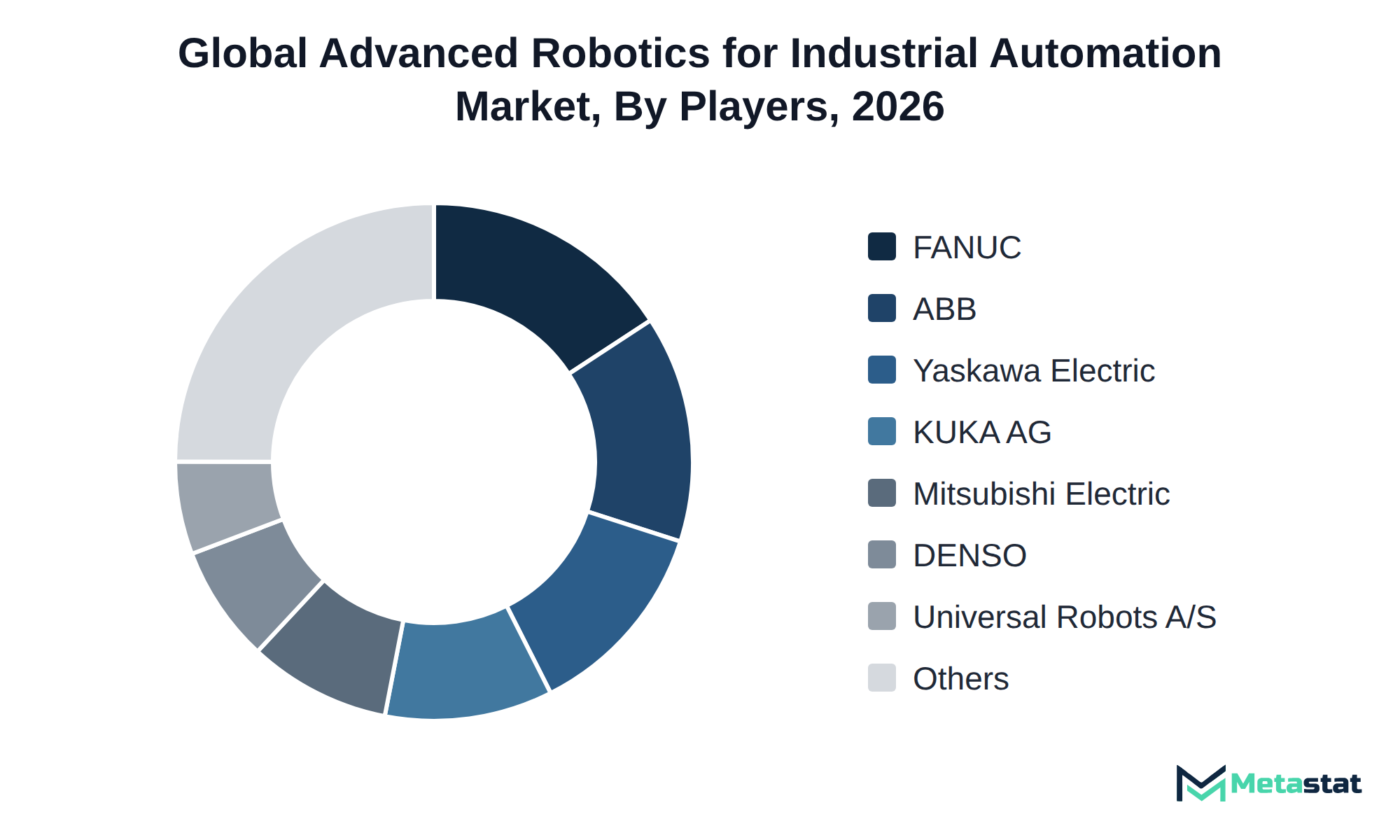
In the Advanced Robotics for Industrial Automation market, companies engage in competition through differentiated offerings in robot types, technologies, and applications. Buyers select products based on factors including price, certification, customization, and service quality. The segmentation includes articulated robots, SCARA robots, Cartesian and gantry robots, and delta and parallel robots, each catering to distinct operational needs across various industries.
ABB Ltd. emphasizes automation solutions that enhance operational efficiency and productivity, particularly in the automotive and electrical industries. FANUC Corporation prioritizes robotics integration through advanced machine vision and artificial intelligence technologies, supporting diverse applications from material handling to welding. Yaskawa Electric Corporation focuses on providing advanced motion control technologies and robotics for manufacturing processes, contributing significantly to growth in the market.
The expected growth relies on several key developments within the Advanced Robotics for Industrial Automation market. First, the demand for articulated robots will contribute to reaching the market's potential. Second, advancements in artificial intelligence and machine learning are crucial, with growth to USD 20 billion by 2033. This technology supports more sophisticated automation solutions, appealing to various industries. Potential risks exist, particularly from supply chain disruptions that impact production timelines and increase costs. Such disruptions hinder the overall growth trajectory, particularly for regions like North America and Europe, where manufacturing capabilities strongly influence market dynamics. Continuous monitoring of these factors remains essential for managing risk in the Advanced Robotics for Industrial Automation market.
By Robot Type: Articulated Robots, SCARA Robots, Cartesian and Gantry Robots, Delta and Parallel Robots, Others (Cylindrical and Polar Robots)
By Technology: Machine Vision and Robotic Vision, Artificial Intelligence and Machine Learning, Force/Torque Sensing and Haptic Control, Digital Twin and Simulation, Advanced Motion Control and Path Planning, Industrial Internet of Things (IIoT) Connectivity, Cloud and Edge Robotics, Others (Specialized Robot Programming and Control Technologies)
By Application: Material Handling and Machine Tending, Welding and Soldering, Assembly and Disassembly, Painting, Coating, and Dispensing, Cutting, Grinding, Deburring, and Polishing, Inspection, Testing, and Measurement, Others (Robotic Additive Manufacturing)
By End-Use Industry: Automotive, Electrical and Electronics, Metal and Machinery, Plastics and Chemicals, Food and Beverage, Pharmaceuticals and Medical Devices, Aerospace and Defense, Others (Wood Products, and Paper Products)
The report strategically identifies and profiles the key market players and analyses their core competencies in each sub-segment of the Advanced Robotics for Industrial Automation market.
|
Report Attributes |
Details |
|
Study Period |
2021-2033 |
|
Base Year |
2025 |
|
Estimated Year |
2026 |
|
Forecast Period |
2026-2033 |
|
Historical Period |
2021-2025 |
|
Growth Rate |
CAGR 9.5% from 2026 to 2033 |
|
Revenue Unit |
USD billion |
|
Segmentation |
By Robot Type, Technology, Application, End-Use Industry, and Region |
|
By Region |
North America (By Robot Type, Technology, Application, End-Use Industry, and Country)
|
|
Europe (By Robot Type, Technology, Application, End-Use Industry, and Country)
|
|
|
Asia Pacific (By Robot Type, Technology, Application, End-Use Industry, and Country)
|
|
|
South America (By Robot Type, Technology, Application, End-Use Industry, and Country)
|
|
|
Middle East and Africa (By Robot Type, Technology, Application, End-Use Industry, and Country)
|
Find answers to common questions about this report
The Advanced Robotics for Industrial Automation market size was valued at USD 37.8 billion in 2025.
The market is projected to grow at a CAGR of 9.5% during the forecast period from 2026 to 2033.
The North America Advanced Robotics for Industrial Automation market size is estimated to reach USD 13.4 billion by 2033.
Articulated Robots lead the Advanced Robotics for Industrial Automation market, with a projected value of USD 53.3 billion by 2033. This segment's growth reflects a compound annual growth rate of 9.8 percent from 2026 to 2033.
Shifts in buyer preferences drive increased investment in advanced robotics, particularly within the manufacturing sector, as companies seek efficiency and productivity enhancements. The integration of artificial intelligence and machine learning into robotic systems presents a significant growth opportunity, with a projected compound annual growth rate of 13.4% through 2033.
High costs associated with advanced robotics present a significant barrier for manufacturers, particularly among small and medium enterprises. Rising prices for critical components, including sensors and processors, exert pressure on profit margins, limiting suppliers' ability to compete effectively.
The increasing integration of artificial intelligence into robotic systems significantly drives adoption in the Advanced Robotics for Industrial Automation market. This trend is fueled by heightened demand for intelligent automation, particularly in industries requiring advanced analytics and decision-making capabilities.
The Advanced Robotics for Industrial Automation market is estimated to reach a valuation of USD 78.2 billion by 2033.
Key players operating in the Advanced Robotics for Industrial Automation market include ABB Ltd., FANUC Corporation, Yaskawa Electric Corporation, KUKA AG, Mitsubishi Electric Corporation, Universal Robots A/S, and DENSO Corporation.
The advanced robotics for industrial automation market is projected to reach USD 78.2 billion by 2033.
The analysts below cover Machinery & Equipment research at Metastat Insights.
LEAD ANALYST
Utkarsh Khirodkar is a Lead Market Research Analyst at MetaStat Insight, specializing in market intelligence, technology sector assessments, and competitive strategy.

INDUSTRY CONSULTANT - CHEMICALS & ADVANCED MATERIALS
Chemicals and Materials · Machinery & Equipment · Packaging
Amit Gadhekar Consultant for Chemicals and Materials at MetaStat Insight, directing sector-specific intelligence, research, and strategic consulting across global chemical and processing markets.

PRINCIPAL CONSULTANT - QUALITY SYSTEMS & COMPLIANCE
Electronics and Semiconductor · Machinery & Equipment · Professional Services
Omkar Phadtare is an Industry Consultant at MetaStat Insight, specializing in quality systems, regulatory compliance, and standards benchmarking to drive data-driven market intelligence and strategic industry research.

ENERGY & INFRASTRUCTURE INDUSTRY CONSULTANT
Automotive and Transportation · Electronics and Semiconductor · Energy and Power · Machinery & Equipment
Saurabh Vasant Ganvir consults for Energy & Infrastructure Industry at MetaStat Insight, specializing in renewable energy, solar EPC, and electric vehicle (EV) infrastructure markets.

LEAD CONSULTANT - COMMUNICATION, TELECOM, AND IT
Electronics and Semiconductor · Information & Technology · Machinery & Equipment · Professional Services
Ravindra Sathe Consultants for Communication, Telecom, and IT at MetaStat Insight. He leads the firm's industry research initiatives across telecommunications infrastructure, digital connectivity, enterprise networking, and emerging information technology domains.
Integrating zero-trust access controls across legacy electronic health record systems involves complex compliance overhead. Team produced an analysis that clearly separated identity governance and administration tools from privileged access management platforms. Their evaluation of HIPAA and GDPR compliance features across cloud native solutions gave our architecture group clear baseline criteria. The custom data request regarding biometric authentication adoption in hospital networks was returned promptly with clear documentation.
Evaluating calorific value requirements and air permit compliance across municipal waste facilities requires localized data. Metastat Insight structured their analysis around operational throughput capacity and feedstock composition variations in Latin America and Eastern Europe. Their competitive mapping of sorting equipment vendors helped clarify technology differences between optical separators and heavy media systems. The study provided an objective baseline during our capital expenditure reviews.
Decarbonizing industrial thermal processes hinges on refrigerant regulations and compressor efficiency limits. Metastat Insights delivered a thorough market analysis that evaluated natural refrigerants like CO2 and hydrocarbons against synthetic low-GWP alternatives. The breakdown of utility incentives and grid capacity constraints across key European manufacturing hubs offered valuable perspective. The follow-up conversation with their sector analysts addressed our specific questions on mechanical vapor recompression systems efficiently.
Explore related market intelligence reports worth reading alongside this one.