
Nov 01, 2025
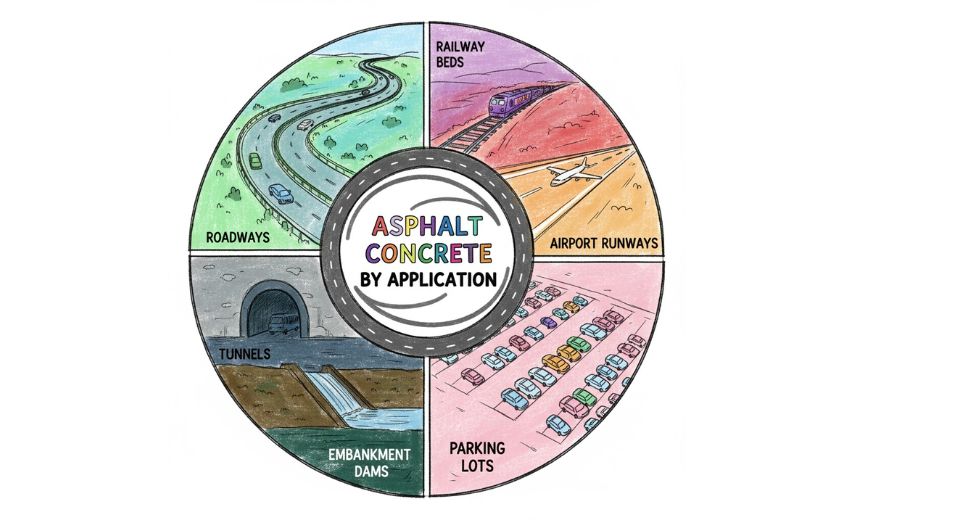
In the era of growing cityscapes today, old roadways and increasing pressure on transport infrastructure, the global asphalt concrete market – as introduced by Metastat Insight – has assumed a greater significance. With cities and regions demanding smoother journeys, more secure road surfaces and fewer maintenance requirements, the substance beneath millions of vehicles daily is more in the public eye. Infrastructure projects no longer depend on merely pouring pavement; they depend on material selection that provides reliability and efficiency.
Market Context
The transport and construction industries are subject to various pressures: roads wear out sooner with increased traffic and increased weather harshness, repair windows are diminishing due to user disruption, and budgets creak under repeated repairs. Here the asphalt concrete market is a solution platform: it offers materials that are formulated for airport runways, road surfaces, parking lots and other paved uses that require longevity and high performance. It offers a binder-aggregate composite well-suited to perform under differing traffic burdens and climates, which is to satisfy the challenge of providing long-lasting pavement surfaces at a reduced life-cycle cost.
How It Works / Why It's Valuable
Essentially, asphalt concrete is a blend of bitumen or asphalt binder for bonding and mineral aggregate (gravel, sand, crushed stone) for strength. Flexibility is provided by the binder, strength by the aggregate, and the composite as a whole provides a load-carrying, smooth surface. Some special advantages include relatively fast curing and installation, simpler repair than rigid concrete, and the ability to use recycled material or modified binders for improved performance. For instance, warm-mix asphalt types lower production temperatures and energy usage, while polymer-modified mixtures increase service life under heavy truck traffic. These characteristics render asphalt concrete a favoured option in both new building and maintenance activities.
Growth Story / Technological Evolution
In the last decade, the market for asphalt concrete has transitioned from conventional hot-mix applications to sophisticated formulations and wider applications. At first, mass take-up concentrated on baseline road construction: putting down the base surface across developing economies. Breakthroughs came later with the addition of recycled asphalt pavement (RAP), warm-mix systems and modified binders with greater durability or reduced environmental footprint. Increasingly, sensor integration, improved quality-control systems and digital planning tools have solidified the position of asphalt concrete products within infrastructure plans. The transition from general mix to engineered systems highlights the way that markets have developed and increasingly provide more specialized solutions.
Regional or Global Trends
Takeup of asphalt concrete is highest in Asia-Pacific, where urbanisation and infrastructural growth are driving demand for new road infrastructure and airport buildings. The Asia-Pacific region is ahead on market share in engineered pavement materials, according to some reports. The established markets of Europe and North America concentrate on higher-spec performance mixes, maintenance and rehabilitation. Growth markets like the Middle East, Africa and parts of Latin America have high growth prospects: budgets are being unlocked, and newer programmes are putting materials such as asphalt concrete at the forefront in road-network improvements.
Challenges and Opportunities
A number of challenges persist for the asphalt concrete industry: raw-material prices (bitumen being petroleum-based) are unpredictable, environmental controls on emissions and recycling are becoming stricter, and competition from other pavement materials (rigid concrete, pervious surfaces) remains a pressure on price-performance choices. Conversely, numerous opportunities exist. Technological innovation—more RAP utilization, warm mix adoption, and data-based asset management—has the potential to unlock new value-streams; smart city and connected transportation infrastructure growth provides integration opportunities; and expansion into lesser-served geographies provides new demand vistas.
Why It Matters Now
The global asphalt concrete market outlined by Metastat Insight is important not only because roads are important, but because roads provide the backbone of commerce, mobility and resilience. As climate change increases pressure on existing surfaces, as sustainability becomes a necessary quality of every new construction, and as digitalisation transfers asset-management attention to pavement materials, the correct selection of surfacing material has the potential to influence outcomes for decades. In that light, this market is at the nexus of transport, urbanisation and sustainability. The international asphalt concrete industry has a part to play in defining the future of how infrastructure enables people and economies.
Drop us an email at:
Call us on:
+1 214 613 5758
+91 73850 57479
 inquiry@metastatinsight.com
 US: +1 3023308252
UK: +44 2034116747APAC: +91 7385057479
US: +1 3023308252
UK: +44 2034116747APAC: +91 7385057479 Address





.png) Agriculture
Agriculture Aerospace and Defense
 Automotive and Transportation
 Banking & Finance
 Biotechnology
 Chemicals and Materials
 Consumer Goods
 Energy and Power
 Food and Beverages
 Healthcare IT
 Information & Technology
 Machinery & Equipment
 Packaging
 Healthcare
 Electronics and Semiconductor
 Medical Devices
