
LEAD ANALYST
Utkarsh Khirodkar is a Lead Market Research Analyst at MetaStat Insight, specializing in market intelligence, technology sector assessments, and competitive strategy.

Used Cooking Oil Market Size, Share, By Source (HoReCa (Hotels, Restaurants, and Catering), Household Kitchens, and Food Processing Plants), By Application (Animal Feed, Bio Diesel, Oleochemicals, Soap and Detergent Manufacturing, Lubricants & Industrial Oils, Energy Generation, Cosmetics and Personal Care Products, and Other), By Distribution Channel (Direct Collection from Households, Aggregators, Middlemen, Waste Management Companies, Restaurants, and Commercial Contracts), By Form (Crude UCO and Filtered UCO), Industry Analysis, Growth, Trends, and Forecasts, 2026-2033
MSI-4529
January, 2026
260 Pages
Report Details
Comprehensive Market Analysis And Insights
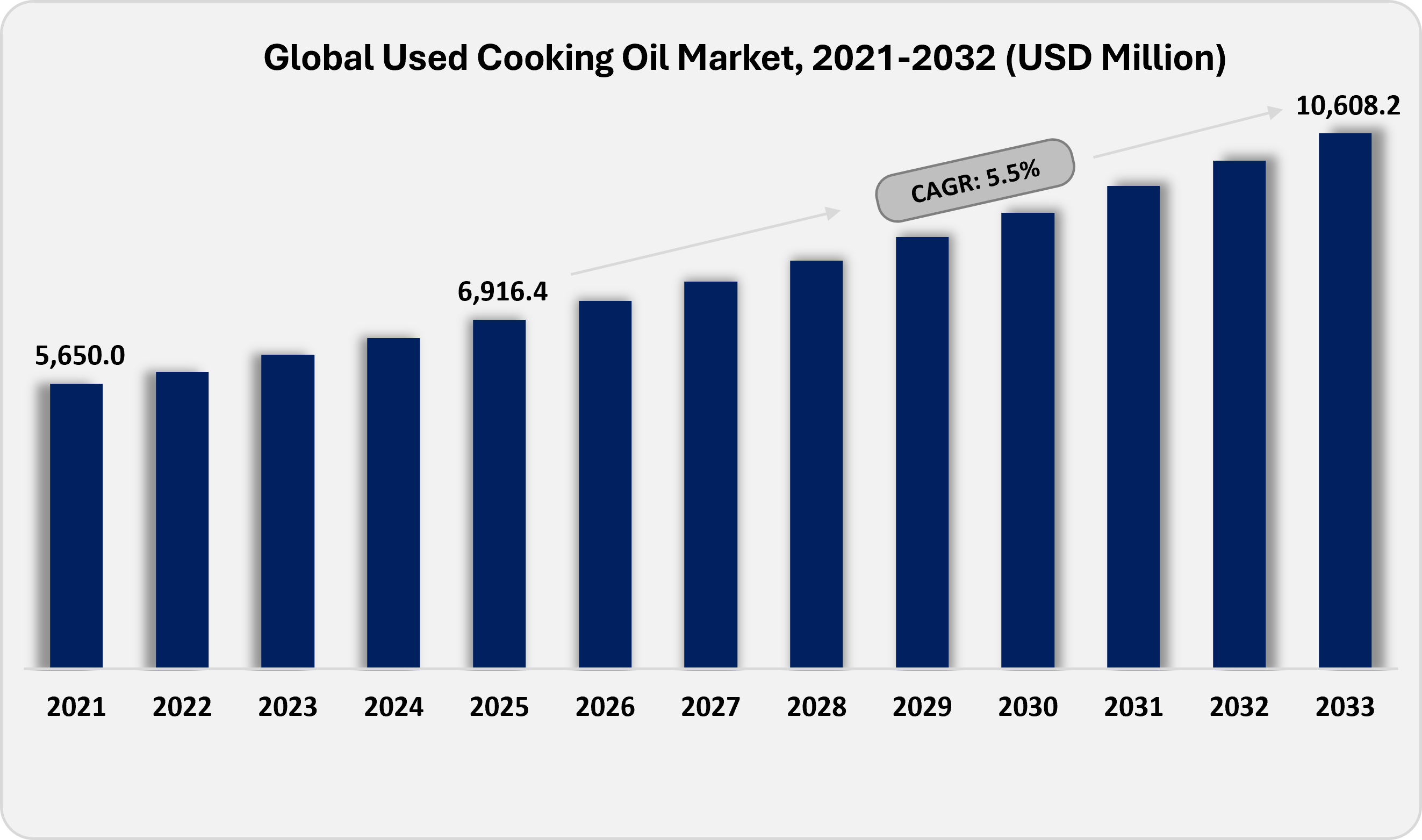
The global Used Cooking Oil market size was valued at USD 6,916.4 million in 2025. The market is projected to grow from USD 7,289.6 million in 2026 to USD 10,608.2 million by 2033, exhibiting a CAGR of 5.5% during the forecast period.
The used cooking oil (UCO) market is primarily driven by its conversion into biodiesel and renewable diesel, fueled by global decarbonization mandates. In the European Union, where the Renewable Energy Directive sets binding targets, UCO is a key advanced feedstock. According to the European Biodiesel Board, around 1.2 million tonnes of used cooking oil (UCO) were collected domestically in 2022, with additional imports mainly from Asia to meet demand. The United States market is also policy-driven, with the Renewable Fuel Standard creating Renewable Identification Numbers (RINs) that provide an economic incentive. The United States Environmental Protection Agency found that in 2023, biomass-based diesel, including fuels from UCO, totalled approximately 10.3 million metric tonnes and UCO is becoming an increasingly bigger part of the total feedstock mix with other fats and oils.
Supply chain logistics and collection infrastructure are critical constraints of the market. The National Renderers Association states that U.S. renderers collect over 0.68 million tonnes of UCO per year from commercial sources. However, a significant amount still goes uncollected through formal channels. In economies like China and Indonesia, government initiatives are expanding formal collection networks to curb illegal diversion into animal feed, a practice banned in the EU since 2002. UCO prices are closely linked to regular vegetable oils like soybean and palm, usually running a bit cheaper to keep biodiesel blending profitable. Big players like Neste, Darling Ingredients, and Valero are all-in, locking down long-term UCO contracts for sustainable production across the years. The emphasis on building traceable and transparent supply chains which meet strict sustainability certification requirements is driving market growth in Europe and North America markets.
Strong demand from the biofuel industry, driven by renewable fuel mandates.
The market is driven by government mandates for renewable fuel blends and steady demand. The availability of waste oils, a low-carbon feedstock is also a key catalyst in the growth landscape. Refineries are ensuring a steady supply of UCO to avoid missing of compliance targets. The collectors and processors are experiencing new growth opportunities owing to increased demand.
Corporate sustainability goals promoting waste-to-resource initiatives.
Companies are setting net-zero and circular economy targets to meet stakeholder expectations. Using recycled feedstocks reduces Scope 3 emissions and virgin material use, creates strategic partnerships and premium markets for waste oils, and turns a disposal cost into a sustainability asset.
Complex and costly logistics for collection and purification.
Gathering waste oil from countless small sources like restaurants and factories is fragmented and inefficient process. Moreover, transporting low-density and hazardous material is expensive. The purification process which removes contaminants, requires significant energy and specialized equipment, squeezing profit margins of the processor. Waste oil collection from multiple small places like restaurants or factories is a complex process. It's scattered, inefficient, low-density, and hazardous, making transport expensive. Purifying UCO to remove contaminants hampers the process further and reduces the profit margins.
Contamination and inconsistent quality are affecting processing efficiency.
The UCO is generally not pure, it's usually mixed with water, food bits, or leftover lubricants. This factor impacts equipment and demands extra pre-treatment. Inconsistent feedstock quality hampers yield combined with refining costs will restraint the market growth.
Expansion into higher value biochemicals like bio lubricants or plastics.
The specialty chemicals such as bio lubricants and bioplastics provide better opportunity owing to higher prices and better profit margins. It reduces the dependability on uncertain governments decisions on biofuels.
The global Used Cooking Oil market is mainly classified based on Source, Application, Distribution Channel, and Form.
Bigger sites are convent and biggest collection source for UCO. HoReCa sites enable efficient, quick, and scheduled pickups. The disposal rules enable businesses to co-ordinate and mange better collection across HoReCa industry. The segment is organized, with specialized renderers or biofuel companies fighting to lock down these arranged sources. Owing to disposal rules, efficient pickups, and managed collection, the segment is expected to garnet a considerable growth within the forecast period.
Individual volumes are smaller which results in increased per liter cost. Fundamental public awareness and easy drop-off points like special municipal bins are key pain points of this segment. Moreover, adulteration with water and other materials to increase the volume, is a key risk factor observed for this segment. Major collection happens through city waste programs and small recycling pilots. However, there's a huge untapped potential for this segment in the future as the key players will try to enhance and manage better operations for the collection process.
Food Processing Plants produce big, steady batches that are often cleaner and more consistent than HoReCa industry. The collection deals are direct, long-term, and the plants appreciate having waste handled professionally. Occasionally, food processing plants get paid for their UCO instead of having to pay to dispose of it. This is the top-tier segment for collectors and biorefineries owing to easy logistics, large volumes, and clean raw materials.
UCO is processed into feed-grade fats and calcium soaps for livestock. EU regulations restrict its use in feed due to contamination risks. It remains a significant market in regions with less stringent food-safety regulations such as Asia Pacific and South America. UCO competes directly with biodiesel for feedstock in these regions. Animal Feed is a lower-value outlet than fuel, offering less price support. Market demand in this segment is declining within premium and regulated markets.
UCO is a premier low-carbon feedstock for biodiesel production. It offers significant GHG savings under fuel mandates such as RFS and RED. The segmental demand is driven by policy and regulations, creating a stable, and high-volume offtake. The segments growth is directly tied to blending mandates and tax incentives.
UCO is split and processed into fatty acids, glycerin, and methyl esters. These serve as renewable building blocks for diverse industries such as oleochemicals. It offers a market diversification away from the volatile biofuels industry. Production requires consistent quality and specialized refining and commands higher margins than standard biodiesel when purified. This segment benefits from the broader shift toward increased demand for bio-based chemicals.
Saponified used cooking oil is a key ingredient in industrial soaps and cleaning agents. The segment prioritizes low-cost, stable supply over sustainability credentials. It acts as a secondary market for lower-quality or contaminated UCO streams. It provides a baseline demand that absorbs supply that does not meet fuel standards. Innovation is limited, howerver, it's a traditional, volume-driven use, combined with thin and competitive margins will provide a secondary demand within the market.
Processed UCO is used to produce biodegradable lubricants for marine and forestry applications. It requires advanced refining and additive treatment for stability. Products command a significant price premium over petrochemical lubes. Environmental regulations in sensitive ecosystems will fuel the segment growth. It represents a strategic diversification into specialty chemicals. The segmental volume is expected growing owing to stricter ecological laws implementation.
UCO can be directly burned in modified boilers for heat and power. This Application competes on cost with natural gas and other fuels. It is common for on-site waste disposal at large food processing plants. It lacks the policy-driven price support of transport fuel markets. It serves as a fallback option where collection for higher uses is not economical. It represents the lowest rung on the value ladder.
Highly refined UCO derivatives, such as glycerin and fatty acids, are used in products like soaps and creams. The segment demands the highest purity and strictest safety certifications globally. The volume is lower compared to fuel markets but offers strong margins and new growth opportunities. The segment aligns with the brand's stories of natural and sustainable sourcing. Supply chains are distinct, often segregated from bulk fuel feedstock to maintain better output quality.
The Others segment includes potential uses in bioplastics, asphalt additives, and animal bedding. These applications are in early-stage development and are on pilot scale. This segment represents future diversification pathways for the UCO value chain. Market viability depends on technological breakthroughs and cost competitiveness. This category highlights ongoing efforts to utilize full market potential across the globe. Current commercial impact is minimal but is expected to provide future opportunities for growth.
Collection requires significant public infrastructure, like municipal drop-off bins or curbside programs. Participation relies heavily on consumer awareness and convenience, making scaling difficult. High contamination risk from mixing with other household waste reduces the oil's value and processability. The segment represents a vast untapped supply pool. However, its unit economics are challenging owing to low volume per point and high collection costs. This channel is a long-term strategic bet on increasing total feedstock.
This segment is operated by local or regional operators which builds direct contracts with restaurants, caterers, and food processors. They provide containers, scheduled pickups, and basic filtration, acting as the first consolidation point. The segments growth hinges on dense route density and strong customer relationships. The aggregators sell collected oil to larger traders and pre-processors for better margin to enable local logistical service. This segment is highly competitive and fragmented, leading to ongoing consolidation. The segment is essential for accessing the fragmented HoReCa sector.
Major waste management firms are adding UCO collection to their portfolios of commercial waste services. These companies provide a one-stop shop solution for businesses and creates synergies in collection routes. They can offer competitive rates by bundling services and have the scale to invest in preprocessing facilities. They typically act as large-scale aggregators, supplying directly to bio-refineries or major traders. Their involvement signifies the commoditization and professionalization of UCO as a waste stream.
Crude UCO contains significant impurities like food solids, water, and other oils. The value of UCO is discounted for this segment owing to higher refining costs and processing risk for the buyer. Price is heavily dependent on Free Fatty Acid (FFA) content and moisture levels. Trading often occurs locally between collectors and initial aggregators and pre-processors. The crude UCO form is subject to the most significant quality inconsistencies and price volatility in the entire UCO market. It represents the base commodity before any value-added processing.
Filtered UCO undergoes physical removal of solids and water to meet basic contractual specifications. This preprocessing adds value and stabilizes quality for more extended storage and transport. It is the standard form for domestic and international trade between aggregators and large biorefineries. This segment commands a premium over crude UCO, reflecting the cost of filtration and quality assurance. The filtered UCO enables more efficient logistics and is typical feedstock for biodiesel (FAME) production. This Form establishes the benchmark price for the bulk UCO market globally.
The global used cooking oil (UCO) market features a fragmented and dynamic competitive landscape, dominated by two primary tiers of players. Large-scale, vertically integrated aggregators and renderers such as Darling Ingredients and Baker Commodities, Inc., which leverage vast, established logistics networks to collect UCO at scale, primarily from the commercial HoReCa (Hotels, Restaurants, and Catering) sector and food processing plants.
Their competitive advantage stems from operational efficiency, long-term client contracts, and integrated waste processing capabilities. Parallelly, specialized UCO and biofuel-focused collectors like Olleco, Mahoney Environmental, and MBP Solutions compete through dense regional collection routes, value-added services, and stringent quality control to serve as critical feedstock suppliers. These players are increasingly pressured by intense demand from biofuel producers, driven by renewable fuel mandates like the U.S. RFS and the EU's RED II, which prioritize certified, traceable waste feedstocks.
The supply chain is further shaped by international traders and intermediaries such as Targray, Quatra, and Bio-Oil, which specialize in aggregating, certifying, such as ISCC EU, and transporting UCO across borders to meet demand in key bio-refining regions. Their role is crucial in ensuring sustainability compliance and managing complex logistics for UCO market. The market foundation consists of numerous regional and independent collectors, such as Eazy Grease, LLC, Lifecycle Oils, Tagaddod, and Aris BioEnergy, which possess deep local networks but often face margin pressure and consolidation. Strategic initiatives across the landscape focus on securing long-term supply agreements, investing in traceability systems to prevent fraud, and expanding into emerging high-supply regions. This environment is driving steady consolidation, as larger players acquire regional operators to secure feedstock. All key market players are expected to adapt rigorous sustainability and documentation standards set by major end-users in the renewable diesel and sustainable aviation fuel industries.
Market size is forecast to rise from USD 6,916.4 million in 2025 to over USD 10.60 billion by 2033.
Global UCO collection is forecast to grow significantly, propelled by ambitious renewable fuel mandates. The EU's Renewable Energy Directive III (RED III) maintains a high target for advanced biofuels, with UCO as a key feedstock. The U.S. Renewable Fuel Standard (RFS) and new incentives, such as the Sustainable Aviation Fuel (SAF) Tax Credits under the Inflation Reduction Act (IRA), create powerful, long-term demand pull from the renewable diesel and SAF sectors. This regulatory certainty, as outlined in government policy roadmaps, will continue to make UCO a critically scarce and sought-after commodity, supporting sustained price premiums over virgin oils.
This research report categorizes the Used Cooking Oil market based on key segments and regions, forecasts revenue growth, and analyses trends in each submarket. The report analyses the key growth drivers, opportunities, and challenges influencing the Used Cooking Oil market. Recent market developments and competitive strategies such as expansion, type launch, development, partnership, merger, and acquisition have been included to draw the competitive landscape in the market.
The report strategically identifies and profiles the key market players and analyses their core competencies in each sub-segment of the Used Cooking Oil market.
|
Report Attributes |
Details |
|
Study Period |
2021-2033 |
|
Base Year |
2025 |
|
Estimated Year |
2026 |
|
Forecast Period |
2026-2033 |
|
Historical Period |
2021-2025 |
|
Growth Rate |
CAGR 5.5% from 2026 to 2033 |
|
Revenue Unit |
USD million |
|
Sales Volume Unit |
Kilotons |
|
Segmentation |
By Source, Application, Distribution Channel, Form, and Region |
|
By Source |
HoReCa (Hotels, Restaurants, Catering) |
|
Household Kitchens |
|
|
Food Processing Plants |
|
|
By Application |
Animal Feed |
|
Bio Diesel |
|
|
Oleochemicals |
|
|
Soap and Detergent Manufacturing |
|
|
Lubricants & Industrial Oils |
|
|
Energy Generation |
|
|
Cosmetics & Personal Care Products |
|
|
Other |
|
|
By Distribution Channel |
Direct Collection from Households |
|
Aggregators / Middlemen |
|
|
Waste Management Companies |
|
|
Restaurants / Commercial Contracts |
|
|
By Form |
Crude UCO |
|
Filtered UCO |
|
|
By Region |
North America (By Source, Application, Distribution Channel, Form, and Country) |
|
|
|
|
|
|
|
Europe (By Source, Application, Distribution Channel, Form, and Country) |
|
|
|
|
|
|
|
|
|
|
|
|
|
|
Asia Pacific (By Source, Application, Distribution Channel, Form, and Country) |
|
|
|
|
|
|
|
|
|
|
|
|
|
|
|
|
South America (By Source, Application, Distribution Channel, Form, and Country) |
|
|
|
|
|
|
|
|
Middle East and Africa (By Source, Application, Distribution Channel, Form, and Country) |
|
|
|
|
|
|
|
|
Find answers to common questions about this report
The Metastat Insights study shows that the global Used Cooking Oil market size was USD 6,916.4 million in 2025
The global Used Cooking Oil market is likely to grow at a CAGR of 5.5% over the forecast period (2026-2033).
The Metastat Insights analysis shows that the North America Used Cooking Oil market size is estimated to be USD 3119.9 million by 2033.
The HoReCa (Hotels, Restaurants, Catering) is the leading type segment in the global market.
Strong demand from the biofuel industry, driven by renewable fuel regulations and corporate sustainability goals supporting waste-to-resource efforts
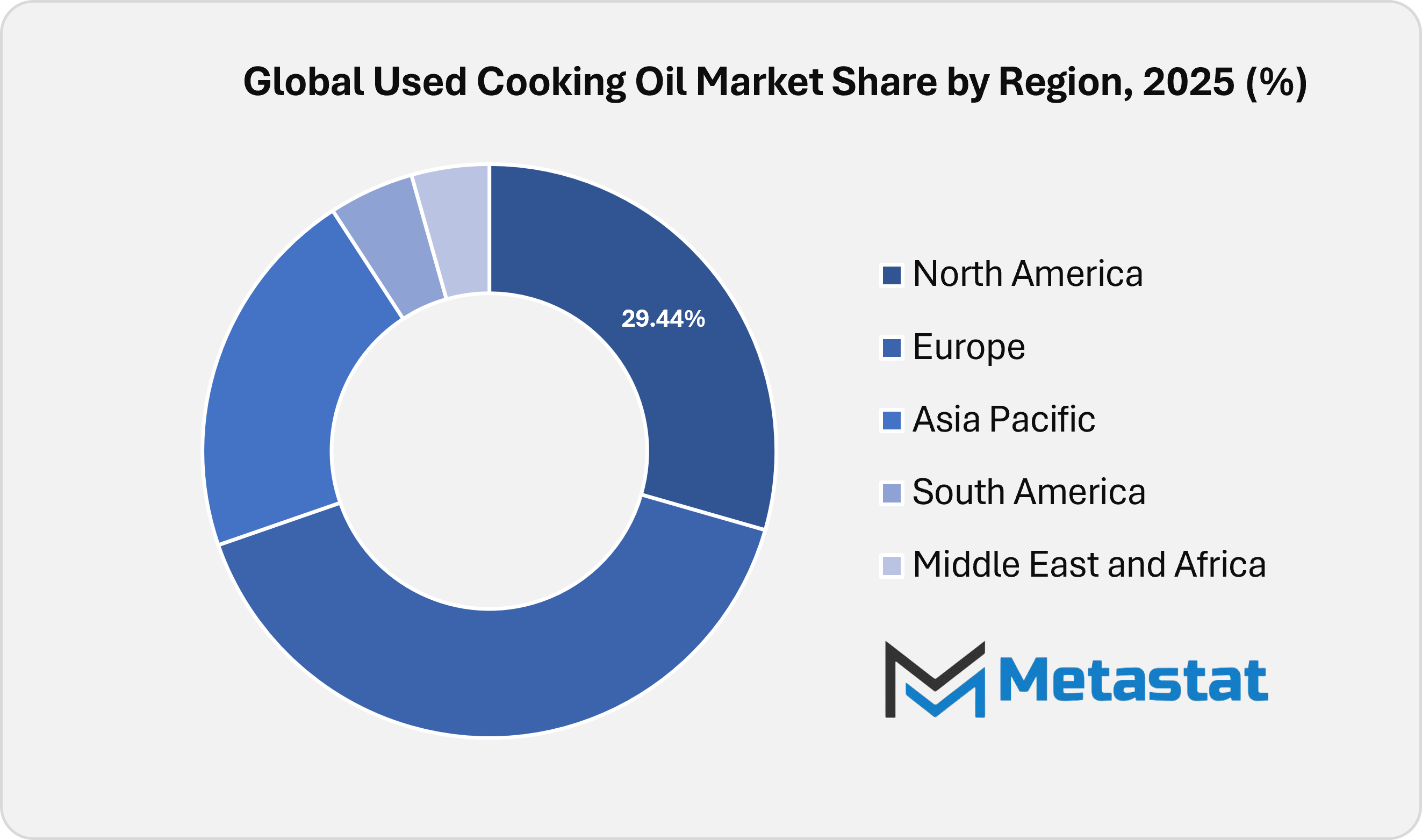
The Europe region dominates the market.
Complicated and expensive logistics for collecting and purifying will slow the market's growth during the forecast period.
Environmental regulations mandating biofuel blending, rising demand for sustainable feedstocks, and favorable economic incentives for waste-to-value c
Global Used Cooking Oil market is estimated to reach USD 10,608.2 million by 2033.
Top players operating in the Used Cooking Oil industry includes Targray, Quatra, Olleco, Bio-Oil, MBP Solutions, Darling Ingredients, and Baker Commodities.
Choose Your License
Used Cooking Oil Market
The analysts below cover Food and Beverages research at Metastat Insights.
LEAD ANALYST
Utkarsh Khirodkar is a Lead Market Research Analyst at MetaStat Insight, specializing in market intelligence, technology sector assessments, and competitive strategy.

LEAD PRINCIPAL ANALYST, PHARMA AND HEALTHCARE
Food and Beverages · Healthcare · Healthcare IT · Medical Devices
Ajay Devgire is the Lead Healthcare Analyst at MetaStat Insight, leading strategic research and market intelligence initiatives across the global healthcare domain.

SENIOR RESEARCH ANALYST
Biotechnology · Food and Beverages · Medical Devices · Packaging
Snehal Pasalkar is a Research Analyst at MetaStat Insight, operating at the intersection of life sciences research, competitive strategy, and market intelligence.
Tracking ceramic matrix composite adoption in high-bypass aero engines requires strict attention to material qualification cycles and FAA airworthiness testing milestones. The MetaStat Insight team provided a detailed timeline of silicon carbide fiber manufacturing capacity and commercial foundry lead times. Having clear visibility into upstream thermal barrier coating supply helped us stress-test our long-term component procurement strategy.
Transitioning ultra-class mining haul trucks to alternative power requires concrete data on remote hydrogen refueling infrastructure economics. The report evaluated megawatt-scale electrolyzer installation expenses, onsite storage safety mandates, and heavy-duty fuel cell stack degradation under continuous duty cycles. That technical rigor helped our engineers benchmark realistic total operating cost horizons for off-highway fleet decarbonization.
Enterprise zero-trust network rollouts are often slowed down by multi-cloud transit latency and proprietary hardware retirement schedules. This study provided realistic total cost of ownership models comparing cloud-delivered security edge solutions against traditional hardware refreshes. The analysis of contract renewal lengths and software maintenance fees gave us clear visibility into enterprise replacement cycles over the next three to five years.
Explore related market intelligence reports worth reading alongside this one.