
LEAD ANALYST
Utkarsh Khirodkar is a Lead Market Research Analyst at MetaStat Insight, specializing in market intelligence, technology sector assessments, and competitive strategy.

Tequila Market Size, Share, By Type (Blanco, Reposado, Anejo, and Others), By Grade (Value, Premium, High End Premium, and Super Premium), By Distribution Channel (On-trade and Off Trade), By End User (Men and Women), Industry Analysis, Growth, Trends, and Forecasts, 2026-2033
Report ID
MSI-4539
Published
February, 2026
Pages
310 Pages
Format
Report Details
Choose Your License
Tequila Market
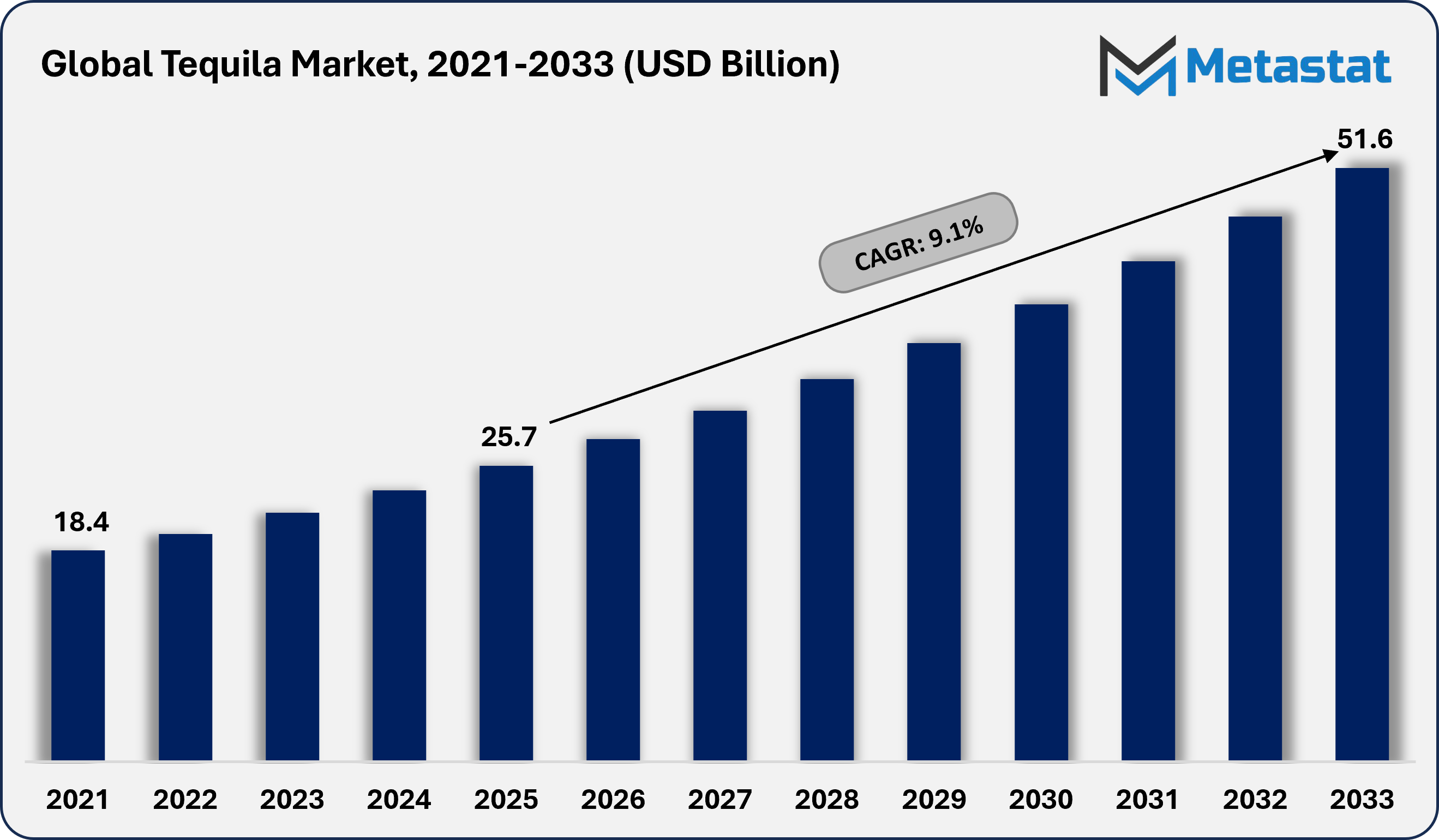
The global tequila market size was valued at USD 25.7 billion in 2025.
The tequila market is projected to grow from USD 28 billion in 2026 to USD 51.6 billion by 2033, exhibiting a CAGR of 9.1% during the forecast period.
The global Tequila market is experiencing a transformative phase driven by surging production, shifting consumer preferences toward premiumization, and robust export flows. According to the Consejo Regulador del Tequila (CRT), tequila production reached 495.8 million liters in 2024, and exports totaled 400.3 million liters, underscoring the category’s export orientation. The United States remained the largest destination, with imports rising 4.1% in 2024 to 334.9 million liters.
The trend reflects ongoing efforts to expand beyond traditional strongholds. A January 2025 cooperation initiative between Jalisco and partners in Spain targeted higher tequila visibility in European markets. Moreover, the sector has been placing greater emphasis on sustainability, supply chain transparency, and social accountability. Under CRT-led initiatives, the Agave Responsable Social (ARS) certification supports traditional agave growers and strengthens direct links between agave and tequila producers, improving supply-chain resilience.
Growing global demand for premium and craft spirits
Consumers are progressively looking for premium drinks over mass-manufactured spirits. High-quality tequila, particularly 100% agave expressions, attracts consumers willing to pay for craftsmanship and provenance. The shift is prompting producers to broaden portfolios across premium tiers, supporting value growth.
Rising popularity of tequila-based cocktails and mixology
The adaptability of tequila in cocktails has increased its global consumption. Mixologists and bars are innovating with tequila-based cocktails, introducing flavors and experiences that resonate with younger, urban consumers. This has expanded tequila's visibility in on-trade venues such as bars, restaurants, and hotels.
High production costs and limited agave supply
The production of tequila relies on the blue agave plant, which requires 6–8 years to reach maturity. Variations in agave yields, along with labor-intensive cultivation and harvesting, elevate production costs and constrain pricing flexibility and capacity expansion.
Stringent regulations and geographical indication restrictions
Tequila must adhere to stringent legal standards according to Mexico’s Appellation of Origin regulations. Only designated regions and authorized producers are permitted to use the tequila designation, raising compliance costs and limiting new entrants.
Expansion into emerging markets
Emerging markets across Asia-Pacific and selected European and Latin American countries are showing rising interest in tequila as consumers explore new spirits categories. Effective marketing and distribution strategies could unlock incremental demand beyond the U.S. and Mexico.
Increasing consumer awareness of authentic tequila
Education on 100% agave tequila, aging methods, and heritage branding is strengthening preference for authentic products. This enables producers to set premium prices and build brand loyalty while distinguishing themselves from imitation or mixto tequilas.
The global tequila market is segmented based on type, grade, distribution channel, and end user.
Blanco tequila is unaged or aged for less than two months, offering a pure agave flavor profile. Blanco is known for its fresh, herbal, and citrus notes, making it ideal for cocktails. The segment appeals to consumers seeking authentic, clean-tasting tequila. It is widely used in mixology due to its versatility and bold agave character.
Reposado tequila is aged for 2–12 months in oak barrels, giving it a smoother, slightly woody profile. The aging adds complexity, blending agave with hints of vanilla or caramel. Consumers who prefer balanced, mellow flavors often choose reposado.
Anejo tequila is aged for 1–3 years, resulting in richer, deeper flavors. Oak maturation brings out notes of chocolate, nuts, and spices, creating a luxurious profile. It targets premium drinkers who enjoy sipping spirits neat. Añejo is positioned closer to fine whiskies in depth and sophistication.
The other segment includes Extra Anejo, flavored tequila, and infused or specialty variants. Extra Anejo, aged over 3 years, attracts connoisseurs seeking ultra-premium quality. Flavored options appeal to younger and experimental consumers. These variants support portfolio diversification and niche preferences.
Value-grade tequila consists of entry-level products. Packaged for high-volume sales, these products are primarily used for casual occasions and basic cocktails. Value-grade tequila experiences strong sales throughout the mass market retail channel. In price-sensitive markets, value tequila remains the most accessible tier and delivers high retail velocity.
Premium tequila is of better quality, leaning more toward the 100% agave and agave-pure products. This premium tequila market segment is growing as consumers from lower tier segments begin to upgrade. These products are commonly found in upper tier bars and restaurants.
The high-end premium segment includes well-crafted, branded, and aged tequilas produced through enhanced production methods. The segment appeals to consumers seeking refined taste, authenticity, and status. This is commonly found in boutique urban markets and specialty high-end shops. High-end premium brands stand out owing to their heritage and craftsmanship.
The super premium segment consists of aged and artisanal tequilas positioned for collectors and connoisseurs. Super premium tequila is often marketed as a luxury spirit, as are fine whiskies and cognacs. Super premium tequilas stand out through refined sensory profiles, authenticity cues, and limited-edition releases, often positioned alongside luxury whisky and cognac.
On-trade channels encompass bars, restaurants, hotels, nightclubs, and lounges, where tequila sales are enhanced through cocktails, tastings, and premium experiences. On-trade channels are also crucial for shaping perceptions and trial of brands.
Off-trade includes supermarkets, liquor stores, duty-free retailers, and online channels. It enables and encourages at-home consumption and bulk buying. Sales in off-trade are enhanced due to promotions, innovations in packaging, and the growth of e-commerce. Customers in this segment also tend to purchase craft and premium goods more frequently.
The male consumer segment has historically been the largest for tequila consumer, particularly across premium and aged expressions.
Women’s segment is a rapidly growing segment of the tequila market, largely owing to the popularity of cocktails as well as flavoured tequila and the premium drink experiences.
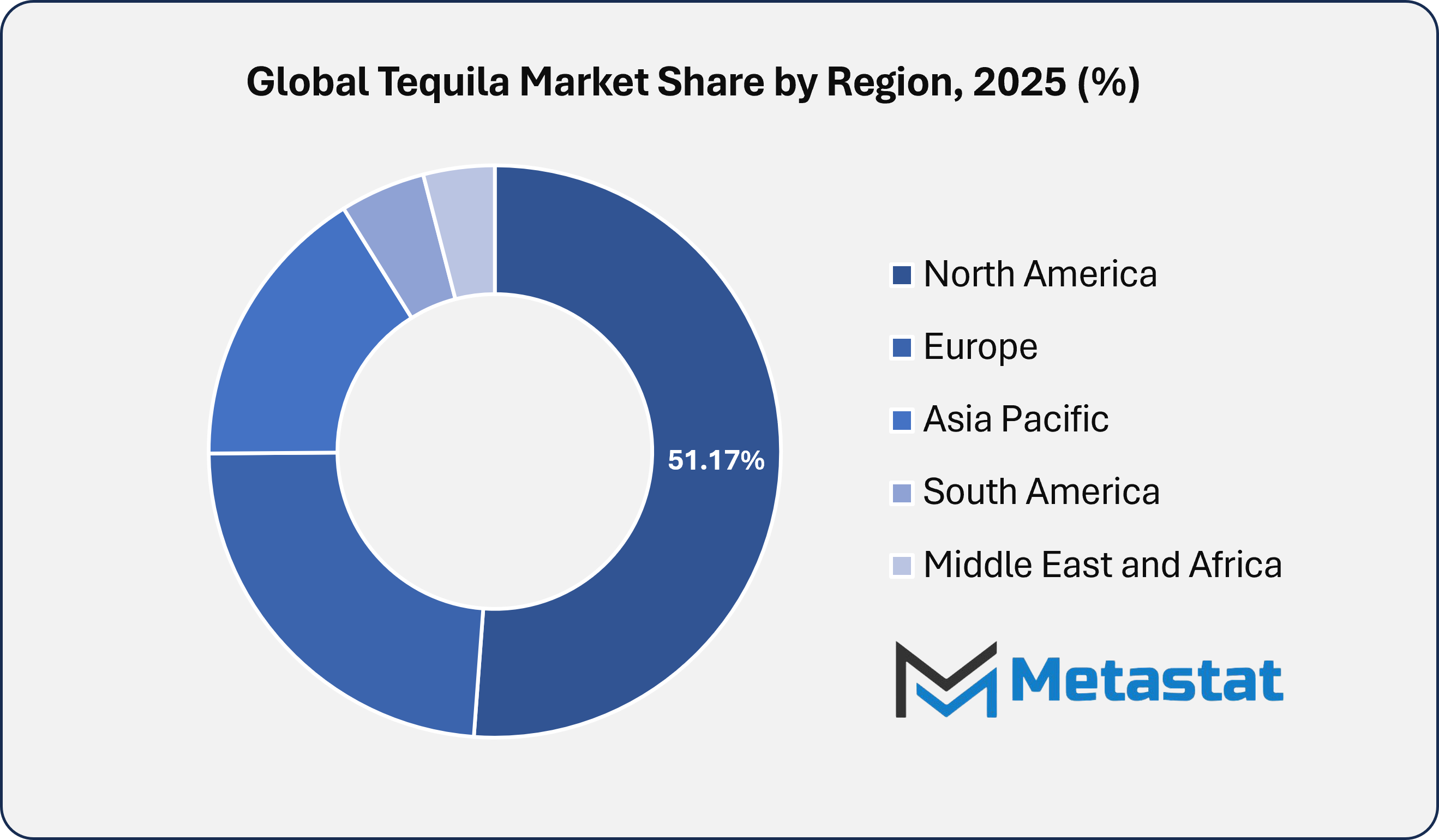
In North America as consumers are trending towards crafted spirits, premium cocktails, and sipping tequilas, is driving the demand for high-end tequila. The strong cocktail culture present, the willingness to pay for premium tequila, and the overall strong economy in the North America region, driving the growth of Tequila market in North America. Tequila cocktails, especially Margaritas and Palomas, are extremely advertised in bars, restaurants, and entertainment venues. The flourishing mixology trend encourages consumers to explore diverse tequila expressions, boosting both volume and value growth in the region.
The tequila market is characterized by a competitive landscape dominated by global beverage conglomerates alongside heritage Mexican distillers and fast-growing premium craft brands. Diageo (Don Julio, Casamigos) and Constellation Brands (Casa Noble, Mi Campo) remain influential leaders owing to strong distribution networks, premium-focused portfolios, and continued investment in brand-led innovation. Pernod Ricard, Bacardi, Brown-Forman, Campari Group, and Sazerac Company also maintain prominent positions through portfolio premiumization, brand revivals, and expansion into the super-premium and luxury segments.
Established brands like José Cuervo, Sauza, Cazadores, El Jimador, Hornitos, and Corralejo highlight stability in the category, utilizing enduring agave cultivation partnerships and traditional production techniques to uphold loyalty in both local and global markets. Meanwhile, boutique and craft-focused brands like G4 Tequila, Fortaleza, Maestro Dobel, Clase Azul, Código 1530, Lunazul, Milagro, Teremana, Espolòn, Tres Generaciones, Cabo Wabo, 1800 Tequila, and Casa Aceves continue to energize the market through small-batch production, terroir-led expressions, and differentiated brand narratives. Increased investment in sustainable agave farming, expansion of premium and extra añejo segments, and deeper on-trade engagement via mixology and hospitality partnerships are supporting market expansion. Businesses are progressively embracing digital branding, exclusive product launches, and experiential marketing to enhance consumer interaction.
Market size is forecast to rise from USD 25.7 billion in 2025 to over USD 51.6 billion by 2033.
Future growth in the tequila market will be driven by premiumization, sustainability-led production, and rising global appreciation for authentic agave-based spirits. Increasing demand for additive-free and craft expressions, supported by transparent labeling and traditional production methods, will continue to strengthen consumer trust. Innovation in flavors, ready-to-drink formats, and celebrity-backed brands will broaden the category’s appeal to younger demographics. Expanding distribution in Asia-Pacific and Europe, along with a strengthening global mixology culture, will support broader tequila adoption and sustain category growth.
This research report categorizes the Tequila market based on key segments and regions, forecasts revenue growth, and analyses trends in each submarket. The report analyses the key growth drivers, opportunities, and challenges influencing the Tequila market. Recent market developments and competitive strategies such as expansion, product launch, development, partnership, merger, and acquisition have been included to outline the competitive landscape.
The report strategically identifies and profiles the key market players and analyses their core competencies in each sub-segment of the Tequila market.
|
Report Attributes |
Details |
|
Study Period |
2021-2033 |
|
Base Year |
2025 |
|
Estimated Year |
2026 |
|
Forecast Period |
2026-2033 |
|
Historical Period |
2021-2025 |
|
Growth Rate |
CAGR 9.1% from 2026 to 2033 |
|
Revenue Unit |
USD billion |
|
Sales Volume Unit |
Million Liters |
|
Segmentation |
By Type, Grade, Distribution Channel, End User, and Region |
|
By Type |
|
|
By Grade |
|
|
By Distribution Channel |
|
|
By End User |
|
|
By Region |
North America (By Type, Grade, Distribution Channel, End User, and Country) |
|
|
|
|
|
Europe (By Type, Grade, Distribution Channel, End User, and Country) |
|
|
|
|
|
Asia Pacific (By Type, Grade, Distribution Channel, End User, and Country) |
|
|
|
|
|
South America (By Type, Grade, Distribution Channel, End User, and Country) |
|
|
|
|
|
Middle East and Africa (By Type, Grade, Distribution Channel, End User, and Country) |
|
|
|
Find answers to common questions about this report
The Metastat Insights study shows that the global Tequila market size was USD 25.7 billion in 2025.
The global Tequila market is likely to grow at a CAGR of 9.1% over the forecast period (2026-2033).
The Metastat Insights analysis shows that the North America Tequila market size is estimated to be USD 26.3 billion by 2033.
The Blanco is the leading type segment in the global market.
Growing global demand for premium and craft spirits and Rising popularity of tequila-based cocktails and mixology are key driving factors, boosting the market.
North America region dominates the market.
High production costs and limited agave supply will hamper the market growth within the forecast period.
Tequila adoption is expected to strengthen due to rising premiumization, expanding cocktail culture, and growing consumer preference for authentic, 100% agave spirits.
Global Tequila market is estimated to reach USD 51.6 billion by 2033.
Top players operating in the Tequila industry includes Diageo PLC, Constellation Brands, Inc., Suntory Holdings Limited, Pernod Ricard SA, Bacardi LTD., Jose Cuervo, G4 Tequila, Sauza Tequila, Heaven Hill Distilleries, Inc. , Campari Group, Sazerac Company Inc. , Brown-Forman Corporation, Casa Aceves, Cabo Wabo, 1800 Tequila, El Jimador, Hornitos, Espolon, Don Julio, Clase Azul, Codigo 1530, Lunazul, Milagro Tequila, Teremana Tequila, Tres Generaciones, Olmeca Altos, Corralejo, Tequila Fortaleza, Maestro Dobel, and Cazadores.
The analysts below cover Food and Beverages research at Metastat Insights.
LEAD ANALYST
Utkarsh Khirodkar is a Lead Market Research Analyst at MetaStat Insight, specializing in market intelligence, technology sector assessments, and competitive strategy.

LEAD PRINCIPAL ANALYST, PHARMA AND HEALTHCARE
Food and Beverages · Healthcare · Healthcare IT · Medical Devices
Ajay Devgire is the Lead Healthcare Analyst at MetaStat Insight, leading strategic research and market intelligence initiatives across the global healthcare domain.

SENIOR RESEARCH ANALYST
Biotechnology · Food and Beverages · Medical Devices · Packaging
Snehal Pasalkar is a Research Analyst at MetaStat Insight, operating at the intersection of life sciences research, competitive strategy, and market intelligence.
Tracking capacity expansion in single-use bioprocessing requires dependable data on raw material availability and cleanroom-grade polymer supply chains. The competitive landscape chapter gave a grounded evaluation of secondary component suppliers across North America and Asia-Pacific rather than simply reprinting press releases. Having that level of supplier benchmarking helped clarify dual-sourcing considerations for our clinical pipeline planning.
When evaluating distributed energy resource management systems, standard research summaries tend to gloss over the operational differences between front-of-the-meter utility deployments and behind-the-meter industrial sites. The MetaStat Insight report addressed those distinctions directly, especially regarding software interoperability standards and grid interconnection backlogs. The five-year market sizing across regional transmission organizations provided actionable context for our grid modernization strategy.
Most industry reports on warehouse automation bundle autonomous mobile robots and fixed conveyor installations into the same top-level numbers, which complicates advisory work. This study split the market cleanly by payload tiers, navigation technology, and fleet management software layers. The regional forecast for Western Europe gave our team defensible adoption benchmarks when evaluating capital allocation for logistics clients, saving us days of secondary data scrubbing.
Explore related market intelligence reports worth reading alongside this one.