Saudi Arabia Infrastructure Market Size, Share, By Service Type (Construction, Maintenance, Design, Consulting, and Others), By Technology (Smart Grids, Renewable Energy, IoT Solutions, Automation, and Others), By Application (Transportation, Water Supply, Waste Management, Urban Development, and Others), By End User (Government, Private Sector, Utilities, and Contractors), Industry Analysis, Growth, Trends, and Forecast, 2026-2033
Report ID
MSI-4700
Published
April 30, 2026
Pages
310 Pages
Format
Report Details
Comprehensive Market Analysis And Insights
Market Overview
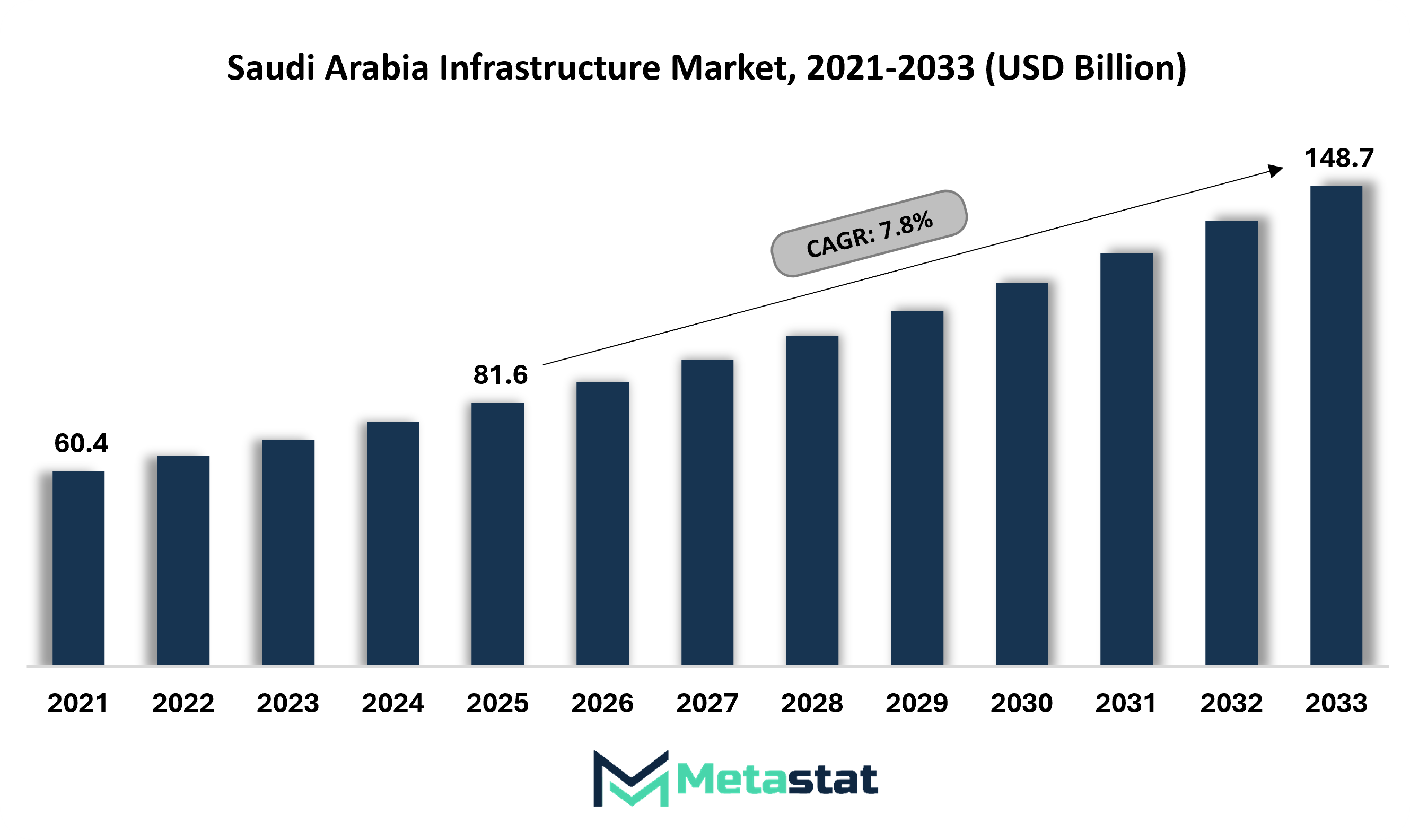
Saudi Arabia Infrastructure market size is valued at USD 81.6 billion in 2025 and projected to grow at a CAGR of 7.8% during the forecast period, reaching USD 148.7 billion by 2033.
Saudi Arabia Infrastructure Market: Comprehensive Data-Driven Market Analysis and Strategic Outlook
Construction segment accounts for a market share of 77.5% in 2025.
Key trends driving growth: Government-backed Vision spending continues to accelerate roads, railways, smart cities, and utility upgrades, rising private participation through PPP models is expanding funding sources and speeding project execution.
Opportunities include demand for green construction materials, modular building, and carbon-efficient infrastructure is rising and Airport, rail, and logistics hub expansion creates opportunities for engineering, automation, and digital systems providers
Key insight: Saudi Arabia’s infrastructure market is being reshaped by Vision, with giga-projects, transport corridors, housing, and tourism assets driving one of the largest construction pipelines globally.
The Saudi Arabia Infrastructure Market is one of the most dynamic segments of the regional economy, focused on physical and digital infrastructure development across transport, utilities, housing, tourism, logistics, and industrial ecosystems. Large-scale public investment programs are accelerating the development of roads, railways, airports, ports, power networks, desalination plants, and urban districts.
Government entities, sovereign funds, developers, EPC contractors, and technology providers are investing in sustainable design, automation systems, prefabrication methods, and intelligent asset management. Rising urbanization, economic diversification goals, and population-linked service requirements are projected to support long-term expansion of the Saudi Arabia Infrastructure Market.
Market Dynamics
Growth Drivers:
Government-backed Vision 2030 spending continues to accelerate roads, railways, smart cities, and utility upgrades.
Large public allocations will sustain transport corridors, metro links, logistics parks, digital zones, water grids, and energy networks. Strong policy direction will enhance contractor confidence, increase tendering activity, and expand long-term project planning. Urban expansion will create fresh requirements for engineering services, equipment supply, and maintenance contracts.
Rising private participation through PPP models is expanding funding sources and speeding project execution.
Public-private partnership activity will attract institutional capital, international developers, and specialized operators. Broader financing channels will reduce pressure on state budgets and support faster project mobilization. Structured risk-sharing models will improve bankability, encourage innovation, and raise delivery standards across transport, healthcare, education, and utility assets.
Market Restraints
High dependence on imported materials can expose projects to supply chain disruption and price volatility.
Steel, equipment, electrical systems, and finishing materials sourced from overseas markets will face freight delays, currency pressure, or commodity price fluctuations. Cost uncertainty will challenge budgeting accuracy and margin control. Procurement teams will require stronger inventory planning, diversified sourcing, and longer contract visibility.
Labor shortages and execution complexity across multiple mega-projects will create delivery delays.
Simultaneous construction programs will increase requirements for engineers, supervisors, skilled technicians, and site managers. Workforce gaps will slow installation schedules and quality checks. Complex coordination among contractors, consultants, and regulators will require advanced planning systems, stronger training pipelines, and disciplined milestone tracking.
Opportunities
Demand for green construction materials, modular building, and carbon-efficient infrastructure is rising.
Sustainable cement, recycled steel, prefabricated units, smart energy systems, and low-emission transport networks will gain wider adoption. Developers are seeking faster project delivery with lower waste output. Manufacturers offering certified eco-products, digital tracking tools, and energy-saving designs will secure strong business potential.
Market Segmentation Analysis
The Saudi Arabia Infrastructure market is classified based on Service Type, Technology, Application, and End User.
By Service Type, the market is further segmented into:
Construction segment is valued at USD 68.2 billion in 2026 and is projected to reach USD 107.0 billion by 2033, at a CAGR of 6.7% during the forecast period.
Construction activity will expand through metro corridors, industrial zones, logistics parks, housing clusters, airport upgrades, port capacity expansion, and tourism projects. Faster project delivery, modular building techniques, stronger material sourcing networks, and digital planning systems will support cost control, productivity gains, and timely asset development.
Maintenance
Maintenance segment is valued at USD 10.9 billion in 2026 and is projected to reach USD 25.2 billion by 2033, at a CAGR of 12.7% during the forecast period.
Maintenance requirements will rise with expanding road networks, bridges, tunnels, utilities, airports, and public facilities. Predictive servicing, sensor-based inspections, lifecycle budgeting, rapid repair programs, and energy-efficient retrofits will improve durability, reduce downtime, and maintain long-term operational value across national assets.
Design
Design segment is valued at USD 4.4 billion in 2026 and is projected to reach USD 8.0 billion by 2033, at a CAGR of 8.8% during the forecast period.
Design services will gain momentum through smart city planning, climate-ready structures, efficient transport layouts, water reuse systems, and sustainable public spaces. Advanced modeling software, digital twins, energy simulations, and local code alignment will guide resilient project outcomes with higher performance standards.
Consulting
Consulting segment is valued at USD 2.7 billion in 2026 and is projected to reach USD 5.9 billion by 2033, at a CAGR of 11.8% during the forecast period.
Consulting activity will strengthen through policy support, project feasibility studies, investment models, procurement planning, regulatory guidance, and risk management. Specialist advisory firms will help investors and authorities improve schedule discipline, budget visibility, contract performance, and governance quality for major developments.
Others
Others segment is valued at USD 1.7 billion in 2026 and is projected to reach USD 2.6 billion by 2033, at a CAGR of 6% during the forecast period.
Other services include testing, surveying, safety integration, landscaping, material certification, waste handling, and facility commissioning. Larger project pipelines, stricter compliance needs, and rising quality benchmarks will create wider service opportunities across urban and industrial developments.
By Technology, the market is divided into:
Smart Grids
Smart Grids segment is projected to reach USD 13.7 billion by 2033, at a CAGR of 5.5% during the forecast period.
Smart grid adoption will accelerate through digital meters, load balancing equipment, outage detection systems, and grid analytics. Stronger electricity requirements from cities, factories, and transport electrification will support reliable distribution networks, lower transmission losses, and efficient nationwide power management.
Renewable Energy segment is projected to reach USD 41.4 billion by 2033, at a CAGR of 11% during the forecast period.
Renewable energy deployment will increase through solar parks, wind farms, storage systems, green hydrogen facilities, and hybrid generation assets. National diversification goals, lower generation costs, and sustainability targets will support cleaner infrastructure expansion with stronger long-term energy security.
IoT Solutions
IoT Solutions segment is projected to reach USD 23.6 billion by 2033, at a CAGR of 11.6% during the forecast period.
IoT solutions will expand through connected streetlights, traffic sensors, water monitoring devices, asset tracking equipment, and smart building controls. Real-time data flow will improve planning accuracy, service response speed, resource efficiency, and preventive maintenance across dense urban zones.
Automation
Automation segment is projected to reach USD 20.6 billion by 2033, at a CAGR of 12.3% during the forecast period.
Automation utilization will rise through robotic inspection systems, autonomous equipment, digital control rooms, warehouse automation, and intelligent transport management. Faster operations, lower manual error rates, safer worksites, and higher throughput will strengthen competitiveness across infrastructure delivery chains.
Others
Others segment is projected to reach USD 49.3 billion by 2033, at a CAGR of 3.6% during the forecast period.
Other technologies include drones, blockchain records, geospatial mapping, advanced materials, cybersecurity systems, and cloud platforms. Broader digital transformation programs will create fresh requirements for integrated solutions supporting transparency, resilience, and scalable infrastructure management.
By Application, the market is further divided into:
Transportation
Transportation segment is projected to reach USD 43.1 billion by 2033.
Transportation investment will focus on highways, rail links, airports, seaports, logistics hubs, and urban transit corridors. Tourism growth, trade expansion, and population movement will support faster connectivity, lower freight costs, and wider regional economic integration.
Water Supply
Water Supply segment is projected to reach USD 25.3 billion by 2033.
Water supply projects will advance through desalination plants, storage reservoirs, smart pipelines, leak detection networks, and wastewater reuse systems. Rising urban requirements and resource conservation priorities will support reliable supply networks with stronger efficiency across municipalities.
Waste Management
Waste Management segment is projected to reach USD 10.4 billion by 2033.
Waste management requirements will increase through recycling centers, waste-to-energy plants, collection fleets, landfill modernization, and sorting facilities. Cleaner cities, environmental targets, and circular economy planning will drive better resource recovery and improved sanitation outcomes.
Urban Development
Urban Development segment is projected to reach USD 56.5 billion by 2033.
Urban development activity will expand through mixed-use districts, public facilities, housing communities, digital neighborhoods, healthcare zones, and leisure destinations. Large masterplans will reshape city landscapes with better livability, stronger investment appeal, and broader employment generation.
Others
Others segment is projected to reach USD 13.4 billion by 2033.
Other applications include industrial parks, defense facilities, education campuses, sports venues, and cultural destinations. Diversified national spending programs will open new construction pipelines while improving service coverage across multiple economic sectors.
By End User, the Saudi Arabia Infrastructure market is divided as:
Government
Government segment is projected to grow at a CAGR of 5.2% during the forecast period.
Government spending will remain dominant through transport upgrades, utility expansion, social housing, healthcare centers, and strategic economic zones. Public budgets, national transformation agendas, and sovereign investment channels will continue supporting large-scale project execution across priority sectors.
Private Sector
Private Sector segment is projected to grow at a CAGR of 10.2% during the forecast period.
Private sector participation will grow through public-private partnerships, commercial real estate, industrial assets, logistics facilities, data centers, and tourism facilities. Capital inflows, faster approvals, and revenue-linked models will attract broader investor interest over the coming years.
Utilities
Utilities segment is projected to grow at a CAGR of 11% during the forecast period.
Utilities spending will rise through power generation, transmission lines, substations, gas networks, water treatment plants, and district cooling systems. Capacity additions, efficiency improvements, and digital monitoring platforms will support reliable service delivery for expanding cities and industries.
Contractors
Contractor's segment is projected to grow at a CAGR of 8.4% during the forecast period.
Contractors will gain opportunities through mega-projects, maintenance contracts, specialized engineering works, and turnkey delivery models. Requirements for skilled labor, modern equipment, local sourcing, and schedule discipline will reward firms with strong execution capabilities and safety records.
Competitive Landscape and Strategic Insights
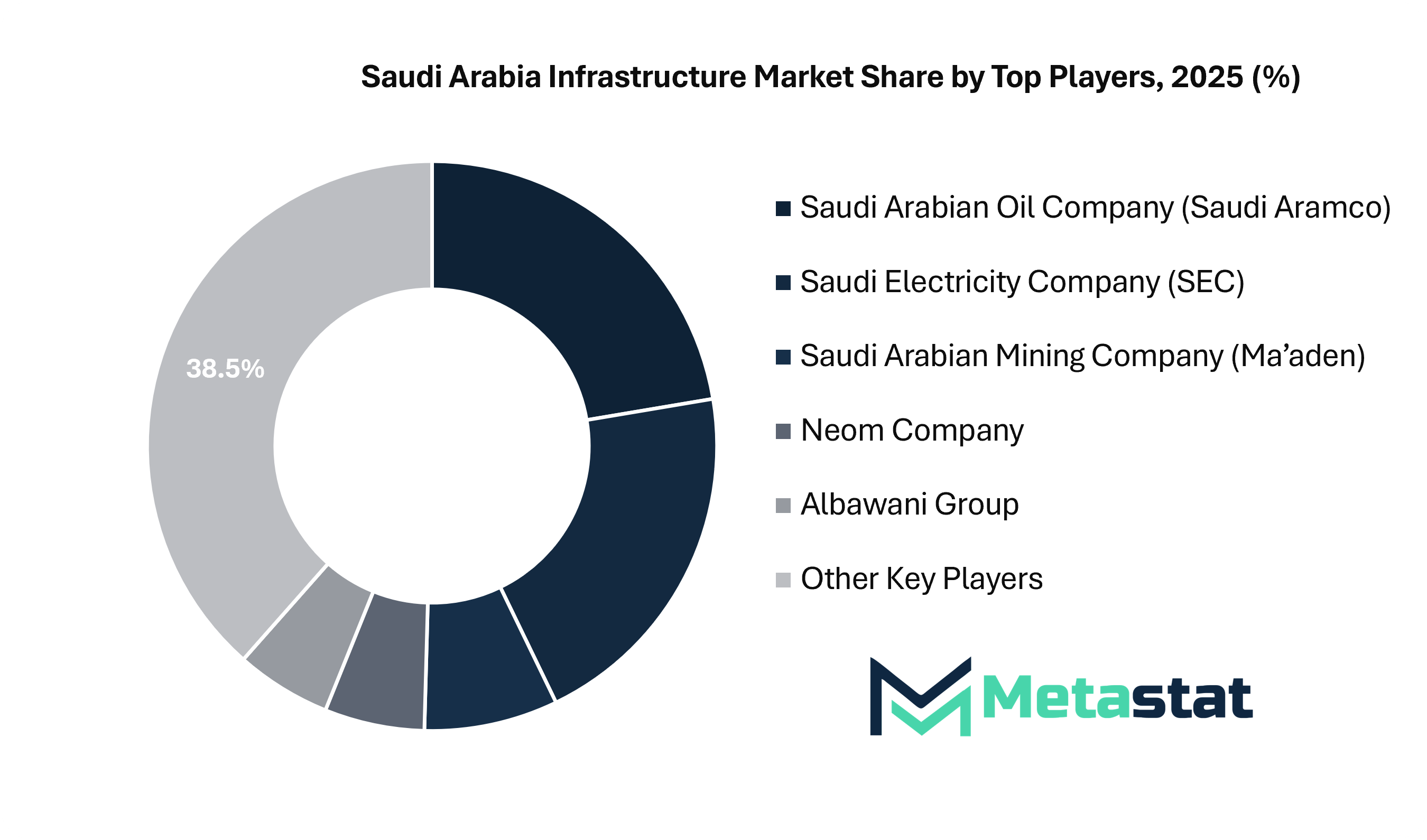
The Saudi Arabia Infrastructure Market continues expanding through public spending, private partnerships, and long-term planning across transport, energy, housing, utilities, and industrial zones. Market expansion is linked with new cities, logistics corridors, and utility upgrades that support business activity. Large domestic companies retain a strong position owing to their understanding of local regulations, procurement norms, and project requirements. Saudi Aramco supports infrastructure-linked roads, pipelines, and service networks near energy assets. Saudi Electricity Company supports grid modernization and power supply reliability, while Marafiq Group strengthens water and power services for industrial communities across the country.
Mining and clean energy projects will also shape opportunities for contractors and material suppliers. Saudi Arabian Mining Company, Ma’aden, develops processing sites, rail links, utilities, and workforce facilities across mining corridors. ACWA Power invests in solar, water treatment, desalination, and energy transition projects that increase infrastructure capacity across multiple regions. Saudi Arabia Railway Company supports freight and passenger movement, helping ports and inland hubs improve connectivity. Tamasuk Holding Company participates in infrastructure investment and development through diversified project platforms, while Red Sea International Company provides modular buildings and camp solutions for remote work areas across large construction programs.
Urban tourism and mixed-use districts are creating fresh opportunities for developers and service providers. NEOM Company stands at the center of planned smart city development, where transport, housing, digital systems, and utilities must scale together. Albawani Group handles civil works, commercial buildings, and public facilities across major developments. El Seif Engineering Contracting Company has experience in towers, hotels, and complex structures requiring disciplined delivery. Almabani General Contractors Company is active in airports, roads, and civic infrastructure projects that improve access for residents and visitors across regions.
Competition among these companies will remain strong, as scale, financial strength, and delivery track records often determine project awards. Firms that manage cost control, skilled labor, safety, and local sourcing effectively will secure stronger project pipelines. Technology use in design, project tracking, and maintenance will improve timelines and reduce waste. International partners will participate in selected ventures, although domestic players will remain important owing to trusted relationships, regulatory familiarity, and execution strength. For investors and suppliers, these companies offer a clear view of infrastructure spending direction within Saudi Arabia’s national economy.
Forecast and Future Outlook
Market size is forecast to rise from USD 81.6 billion in 2025 to over USD 148.7 billion by 2033.
The Saudi Arabia Infrastructure Market is projected to benefit from sustained capital deployment, industrial diversification, and urban population expansion. Future investment will favor low-carbon buildings, autonomous transport systems, smart utilities, desalination upgrades, logistics automation, and mixed-use mega communities.
This research report categorizes the Saudi Arabia infrastructure market based on key segments and regions, forecasts revenue growth, and analyses trends in each submarket. The report analyses the key growth drivers, opportunities, and challenges influencing the infrastructure market. Recent market developments and competitive strategies such as expansion, product launch, partnership, merger, and acquisition have been included to draw the competitive landscape in the market.
The report strategically identifies and profiles the key market players and analyses their core competencies in each sub-segment of the Saudi Arabia infrastructure market.
Report Attributes
Details
Study Period
2021-2033
Base Year
2025
Estimated Year
2026
Forecast Period
2026-2033
Historical Period
2021-2025
Growth Rate
CAGR 7.8% from 2026 to 2033
Revenue Unit
USD billion
Segmentation
By Service Type, Technology, Application, End User, and Region
Service Type:
Construction
Maintenance
Design
Consulting
Others
Technology:
Smart Grids
Renewable Energy
IoT Solutions
Automation
Others
Application:
Transportation
Water Supply
Waste Management
Urban Development
Others
End User:
Government
Private Sector
Utilities
Contractors
WHAT REPORT PROVIDES
Key Company Market Share, Revenue, and Position/Ranking
Key Market Leaders
Full In-Depth Analysis of the Parent Industry
Industry Statistics
Important Changes in Market and Its Dynamics
Segmentation Details of the Market
Historical, On-Going, and Projected Market Analysis
Assessment of Niche Industry Developments
Market Share Analysis
Key Strategies of Major Players
Company Profiles of Key Players
Unique Selling Prepositions of Leading Market Players
Emerging Segments and Regional Growth Potential
Key Strategic Recommendations
Competitive Benchmarking
End of Report Overview
Frequently Asked Questions
Find answers to common questions about this report
Top players operating in the Saudi Arabia Infrastructure industry include Saudi Arabian Oil Company (Saudi Aramco), Saudi Electricity Company (SEC), Saudi Arabian Mining Company (Ma’aden), Acwa Group, and Saudi Arabia Railway Company (SAR).
Saudi Arabia Infrastructure market is estimated to reach USD 148.7 billion by 2033.
The Saudi Arabia Infrastructure market is expected to grow at a CAGR of 7.8% over the forecast period (2026-2033).
The Metastat Insights study shows that the Saudi Arabia Infrastructure market size was USD 81.6 billion in 2025.
Government-backed Vision 2030 spending continues to accelerate roads, railways, smart cities, and utility upgrades and Rising private participation through PPP models is expanding funding sources and speeding project execution are key driving factors, boosting the market.
The Construction is the leading type segment in the Saudi Arabia market.
High dependence on imported materials can expose projects to supply chain disruption and price volatility will hamper the market growth within the forecast period.
Personal Watercraft Market Size, Share, Trends, 2033
Personal Watercraft market size is valued at USD 1,253.7 million in 2025 and projected to reach USD 2,407.9 million by 2033, growing at a CAGR of 8.5%.
Personal Watercraft market, Personal Watercraft Market Size, Personal Watercraft Market Share, Personal Watercraft Market Analysis, Personal Watercraft Market Growth, Personal Watercraft Market Trends, Personal Watercraft Market Research Report, Personal Watercraft Market Forecast, Personal Watercraft, Personal Watercraft Market Research, Personal Watercraft Industry, Personal Watercraft Industry Report, Personal Watercraft Market Data, Personal Watercraft Statistics, Personal Watercraft Market Statistics, Personal Watercraft Industry Trends, Personal Watercraft Market Report, Personal Watercraft Market Trends, Personal Watercraft Market News, Personal Watercraft Forecasts, Personal Watercraft Market Intelligence Report, Personal Watercraft market outlook, Personal Watercraft market segmentation, Personal Watercraft market drivers, Personal Watercraft market restraints, Personal Watercraft market opportunities, Personal Watercraft market CAGR, Personal Watercraft suppliers, Personal Watercraft manufacturers, Personal Watercraft market by region, North America Personal Watercraft market, Asia Pacific Personal Watercraft market, Europe Personal Watercraft market, Personal Watercraft market competitive landscape, Personal Watercraft market key players, Stand-up Personal Watercraft market, Rec-Lite Personal Watercraft market, Luxury Personal Watercraft market, Electric Personal Watercraft market, Personal Watercraft for Sports & Racing, Personal Watercraft for Military & Defense.
Offshore Support Vessel Market Size, Share, Trends, 2033
Global Offshore Support Vessel market size: USD 26.8 billion in 2025, forecast USD 47 billion by 2033 at a 7.3% CAGR, with segment and regional analysis.
Offshore Support Vessel market, Offshore Support Vessel Market Size, Offshore Support Vessel Market Share, Offshore Support Vessel Market Analysis, Offshore Support Vessel Market Growth, Offshore Support Vessel Market Trends, Offshore Support Vessel Market Research Report, Offshore Support Vessel Market Forecast, Offshore Support Vessel, Offshore Support Vessel Market Research, Offshore Support Vessel Industry, Offshore Support Vessel Industry Report, Offshore Support Vessel Market Data, Offshore Support Vessel Statistics, Offshore Support Vessel Market Statistics, Offshore Support Vessel Industry Trends, Offshore Support Vessel Market Report, Offshore Support Vessel Market Trends, Offshore Support Vessel Market News, Offshore Support Vessel Forecasts, Offshore Support Vessel Market Intelligence Report, Offshore Support Vessel market outlook, Offshore Support Vessel market segmentation, Offshore Support Vessel market drivers, Offshore Support Vessel market restraints, Offshore Support Vessel market opportunities, Offshore Support Vessel market CAGR, Offshore Support Vessel suppliers, Offshore Support Vessel manufacturers, Offshore Support Vessel market by region, North America Offshore Support Vessel market, Asia Pacific Offshore Support Vessel market, Europe Offshore Support Vessel market, Offshore Support Vessel market competitive landscape, Offshore Support Vessel market key players, Anchor Handling Tug Supply Vessels market, Platform Supply Vessels market, Multi-Purpose Support Vessels market, Offshore Oil and Gas application, Offshore Wind application, Offshore Decommissioning application, Deepwater Offshore Support Vessel market, Ultra-Deepwater Offshore Support Vessel market, Marine Diesel Oil fuel type, LNG fuel type, Biofuel fuel type.
UK Bus & Coach Fleet Leasing, Rental and Finance Market Size, Share, Trends, 2033
UK Bus & Coach Fleet Leasing, Rental and Finance market size is valued at USD 886.4 million in 2025 and is projected to reach USD 1,442.8 million in 2033, at a CAGR of 6.3% from 2026 to 2033
UK Bus & Coach Fleet Leasing, Rental and Finance Market, UK Bus & Coach Fleet Leasing, Rental and Finance Market Size, UK Bus & Coach Fleet Leasing, Rental and Finance Market Share, UK Bus & Coach Fleet Leasing, Rental and Finance Market Analysis, UK Bus & Coach Fleet Leasing, Rental and Finance Market Growth, UK Bus & Coach Fleet Leasing, Rental and Finance Market Trends, UK Bus & Coach Fleet Leasing, Rental and Finance Market Research Report, UK Bus & Coach Fleet Leasing, Rental and Finance Market Forecast, UK Bus & Coach Fleet Leasing, Rental and Finance, UK Bus & Coach Fleet Leasing, Rental and Finance Market Research, UK Bus & Coach Fleet Leasing, Rental and Finance Industry, UK Bus & Coach Fleet Leasing, Rental and Finance Industry Report, UK Bus & Coach Fleet Leasing, Rental and Finance Market Data, UK Bus & Coach Fleet Leasing, Rental and Finance Statistics, UK Bus & Coach Fleet Leasing, Rental and Finance Market Statistics, UK Bus & Coach Fleet Leasing, Rental and Finance Industry Trends, UK Bus & Coach Fleet Leasing, Rental and Finance Market Report, UK Bus & Coach Fleet Leasing, Rental and Finance Market Trends, UK Bus & Coach Fleet Leasing, Rental and Finance Market News, UK Bus & Coach Fleet Leasing, Rental and Finance Forecasts, UK Bus & Coach Fleet Leasing, Rental and Finance Market Intelligence Report
Inductive Loop Vehicle Detector market size is valued at USD 93.1 million in 2025 and is projected to reach USD 205.5 million in 2033, at a CAGR of 10.4% from 2026 to 2033.