Roll Forming System Market Size, Share, By Type (Portable On-Site Roll Forming Machines and Stationary Stand-Alone Roll Formers), By Application (Aviation, Automotive, Construction, Oil, Gas, and Others, By Category (Semi-automatic and Automatic), Industry Analysis, Growth, Trends, and Forecast, 2026-2033
Report ID
MSI-4597
Published
April 10, 2026
Pages
320 Pages
Format
Report Details
Comprehensive Market Analysis And Insights
Market Overview
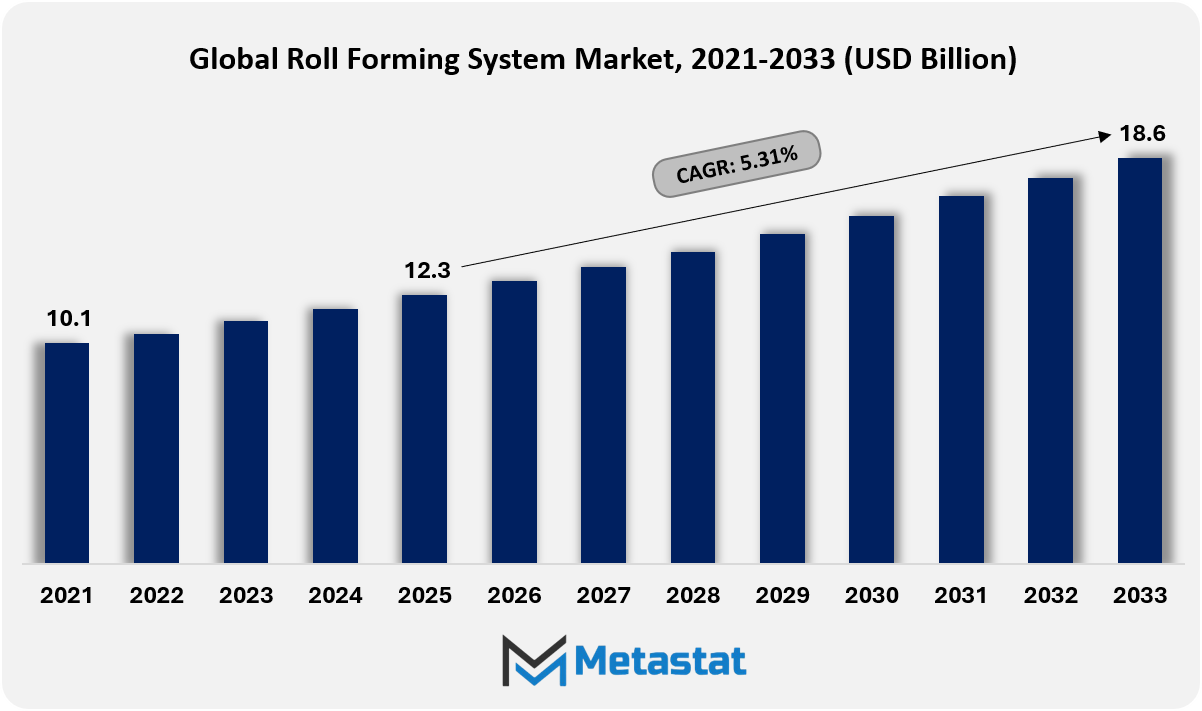
The Global Roll Forming System market size was valued at USD 12.3 billion in 2025 and projected to grow at a CAGR of 5.3% during the forecast period, reaching USD 18.6 billion by 2033.
Global Roll Forming System Market: Comprehensive Data-Driven Market Analysis and Strategic Outlook
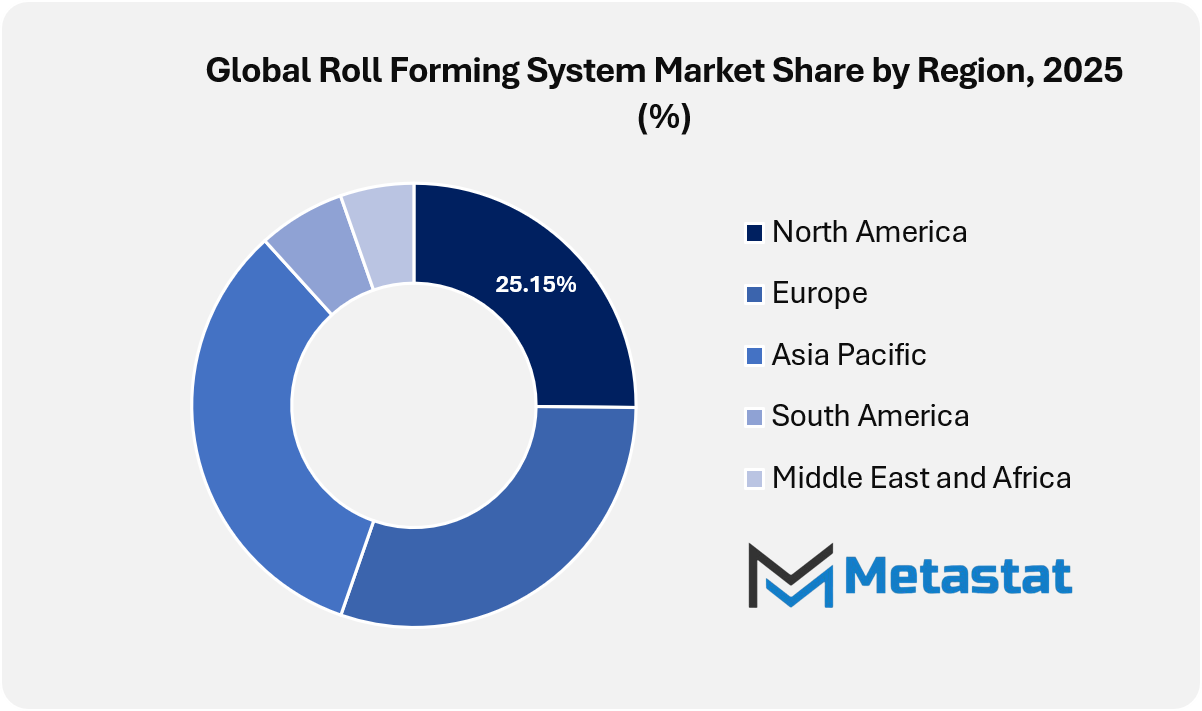
North America accounts for 25.2% of the global market in 2025, with the U.S. leading within the regional market.
Portable On-Site Roll Forming Machines segment accounts for a market share of 36.2% in 2025.
Key trends driving growth: Increased demand for high-throughput, repeatable metal profiles in automotive, construction, and appliance manufacturing; increased adoption of automated, in-line processing to reduce scrap, stabilize quality, and lower unit cost.
Opportunities include increased integration of servo-driven controls, IoT condition monitoring, and quick-change tooling to boost productivity and enable mass customization.
Key insight: Continuous metal profiling demand combined with automation-led efficiency positions roll forming systems for sustained industrial relevance.
The Global Roll Forming System Market within the commercial equipment and metal processing industry is expected to evolve beyond conventional production narratives when viewed through the lens of India’s long-term industrial direction. In the coming years, India is likely to treat roll forming systems not only as equipment for shaping steel sections, but also as enabling infrastructure for precision-driven manufacturing ecosystems. The focus is expected to shift toward systems that integrate seamlessly with digital production floors, where data-led monitoring, predictive performance management, and adaptive tooling become standard expectations rather than optional upgrades.
Indian manufacturers are expected to increasingly align roll forming capabilities with customized production requirements rather than volume-centric output. This transition will enable producers to design profiles tailored for complex architectural forms, modular construction standards, and lightweight structural applications required by advanced engineering projects. Automation will not only improve efficiency, it will also redefine how consistency and repeatability are achieved across geographically dispersed facilities. As a result, roll forming setups are likely to be planned as scalable units that can be replicated across industrial corridors without compromising output precision.
Market Dynamics
Growth Drivers:
Increased demand for high-throughput, repeatable metal profiles in automotive, construction, and appliance manufacturing.
Increased demand for high-throughput, repeatable metal profiles in automotive, construction, and appliance manufacturing will support long-term adoption. Manufacturers are expected to prioritize consistency, dimensional accuracy, and volume efficiency. Future production environments will favor continuous forming lines that support standardized output, enabling stable supply chains and predictable performance across large-scale industrial applications.
Increased adoption of automated, in-line processing to reduce scrap, stabilize quality, and lower unit cost.
Increased adoption of automated, in-line processing is expected to reshape operating models through lower scrap generation, stabilized quality, and reduced unit cost. Smart automation will enable synchronized forming, cutting, and punching operations. Over time, digitally controlled lines are expected to support higher uptime and precision-focused manufacturing aligned with global cost-optimization targets.
Restraints and Challenges:
High upfront CapEx for tooling, mill stands, controls, and commissioning, limiting uptake among small and mid-size fabricators.
High CapEx for tooling, mill stands, controls, and commissioning is expected to limit adoption among small and mid-size fabricators. Budget constraints may delay modernization plans. Financial pressure is likely to encourage selective investments, phased deployment strategies, and longer system lifecycles until cost structures become more accessible across broader industrial segments.
Long changeover and tooling lead times for multi-profile production, reducing flexibility for short-run customization.
Long changeover and tooling lead times for multi-profile production are expected to reduce flexibility during short-run customization. Production planners may face scheduling inefficiencies. Future competitiveness will depend on reducing downtime while balancing customization requirements, pushing manufacturers to reassess portfolio complexity and operational responsiveness under fluctuating order volumes.
Opportunities:
Increased integration of servo-driven controls, IoT condition monitoring, and quick-change tooling to boost productivity and enable mass customization.
Increased integration of servo-driven controls, IoT condition monitoring, and quick-change tooling is expected to unlock productivity gains and support mass customization. Advanced sensing and predictive analytics will improve operational visibility. Over the coming years, intelligent systems are likely to enable adaptive manufacturing environments to make rapid configuration shifts without compromising throughput stability.
Market Segmentation Analysis
The Global Roll Forming System market is classified based on Type, Application, Category, and Region.
By Type, the market is further segmented into:
Portable On-Site Roll Forming Machines
Portable On-Site Roll Forming Machines segment is estimated at USD 4.7 billion in 2026 and is projected to reach USD 7.6 billion by 2033, at a CAGR of 7.2% during the forecast period.
Portable on-site roll forming machines are expected to support future production and infrastructure programs through location-based manufacturing. Deployment near project sites can reduce logistics dependency, handling delays, and material wastage. Industry adoption is likely to strengthen where fast customization, flexible profiles, and cost containment remain operational priorities across time-sensitive industrial projects.
Stationary Stand-Alone Roll Formers
Stationary Stand-Alone Roll Formers segment is estimated at USD 8.3 billion in 2026 and is projected to reach USD 11 billion by 2033, at a CAGR of 4.1% during the forecast period.
Stationary Stand-Alone Roll Formers will continue to serve high-volume manufacturing environments requiring uniformity and dimensional consistency. Factory-integrated systems are expected to align with advanced automation frameworks, quality monitoring tools, and predictive maintenance systems. Long-term relevance will remain tied to standardized output, operational stability, and continuous production cycles.
By Application, the market is divided into:
Aviation
Aviation segment is projected to reach USD 0.7 billion by 2033, at a CAGR of 8.4% during the forecast period.
Aviation applications will depend on roll forming systems supporting lightweight structural profiles and tight tolerance requirements. Material efficiency, surface accuracy, and repeatable forming techniques will affect procurement choices. Future aerospace packages will feature system compatibility with advanced alloys and scalable production necessities aligned with global fleet expansion.
Automotive
Automotive segment is projected to reach USD 3.8 billion by 2033, at a CAGR of 3.9% during the forecast period.
Automotive production is expected to increasingly use roll forming systems to support chassis components, reinforcement structures, and safety-critical parts. Production lines will prioritize speed, repeatability, and reduced material loss. Market growth is likely to be supported by electric vehicle expansion, modular platform development, and stringent structural performance benchmarks.
Construction
Construction segment is projected to reach USD 9.3 billion by 2033, at a CAGR of 6.4% during the forecast period.
Construction sector demand will increase via urbanization projects and industrial venture pipelines. Roll forming structures will help panel fabrication, framing solutions, and roofing components. Preference will prefer machines helping profile versatility, rapid changeovers, and constant output, aligned with modern-day building codes and sustainability objectives.
Oil & Gas
Oil & Gas segment is projected to reach USD 1.9 billion by 2033, at a CAGR of 2.9% during the forecast period.
Oil and gasoline operations will utilize roll forming structures for pipelines, help systems, and containment components. Equipment selection will emphasize durability, cloth power compatibility, and performance below excessive operational situations. Future investment will hyperlink with power infrastructure enhancements and regional exploration activities.
Others (Storage Industry, etc.)
Others (Storage Industry, etc.) segment is projected to reach USD 2.8 billion by 2033, at a CAGR of 4.9% during the forecast period.
Storage industry applications are expected to grow with warehouse automation and logistics expansion. Roll forming systems will support racking systems, shelving units, and modular storage frameworks.
By Category, the market is further divided into:
Semi-automatic
Semi-automatic segment is projected to reach USD 6.6 billion by 2033.
Semi-automatic category adoption is expected to remain relevant among mid-scale manufacturers seeking controlled automation without full system complexity. Operator-assisted processes help balance flexibility and productivity. Future relevance will align with cost-conscious operations, varied production batches, and gradual automation transition strategies.
Automatic
Automatic segment is projected to reach USD 12 billion by 2033.
Automatic systems are expected to define long-term market advancement through minimal manual intervention and integrated digital control. High-output environments will favor automatic roll forming lines supported by predictive analytics and real-time adjustments. Industrial adoption is likely to expand where consistency, speed, and operational intelligence remain decisive factors.
By Region:
Based on geography, the Global Roll Forming System market is divided into North America, Europe, Asia-Pacific, South America, Middle East, and Africa.
North America Roll Forming System Market is set to expand at a CAGR of 5.3% within the forecast period, reaching a market size (TAM) of USD 4 billion by the end of 2033.
North America drives the Global Roll Forming System Market through sustained investment in industrial automation and advanced production practices across construction, automotive, and infrastructure sectors.
North America supports market growth through strong demand for precision-engineered metal components, supported by technological advancements and stable capital expenditure in manufacturing facilities.
Asia Pacific presents strong opportunities in the Global Roll Forming System Market due to rapid industrial growth, expanding urban infrastructure projects, and increasing adoption of cost-effective metal forming solutions.
Asia Pacific offers growth opportunities for the Global Roll Forming System Market through expanding automotive production, rising construction activity, and increasing adoption of scalable manufacturing systems.
The Middle East, Africa, and South America together reflect steady progress in the Global Roll Forming System Market, supported by gradual industrialization, infrastructure modernization efforts, and increasing adoption of durable metal fabrication technologies.
Competitive Landscape and Strategic Insights
Competition in the Global Roll Forming System Market is increasingly shaped by automation depth, tooling flexibility, digital integration capabilities, and lifecycle service support. Vendors are moving beyond equipment-only positioning and are strengthening their value propositions through productivity optimization, application-specific engineering, and reduced changeover time for multi-profile production environments.
Strategic differentiation is also expected to come from modular machine architecture, quick-change tooling systems, and remote diagnostics that improve uptime and operating visibility. As customer requirements shift toward customized profiles and shorter production runs, suppliers with strong engineering support and scalable automation platforms are likely to strengthen their competitive position.
North American and European players remain influential through innovation and established industry expertise. Hayes International, Howick Ltd., Knudson Manufacturing, Inc., Liberty Seamless Machinery, Metform International Ltd., New Tech Machinery, Samco Machinery, Schlebach Maschinen GmbH, The Bradbury Group, Dreistern GmbH and Co. KG, Hennecke Profiliertechnik, and Fagor Arrasate are recognized for advanced engineering, robust construction, and application-specific solutions. Their systems support manufacturers seeking precision, durability, and reduced downtime across demanding production environments.
Several regional and specialized manufacturers also contribute to market depth and product diversity. Companies such as Jupiter Roll Form Machines Private Limited, Shree Gayatri Engineers, LOTOS Forming, Roll Former, LLC, Roll Forming Machines LLC, SACFORM / AGMline, Zhongtuo Roll Forming Machinery Co., Ltd., Xiamen Dahezhongbang Machinery Co., Ltd., Metal Rollforming Systems, Inc., Marion Manufacturing Company, T and H Lemont, SFS International, STAM S.R.L., Tecnoma S.R.L., ROBOR S.R.L., and DIPER S.R.L. address niche requirements and regional demand patterns. Zeman Bauelemente Produktionsgesellschaft mbH adds strength in structural applications, reinforcing the market’s ability to serve both standard and highly customized production needs.
Overall, competition within the Global Roll Forming System Market is expected to encourage continuous improvements in machine performance, digital integration, and after-sales support. Companies that balance performance, adaptability, and long-term service value are likely to remain relevant as manufacturers increasingly seek dependable partners rather than standalone equipment providers. The market outlook points toward smarter systems that align with evolving manufacturing expectations while retaining the core advantage of roll forming, high output with consistent quality.
Forecast and Future Outlook
Market size is forecast to rise from USD 12.3 billion in 2025 to over USD 18.6 billion by 2033.
Beyond production levels, roll forming technology will influence procurement strategies, supplier qualification models and long-term manufacturing flexibility planning. The future presence of the market will be defined less by production volume and more by the ability to provide repeatable accuracy, design freedom and integration compatibility within an increasingly complex industrial ecosystem.
This research report categorizes the Roll Forming System market based on key segments and regions, forecasts revenue growth, and analyses trends in each submarket. The report analyses the key growth drivers, opportunities, and challenges influencing the Roll Forming System market. Recent market developments and competitive strategies such as expansion, product launch, partnership, merger, and acquisition have been included to draw the competitive landscape in the market.
The report strategically identifies and profiles the key market players and analyses their core competencies in each sub-segment of the Roll Forming System market.
Report Attributes
Details
Study Period
2021-2033
Base Year
2025
Estimated Year
2026
Forecast Period
2026-2033
Historical Period
2021-2025
Growth Rate
CAGR 5.3% from 2026 to 2033
Revenue Unit
USD billion
Sales Volume Unit
Units
Segmentation
By Type, Application, Category, and Region
By Region
North America (By Type, Application, Category, and Country)
United States
Canada
Mexico
Europe (By Type, Application, Category, and Country)
Germany
France
UK
Italy
Spain
Russia
Rest of Europe
Asia Pacific (By Type, Application, Category, and Country)
China
Japan
India
South Korea
Australia
Southeast Asia
Rest of Asia Pacific
South America (By Type, Application, Category, and Country)
Brazil
Argentina
Rest of South America
Middle East and Africa (By Type, Application, Category, and Country)
Saudi Arabia
UAE
South Africa
Rest of Middle East and Africa
WHAT REPORT PROVIDES
Key Company Market Share and Revenue
Key Market Leaders
Full In-Depth Analysis of the Parent Industry
Industry Statistics
Important Changes in Market and Its Dynamics
Segmentation Details of the Market
Historical, On-Going, and Projected Market Analysis
Assessment of Niche Industry Developments
Market Share Analysis
Key Strategies of Major Players
Company Profiles of Key Players
Unique Selling Propositions of Leading Market Players
Stage Hoist market size is valued at USD 236.3 million in 2025 and is projected to reach USD 395.3 million in 2033, at a CAGR of 6.3% from 2026 to 2033.
Global Taper Lock Bushing market is valued at USD 1,187.8 million in 2025 and is projected to reach USD 1,808.0 million in 2033, at a CAGR of 5.4% from 2026 to 2033
Europe Mini Excavators Market Size, Share, Trends, 2033
Europe Mini Excavators market size is valued at USD 2,162.9 million in 2025 and is projected to reach USD 3,004.1 million in 2033, at a CAGR of 4.2% from 2026 to 2033
Europe Mini Excavators Market, Europe Mini Excavators Market Size, Europe Mini Excavators Market Share, Europe Mini Excavators Market Analysis, Europe Mini Excavators Market Growth, Europe Mini Excavators Market Trends, Europe Mini Excavators Market Research Report, Europe Mini Excavators Market Forecast, Europe Mini Excavators, Europe Mini Excavators Market Research, Europe Mini Excavators Industry, Europe Mini Excavators Industry Report, Europe Mini Excavators Market Data, Europe Mini Excavators Statistics, Europe Mini Excavators Market Statistics, Europe Mini Excavators Industry Trends, Europe Mini Excavators Market Report, Europe Mini Excavators Market Trends, Europe Mini Excavators Market News, Europe Mini Excavators Forecasts, Europe Mini Excavators Market Intelligence Report
Global Switch Actuators market size is valued at USD 18.4 billion in 2025 and is projected to reach USD 30.6 billion in 2033, at a CAGR of 6.6% from 2026 to 2033