Air Compressor Rental Market Size, Share, By Compressor Type (Rotary Screw Compressors, Reciprocating Compressors, Centrifugal Compressors, and Others), By Lubrication Type (Oil‑Filled Compressors and Oil‑Free Compressors), By Rental Type (Short-Term Rental and Long-Term Rental), By End-Use Industry (Manufacturing, Construction, Mining, Oil, Gas, and Others), Industry Analysis, Growth, Trends, and Forecast, 2026-2033
Report ID
MSI-4724
Published
May 8, 2026
Pages
315 Pages
Format
Report Details
Comprehensive Market Analysis And Insights
Market Overview
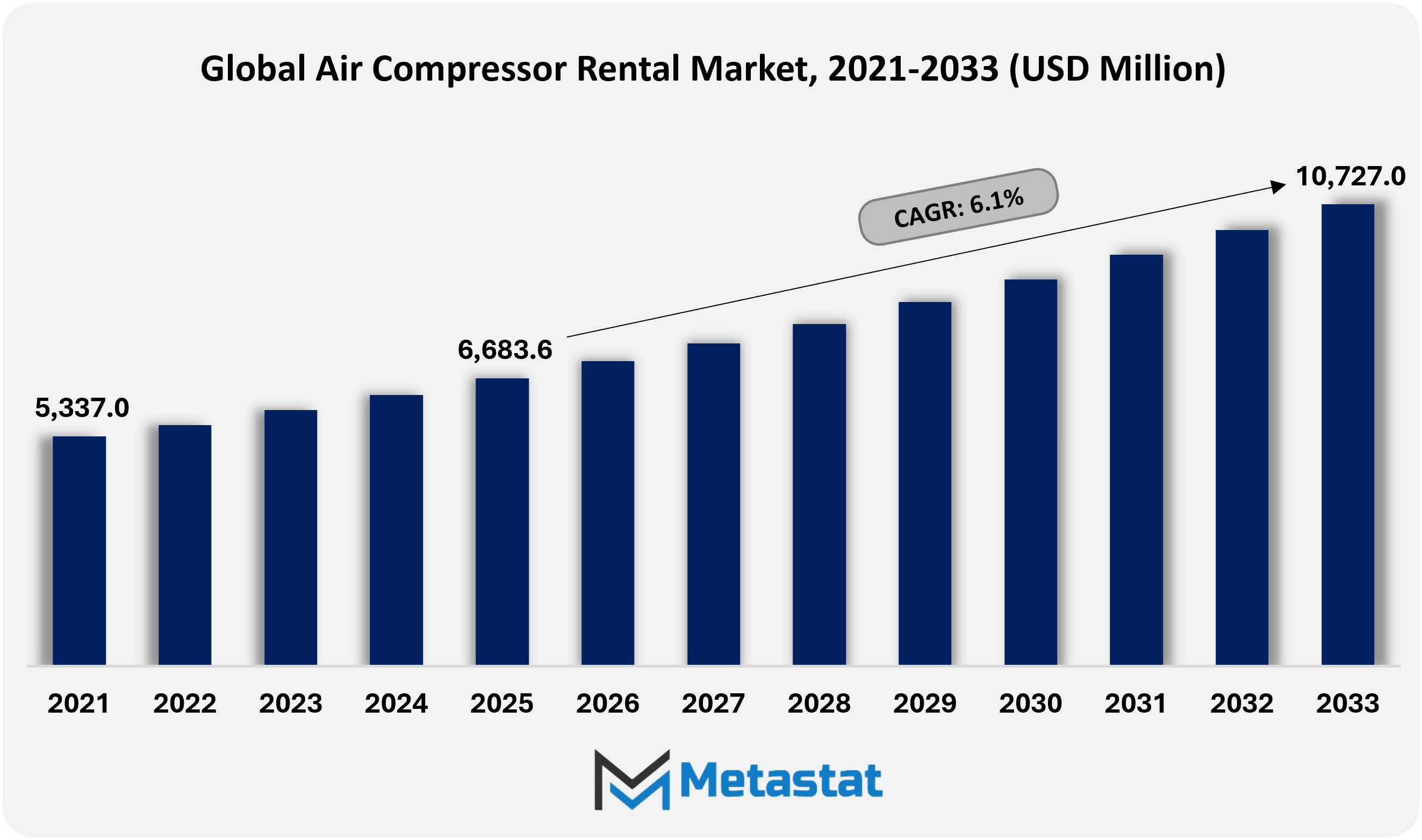
Global Air Compressor Rental market size is valued at USD 6,683.6 million in 2025 and projected to grow at a CAGR of 6.1% during the forecast period, reaching USD 10,727 million by 2033.
Global Air Compressor Rental Market: Comprehensive Data-Driven Market Analysis and Strategic Outlook
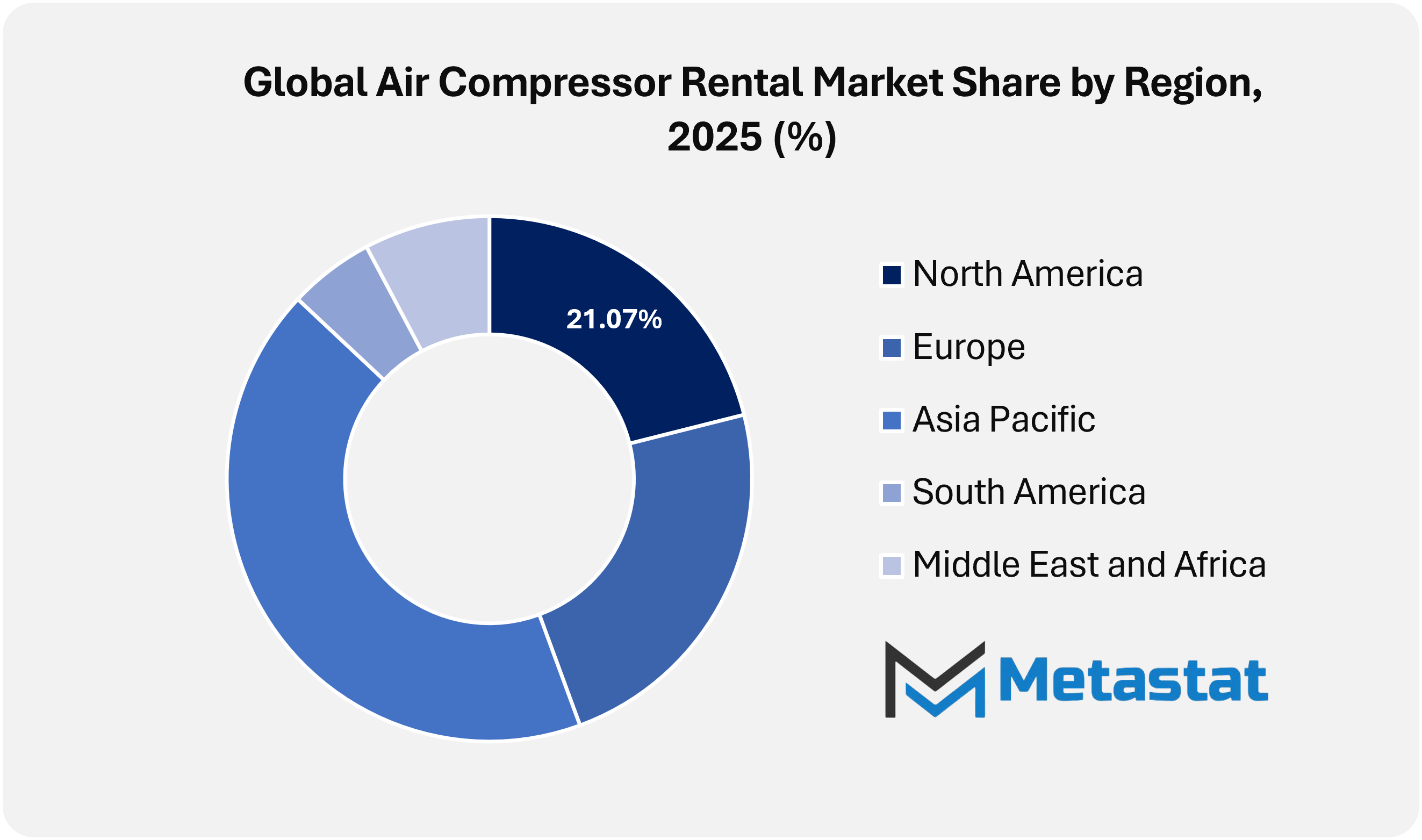
North America accounted for 21.1% of the global market in 2025, with the U.S. leading the regional market.
The rotary screw compressors segment accounted for 58.3% of the market in 2025.
Key trends driving growth: Growing Construction and Infrastructure Activity driving demand for temporary compressed air solutions across large infrastructure projects and industrial sites along with cost-effectiveness and operational flexibility as renting eliminates large upfront purchases and enables scalable compressor capacity for varying project durations.
Opportunities include shift towards eco-friendly and advanced technology solutions including energy-efficient, oil-free, electric and hybrid compressors with IoT-enabled monitoring, predictive maintenance and compliance with stricter emission regulations.
Key insight: Surging infrastructure activity and flexible industrial operations fuel demand momentum in the Global Air Compressor Rental Market.
The global air compressor rental market, within the industrial equipment and temporary power solutions industry, will expand beyond traditional construction and mining applications, shaping how organizations manage compressed air access in uncertain operating environments. Demand is shifting from simple short-term equipment rentals toward integrated service ecosystems in which uptime guarantees, remote diagnostics, and performance-based contracts define customer relationships. Rental providers are evolving from asset suppliers into operational partners supporting refinery turnarounds, shipyard retrofits, semiconductor fabrication expansions, and large-scale infrastructure rehabilitation programs.
Over the coming years, digital asset monitoring, predictive maintenance algorithms, and telematics-enabled fleet management will redefine how compressor units are deployed across dispersed project sites. Contractors will increasingly demand real-time pressure analytics, fuel optimization dashboards, and automated service scheduling to reduce downtime. Rental fleets are also expected to include more oil-free and variable-speed units tailored for food processing, pharmaceutical manufacturing, and data center cooling retrofits, where air purity standards require stricter compliance.
Market Dynamics
Growth Drivers:
Growing Construction and Infrastructure Activity driving demand for temporary compressed air solutions across large infrastructure projects and industrial sites.
Rapid urban expansion, highway development, metro rail corridors, power plants, and industrial parks are increasing equipment requirements across both emerging and developed economies. Large project sites require reliable compressed air for drilling, blasting, painting, and heavy tool operation. The global air compressor rental market is gaining traction as end users increasingly prefer temporary rental solutions that support phased construction schedules, remote site operations, and short-term capacity requirements without permanent asset ownership.
Cost-effectiveness and Operational Flexibility as renting eliminates large upfront purchases and enables scalable compressor capacity for varying project durations.
Capital conservation strategies are encouraging contractors and manufacturers to prioritize rental agreements over asset acquisition. Rental models reduce the financial burden associated with procurement, storage, depreciation, and lifecycle servicing. The global air compressor rental market is expanding through scalable capacity planning, which allows companies to adjust compressor size and output based on seasonal workloads, shutdown maintenance cycles, and project-specific air pressure requirements.
Restraints and Challenges:
High Operational and Maintenance Costs associated with logistics, fuel consumption, and servicing of compressor units, which can limit profitability.
Transport coordination, fuel price volatility, spare parts sourcing, and routine servicing requirements increase operating expenditure for rental providers. Profit margins will narrow when utilization rates decline or when machines remain idle between contracts. Market participants will need to optimize fleet efficiency, strengthen preventive maintenance frameworks, and improve asset monitoring to preserve profitability.
Equipment Availability Challenges and Lead Times during peak demand periods affecting rental supply for high-demand or specialized models.
Peak demand periods linked to infrastructure booms or industrial growth can strain fleet availability, especially for high-pressure, oil-free, or large-capacity units. Extended procurement timelines will also delay fleet expansion. The global air compressor rental market will face temporary constraints when rental companies experience equipment shortages, creating scheduling challenges for contractors operating under strict project timelines.
Opportunities:
Shift to Eco-Friendly and Advanced Technology Solutions including energy-efficient, oil-free, electric and hybrid compressors with IoT-enabled monitoring, predictive maintenance and compliance with stricter emission regulations.
Environmental compliance standards are tightening across multiple regions, encouraging a transition toward electric, hybrid, and low-emission compressor technologies. Digital integration through IoT-enabled monitoring systems supports predictive maintenance, fuel optimization, and remote diagnostics. The global air compressor rental market will modernize through smart fleet management platforms, improving uptime, regulatory compliance, and long-term sustainability across industrial and construction sectors.
Market Segmentation Analysis
The Global Air Compressor Rental market is classified based on Compressor Type, Lubrication Type, Rental Type, and End-Use Industry.
By Compressor Type, the market is further segmented into:
Rotary Screw Compressors segment is valued at USD 4,127.1 million in 2026 and is projected to reach USD 6,385.8 million by 2033, at a CAGR of 6.4% during the forecast period.
Rotary screw compressors will maintain a leading position in the Global Air Compressor Rental market owing to their ability to deliver continuous airflow and reliable operational performance. Industrial facilities requiring stable compressed air for extended operations are increasingly adopting these systems. Segment expansion is supported by increased usage across automated plants and infrastructure projects where energy efficiency and lower maintenance requirements remain important.
Reciprocating Compressors
Reciprocating Compressors segment is valued at USD 2,101.8 million in 2026 and is projected to reach USD 3,040 million by 2033, at a CAGR of 5.4% during the forecast period.
Reciprocating compressors continue to hold relevance for intermittent and high-pressure applications across small- and mid-scale operations. Cost efficiency and simple mechanical design are supporting adoption among workshops, contractors, and localized construction projects. Segment growth in the Global Air Compressor Rental market is being supported by sectors requiring portable, compact, and application-specific compressed air solutions.
Centrifugal Compressors
Centrifugal Compressors segment is valued at USD 560.2 million in 2026 and is projected to reach USD 870 million by 2033, at a CAGR of 6.5% during the forecast period.
Centrifugal compressors support large-scale industrial projects that require high-volume airflow and stable pressure output. Expansion across heavy processing industries is increasing rental demand for these advanced compressor systems. Growth of this segment in the Global Air Compressor Rental market is being driven by rising preference for high-capacity equipment designed for continuous industrial production environments.
Others
Others segment is valued at USD 295.2 million in 2026 and is projected to reach USD 431.2 million by 2033, at a CAGR of 5.6% during the forecast period.
Other compressor categories, including portable and hybrid systems, serve niche operational requirements across specialized industrial projects. Rental providers are expanding customized offerings to address varying pressure levels and capacity needs. Segment development within the Global Air Compressor Rental market is benefiting from technological improvements that enhance flexibility, digital monitoring, and operating precision.
By Lubrication Type, the market is divided into:
Oil‑Filled Compressors
Oil‑Filled Compressors segment is projected to reach USD 5,873 million by 2033, at a CAGR of 5.6% during the forecast period.
Oil-Filled Compressors continue to support applications requiring durability and enhanced cooling performance. Heavy-duty industries rely on these systems for extended workloads under demanding operating conditions. Segment demand in the Global Air Compressor Rental market remains supported by cost-conscious operators that prioritize performance consistency and mechanical strength.
Oil‑Free Compressors
Oil‑Free Compressors segment is projected to reach USD 4,854 million by 2033, at a CAGR of 6.8% during the forecast period.
Oil-Free Compressors are witnessing increased adoption across sectors that require contamination-free compressed air, including food processing, pharmaceuticals, electronics, and healthcare manufacturing. Strict quality and air purity standards are supporting rental demand for advanced clean-air systems. Segment expansion in the Global Air Compressor Rental market is being driven by regulatory compliance and precision-focused industrial processes.
By Rental Type, the market is further divided into:
Short-Term Rental
Short-Term Rental segment is projected to reach USD 6,842.7 million by 2033.
Short-Term Rental services remain highly relevant for contractors managing temporary projects, emergency breakdowns, and seasonal production increases. Flexible rental agreements help maintain operational continuity without long-term capital commitments. Segment expansion in the Global Air Compressor Rental market is supported by infrastructure development and fast-paced industrial deployment cycles.
Long-Term Rental
Long-Term Rental segment is projected to reach USD 3,884.2 million by 2033.
Long-Term Rental arrangements provide predictable operating expenditure and reliable equipment access for continuous manufacturing facilities. Enterprises seeking financial efficiency are increasingly preferring structured rental contracts over direct ownership. Segment growth in the Global Air Compressor Rental market is also supported by strategic partnerships between rental providers and large industrial operators, strengthening recurring revenue streams.
By End-Use Industry, the Global Air Compressor Rental market is divided as:
Manufacturing
Manufacturing segment is projected to grow at a CAGR of 6.4% during the forecast period.
Manufacturing facilities rely on compressed air systems for automation, material handling, assembly, and packaging operations. Increased industrial automation is supporting rental demand for scalable production environments. The Global Air Compressor Rental market is expanding through rising manufacturing output and continued modernization of factory infrastructure.
Construction
Construction segment is projected to grow at a CAGR of 5.5% during the forecast period.
Construction activity is generating steady demand for portable air compressor solutions used in drilling, blasting, concrete work, and material processing. Infrastructure expansion across urban and industrial corridors is accelerating rental adoption. The Global Air Compressor Rental market is benefiting from government-backed development projects and private sector investments in large-scale construction activity.
Mining segment is projected to grow at a CAGR of 6% during the forecast period.
Mining operations require robust compressed air systems for extraction, ventilation, drilling, and equipment control functions. Remote site activity is increasing preference for rental solutions that offer mobility, rapid deployment, and service support. Mining-led demand continues to contribute to steady growth in the Global Air Compressor Rental market.
Oil & Gas
Oil & Gas segment is projected to grow at a CAGR of 7.3% during the forecast period.
Oil & Gas operations depend on high-capacity compressed air systems for processing, maintenance, shutdown services, and field operations. Fluctuating project cycles are increasing preference for flexible rental models across the value chain. The Global Air Compressor Rental market is benefiting from upstream and downstream investment programs focused on improving operational efficiency.
Others
Others segment is projected to grow at a CAGR of 5.5% during the forecast period.
Other end-use sectors, including utilities, transportation infrastructure, and municipal services, are strengthening demand for adaptable compressed air solutions. Rising environmental compliance standards are also supporting adoption of energy-efficient rental equipment. The Global Air Compressor Rental market continues to advance through end-use diversification and ongoing technological refinement across industrial ecosystems.
By Region:
Based on geography, the Global Air Compressor Rental market is divided into North America, Europe, Asia-Pacific, South America, Middle East, and Africa.
North America Air Compressor Rental Market is set to expand at a CAGR of 6.1% within the forecast period, reaching a market size (TAM) of USD 1,952.3 million by the end of 2033.
North America drives the Air Compressor Rental market through strong oil & gas activity, industrial maintenance demand, and ongoing infrastructure redevelopment across the United States and Canada.
Europe supports the Global Air Compressor Rental market through industrial modernization, manufacturing upgrades, energy-efficiency initiatives, and steady demand from construction and process industries.
Asia-Pacific creates significant opportunities in the Air Compressor Rental market through rapid urbanization, industrial expansion, and large-scale infrastructure development across China, India, and Southeast Asia.
Across the Middle East, Africa, and South America, the Air Compressor Rental market is gaining traction through oilfield developments, mining investments, and increasing commercial construction activity supported by regional infrastructure modernization programs.
Competitive Landscape and Strategic Insights
The Global Air Compressor Rental market has grown steadily as industries increasingly seek flexible and cost-effective equipment solutions. Many businesses prefer renting over buying owing to lower upfront investment and reduced maintenance responsibility. Construction projects, oil & gas operations, mining sites, power plants, and manufacturing facilities frequently require compressed air for short-term, seasonal, or project-based use. Rental services allow companies to scale operations quickly without locking capital into heavy equipment, while infrastructure development across emerging economies continues to support long-term market expansion.
Large global participants continue to strengthen their market presence through broad service networks and diversified equipment fleets. Companies including Atlas Copco AB, Aggreko plc, United Rentals, Inc., Sunbelt Rentals, Inc., and Herc Holdings Inc. have established strong positions by offering reliable compressor rental solutions for industrial and commercial applications. Their portfolios include portable, stationary, diesel-powered, and electric-powered air compressors suited to different pressure and flow requirements. Strong focus on rapid deployment, on-site support, and preventive servicing helps customers maintain operational continuity during critical projects.
In addition to these leading participants, several specialized rental providers and equipment manufacturers play an important role in expanding access to advanced compressor systems. Caterpillar Inc., Ingersoll Rand Inc., AERZEN Rental Solutions, Boels Rental Holding B.V., and Loxam Group are strengthening regional presence through partnerships, acquisitions, and fleet expansion strategies. Regional providers including Kiloutou SAS, Nishio Rent All Co., Ltd., HSS Hire Group plc, GAP Group Limited, and Kennards Hire Pty Ltd are also expanding their offerings to meet rising demand from infrastructure and industrial sectors.
North America, Europe, and Asia-Pacific remain key revenue contributors owing to strong industrial activity and established rental adoption across major end-use industries. Companies such as Coates Hire Operations Pty Ltd, Sunstate Equipment Co., LLC, EquipmentShare.com Inc., CRU Air + Gas, LLC, and Durante Equipment, LLC support regional contractors through customized rental programs. Additional participants including Byrne Equipment Rental LLC, OTC Industrial Technologies, Inc., air4rent Kompressoren Vermietung GmbH, Dalgakiran Kompresor Sanayi ve Ticaret A.S., Ing. Enea Mattei S.p.A., General de Alquiler de Maquinaria, S.A., Sigma Utility Care Private Limited, Sarwat Engineering Company, MacAllister Rentals, Empire Tool Rentals, and Perennial Technologies address niche demand across specialized industrial applications. Ongoing industrial expansion, stricter environmental regulations, and increased preference for energy-efficient equipment will support steady momentum across the Global Air Compressor Rental market.
Forecast and Future Outlook
Market size is forecast to rise from USD 6,683.6 million in 2025 to over USD 10,727 million by 2033.
Capital expenditure caution among mid-sized manufacturers is encouraging long-term rental frameworks that preserve balance sheet flexibility while ensuring access to advanced equipment. Service-level agreements are expected to evolve into performance-based contracts linked to output efficiency, uptime, and energy consumption metrics. Through these developments, the market landscape is moving toward a technology-led service model that combines engineering reliability, digital oversight, and flexible commercial structures.
This research report categorizes the Air Compressor Rental market based on key segments and regions, forecasts revenue growth, and analyses trends in each submarket. The report analyses the key growth drivers, opportunities, and challenges influencing the Air Compressor Rental market. Recent market developments and competitive strategies such as expansion, product launch, partnership, merger, and acquisition have been included to draw the competitive landscape in the market.
The report strategically identifies and profiles the key market players and analyses their core competencies in each sub-segment of the Air Compressor Rental market.
Report Attributes
Details
Study Period
2021-2033
Base Year
2025
Estimated Year
2026
Forecast Period
2026-2033
Historical Period
2021-2025
Growth Rate
CAGR 6.1% from 2026 to 2033
Revenue Unit
USD million
Segmentation
By Compressor Type, Lubrication Type, Rental Type, End-Use Industry, and Region
By Region
North America (By Compressor Type, Lubrication Type, Rental Type, End-Use Industry, and Country)
United States
Canada
Mexico
Europe (By Compressor Type, Lubrication Type, Rental Type, End-Use Industry, and Country)
Germany
France
UK
Italy
Spain
Russia
Rest of Europe
Asia Pacific (By Compressor Type, Lubrication Type, Rental Type, End-Use Industry, and Country)
China
Japan
India
South Korea
Australia
Southeast Asia
Rest of Asia Pacific
South America (By Compressor Type, Lubrication Type, Rental Type, End-Use Industry, and Country)
Brazil
Argentina
Rest of South America
Middle East and Africa (By Compressor Type, Lubrication Type, Rental Type, End-Use Industry, and Country)
Saudi Arabia
UAE
South Africa
Rest of Middle East and Africa
WHAT REPORT PROVIDES
Key Company Market Share, Revenue, and Position/Ranking
Key Market Leaders
Full In-Depth Analysis of the Parent Industry
Industry Statistics
Important Changes in Market and Its Dynamics
Segmentation Details of the Market
Historical, On-Going, and Projected Market Analysis
Assessment of Niche Industry Developments
Market Share Analysis
Key Strategies of Major Players
Company Profiles of Key Players
Unique Selling Propositions of Leading Market Players
Emerging Segments and Regional Growth Potential
Key Strategic Recommendations
Competitive Benchmarking
Import Export Trade Statistics
End of Report Overview
Frequently Asked Questions
Find answers to common questions about this report
Top players operating in the Air Compressor Rental industry include Atlas Copco AB, Aggreko plc, United Rentals, Inc., Sunbelt Rentals, Inc., Herc Holdings Inc., AERZEN Rental Solutions, Caterpillar Inc., and Kiloutou SAS.
Global Air Compressor Rental market is estimated to reach USD 10,727 million by 2033.
The Rotary Screw Compressors is the leading type of segment in the Global market.
High Operational and Maintenance Costs associated with logistics, fuel consumption, and servicing of compressor units, which can limit profitability. will hamper the market growth within the forecast period.
Asia Pacific region dominates the market.
Growing Construction and Infrastructure Activity driving demand for temporary compressed air solutions across large infrastructure projects and industrial sites. and Cost-effectiveness and Operational Flexibility as renting eliminates large upfront purchases and enables scalable compressor capacity for varying project durations. are key driving factors, boosting the market.
The Metastat Insights analysis shows that the North America Air Compressor Rental market size is estimated to be USD 1,952.3 million by 2033.
The Metastat Insights study shows that the Global Air Compressor Rental market size was USD 6,683.6 million in 2025.
The Global Air Compressor Rental market is expected to grow at a CAGR of 6.1% over the forecast period (2026-2033).
Stage Hoist market size is valued at USD 236.3 million in 2025 and is projected to reach USD 395.3 million in 2033, at a CAGR of 6.3% from 2026 to 2033.
Global Taper Lock Bushing market is valued at USD 1,187.8 million in 2025 and is projected to reach USD 1,808.0 million in 2033, at a CAGR of 5.4% from 2026 to 2033