Global Tarot Cards Market Size, Share, By Type (Rider-Waite-Smith Tarot Decks, Tarot de Marseille Decks, Thoth Tarot Decks, and Others), By Application (Divination and Fortune-Telling, Self-Reflection and Personal Development, Spiritual and Ritual Practice, Professional Tarot Reading, and Others), By End-user (Individual Consumers, Professional Tarot Readers, Spiritual Practitioners, and Others), By Distribution Channel (Online and Offline), Industry Analysis, Growth, Trends, and Forecast, 2026-2033
Report ID
MSI-4888
Published
August 10, 2026
Pages
277 Pages
Format
Market Size 2021
USD 214.3 Million
Historical
Market Size 2025
USD 243.1 Million
Base year
Market Size 2033
USD 320.5 Million
Forecast
CAGR 2025-2033
3.5%
Forecast period
Report Details
Comprehensive Market Analysis And Insights
Market Overview
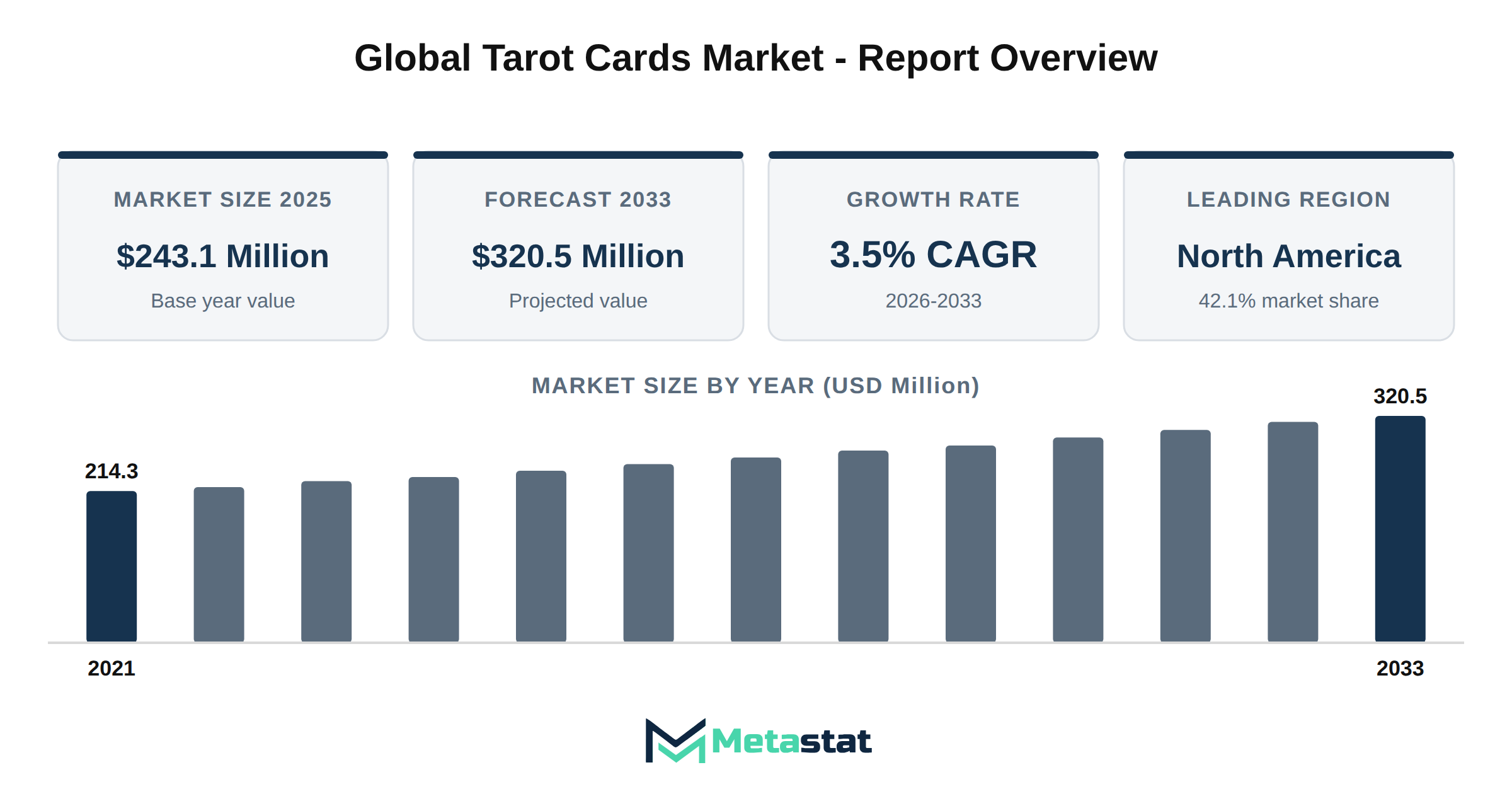
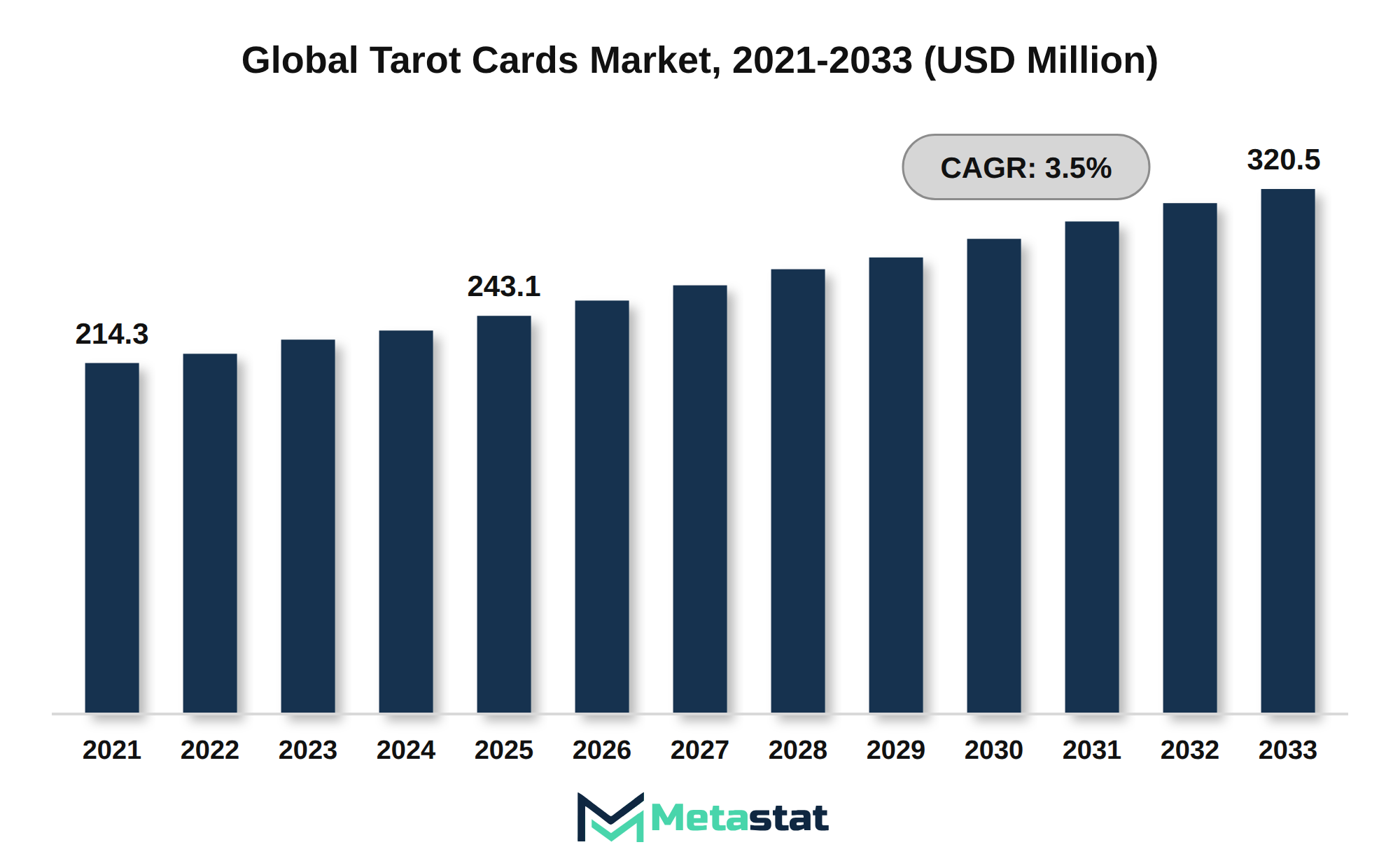
The global Tarot Cards market was valued at USD 243.1 million in 2025 and is projected to reach USD 320.5 million by 2033, growing at a CAGR of 3.5% over the forecast period.
The Tarot Cards market reached a valuation of USD 243.1 million in 2025, marking a steady increase from USD 214.3 million in 2021. This growth trajectory is evident, with projected revenues climbing to USD 320.5 million by 2033, representing a compound annual growth rate (CAGR) of 3.5% over the forecast period from 2026 to 2033. The market displays robust demand across various customer segments, driven by cultural and spiritual interests, and the rising popularity of tarot reading for both personal development and professional use.
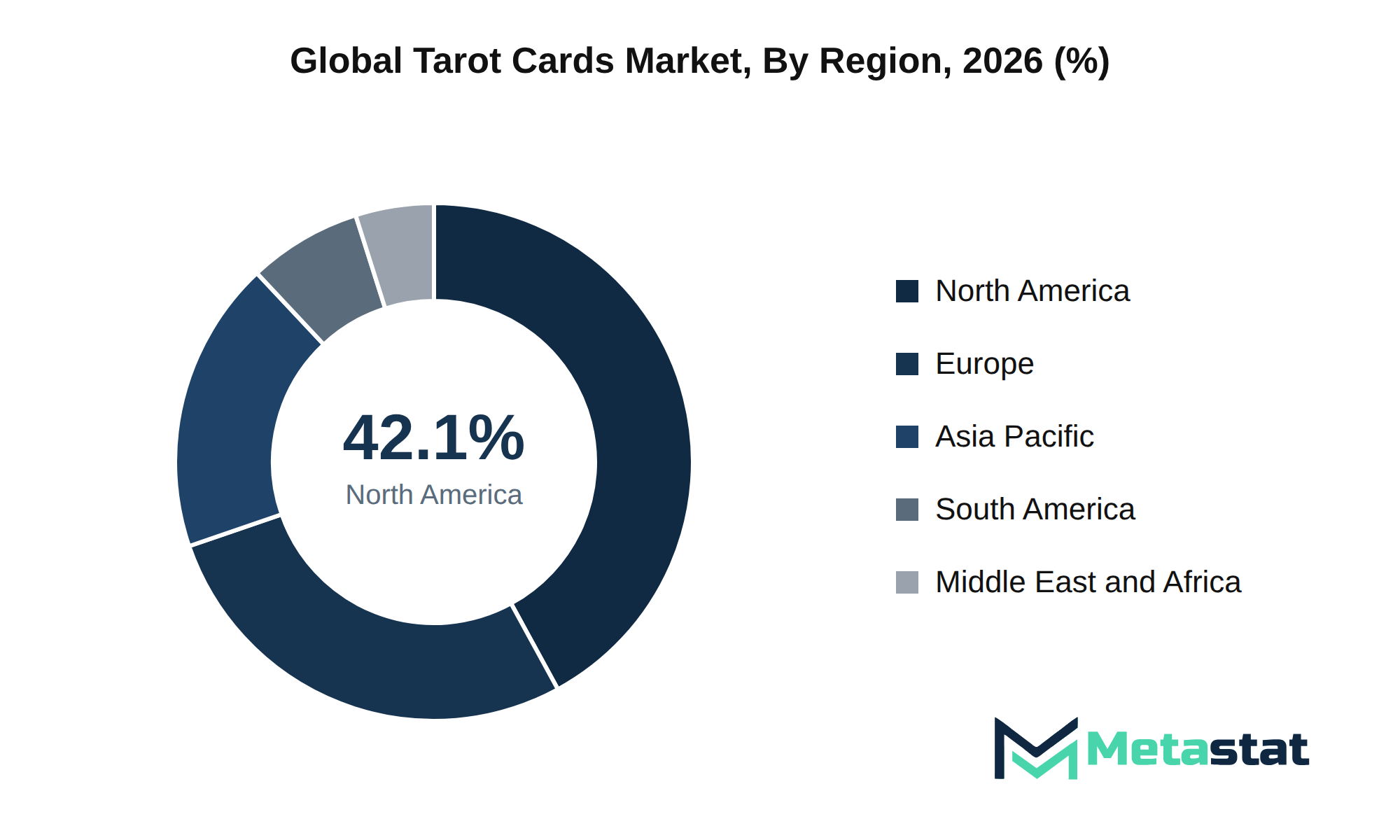
Regional dynamics indicate that North America holds a market share of 42.1%, with a projected value of USD 129.9 million by 2033, maintaining a CAGR of 3.5%. Europe follows closely with a market share of 27.7%, while the Asia Pacific region accounts for 18.3%. The diverse applications of tarot cards, including divination, self-reflection, and spiritual practices, contribute to the market's expanding footprint worldwide.
The Tarot Cards market experiences significant trends impacting its growth trajectory. Increasing interest in tarot readings for self-reflection and personal development drives demand for various decks, particularly the Rider-Waite-Smith and Tarot de Marseille decks. The application of tarot for divination and fortune-telling receives substantial attention, with a projected CAGR of 4.6% from 2026 to 2033, reflecting consumer inclination towards spiritual exploration and personal insight.
Distribution channels play a crucial role in market dynamics. The online segment, representing a growing preference for digital purchasing, is projected to expand at a CAGR of 5.1% through 2033. In contrast, the offline segment demonstrates slow growth, indicating a shift in consumer habits towards e-commerce platforms for tarot card acquisition.
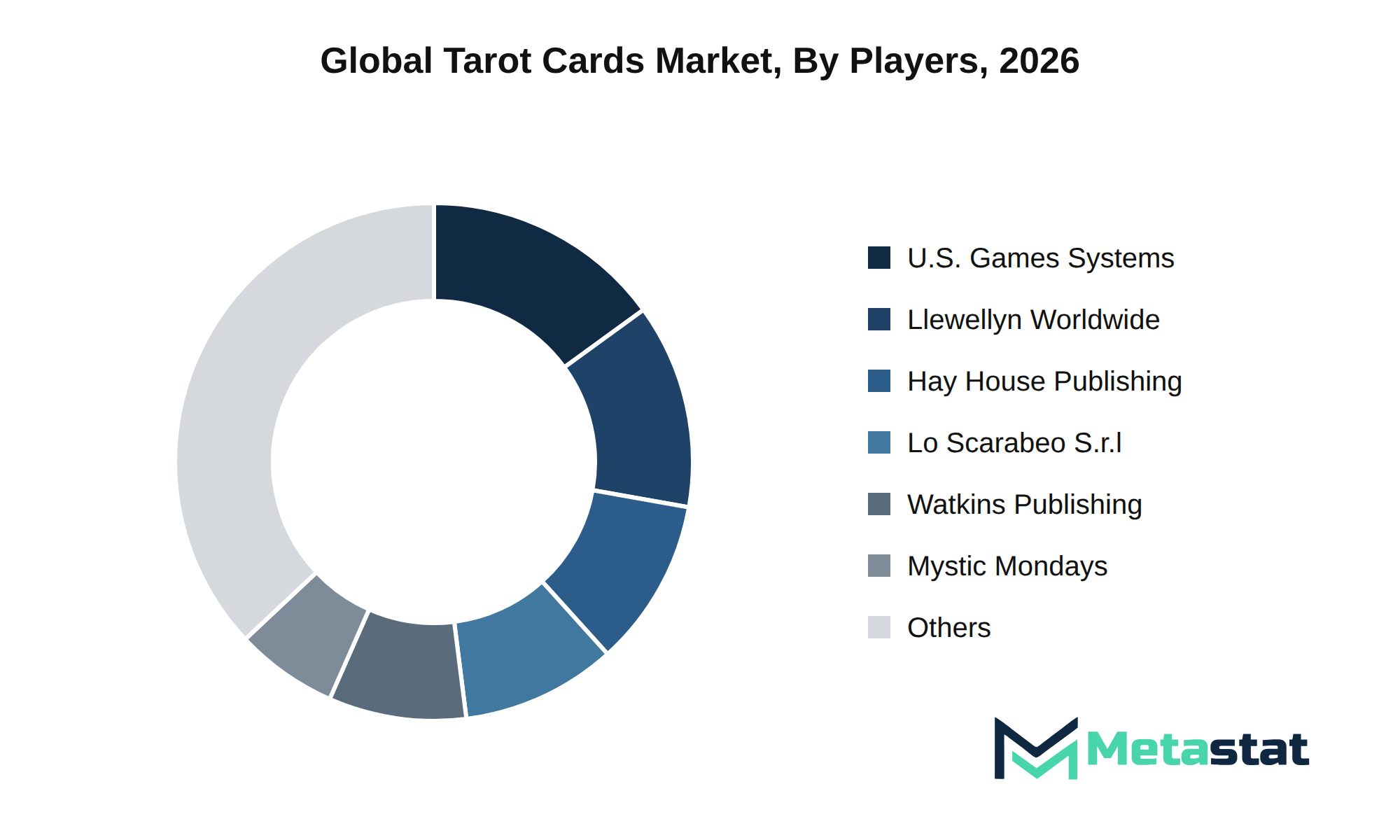
Key players in the competitive landscape include U.S. Games Systems, Inc., Llewellyn Worldwide, Ltd., and Lo Scarabeo S.r.l. These companies focus on innovation and product diversification to capture market share. Strategic collaborations and marketing initiatives enhance brand visibility and consumer engagement, influencing purchase decisions and customer loyalty.
Macroeconomic factors, including inflationary pressures and currency volatility, impact pricing strategies and operational costs for manufacturers and distributors in the market. Companies navigate these challenges while maintaining product affordability to sustain growth and demand in the Tarot Cards market.
Future strategic outlooks indicate a focus on sustainability and ethical sourcing within the tarot card industry. Brands that adopt eco-friendly practices and materials are likely to attract environmentally conscious consumers, reinforcing their market position. By aligning with these values, companies enhance customer relationships and strengthen long-term loyalty.
Market Dynamics
Macro-economic factors drive market growth
The Tarot Cards market experiences enhanced growth driven by macro-economic factors including GDP growth, consumer spending, and capital investment environments. Rising disposable incomes among consumers support increased spending on leisure activities, including Tarot card purchases. A focus on personal development and self-care contributes to a notable shift in consumer behavior, leading to higher demand for Tarot Cards in various applications.
Investment in digital transformation and technological integration further drives the market forward. The integration of online retail platforms facilitates access to diverse Tarot card options, attracting a broader audience. Enhanced online presence and marketing strategies enable suppliers to reach potential customers more effectively, boosting sales and expanding market penetration.
Globalization enhances market access and increases competition among suppliers. International trading opportunities improve the availability of unique and diverse Tarot card designs, appealing to consumers' evolving preferences. These factors collectively sustain a positive forecast for the market, with revenue projected to grow from USD 243.1 million in 2025 to USD 320.5 million by 2033, reflecting a compound annual growth rate of 3.5%.
Shifting demographic patterns drive market demand
The Tarot Cards market experiences growth driven by shifting demographic patterns. Aging populations increasingly seek self-reflection and personal development, prompting higher interest in Tarot cards driven by tools for insight and guidance. Urbanization trends contribute to lifestyle changes, allowing for greater exposure to alternative spirituality practices, including Tarot reading.
Consumer behaviors evolve, with younger demographics embracing Tarot cards for both divination and personal growth. The rise of wellness culture encourages individuals to explore various spiritual practices, including Tarot, attributed to a means of self-discovery and connection. This heightened interest leads to an expanding customer base, enhancing market penetration.
Online communities and social media platforms facilitate awareness and accessibility, allowing users to share experiences and resources related to Tarot cards. This connection creates a supportive environment for individuals exploring Tarot, driving demand across diverse segments, including individual consumers and spiritual practitioners.
The convergence of these demographic trends positions the Tarot Cards market for sustained growth. Anticipated increases in participation from both seasoned practitioners and newcomers signify a robust trajectory for the market through 2033.
Regulatory compliance and economic pressures
The Tarot Cards market encounters multiple restraints that hinder growth and expansion. Regulatory compliance imposes significant challenges, driven by stringent requirements for product safety and labeling. These compliance hurdles result in increased operational costs and extended timelines, affecting overall market dynamics.
Macroeconomic headwinds, including inflationary pressures, complicate the landscape. Rising costs of materials and labor create financial strain on producers, limiting their ability to invest in innovation and marketing. This situation impacts the market by restricting the adoption of new designs and features that could attract consumers.
Supply chain disruptions contribute to inefficiencies that delay product availability. Geopolitical instability exacerbates this issue, causing fluctuations in material costs and impacting trade routes. Consequently, manufacturers face challenges in maintaining consistent inventory levels and fulfilling customer demand.
Resource scarcity and high capital investment requirements pose additional barriers to market entry. Startups and smaller players find it increasingly difficult to compete against established firms that possess the financial resources to navigate these challenges effectively. The resulting market fragmentation leads to a lack of cohesion in product offerings, making it hard for consumers to find the desired Tarot Cards.
Technological obsolescence presents risks that players address to remain competitive. The rapid pace of digital transformation in entertainment and spirituality shifts consumer preferences away from traditional Tarot Cards. This shift prompts companies to explore innovative approaches, including integrating digital applications, to retain customer interest and attract a broader audience.
Finally, privacy concerns and data security vulnerabilities related to online transactions discourage consumer engagement. Ensuring robust protection of personal information is crucial for maintaining trust in the market, particularly with the rise of e-commerce platforms that cater to Tarot Cards enthusiasts.
Geopolitical tensions and trade disruptions
Geopolitical fragmentation impacts the Tarot Cards market by introducing uncertainties in supply chains and increasing operational costs. Fluctuations in trade relations and tariffs create obstacles for manufacturers, affecting their ability to source materials and components efficiently. Suppliers experience heightened compliance overhead, resulting in delays and reduced responsiveness to market demands, limiting overall market growth.
Technological disruptions further complicate market dynamics. Rapid advancements require ongoing investment in research and development, straining resources for smaller firms. This complexity in integration hinders new product development and innovation, placing pressure on the competitive landscape and reducing market competitiveness.
Logistics disruptions stemming from geopolitical events and trade policies induce significant volatility in shipping and transportation costs. Manufacturers face challenges in maintaining inventory levels, impacting their ability to meet consumer demand. Supply chain instability contributes to rising input cost structures, which pressures profit margins across the industry, ultimately affecting profitability.
Evolving consumer preferences lead to changing downstream demands. The Tarot Cards market encounters saturation in certain segments, compelling companies to differentiate their offerings. Heightened competition results in pricing compression, intensifying the need for strategic positioning through unique product features or branding initiatives to capture consumer interest.
Workforce skill gaps and talent retention pressures present additional challenges. Companies in the market struggle to attract and retain skilled professionals necessary for navigating technological advancements and maintaining operational efficiency. Addressing these workforce issues is crucial for sustaining growth and competitive advantage in the Tarot Cards sector, influencing long-term market stability.
The Tarot Cards market experiences opportunities stemming from emerging technological advancements that enhance user engagement and accessibility. Digital transformation facilitates online platforms for purchasing and learning, catering to a growing consumer base interested in tarot for both personal and professional applications. This shift creates significant opportunities for new entrants and established players who adapt to digital procurement shifts.
Infrastructure modernization impacts the market by enabling enhanced distribution channels and logistics. Improved online shopping experiences and streamlined supply chains support consumer demand, particularly in North America, where online sales are projected to expand significantly. This growth in online distribution aligns with changing buying behaviors, driven by consumers increasingly seeking digital solutions for acquiring tarot products.
Geographical expansion presents additional opportunities, particularly within emerging markets in Asia Pacific and South America. Increased interest in spiritual practices and personal development in these regions contributes to a rising demand for tarot cards. Companies that strategically localize their offerings capitalize on these trends, broadening their market reach and enhancing revenue generation.
Sustainability imperatives drive market opportunities. Growing awareness of environmental impacts prompts consumers to favor eco-friendly product options. Companies that integrate sustainable practices into their production processes and product offerings attract environmentally conscious consumers, leading to a competitive edge in the Tarot Cards market.
Next-generation innovations in tarot card designs and applications present further growth potential. Unique artistic expressions and niche applications, including tarot-themed merchandise, diversify product portfolios, appealing to broader audiences. By embracing these innovations, market players enhance their value propositions and stimulate consumer interest.
Market Segmentation Analysis
The Global Tarot Cards market is segmented based on Type, Application, End-user, and Distribution Channel.
By Type, the market is further segmented into:
Rider-Waite-Smith Tarot Decks
Tarot de Marseille Decks
Thoth Tarot Decks
Others (Contemporary / Modern Tarot Decks, and Italian / Historical Tarot Decks)
Rider-Waite-Smith Tarot Decks
Rider-Waite-Smith Tarot Decks hold a significant position within the Tarot Cards market, valued at USD 87.7 million in 2026. This segment is projected to reach USD 108.2 million by 2033, reflecting a compound annual growth rate (CAGR) of 3% during the forecast period. Demand for this specific type of tarot deck stems from its historical significance and widespread recognition, appealing to both novice and experienced users. The enduring popularity results from cultural influences and the deck's portrayal in media, which enhances its visibility and accessibility.
Factors driving adoption include the increasing interest in spirituality and personal development, propelling individuals toward tarot for guidance and self-reflection. Consumers often view Rider-Waite-Smith Tarot Decks because valuable tools for introspection and divination, aligning with trends in alternative practices. These dynamics fuel market expansion, creating strategic opportunities for suppliers dedicated to meeting this demand.
Technological advancements in deck design and production contribute to the segment's evolution. Enhanced printing techniques and eco-friendly materials attract environmentally-conscious consumers, supporting sustainable practices within the industry. Digital versions of the decks cater to a growing segment of tech-savvy users, expanding the audience and driving sales through online channels.
Pricing structures within this segment maintain competitiveness, influenced by production costs and consumer willingness to invest in quality tarot decks. Margin pressures arise from fluctuations in raw material prices, necessitating strategic sourcing and efficient production methodologies. Such approaches ensure that the segment remains resilient and responsive to market fluctuations.
Overall, Rider-Waite-Smith Tarot Decks represent a robust segment within the Tarot Cards market, poised for continued growth through evolving consumer preferences and the adoption of innovative practices. The projected increase in market value highlights its significance in the broader context of tarot and spiritual exploration.
Tarot de Marseille Decks
Growth within the Tarot de Marseille Decks segment reflects strong demand for traditional tarot reading practices. This demand arises from renewed interest in historical and cultural tarot interpretations, appealing to both novice and experienced users. The segment is projected to reach USD 59.4 million by 2033, with a CAGR of 2.6% during the forecast period.
Adoption of Tarot de Marseille Decks is influenced by the rising popularity of tarot-based self-reflection and personal development activities. Consumers increasingly seek tools that enhance spiritual practices and promote mindfulness. Consequently, the segment benefits from a diverse range of end-users, including individual consumers and spiritual practitioners.
Challenges related to pricing volatility and margin pressures impact the segment, with fluctuations in raw material costs affecting production. Strategic opportunities exist for brands to innovate and diversify product offerings, catering to modern preferences while maintaining the historical essence of the decks. Enhanced distribution channels, particularly online sales platforms, facilitate access and purchasing convenience, further driving market growth for Tarot de Marseille Decks.
Thoth Tarot Decks
Demand for Thoth Tarot Decks continues to grow, driven by their unique symbolism and appeal among both novice and experienced tarot readers. This segment benefits from a resurgence in interest in spiritual and self-reflective practices, aligning with broader trends in wellness and personal development. Enthusiasts value the intricate artwork and metaphysical depth associated with Thoth Tarot, which enhances their experience and connection with the cards.
Technological advancements contribute to segment growth; digital adaptations of Thoth Tarot decks provide accessibility through mobile applications and online platforms. These innovations appeal to a younger demographic interested in tarot for personal insight and entertainment. While the tarot community embraces online channels for distribution, the Thoth Tarot Decks segment gains visibility and reach, enabling easier access for consumers.
Thoth Tarot Decks are projected to reach USD 36 million by 2033, reflecting an expanding consumer base and increased sales opportunities. The ongoing evolution of tarot practices and educational resources enhances the segment's attractiveness, encouraging more individuals to explore tarot reading because a means of self-discovery. The market's focus on engaging content and community-building will continue to drive interest and stimulate growth within this segment.
Others (Contemporary / Modern Tarot Decks, and Italian / Historical Tarot Decks)
This segment experiences a projected growth rate of 3.9% during the forecast period, driven by increasing interest in diverse tarot card designs and themes. Contemporary and modern tarot decks appeal to new generations seeking personalization and unique aesthetic expressions in their tarot practices. The inclusion of Italian and historical tarot decks enriches the segment by attracting collectors and enthusiasts interested in traditional art and cultural heritage.
Adoption within the Others segment aligns with rising consumer engagement in tarot practices for self-reflection, spiritual exploration, and entertainment. Availability of these decks through online platforms enhances accessibility, creating a wider audience base. Engagement within social media communities dedicated to tarot sharing further stimulates demand, encouraging users to explore various deck designs.
Competitive dynamics in the market highlight several prominent players including U.S. Games Systems, Inc., Llewellyn Worldwide, Ltd., and Lo Scarabeo S.r.l. These companies focus on expanding their portfolios by introducing innovative designs and collaborating with artists to attract a broader audience. Strategic investments in marketing and partnerships with influencers support brand recognition and consumer loyalty. This competitive environment drives growth and innovation within the segment.
Ultimately, growth within the Others (Contemporary / Modern Tarot Decks, and Italian / Historical Tarot Decks) segment represents a shift in consumer preferences toward more personalized and culturally resonant tarot experiences. Expansion efforts capitalize on this trend, with firms adapting to evolving market demands while navigating challenges associated with pricing volatility and competitive pressures.
By Application, the market is further segmented into:
Divination and Fortune-Telling
Self-Reflection and Personal Development
Spiritual and Ritual Practice
Professional Tarot Reading
Divination and Fortune-Telling
Valued at USD 75.7 million in 2026, the divination and fortune-telling segment is projected to reach USD 103.8 million by 2033, at a CAGR of 4.6% during the forecast period. The growing interest in spiritual practices and self-discovery drives demand within this segment. Consumers increasingly seek connections with intuition and personal guidance, leading to a rise in tarot card usage for both recreational and spiritual purposes. Various industries, including wellness, personal development, and entertainment, benefit from this trend due to tarot reading integrating into diverse aspects of modern life.
Technological advancements enhance the accessibility and appeal of tarot reading. Digital platforms facilitate remote consultations, expanding the customer base for professional tarot readers. This shift toward online services reduces geographical barriers, allowing players in the tarot cards market to reach wider audiences. The growing acceptance of online tarot readings influences consumer behavior, emphasizing convenience and flexibility in obtaining guidance through tarot.
Market dynamics are further shaped by evolving consumer preferences and cultural shifts. Younger generations increasingly embrace tarot because a tool for self-reflection and personal development. This demographic shift encourages innovation in product offerings, including themed decks and educational resources. Since these consumers often prioritize authenticity and uniqueness, suppliers focused on high-quality materials and artistic design experience improved market positioning.
While the segment expands, established players face increased competition from new entrants and niche brands that cater to specific consumer demands. Maintaining a competitive edge requires continuous adaptation to market trends and consumer preferences. Investments in marketing and branding, alongside product diversification, support sustained growth within the divination and fortune-telling segment of the tarot cards market.
Self-Reflection and Personal Development
Growth in the Self-Reflection and Personal Development segment is driven by increasing consumer interest in personal growth and self-awareness practices. Individuals seek tools that support introspection and emotional well-being, leading to a higher demand for Tarot cards tailored for personal development. This trend aligns with broader societal movements emphasizing mental health and personal practices.
The segment is estimated to reach USD 76.5 million by 2033, at a CAGR of 2.8% during the forecast period. Consumers increasingly view Tarot cards not only because divination tools but because resources for self-exploration, resulting in broader acceptance within therapeutic and self-help communities. This shift reinforces the segment's growth potential, especially among individual consumers seeking meaningful ways to engage with their emotions and thoughts.
Consumer preferences are shifting towards products that facilitate personal insights and mindfulness. The focus on emotional intelligence and self-care ensures that the market attracts a diverse audience. Increased awareness of Tarot because a medium for self-reflection expands its appeal beyond traditional users, enhancing market dynamics.
Investment in product development aimed at enhancing user experience through innovative designs and educational resources positions this segment for sustained growth. Companies in the Tarot Cards market that offer engaging content and interactive experiences are likely to capture a larger share of the expanding consumer base dedicated to self-reflection and personal development.
Spiritual and Ritual Practice
Growth within the Spiritual and Ritual Practice segment stems from an increasing interest in alternative practices. This trend reflects a broader societal shift towards spirituality, with individuals seeking deeper connections and understanding through tarot cards. The demand arises predominantly from spiritual practitioners and individual consumers who use tarot cards for rituals, self-reflection, and meditation. Increasing awareness of the benefits associated with tarot practices supports market expansion, and the segment is projected to reach USD 56.6 million by 2033.
Technological advancements contribute to this growth, with online resources and communities enhancing accessibility to spiritual practices. Consumers increasingly access digital platforms for tarot readings and instructional content, driving demand for innovative deck designs and formats. This digital transformation influences consumer behavior and purchasing patterns, emphasizing the need for tarot card manufacturers to adapt their offerings to meet evolving consumer expectations.
The Spiritual and Ritual Practice segment represents a significant area of growth within the Tarot Cards market, driven by changing consumer preferences, technological innovations, and a growing interest in spiritual exploration.
Professional Tarot Reading
Growth in the Professional Tarot Reading segment reflects a steady demand for personalized tarot services, primarily driven by a rising interest in spiritual guidance and self-discovery. This demand arises from both individual consumers seeking insights into personal challenges and professional tarot readers offering their expertise to a growing clientele. The segment benefits from various factors, including increasing acceptance of alternative spiritual practices and the expansion of online platforms facilitating access to readings.
Technological maturation supports the Professional Tarot Reading segment through enhanced online platforms that connect clients with readers, streamlining booking processes and improving user experiences. Next-generation upgrades, including mobile applications and interactive features, enrich the consumer experience and encourage wider adoption of tarot reading services. Evolving consumer preferences toward authentic, personalized experiences drive growth within the segment, encouraging professional readers to adapt their offerings to align with client expectations.
By 2033, the Professional Tarot Reading segment is projected to grow at a CAGR of 3.1% during the forecast period, reflecting its increasing value within the broader Tarot Cards market. Financial opportunities for professional tarot readers expand due to their leverage of online channels to reach diverse audiences. This strategic shift toward digital platforms not only enhances market accessibility but increases competition among service providers, prompting innovations and service diversification.
The Professional Tarot Reading segment enjoys a favorable growth trajectory due to factors including technological advancements, evolving consumer preferences, and the increasing legitimacy of spiritual practices. The market outlook indicates continued expansion, driven by these underlying dynamics and a growing appreciation for the value of tarot readings in modern life.
By End-user, the market is further segmented into:
Individual Consumers
Professional Tarot Readers
Spiritual Practitioners
Others (Tarot Educators / Instructors, and Metaphysical & Spiritual Businesses)
Individual Consumers
Valued at USD 101.9 million in 2026, the Individual Consumers segment is projected to reach USD 133.6 million by 2033, reflecting a CAGR of 3.9% during the forecast period. Demand in this segment is driven by the increasing interest in personal development and self-reflection practices, which often incorporate tarot readings. Individual consumers increasingly seek tarot cards for both recreational purposes and serious personal insights, creating a lively market.
Growing awareness of tarot among younger demographics contributes to market expansion, with social media platforms facilitating knowledge sharing and community building around tarot practices. The rise of e-commerce platforms enhances accessibility, allowing individual consumers to purchase diverse tarot decks and related content easily. This trend supports growth in the market, driven by consumers exploring various styles and interpretations of tarot.
Technological advancements play a role in the evolution of tarot, with digital tarot applications and interactive content enhancing user experiences. This evolution attracts tech-savvy consumers who appreciate the convenience of mobile applications alongside traditional card decks. These shifts in consumer preferences indicate significant changes within the market, reflecting the ongoing adaptation to contemporary lifestyles.
In addition, the increasing popularity of alternative spirituality and personal practices supports demand. Individual consumers leverage tarot because a tool for introspection and guidance, further expanding the market. The segment's growth correlates with broader trends in mental wellness and self-care, positioning it favorably within the wider context of personal development industries.
Professional Tarot Readers
Demand for Professional Tarot Readers continues to experience growth driven by increasing interest in alternative spiritual practices and personal guidance. Clients seek insights through tarot readings, connecting with professional readers who provide personalized interpretations. This segment benefits from a cultural shift towards openness regarding spirituality and self-exploration, encouraging individuals to seek professional advice through tarot. The rising popularity of tarot reading platforms enhances accessibility, allowing professionals to reach a broader audience.
This segment is projected to reach USD 78.4 million by 2033, at a CAGR of 3.2% during the forecast period. Revenue growth within this segment reflects the increasing value placed on professional tarot readings amid evolving consumer preferences. Technological advancements in online platforms for bookings and consultations streamline the customer experience, further supporting market growth. Rising consumer interest in mental health and wellness influences demand for tarot readings, with professionals adapting their offerings to meet evolving needs.
The Professional Tarot Readers segment aligns with broader trends in the Tarot Cards market, highlighting the importance of personal connection and tailored experiences. While the market expands, professionals who leverage digital tools and maintain a strong online presence are positioned to thrive, catering to clients seeking guidance in their personal journeys.
Spiritual Practitioners
Growth in the Spiritual Practitioners segment reflects a rising integration of tarot cards into spiritual practices, contributing significantly to the overall Tarot Cards market. This segment benefits from increasing interest in spiritual healing modalities, driving demand among practitioners who use tarot for guidance and self-reflection. Societal shifts toward mental wellness and the exploration of alternative spiritualities enhance adoption rates within this demographic.
Projected growth of the segment highlights its potential, with expectations to reach USD 60.8 million by 2033. The expansion creates opportunities for product evolution and innovation, encouraging suppliers to develop specialized decks and resources that cater specifically to spiritual practitioners. This evolution aligns with broader consumption shifts toward personalized and meaningful spiritual experiences.
The market includes a diverse array of players, creating competitive dynamics that support strategic investment opportunities. While the segment matures, challenges including pricing volatility and margin pressures arise, compelling practitioners to seek out cost-effective solutions while maintaining quality. Continued interest in spiritual practices ensures ongoing engagement with tarot cards, cementing their role in the evolving marketplace.
Others (Tarot Educators / Instructors, and Metaphysical & Spiritual Businesses)
Growth in the Others (Tarot Educators / Instructors, and Metaphysical & Spiritual Businesses) segment is projected to grow at a CAGR of 3.4% during the forecast period. This growth reflects an increasing interest in tarot education and spiritual practices, driven by more individuals seeking guidance and resources in metaphysical areas. Educational institutions and spiritual businesses provide courses and workshops that enhance the understanding of tarot reading, thereby expanding the user base. This segment sees significant demand from both aspiring tarot practitioners and established professionals looking to deepen their knowledge.
Technological advancements contribute to this segment's growth, enabling online platforms for remote learning and interaction. The convenience of online courses attracts a broader audience, including those unable to attend in-person workshops. The rise of social media platforms facilitates community-building among tarot enthusiasts, enhancing engagement and interest in tarot-related educational offerings. This increased access leads to higher enrollment rates in tarot education programs and a greater demand for metaphysical products and services.
Cost structures in this segment remain influenced by competition and pricing strategies among educators and businesses. Pricing volatility occurs due to fluctuations in the demand for courses and materials, which affect profitability. Nonetheless, established brands within the tarot education space maintain resilience through diverse offerings and strong brand loyalty. Strategic investments in marketing and course development enhance visibility and attract customers, ultimately driving growth within the Others segment of the Tarot Cards market.
By Distribution Channel, the market is further segmented into:
Online
Offline
Online
Valued at USD 157.4 million in 2026, the Online segment of the Tarot Cards market is projected to reach USD 222.9 million by 2033, achieving a CAGR of 5.1% during the forecast period. Increasing consumer preference for online shopping, driven by convenience and accessibility, significantly fuels demand within this segment. The rise in digital platforms for purchasing Tarot Cards enhances market reach, attracting a broader customer base including individual consumers and spiritual practitioners.
Technological advancements in e-commerce platforms contribute to an efficient shopping experience, allowing consumers to explore diverse product offerings. Enhanced digital marketing strategies enable sellers to effectively target niche audiences, further expanding the segment. This shift towards online distribution channels reflects changing consumer behavior towards convenience and quick access to various Tarot products.
The growing trend of self-reflection and personal development drives demand for Tarot Cards purchased online. The accessibility of educational resources related to Tarot readings and interpretations online encourages new consumers to engage with the product. This trend increases purchasing frequency, reinforcing the segment's growth trajectory.
The Online segment within the Tarot Cards market benefits from evolving consumer preferences and technological innovations, positioning it for significant growth in the coming years.
Offline
Growth in the offline distribution channel for the Tarot Cards market reflects a steady consumer preference for in-person experiences and physical products. Many buyers prefer the tactile experience of handling Tarot cards prior to purchase, enhancing their connection to the product. This segment serves a diverse range of end-users, including individual consumers and professional tarot readers, who benefit from the immersive environment provided by physical stores. The offline segment is expected to reach USD 97.6 million by 2033, at a CAGR of 0.4% during the forecast period. Continued interest in traditional retail formats supports this growth, driven by the cultural significance of Tarot cards in various communities. Local metaphysical shops and bookstores contribute to the segment's expansion, providing customers access to a variety of decks and educational materials.
By Region
Based on geography, the Global Tarot Cards market is divided into North America, Europe, Asia-Pacific, South America, Middle East, and Africa.
North America
North America represents a significant portion of the Tarot Cards market, holding a 42.1% share of the global market in 2025. The region is projected to expand at a CAGR of 3.5% within the forecast period, reaching a market size (TAM) of USD 129.9 million by the end of 2033.
Demand for Tarot Cards is influenced by various factors, including cultural preferences and the growing interest in personal development and spiritual practices among consumers in the United States, Canada, and Mexico. This heightened interest drives adoption rates across several segments, particularly in the application of divination and fortune-telling.
Investment in localized manufacturing and distribution channels supports market growth. The online distribution channel thrives, with a projected CAGR of 5.1% through 2033. This expansion reflects a shift in consumer behavior toward digital purchasing methods, enhancing accessibility and convenience for buyers.
Key players operating in the North American market include U.S. Games Systems, Inc., Llewellyn Worldwide, Ltd., and Hay House Publishing. These companies engage in product innovation and strategic partnerships to strengthen their positions in the market.
Emerging trends including increased participation in spiritual practices and the popularity of Tarot because a tool for self-reflection contribute positively to market dynamics. With consumers seeking diverse and personalized experiences, the Tarot Cards market in North America is well-positioned for sustained growth.
Europe
Europe holds a 27.7% share of the global Tarot Cards market in 2025. The demand for Tarot Cards in this region arises from a blend of cultural appreciation for divination practices and an increasing focus on self-reflection and personal development. Countries including Germany, France, and the UK exhibit strong engagement with Tarot Cards, driven by a historical affinity for spiritual practices and a growing community of practitioners.
The Tarot Cards market in Europe benefits from a well-established distribution network, with both online and offline channels facilitating access to various consumer segments. Online sales are expected to see significant growth, driven by increased digital engagement and the proliferation of e-commerce platforms. Offline channels remain vital, catering to local consumer preferences and creating community through physical retail experiences.
Germany leads in market activity, followed closely by the UK and France. These nations demonstrate a mature market environment with a diverse range of offerings, including traditional decks like Rider-Waite-Smith and contemporary variants. Italy and Spain contribute to market vitality through unique cultural interpretations of Tarot, enriching the overall diversity of products available.
Investment in localized manufacturing and supply chain optimization sustains market dynamics. The presence of major players further strengthens competition and innovation, ensuring that the Tarot Cards market in Europe remains active and responsive to consumer trends and preferences. Emerging market segments, including Tarot education and instructional resources, indicate potential growth areas, appealing to individuals seeking deeper engagement with Tarot practices.
Asia-Pacific
The Asia-Pacific region holds an 18.3% share of the global Tarot Cards market in 2025. Growth in this market segment is fueled by increasing interest in divination practices and personal development. Countries including China, Japan, India, South Korea, and Australia exhibit rising consumer engagement with Tarot cards, driven by cultural factors and a growing acceptance of alternative spiritual practices.
In China, the market benefits from a rapidly expanding middle class that seeks diverse spiritual experiences. The increasing popularity of online platforms for Tarot readings enhances market accessibility, encouraging consumer participation. Japan features a unique blend of traditional and modern Tarot practices, appealing to both local and international audiences.
India's rich spiritual heritage contributes to a solid demand for Tarot cards, with consumers integrating them into various aspects of life, including personal reflection and guidance. The growth of spiritual practitioners in South Korea further supports the market. Interest in Tarot because a tool for self-discovery and insight continues to rise.
The online distribution channel emerges because a significant driver in the region. E-commerce platforms facilitate the easy acquisition of Tarot decks, enabling widespread access to diverse offerings. This trend reflects a shift in consumer behavior towards digital purchasing, particularly among younger demographics.
Emerging markets within Southeast Asia and the Rest of Asia-Pacific exhibit untapped potential for growth in the Tarot Cards market. Increased internet penetration and growing disposable income in these areas create an opportunity for local vendors to introduce innovative Tarot products, thus expanding their reach and market share.
South America
South America represents a growing segment in the Tarot Cards market. The presence of diverse cultural backgrounds across Brazil, Argentina, and the Rest of South America fuels interest in tarot and alternative spiritual practices. Increasing awareness and acceptance of tarot readings for both personal development and divination enhance demand among individual consumers and spiritual practitioners.
Brazil serves because the largest market in the region, with an expanding population interested in various practices. Argentina follows closely, contributing to market growth through an increasing number of tarot readers and educators. The Rest of South America, while smaller in size, has emerging interest, particularly in urban areas where spiritual practices gain traction.
Online distribution channels play a significant role in accessibility, with e-commerce platforms providing a convenient avenue for purchasing tarot cards. The steady growth of internet penetration and digital literacy in the region supports this trend. Offline channels continue to exist, although they face challenges from the rapidly growing online market.
The market is expected to experience incremental growth driven by cultural nuances and regional buying behaviors. Increased consumer engagement with tarot cards reflects broader trends toward self-exploration and spiritual fulfillment. Collaborations among local vendors and international players enhance competitive dynamics, positioning the region for further expansion in the Tarot Cards market.
Middle East and Africa
Growth in the Middle East and Africa for the Tarot Cards market reflects a blend of cultural interest and rising consumer engagement. Increased adoption stems from a growing appreciation for tarot practices in countries like Saudi Arabia and the UAE, where interest in spiritual well-being is rising. In South Africa, a diverse demographic contributes to a unique cross-section of tarot users, enhancing market dynamics.
The region holds a 4.9% share of the global market in 2025, indicating significant opportunities for segment expansion. Individual consumers lead demand, driven by the increasing availability of tarot resources and online platforms. The online distribution channel is particularly influential, with an anticipated growth trajectory, reflecting broader trends in e-commerce.
Emerging market front-runners demonstrate potential through localized manufacturing densities and regional supply chain dynamics. Cultural nuances play a significant role in shaping procurement behaviors, enhancing connections between suppliers and consumers. Strategic entry barriers evolve alongside foreign direct investment flows, creating a competitive environment that influences growth rates across the sector.
Overall, growth in this market continues to build momentum, with incremental growth vectors arising from evolving consumer preferences and the increasing prominence of tarot practices across the region.
Competitive Landscape and Strategic Insights
The Tarot Cards market features a diverse competitive landscape characterized by strategic alliances and product differentiation among key players. Companies including U.S. Games Systems, Inc., Llewellyn Worldwide, Ltd., and Lo Scarabeo S.r.l. engage in extensive research and development, promoting innovation within their product lines to maintain market relevance. These investments enhance their respective offerings, ensuring alignment with evolving consumer preferences.
Pricing strategies play a significant role in competitiveness. Players adopt various commercial models, from premium pricing for specialized decks to value pricing for mass-market products. This flexibility allows companies like Hay House Publishing and Mystic Mondays LLC to reach a broader audience while enhancing brand equity. The focus on online distribution channels has risen, with players leveraging e-commerce platforms to increase accessibility and streamline purchasing processes.
The market experiences challenges related to barriers to entry and the threat of new entrants. Established players benefit from strong brand loyalty and extensive distribution networks, which deter startups from gaining market share. Companies like Dust II Onyx and Insight Editions apply their established intellectual property portfolios to create significant competitive moats, further strengthening their positions within the Tarot Cards market.
Future competitive dynamics will likely evolve through continued consolidation and strategic partnerships, enhancing operational capabilities and market reach for players. Companies including Laurence King Publishing (Hachette UK Limited) and Dark Horse Direct are strategically positioned to capitalize on emerging opportunities, ensuring sustained growth in this market.
Forecast and Future Outlook
Market size is forecast to rise from USD 243.1 million in 2025 to over USD 320.5 million by 2033. The base case anticipates a compound annual growth rate (CAGR) of 3.5% during this period. The outlook for the Tarot Cards market reflects a stable growth trajectory influenced by factors including cultural interest in divination practices and increased availability of diverse tarot decks.
The bull case envisions accelerated adoption driven by emerging trends in spiritual practices and personal development, resulting in greater engagement from individual consumers and spiritual practitioners. This scenario is expected to lead to higher revenue generation from both online and offline distribution channels.
Conversely, the bear case highlights potential challenges, including economic fluctuations that could impact discretionary spending on tarot products. Regulatory changes in the metaphysical industry could introduce compliance hurdles, restricting market access and growth opportunities.
Overall, the Tarot Cards market is positioned for solid growth, with various factors influencing its expansion and potential challenges requiring strategic navigation.
Tarot Cards Market Key Segments
By Type:
Rider-Waite-Smith Tarot Decks
Tarot de Marseille Decks
Thoth Tarot Decks
Others (Contemporary / Modern Tarot Decks, and Italian / Historical Tarot Decks)
By Application:
Divination and Fortune-Telling
Self-Reflection and Personal Development
Spiritual and Ritual Practice
Professional Tarot Reading
Others (Education and Tarot Learning, Entertainment and Recreational Card Play, Collecting and Artistic Appreciation, and Gift and Lifestyle Use)
By End-user:
Individual Consumers
Professional Tarot Readers
Spiritual Practitioners
Others (Tarot Educators / Instructors, and Metaphysical & Spiritual Businesses)
The report strategically identifies and profiles the key market players and analyses their core competencies in each sub-segment of the Tarot Cards market.
Report Attributes
Details
Study Period
2021-2033
Base Year
2025
Estimated Year
2026
Forecast Period
2026-2033
Historical Period
2021-2025
Growth Rate
CAGR 3.5% from 2026 to 2033
Revenue Unit
USD million
Segmentation
By Type, Application, End-user, Distribution Channel, and Region
By Region
North America (By Type, Application, End-user, Distribution Channel, and Country)
United States
Canada
Mexico
Europe (By Type, Application, End-user, Distribution Channel, and Country)
Germany
France
UK
Italy
Spain
Russia
Rest of the Europe
Asia Pacific (By Type, Application, End-user, Distribution Channel, and Country)
China
Japan
India
South Korea
Australia
Southeast Asia
Rest of Asia Pacific
South America (By Type, Application, End-user, Distribution Channel, and Country)
Brazil
Argentina
Rest of South America
Middle East and Africa (By Type, Application, End-user, Distribution Channel, and Country)
Saudi Arabia
UAE
South Africa
Rest of Middle East and Africa
WHAT REPORT PROVIDES
Company Market Share, Revenue and Ranking for the Tarot Cards Market
Key Company Market Leaders in the Tarot Cards Industry
Full In-Depth Analysis of the Tarot Cards Market Dynamics
Historical, Ongoing and Projected Market Analysis for Tarot Cards
Segmentation Details of the Tarot Cards Market
Key Strategies of Major Players in the Tarot Cards Market
Competitive Benchmarking of Tarot Cards Market Participants
Emerging Segments and Regional Growth Potential in Tarot Cards
Find answers to common questions about this report
The Tarot Cards market size was valued at USD 243.1 million in 2025, according to the Metastat Insights study.
The Tarot Cards market is projected to grow at a CAGR of 3.5% during the forecast period from 2026 to 2033.
The North America Tarot Cards market size is estimated to reach USD 129.9 million by 2033.
Rider-Waite-Smith Tarot Decks lead the Tarot Cards market, with a projected value of USD 108.2 million by 2033. This segment's growth reflects a compound annual growth rate (CAGR) of 3.0% during the forecast period.
The key drivers for the Tarot Cards market include rising disposable incomes, increased consumer spending on leisure activities, and a growing focus on personal development. the integration of online retail platforms and the expansion of globalization enhance market access and competition, further boosting demand.
North America holds the dominant share of the Tarot Cards market, accounting for 42.1 percent in 2025. This significant share reflects the region's strong consumer interest and established market presence.
The Tarot Cards market faces several restraints, including regulatory compliance challenges that increase operational costs and delay product availability. Macroeconomic factors, including inflation and supply chain disruptions, further complicate the landscape, while resource scarcity and high capital investment requirements hinder market entry for smaller players.
Multiple factors favor product adoption in the Tarot Cards market, including increased disposable incomes, a focus on personal development, and the rise of wellness culture. the integration of online retail platforms enhances accessibility, expanding the customer base and driving demand across various segments.
The Tarot Cards market is estimated to reach a valuation of USD 320.5 million by 2033.
Key players in the Tarot Cards market include U.S. Games Systems, Inc., Llewellyn Worldwide, Ltd., Lo Scarabeo S.r.l., Hay House Publishing, Watkins Publishing, and Mystic Mondays LLC.
Gift Cards market size is valued at USD 713.3 billion in 2025 and projected to reach USD 2,275.4 billion by 2033, growing at a CAGR of 15.6%.
Gift Cards market, Gift Cards Market Size, Gift Cards Market Share, Gift Cards Market Analysis, Gift Cards Market Growth, Gift Cards Market Trends, Gift Cards Market Research Report, Gift Cards Market Forecast, Gift Cards, Gift Cards Market Research, Gift Cards Industry, Gift Cards Industry Report, Gift Cards Market Data, Gift Cards Statistics, Gift Cards Market Statistics, Gift Cards Industry Trends, Gift Cards Market Report, Gift Cards Market Trends, Gift Cards Market News, Gift Cards Forecasts, Gift Cards Market Intelligence Report, Gift Cards market 2033, Gift Cards market outlook, Gift Cards market segmentation, Gift Cards market drivers, Gift Cards market restraints, Gift Cards market opportunities, Gift Cards market CAGR, Gift Cards suppliers, Gift Cards manufacturers, Gift Cards market by region, North America Gift Cards market, Asia Pacific Gift Cards market, Europe Gift Cards market, Gift Cards market competitive landscape, Gift Cards market key players, Closed-Loop Gift Cards market, Open-Loop Gift Cards market, Digital and eGift Cards market, Personal Gifting Gift Cards market, Employee Rewards Gift Cards market, Customer Loyalty Gift Cards market, Direct-to-Consumer Gift Cards market.
Luxury Resort Hotel Market Size, Share, Trends, 2033
Luxury Resort Hotel market is valued at USD 42.2 billion in 2025 and projected to reach USD 81.7 billion by 2033, growing at a CAGR of 8.6%.
Luxury Resort Hotel market, Luxury Resort Hotel Market Size, Luxury Resort Hotel Market Share, Luxury Resort Hotel Market Analysis, Luxury Resort Hotel Market Growth, Luxury Resort Hotel Market Trends, Luxury Resort Hotel Market Research Report, Luxury Resort Hotel Market Forecast, Luxury Resort Hotel, Luxury Resort Hotel Market Research, Luxury Resort Hotel Industry, Luxury Resort Hotel Industry Report, Luxury Resort Hotel Market Data, Luxury Resort Hotel Statistics, Luxury Resort Hotel Market Statistics, Luxury Resort Hotel Industry Trends, Luxury Resort Hotel Market Report, Luxury Resort Hotel Market Trends, Luxury Resort Hotel Market News, Luxury Resort Hotel Forecasts, Luxury Resort Hotel Market Intelligence Report, Luxury Resort Hotel Market 2033, Luxury Resort Hotel Market Outlook, Luxury Resort Hotel Market Segmentation, Luxury Resort Hotel Market Drivers, Luxury Resort Hotel Market Restraints, Luxury Resort Hotel Market Opportunities, Luxury Resort Hotel Market CAGR, Luxury Resort Hotel Suppliers, Luxury Resort Hotel Manufacturers, Luxury Resort Hotel Market by Region, North America Luxury Resort Hotel Market, Asia Pacific Luxury Resort Hotel Market, Europe Luxury Resort Hotel Market, Luxury Resort Hotel Market Competitive Landscape, Luxury Resort Hotel Market Key Players, Mainland Beach & Coastal Resorts, Island Resorts, Mountain & Alpine Resorts, Luxury Guest Rooms, Online Travel Agencies, Luxury Tents & Lodges, Tour Operators & Destination Management Companies.
Small Kitchen Appliances Market Size, Share, Trends, 2033
Small Kitchen Appliances market size is valued at USD 37.2 billion in 2025 and projected to reach USD 59.3 billion by 2033, growing at a CAGR of 6.0%.
Small Kitchen Appliances market, Small Kitchen Appliances Market Size, Small Kitchen Appliances Market Share, Small Kitchen Appliances Market Analysis, Small Kitchen Appliances Market Growth, Small Kitchen Appliances Market Trends, Small Kitchen Appliances Market Research Report, Small Kitchen Appliances Market Forecast, Small Kitchen Appliances, Small Kitchen Appliances Market Research, Small Kitchen Appliances Industry, Small Kitchen Appliances Industry Report, Small Kitchen Appliances Market Data, Small Kitchen Appliances Statistics, Small Kitchen Appliances Market Statistics, Small Kitchen Appliances Industry Trends, Small Kitchen Appliances Market Report, Small Kitchen Appliances Market Trends, Small Kitchen Appliances Market News, Small Kitchen Appliances Forecasts, Small Kitchen Appliances Market Intelligence Report, Small Kitchen Appliances Market 2033, Small Kitchen Appliances Market Outlook, Small Kitchen Appliances Market Segmentation, Small Kitchen Appliances Market Drivers, Small Kitchen Appliances Market Restraints, Small Kitchen Appliances Market Opportunities, Small Kitchen Appliances Market CAGR, Small Kitchen Appliances Suppliers, Small Kitchen Appliances Manufacturers, Small Kitchen Appliances Market by Region, North America Small Kitchen Appliances Market, Asia Pacific Small Kitchen Appliances Market, Europe Small Kitchen Appliances Market, Small Kitchen Appliances Market Competitive Landscape, Small Kitchen Appliances Market Key Players, Food Preparation Appliances Market, Coffee Machines Market, Electric Kettles Market, Cooking Appliances Market, Residential Small Kitchen Appliances Market, Foodservice Small Kitchen Appliances Market