Global Smart Utility Metering Market Size, Share, By Meter Type (Smart Electricity Meters, Smart Gas Meters, Smart Water Meters, Smart Heat and Cooling Meters and Others), By Component (Smart Meter Hardware, Communication Modules and Data Concentrators, Head-End Systems and Meter Data Management Software, Installation, Integration and Managed Services and Others), By Communication Technology (Radio Frequency Mesh, Cellular, LTE-M and NB-IoT, Power Line Communication, LoRaWAN and Wireless M-Bus), By End-user Application (Residential, Commercial Buildings, Industrial Facilities, Municipal and Public Infrastructure and Others), Industry Analysis, Growth, Trends, and Forecast, 2026-2033
Report ID
MSI-4846
Published
August 3, 2026
Pages
286 Pages
Format
Market Size 2021
USD 22.7 Billion
Historical
Market Size 2025
USD 30.9 Billion
Base year
Market Size 2033
USD 58.5 Billion
Forecast
CAGR 2025-2033
8.3%
Forecast period
Report Details
Comprehensive Market Analysis And Insights
Market Overview
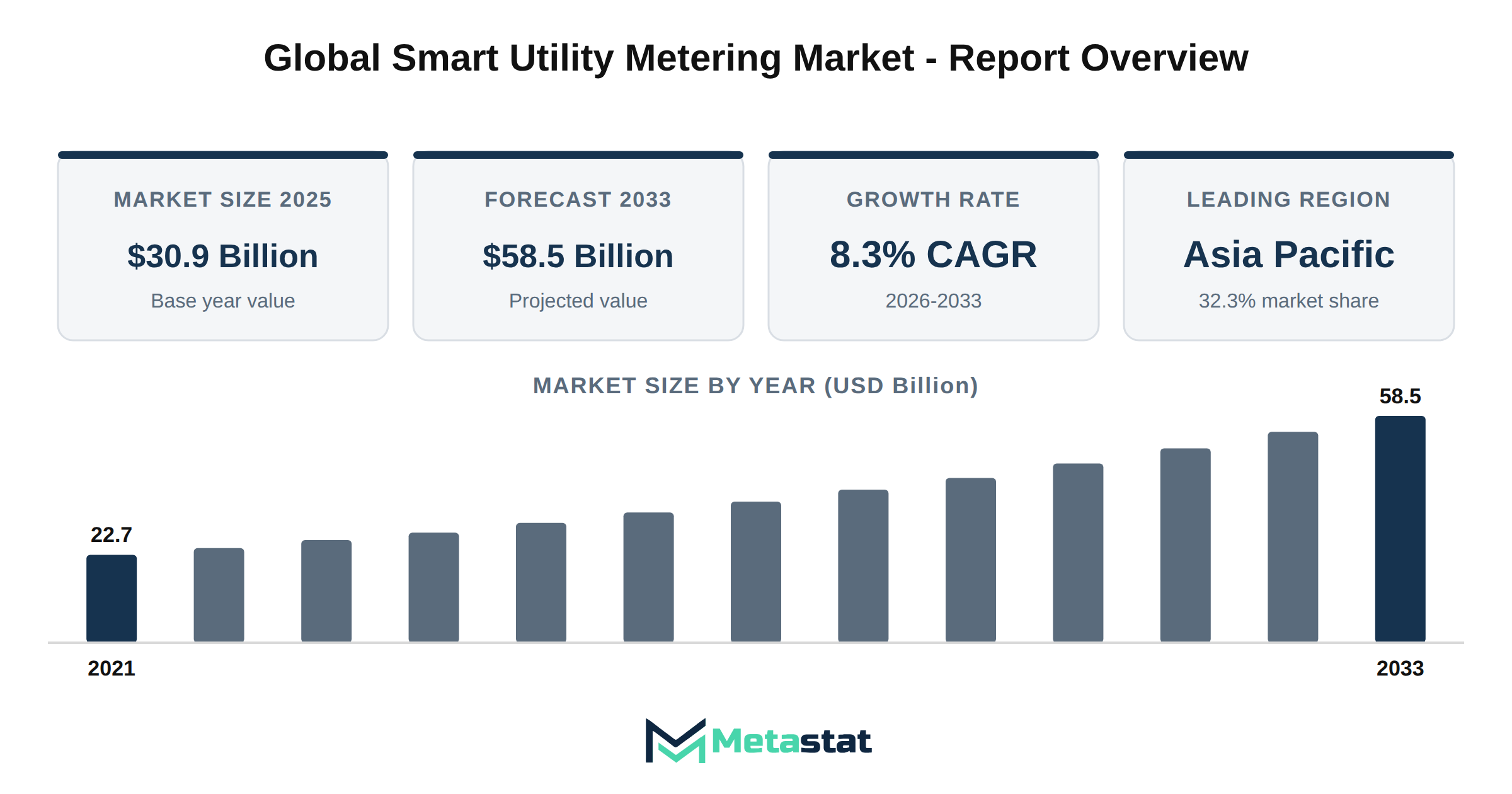
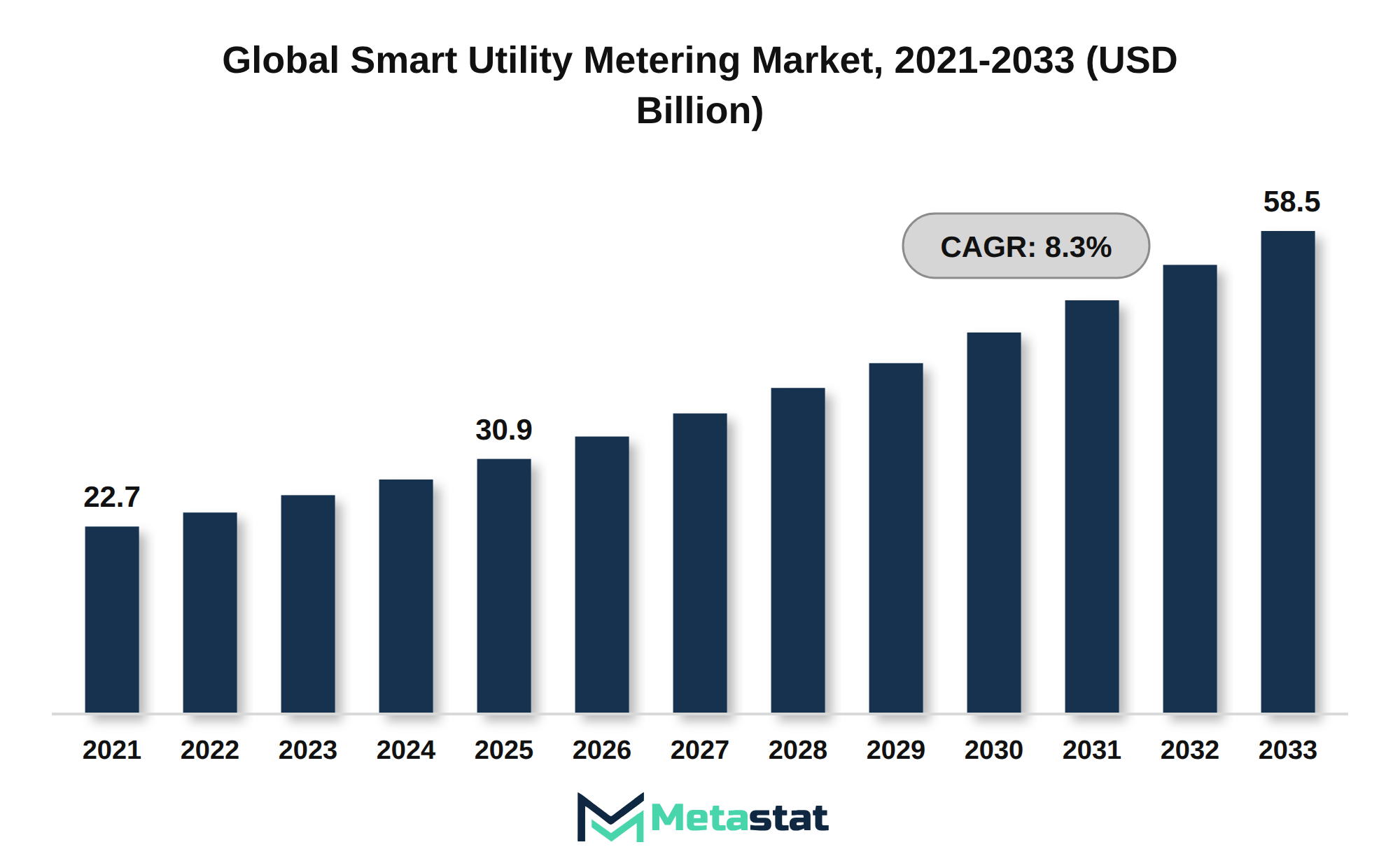
The global Smart Utility Metering market was valued at USD 30.9 billion in 2025 and is projected to reach USD 58.5 billion by 2033, growing at a CAGR of 8.3% over the forecast period.
The Smart Utility Metering market reached a value of USD 30.9 billion in 2025, reflecting significant growth from USD 22.7 billion in 2021. The market is projected to expand to USD 58.5 billion by 2033, achieving a compound annual growth rate (CAGR) of 8.3% during the forecast period from 2026 to 2033. This growth trajectory indicates increasing adoption of smart metering solutions across various sectors, driven by the need for improved energy efficiency and enhanced data management.
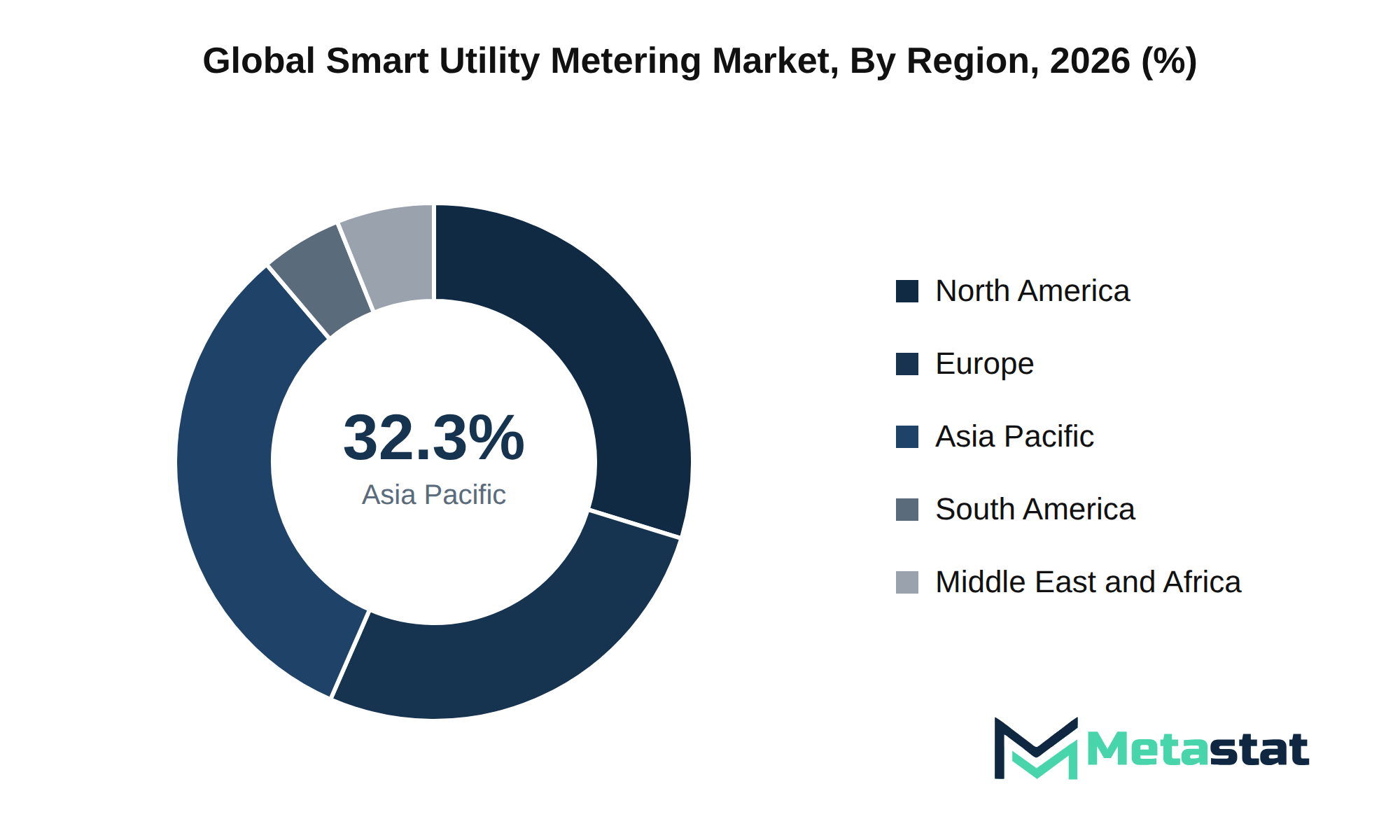
Regional dynamics highlight that Asia Pacific leads with a share of 32.3%, followed closely by North America at 29.8% and Europe at 26.8%. The geographical distribution suggests that emerging economies in Asia Pacific are rapidly adopting smart utility metering technologies, influenced by growing urbanization and infrastructure development. North America’s strong market presence results from advanced technology integration and substantial investments in smart grid initiatives.
The Smart Utility Metering market experiences significant dynamics driven by regulatory compliance and standards that shape the operational landscape. Regulations enforce the adoption of advanced metering infrastructure, enhancing data accuracy and operational efficiency. Compliance requirements influence both manufacturers and utility providers, encouraging investment in technology that aligns with evolving standards and consumer expectations. This trend enhances market growth prospects, prompting stakeholders to adopt smart metering solutions.
Geopolitical risks introduce uncertainties that affect supply chains and operational strategies within the market. Factors including trade policies and international relations impact sourcing and logistics, compelling companies to adapt their procurement strategies to mitigate potential disruptions. The ability to navigate these challenges influences competitive positioning and capital allocation, driving firms to invest in resilient supply chain solutions.
Research and development trajectories focus on next-generation innovations that enhance metering capabilities and improve energy management. Investments in smart technologies, artificial intelligence, and data analytics contribute to the development of more sophisticated metering solutions. These advancements enable utilities to optimize resource allocation and improve customer engagement, creating opportunities for market expansion and operational efficiency.
Sustainable transformation initiatives gain momentum owing to environmental concerns driving demand for energy-efficient solutions. Decarbonization efforts and the circular economy dynamics push utilities to adopt smart metering systems that promote efficiency and reduce waste. By embracing sustainability, the market aligns with global objectives, enhancing its appeal to environmentally conscious consumers and investors.
The market faces challenges related to inflationary pressures and currency volatility, impacting procurement costs and pricing strategies. Companies in the market adapt to fluctuating economic conditions, balancing operational expenses with competitive pricing. Effective capital allocation strategies are essential to navigate these macroeconomic headwinds and sustain growth.
Future strategic outlooks emphasize the importance of infrastructure investments and operational excellence. Companies prioritize CapEx and OpEx realities, ensuring that investments align with long-term growth objectives. By focusing on these areas, stakeholders in the Smart Utility Metering market position themselves to capitalize on emerging opportunities and enhance their overall competitive advantage.
Market Dynamics
Increasing digitization of utility operations
The Smart Utility Metering market experiences significant growth driven by the increasing digitization of utility operations. This trend is fueled by rising demand for accurate, real-time data on energy and resource consumption. Utilities enhance operational efficiency and customer engagement through this data. Adoption of smart utility metering technologies supports utilities in addressing the challenges of aging infrastructure and growing urban populations.
Investment in advanced technologies, including artificial intelligence and automation, plays a critical role in transforming traditional utility practices. Utilities invest significantly in integrating innovative solutions that streamline processes and improve service delivery. This integration positively impacts operational costs. The Smart Utility Metering market benefits from the focus on operational productivity, with utilities aiming to reduce overhead and optimize resource management.
Customers increasingly prioritize energy efficiency and sustainability, resulting in heightened expectations for utility providers. Addressing this demand requires utilities to adopt smart metering solutions that provide transparent energy consumption data. This capability enables consumers to make informed decisions. This shift in consumer behavior drives growth in the market, driven by utilities striving to enhance customer satisfaction and loyalty through improved service offerings.
Technological advancements in communication and data management further accelerate market expansion. The integration of communication modules and data concentrators into existing infrastructure enhances connectivity and data sharing capabilities. This evolution creates opportunities for utilities to implement innovative service models that cater to diverse consumer needs, ultimately positioning the Smart Utility Metering market for sustained growth through 2033.
Investment in infrastructure drives modernization
Investment in infrastructure significantly influences the Smart Utility Metering market by enhancing capacity, reliability, and efficiency in energy distribution and consumption management. The focus on upgrading physical and digital assets results from escalating demands for improved operational productivity and efficient resource management. Stakeholders across various sectors prioritize these enhancements, recognizing the potential for substantial cost savings and operational efficiencies.
Increased capital investments in smart meters and associated technologies stimulate technological integration, encouraging the adoption of advanced communication technologies including cellular, LTE-M, and NB-IoT. This shift enhances data collection and analysis capabilities, allowing utilities to optimize resource allocation and reduce wastage. While utilities embrace these technologies, the market is projected to expand to USD 58.5 billion by 2033, reflecting a compound annual growth rate (CAGR) of 8.3% from the base year of 2025.
The growing emphasis on sustainability and resource stewardship drives infrastructure investment, aligning with consumer demands for environmentally responsible practices. By integrating smart metering solutions, utilities monitor energy consumption patterns and implement strategies to lower carbon footprints. This focus on sustainability improves operational efficiency and enhances the market's appeal to environmentally conscious consumers, driving further demand in the Smart Utility Metering market.
Regulatory challenges restrain market growth
Regulatory tightening presents a significant hurdle for the Smart Utility Metering market. Compliance with evolving regulations often requires substantial investments in technology and infrastructure, deterring smaller players from entering the market. This situation disproportionately affects smaller utility providers, limiting their competitive edge and ability to innovate.
Macroeconomic headwinds, including inflationary pressures, contribute to rising operating costs within the market. Utilities face escalating expenses for both labor and materials, inhibiting capital expenditure on new smart metering technologies. These financial constraints delay the deployment of necessary upgrades, affecting overall market growth.
Supply chain disruptions continue to pose challenges, particularly regarding component availability. Global events lead to shortages of critical materials, hindering manufacturers' ability to meet demand efficiently. This disruption creates a backlog in project timelines, affecting market momentum and potential revenue generation.
Technological obsolescence affects investment decisions in the Smart Utility Metering market. Rapid advances in technology render existing systems outdated before utilities fully recoup their investments. Consequently, reluctance to invest in new systems stymies market expansion and innovation.
Concerns around data security and privacy remain a critical issue for both consumers and utilities. Incidents of data breaches lead to a loss of trust, ultimately limiting the willingness of consumers to adopt new smart metering solutions. This hesitation directly impacts overall demand within the market.
Market fragmentation introduces complexities in standardization and interoperability, further complicating the adoption of smart metering solutions. Various players operate with differing technologies and standards, making it challenging to create a cohesive ecosystem. This fragmentation hinders efficiency and increases costs across the board, limiting growth potential within the market.
Overall, these multifaceted restraints contribute to a cautious approach among utilities when investing in smart metering solutions. The combination of regulatory challenges, rising costs, supply chain issues, and technological risks shapes the competitive landscape, influencing long-term market dynamics.
Geopolitical fragmentation introduces challenges that hinder the Smart Utility Metering market's stability. Increasing tensions among countries result in trade deficits and tariff friction, complicating international supply chains. Manufacturers face difficulties securing components, raising production costs and limiting timely market delivery.
Technological disruptions emerge from this fragmentation, necessitating robust research and development efforts to maintain competitive advantages. Companies struggle to integrate new technologies into existing systems, facing significant costs associated with interoperability friction. This scenario impacts various industries reliant on advanced metering solutions, leading to increased operational expenses.
Market saturation presents another significant challenge, where established players face pressure from emerging substitutes. The influx of alternative technologies, alongside changing downstream demands, creates a competitive environment that compresses pricing and profit margins. Companies navigating this landscape encounter workforce skill gaps and talent retention pressures, complicating operational efficiency and innovation.
Infrastructure gaps contribute to implementation bottlenecks, particularly in regions lacking adequate facilities for smart metering rollout. Retrofitting existing systems incurs additional costs, straining budgets and delaying adoption timelines. These barriers hinder growth potential in the Smart Utility Metering market, limiting the industry's ability to capitalize on evolving opportunities.
Environmental lifecycle footprints and decarbonization mandates increasingly influence market dynamics, pushing firms to adopt sustainable practices. Compliance overhead associated with tightening global regulatory standards adds another layer of complexity, impacting operational decisions. Companies navigate evolving legal liabilities to ensure long-term viability in this competitive market.
Emerging technologies drive market opportunity
Technological disruptions significantly influence the Smart Utility Metering market, with advancements in communication technologies enhancing connectivity and data management capabilities. Innovations including cellular, LTE-M, and NB-IoT technologies contribute to more reliable and efficient meter communication, supporting the rising demand for real-time data analytics and operational efficiency. Adoption of these technologies accelerates market growth, particularly in regions with strong infrastructure initiatives.
Sustainability imperatives drive investments in smart utility metering solutions, aligning with global trends toward energy efficiency and reduced carbon footprints. This shift encourages utilities to adopt advanced metering infrastructures that support eco-friendly practices. The market benefits from increased interest in green transformations, resulting in enhanced product offerings and diversified applications.
Geographical expansion is evident in the Smart Utility Metering market, with high growth potential in developing regions including Asia Pacific and South America. Increasing urbanization and infrastructure modernization initiatives in these areas create opportunities for market players to offer tailored solutions that address local energy needs. This growth trajectory is supported by rising investments in energy efficiency and smart grid technologies.
While businesses evolve toward digital procurement shifts and commercial model transitions, the market adapts to changing buying behaviors and preferences. Enhanced focus on cross-industry mergers and strategic consolidations encourages collaboration among technology providers, further accelerating innovation and market penetration. These dynamics position the Smart Utility Metering market for significant growth through 2033, with an anticipated value of USD 58.5 billion.
Market Segmentation Analysis
The Global Smart Utility Metering market is segmented based on Meter Type, Component, Communication Technology, and End-user Application.
By Meter Type, the market is further segmented into:
Smart Electricity Meters
Smart Gas Meters
Smart Water Meters
Smart Heat and Cooling Meters
Others
Smart Electricity Meters
Growth in the Smart Electricity Meters segment reflects significant shifts in energy consumption patterns, driven by rising demand for efficient energy management solutions. Regulatory frameworks increasingly emphasize the importance of smart metering technologies for enhancing grid reliability and efficiency, further supporting segment expansion. The sector experiences robust adoption across residential, commercial, and industrial end-users, with ongoing investments in energy infrastructure facilitating increased deployment of smart electricity meters.
Technological maturation continues to play a crucial role, enabling advanced features including real-time data analytics and remote monitoring capabilities. These innovations enhance operational efficiency and user engagement, driving consumer interest in adopting smart electricity meters. Economic pressures, including fluctuating energy prices, encourage consumers and businesses to seek cost-effective solutions for energy management, further boosting market demand.
The segment is valued at USD 18.3 billion in 2026 and is projected to reach USD 30.4 billion by 2033, at a CAGR of 7.6% during the forecast period. Competitive dynamics among key players drive continuous product evolution, with companies investing in next-generation upgrades to meet evolving consumer requirements and regulatory standards. While the Smart Utility Metering market expands, the integration of smart electricity meters is essential for achieving sustainable energy management goals.
Smart Gas Meters
Growth in the Smart Gas Meters segment of the Smart Utility Metering market is driven by the increasing demand for accurate billing and efficient energy management. Technological advancements, including the integration of IoT capabilities, enhance data collection and analytics, which leads to improved operational efficiency. The shift towards smart cities and sustainable energy practices further supports this segment's expansion.
Regulatory compliance and standards concerning energy efficiency and safety significantly impact the adoption of smart gas meters. Utilities and energy providers prioritize investments in modern metering solutions to align with these regulations, ensuring long-term sustainability and improved service delivery.
Cost structures in this segment involve initial capital investments for infrastructure upgrades and ongoing operational expenses. Long-term savings from reduced manual meter readings and enhanced data accuracy contribute positively to the overall financial outlook for operators within the market.
Smart Gas Meters segment is estimated to reach USD 8.2 billion by 2033, at a CAGR of 7.4% during the forecast period. This growth trajectory highlights the rising value of smart utility metering solutions, driven by increased recognition of their importance in enhancing energy efficiency and customer satisfaction.
Investment in next-gen upgrades, including advanced communication technologies and data analytics platforms, provides significant strategic opportunities for market players. Adopting these technologies positions companies favorably against competitors and leads to improved market share.
Smart Water Meters
Significant growth within the Smart Water Meters segment reflects the increasing emphasis on efficient water management and conservation strategies. Technological advancements in smart metering solutions drive this expansion, enabling real-time data collection and analytics that optimize water usage. Municipalities and utility companies invest in smart water meters to enhance operational efficiency, reduce water loss, and improve customer engagement through detailed usage insights.
Regulatory compliance shapes the market dynamics, driven by governments worldwide implementing stricter standards for water conservation and management. This regulatory push incentivizes utility companies to adopt smart water metering technologies, aligning with sustainability goals and efficient resource management practices. Adoption extends across various sectors, including residential, commercial, and industrial applications, where demand for precise monitoring and reporting drives market growth.
Smart Water Meters segment is expected to reach USD 14 billion by 2033. The forecasted growth highlights the potential for high returns on investment in this sector, attracting capital from both private and public entities. The competitive landscape features key players who continuously innovate to enhance product capabilities, ensuring they meet evolving market demands and maintain a competitive edge. Strategic partnerships and collaborations among technology providers and utility companies are anticipated to further develop and expand the market.
Overall, ongoing advancements in smart water meter technologies, combined with increasing demand for efficient water management solutions, positions the Smart Utility Metering market because a key area for growth in the coming years.
Smart Heat and Cooling Meters
Growth in the Smart Heat and Cooling Meters segment is projected to reach a compound annual growth rate of 10.5% during the forecast period. Increased emphasis on energy efficiency and sustainability fuels demand for advanced metering solutions. Industries focusing on residential and commercial energy consumption demonstrate a particular interest in these meters. The integration of smart technologies enhances user engagement and operational efficiency, resulting in cost savings for consumers and utility providers alike.
Technological advancements play a significant role in the evolution of smart heat and cooling meters. Features including real-time monitoring, remote access, and data analytics enable users to optimize energy usage and reduce waste. Enhanced capabilities contribute to the segment's appeal among end-users who seek innovative solutions to manage their energy consumption. Regulatory compliance standards further drive the adoption of smart metering technologies, driven by governments and organizations promoting initiatives aimed at reducing carbon footprints and improving energy efficiency.
Investment in research and development supports the ongoing maturation of technology within the market. Manufacturers explore next-generation upgrades that increase functionality and adaptability to various applications. Strategic partnerships and collaborations among key players enhance market reach, allowing for more comprehensive solutions to be offered across different regions. The growing focus on sustainability and energy conservation creates strategic opportunity windows for companies involved in the smart utility metering market.
The Smart Heat and Cooling Meters segment contributes to the overall expansion of the Smart Utility Metering market. The anticipated growth reflects wider trends in energy consumption and management practices, pushing stakeholders to explore and invest in advanced utility metering solutions. By leveraging technological advancements and aligning with regulatory directives, the segment stands poised for sustained growth and significant market share over the forecast period.
By Component, the market is further segmented into:
Smart Meter Hardware
Communication Modules and Data Concentrators
Head-End Systems and Meter Data Management Software
Installation, Integration and Managed Services
Others
Smart Meter Hardware
Valued at USD 17.1 billion in 2026, the Smart Meter Hardware segment is projected to reach USD 27.5 billion by 2033, reflecting a CAGR of 7% during the forecast period. Primary demand drivers for this segment include the increasing focus on energy efficiency and the adoption of smart grid technologies. The growing need for real-time data monitoring and management systems among utility providers fuels segment expansion, enhancing operational efficiency and customer satisfaction.
Technological maturation within the smart metering landscape supports the evolution of hardware solutions, integrating advanced features including enhanced communication capabilities and improved durability. Next-gen upgrades, including IoT-enabled devices, provide utilities with better data analytics and remote management capabilities, contributing to reduced operational costs and increased service reliability. Downstream applications across residential, commercial, and industrial sectors further drive the demand for smart meter hardware, driven by the need for improved energy management and sustainability initiatives.
Regulatory compliance standards focused on energy conservation and emissions reduction incentivize investments in smart metering technologies, creating a favorable environment for growth. Cost structures and pricing volatility, influenced by raw material sourcing and supply chain resilience, present challenges for market players. Strategic opportunity windows emerge for manufacturers that successfully navigate these dynamics, allowing for competitive pricing and enhanced product offerings. The segment's growth prospects align with broader trends within the Smart Utility Metering market.
Communication Modules and Data Concentrators
Growth in the Communication Modules and Data Concentrators segment reflects robust demand for enhanced communication capabilities in Smart Utility Metering. Factors driving this demand include the increasing need for real-time data collection and management solutions across various utilities. Technological maturation leads to advanced communication technologies that improve operational efficiency and data accuracy. The focus on next-generation upgrades in metering infrastructure supports the integration of sophisticated communication modules essential for smart grids.
End-user dynamics play a critical role in shaping the market, with utilities seeking reliable and efficient communication solutions to manage energy distribution effectively. Compliance with regulatory standards for data reporting and accuracy fuels the adoption of advanced communication modules and data concentrators. These modules facilitate compliance by ensuring that utilities meet stringent regulations regarding data accuracy and reporting timelines.
Pricing volatility influences the overall cost structures for utilities investing in these technologies. Long-term operational savings resulting from improved efficiency offset initial investments. The Communication Modules and Data Concentrators segment is projected to reach USD 9.9 billion by 2033, at a CAGR of 9% during the forecast period. Strategic opportunities arise from the need for enhanced connectivity and interoperability among various metering systems, driving investments in innovative solutions.
Head-End Systems and Meter Data Management Software
Investment in Head-End Systems and Meter Data Management Software significantly influences the Smart Utility Metering market. Factors including increasing demand for efficient energy management and enhanced data analytics capabilities drive this segment's growth. Utilities prioritize advanced monitoring systems to streamline operations and improve customer service. This trend leads to a surge in adoption across various regions. Growing awareness of energy efficiency and sustainability initiatives acts because a catalyst for market expansion.
The segment is projected to reach USD 10.5 billion by 2033, reflecting a robust trend in technological maturation and product evolution. Innovations in software capabilities, including predictive analytics and integration with IoT solutions, enhance operational efficiency and data accuracy. These developments cater to the evolving needs of utilities and consumers, driving competitive advantage and market penetration.
Regulatory compliance standards and policies further influence market dynamics, pushing utilities to invest in advanced metering infrastructure. This shift towards modernization aligns with strategic opportunity windows available for both established players and new entrants in the market. Technological advancements continue, and the focus on cost structures and pricing strategies will play a crucial role in determining profit margins.
Installation, Integration and Managed Services
Growing demand for efficient and reliable utility management drives the Installation, Integration and Managed Services segment within the Smart Utility Metering market. Utilities increasingly seek comprehensive solutions that encompass not only the deployment of smart meters but the associated integration and ongoing management services. The transition towards advanced metering infrastructure supports this surge, driven by utilities aiming for enhanced operational efficiency and improved customer engagement.
Investment in smart metering technology reflects a trend towards technological maturation and next-gen upgrades across utilities. Enhanced capabilities offered by these services facilitate real-time data analytics and remote monitoring, appealing to utilities aiming to optimize resource management and reduce operational costs. Regulatory compliance standards necessitate the implementation of more sophisticated metering solutions, further driving demand.
The segment is projected to grow at a CAGR of 9.2% during the forecast period, highlighting the increasing recognition of the value offered by installation and managed services. Utilities benefit from these services through improved data integrity and enhanced customer service, ultimately leading to increased revenue streams. Competition among service providers intensifies because capabilities expand, creating strategic opportunities for players in this space.
Cost structures remain important, with advancements in technology leading to more efficient installation processes and integration techniques. Pricing volatility in raw materials impacts service costs, yet strategic investments in supply chain resilience help mitigate these pressures. The presence of disruptive alternatives could challenge traditional service models, emphasizing the necessity for continuous innovation within the segment to maintain competitiveness.
Growing interest in energy efficiency and sustainability drives demand within the Others sub-segment of the Smart Utility Metering market. Technological maturation facilitates the integration of advanced features in metering solutions, reflecting a shift towards smarter systems. Adoption of innovative applications supports segment expansion, focusing on enhancing the capabilities of existing metering technologies.
Investment in next-gen upgrades, including multi-utility metering solutions, influences product evolution within this sub-segment. Downstream applications, particularly in residential and commercial sectors, experience a notable increase in the utilization of advanced metering systems that promote operational efficiency. Consumption shifts towards integrated utility management solutions enhance demand dynamics.
Regulatory compliance standards continue to shape the market landscape, prompting manufacturers to innovate and align their offerings with evolving policies. Cost structures exhibit variability resulting from manufacturers seeking to manage pricing volatility while maintaining competitive margins. Strategic opportunity windows arise from ongoing advancements in metering technologies, providing avenues for growth in the market.
Supply chain resilience ensures timely delivery and maintains quality standards, particularly concerning raw material sourcing. Logistics vulnerabilities pose challenges that impact the procurement of components necessary for smart metering solutions. Disruptive alternatives in the utility sector, including renewable energy sources and decentralized energy management systems, create competitive pressures and necessitate ongoing innovation.
The potential for technological obsolescence reinforces the need for continuous investment in research and development. Companies within the Others sub-segment navigate these challenges while capitalizing on emerging opportunities to enhance their market position. The trajectory of capital investment outlook remains positive, driven by increasing demand for enhanced utility management systems.
By Communication Technology, the market is further segmented into:
Radio Frequency Mesh
Cellular, LTE-M and NB-IoT
Power Line Communication
LoRaWAN and Wireless M-Bus
Others
Radio Frequency Mesh
Valued at USD 11.2 billion in 2026, the Radio Frequency Mesh segment is projected to reach USD 17.6 billion by 2033, with a CAGR of 6.7% during the forecast period. Increasing demand for smart utility metering systems drives the necessity for reliable and efficient communication technologies. The Radio Frequency Mesh communication technology enables two-way communication between utility providers and consumers, enhancing operational efficiency and improving real-time monitoring capabilities.
Technological maturation contributes significantly to the growth of this segment, with advancements in data transmission and connectivity improving the overall performance of smart metering systems. The adoption of next-generation upgrades, including enhanced security features and increased data capacity, attracts utility companies aiming to optimize their services. These developments highlight the importance of innovation in meeting regulatory compliance standards and fulfilling consumer expectations for energy management.
End-use dynamics reflect a growing trend towards smart metering solutions across various applications, including residential, commercial, and industrial sectors. Investments in infrastructure and capital projects encourage utility companies to transition to smart metering technologies. The rising focus on sustainability and energy efficiency reinforces demand for smart utility metering market solutions, promoting greater adoption of Radio Frequency Mesh technologies.
Pricing volatility associated with raw material sourcing and manufacturing processes exerts pressure on profit margins within the segment. Strategic opportunity windows arise from the increasing need for energy-efficient solutions and the expansion of smart grid initiatives. The combination of these factors creates a favorable outlook for the Radio Frequency Mesh segment, contributing to the overall growth of the smart utility metering market.
Cellular, LTE-M and NB-IoT
Investment in cellular technology, particularly LTE-M and NB-IoT, drives significant momentum in the Smart Utility Metering market. This technology enables efficient data transmission over long distances and enhances connectivity among smart meters. The demand for reliable and scalable communication systems supports this growth, with utilities seeking solutions to improve operational efficiency and reduce service disruptions.
The segment is estimated to reach USD 17.6 billion by 2033, at a CAGR of 11% during the forecast period. Expansion in this segment aligns with the growing emphasis on infrastructure modernization and smart city initiatives worldwide. Adoption of advanced metering infrastructure (AMI) systems necessitates robust communication technologies to ensure effective data collection and management.
Technological maturation represents a key factor, allowing for improved energy management and integration of renewable energy sources. These advancements attract utility companies aiming to meet regulatory compliance standards, optimize resource allocation, and enhance customer engagement. Operators benefit from reduced operational costs and increased revenue through effective management of utilities.
End-user dynamics shift toward residential and commercial applications, reflecting an increasing preference for smart solutions that offer real-time data and enhanced user experiences. While utilities enhance their service offerings, consumer awareness and acceptance of smart metering technologies are expected to increase, further propelling market growth.
Strategic opportunities arise from the growing need for energy efficiency and sustainability initiatives. Investment in R&D for innovative communication solutions creates avenues for market participants to gain a competitive edge. Ongoing advancements will facilitate the evolution of smart utility metering systems, aligning with market demands for greater efficiency and improved performance.
Power Line Communication
Investment in Power Line Communication technology reflects a significant response to the increasing demand for efficient data transmission. This segment benefits from the growing need for reliable and cost-effective solutions in the Smart Utility Metering market. Energy providers seek advanced communication methods, and the emphasis on reducing operational costs drives the adoption of Power Line Communication systems for data transfer.
Technological advancements contribute substantially to segment growth. Increasing data transmission speeds and enhanced connectivity support the integration of Power Line Communication in various applications, encouraging higher penetration rates. This technology offers a compelling alternative to traditional communication methods, appealing particularly to utility companies aiming to modernize infrastructure.
Regulatory compliance and evolving energy policies further influence the segment. Governments emphasize smart grid initiatives and energy efficiency, increasing the focus on technologies that facilitate real-time data exchange. These factors create a conducive environment for investment in Power Line Communication solutions.
By 2033, the Power Line Communication segment is projected to reach USD 12.9 billion, reflecting growth driven by strategic investments and technological maturation. The segment's resilience against disruptive alternatives highlights its role in shaping the future of utility management.
LoRaWAN and Wireless M-Bus
Investment in LoRaWAN and Wireless M-Bus technology drives substantial growth within the Smart Utility Metering market. This technology supports efficient communication for smart meters, enhancing data transmission capabilities while maintaining low power consumption. Increased demand for remote monitoring and real-time data collection further drives adoption among utility providers, municipalities, and commercial users. Regulatory frameworks emphasizing efficiency and sustainability support investments in smart metering solutions, creating a favorable environment for technology expansion.
The segment is projected to grow at a CAGR of 10.3% during the forecast period. Growth in the adoption of IoT devices and smart city initiatives further accelerates the integration of LoRaWAN and Wireless M-Bus systems within utility infrastructures. Enhanced networking capabilities facilitate integration with existing systems, driving operational efficiencies and improved service delivery. This segment's performance significantly contributes to the overall expansion of the smart metering landscape.
Competitive dynamics within the market highlight the emergence of new players and innovative solutions. Several industry participants, including Siemens AG and Itron, Inc., focus on product evolution, technological maturation, and strategic partnerships to enhance their market positioning. The ongoing evolution of communication technologies remains a crucial factor influencing investment decisions and shaping future growth in the Smart Utility Metering market.
Investment in advanced technologies drives innovation within the Others sub-segment of the Smart Utility Metering market. Demand for enhanced functionalities and features sparks the development of new products and solutions tailored to unique applications. Diverse end-user requirements call for specialized metering solutions, leading to the introduction of unique communication technologies and metering components. Technological maturation emphasizes the importance of upgrades to existing systems and software for improved performance and efficiency.
Regulatory compliance standards directly influence the trajectory of this segment. Governments and regulatory bodies increasingly prioritize energy efficiency and sustainability, creating an impetus for utilities to adopt innovative metering solutions. This focus encourages manufacturers to enhance product offerings to meet changing standards, further stimulating market growth. In specific regions, heightened awareness of environmental issues drives increased adoption of smart metering technologies, reflecting a shift in consumption patterns.
Cost structures within the sub-segment remain a critical consideration. Manufacturers face pricing volatility stemming from raw material sourcing challenges, impacting overall production costs. Effective management of supply chain resilience becomes vital in minimizing disruptions and maintaining competitive pricing. The presence of disruptive alternatives introduces additional competition, compelling companies to innovate continuously in technology and services.
Investment outlook for the Others sub-segment reflects a strategic opportunity window for stakeholders. Capital investment trends indicate a growing commitment to developing next-generation solutions that enhance operational efficiencies. This focus on innovation aligns with market demands for tailored metering solutions across various applications, reinforcing the significance of the Others sub-segment within the broader Smart Utility Metering market.
By End-user Application, the market is further segmented into:
Residential
Commercial Buildings
Industrial Facilities
Municipal and Public Infrastructure
Others
Residential
Valued at USD 17.9 billion in 2026, the Residential segment is projected to reach USD 29.3 billion by 2033, achieving a CAGR of 7.3% during the forecast period. Growing urbanization and increasing population drive heightened demand for residential utility metering solutions. Enhanced focus on energy efficiency and sustainability aligns with consumer preferences, pushing utility providers to adopt advanced metering infrastructures that facilitate real-time monitoring and management of energy consumption.
Technological maturation, including the integration of smart technologies, plays a critical role in segment expansion. The adoption of smart electricity, gas, and water meters enables homeowners to make informed decisions about their energy usage, further boosting demand. Innovations in communication technologies including Cellular, LTE-M, and NB-IoT enhance connectivity, ensuring efficient data transmission and operational efficiency.
Regulatory compliance standards and certifications for energy efficiency contribute significantly to market dynamics. Governments worldwide implement policies promoting smart metering systems, creating a favorable regulatory environment for investment. Cost structures associated with smart utility metering are continuously evolving, influenced by advancements in technology and economies of scale achieved through increased production volumes.
Supply chain resilience and raw material sourcing strategies impact pricing volatility within the market. Strategic investment opportunities arise from the ongoing digital transformation in the energy sector, creating white-space analysis that identifies gaps for innovative solutions. The competitive landscape includes key players including Siemens AG, Itron, Inc., and Honeywell International Inc., each vying for market share through differentiated offerings and customer engagement.
The Smart Utility Metering market experiences significant momentum driven by consumer demand for improved utility management and sustainability practices. Downstream applications across various residential utilities will continue to expand owing to metering technologies evolving and adapting to changing consumption trends.
Commercial Buildings
Significant growth in the Commercial Buildings segment of the Smart Utility Metering market reflects a growing emphasis on energy management and sustainability initiatives. Increasing operational costs and regulatory pressures drive building owners to adopt smart metering solutions that enhance energy efficiency and reduce waste. The integration of advanced technologies, including IoT and data analytics, supports real-time monitoring and optimization of energy consumption across commercial properties.
Investment in smart utility metering systems aligns with efforts to comply with stringent energy regulations and sustainability targets. Enhanced data collection and analysis capabilities enable facility managers to make informed decisions, ultimately leading to decreased operating expenses and improved return on investment. The segment is estimated to reach USD 12.3 billion by 2033, at a CAGR of 8.9% during the forecast period.
Emerging technologies including smart sensors and automated systems further stimulate demand within this segment. The trend towards smart building solutions and the increasing adoption of renewable energy sources position commercial buildings because key players in the market. The convergence of these factors indicates strong growth and heightened competition, which will shape the future of the Smart Utility Metering market.
Industrial Facilities
Growth within industrial facilities reflects a strong focus on improving operational efficiency and reducing energy consumption. The integration of smart utility meters plays a critical role in this transformation, enabling real-time data collection and analysis. Industries prioritize automation and digitalization, contributing to demand for advanced metering solutions. Regulatory pressures aimed at reducing emissions further drive adoption, compelling facilities to implement smarter energy management systems.
Investment in next-generation technologies fuels segment expansion, particularly with developments in IoT and AI integration into utility metering. These technologies support predictive maintenance and operational optimization, allowing facilities to anticipate failures and manage resources more effectively. The convergence of energy management systems with smart utility meters enhances the value proposition for end users, improving overall productivity and sustainability.
The industrial facilities segment is expected to reach USD 9.4 billion by 2033, highlighting its significant contribution to the overall growth of the smart utility metering market. This anticipated increase aligns with broader industry trends emphasizing sustainability and cost-effectiveness, positioning smart meters because essential tools for future operations. End-user dynamics shift toward comprehensive energy solutions, propelling growth within the segment and enhancing competition among suppliers.
Municipal and Public Infrastructure
Investment in municipal and public infrastructure contributes significantly to the growth of the Smart Utility Metering market. Increasing urbanization and the demand for improved public services drive this segment's expansion. Governments and municipalities prioritize infrastructure upgrades to enhance efficiency, reduce operational costs, and improve service delivery. Technological maturation in metering solutions supports the integration of smart systems, allowing for advanced data collection and management. The sector experiences a strong push for compliance with regulatory standards aimed at optimizing resource usage, which reinforces investment. The segment is projected to grow at a CAGR of 11% during the forecast period, reflecting a robust interest in modernizing municipal services.
Integration of next-generation upgrades, including improved communication technologies, enhances operational efficiency. Smart water, gas, and electricity meters offer real-time data, enabling better decision-making and resource management for municipal operators. These advancements create strategic opportunity windows for suppliers in the market, driven by municipalities seeking to implement more durable and efficient solutions. Cost structures are positively impacted by long-term savings resulting from reduced operational inefficiencies. The demand for smart utility metering solutions in the municipal and public infrastructure segment enhances overall market growth, indicating a strong future for both providers and end-users.
Investment in smart utility metering technology enables diverse applications beyond traditional electricity, gas, and water sectors. This sub-segment encompasses various specialized metering solutions, catering to specific industry needs and enhancing operational efficiency. Primary demand drivers include the ongoing emphasis on energy efficiency, sustainability initiatives, and the adoption of advanced data analytics. Companies focus on developing innovative products tailored to unique use cases, ensuring compatibility with existing infrastructure while addressing regulatory compliance standards.
Technology maturation signifies an important aspect of this segment, with substantial advancements in sensor capabilities, communication technologies, and integration techniques. Next-generation upgrades facilitate enhanced functionalities and operational flexibility, appealing to a broader range of end-users. Industries seek to optimize resource management and reduce operational costs. Demand for specialized metering solutions continues to strengthen.
Consumption shifts reflect a growing awareness of the importance of accurate measurement and data-driven decision-making. Regulatory compliance standards increasingly influence market dynamics, compelling businesses to adopt modern metering solutions. Investment in research and development ensures that manufacturers remain competitive. Strategic opportunity windows arise from emerging markets and technological advancements. Capital investment outlook remains positive owing to stakeholders recognizing the long-term benefits of integrating innovative metering solutions into their infrastructure.
In the Smart Utility Metering market, evolving consumer demands dictate product evolution and service offerings. Industry players prioritize supply chain resilience and raw material sourcing to mitigate potential disruptions. Disruptive alternatives, including alternative measurement technologies, pose challenges while stimulating innovation within the segment. Addressing these dynamics effectively positions companies for sustained growth and enhances their competitive advantage in the market.
By Region
Based on geography, the Global Smart Utility Metering market is divided into North America, Europe, Asia-Pacific, South America, Middle East, and Africa.
North America
North America represents a growing share of the global Smart Utility Metering market. The market is projected to expand at a CAGR of 8.3% within the forecast period, reaching a market size (TAM) of USD 16.4 billion by the end of 2033.
Investments in infrastructure modernization and advanced metering technologies drive regional market growth. These developments are led by key players in the United States, Canada, and Mexico, focusing on enhancing utility management efficiency and improving energy consumption monitoring.
High-value replacement cycles of aging infrastructure present lucrative opportunities for market players. The ongoing transition toward smart grid solutions increases demand for innovative metering systems across various applications.
Localized manufacturing densities contribute to the competitive landscape within North America. Domestic suppliers, including Siemens AG and Honeywell International Inc., reinforce their positions through strategic partnerships and technological advancements.
Cultural nuances and regional B2B buying behaviors in North America influence procurement dynamics significantly. Organizations prioritize compliance with local regulations while seeking vendors that provide tailored solutions to meet specific regional requirements.
Overall, North America remains a vital region for the Smart Utility Metering market, characterized by strong growth potential and a commitment to adopting advanced utility management technologies.
Europe
The Smart Utility Metering market in Europe represents a significant portion of the global landscape, with a strong commitment to modernizing utility infrastructure demonstrated by countries including Germany, France, the UK, Italy, Spain, and Russia. This commitment is driven by the need for enhanced energy management and sustainability. Regulatory frameworks across these nations support the transition to smart metering systems, promoting energy efficiency and reducing operational costs for utility providers.
Investment in advanced metering technologies is robust, with a focus on smart electricity, gas, and water meters. The integration of communication technologies including cellular, LTE-M, and NB-IoT facilitates real-time data transmission, enhancing the operational efficiency of utilities. Local compliance mandates encourage the adoption of smart utility metering solutions, aligning with broader sustainability goals.
Market dynamics in Europe highlight varying adoption rates among different countries, with Germany and the UK leading in terms of technological uptake and infrastructure readiness. The presence of established market participants, including Siemens AG, Itron, Inc., and Honeywell International Inc., strengthens the competitive landscape, driving innovation and market growth.
Emerging market front-runners within Europe focus on underpenetrated territories, where high-value replacement cycles present opportunities for growth. Increased foreign direct investment (FDI) flows into the region further enhance the prospects for localized manufacturing and supply chain regionalization.
Overall, the Smart Utility Metering market in Europe is projected for significant growth through 2033, driven by strategic entry barriers that encourage innovation and investment in smart infrastructure across the continent.
Asia-Pacific
Asia-Pacific represents a significant portion of the global Smart Utility Metering market in 2025. Countries including China, Japan, India, South Korea, and Australia lead the region in adopting smart utility metering technologies. Technological advancements and a growing emphasis on energy conservation fuel the adoption of smart meters across various sectors. Rising awareness of energy efficiency and sustainability further drives demand for smart utility metering solutions.
China remains a significant contributor to the market, supported by government initiatives aimed at enhancing energy management systems and modernizing existing infrastructure. India follows closely, with increasing investments in smart grid projects and urban infrastructure development, promoting the adoption of smart meters in both residential and commercial sectors. Strong demand in South Korea and Japan arises from their advanced technological landscapes and focus on integrating smart technologies into existing utility frameworks.
Southeast Asia presents an opportunity for market expansion with ongoing infrastructure modernization efforts and growing energy requirements. Countries within this region invest in smart grid technologies, and demand for smart utility metering solutions is expected to rise. The Rest of Asia Pacific presents a diverse market landscape, with varying adoption rates influenced by local regulatory frameworks and infrastructure readiness.
Overall, the Smart Utility Metering market in Asia-Pacific demonstrates significant growth potential, driven by evolving consumer preferences, governmental support for modernization, and the increasing necessity for efficient energy management across all sectors. Investment in localized manufacturing, coupled with strategic entry barriers, enhances the region's appeal to both domestic and international players seeking to capitalize on emerging opportunities.
South America
Brazil and Argentina emerge because key players in the South American Smart Utility Metering market, contributing significantly to the overall market dynamics. Investment in energy-efficient technologies and infrastructure modernization drives demand for smart utility metering solutions, enhancing operational efficiency for utilities.
Brazil's commitment to improving its energy grid resilience facilitates the adoption of smart metering technologies. The country prioritizes modernization initiatives to address challenges in energy distribution and consumption management. Argentina's focus on regulatory frameworks supporting sustainable energy practices encourages increased investment in smart utility metering solutions.
Emerging market front-runners in South America highlight the potential for growth through localized manufacturing and procurement dynamics. Companies operating within this region adapt to cultural nuances and regional B2B buying behaviors to establish a competitive edge. These factors contribute to the anticipated expansion of the market during the forecast period.
Middle East and Africa
The Smart Utility Metering market in the Middle East and Africa is experiencing a growing share of the global market. Saudi Arabia and the UAE emerge because front-runners, driven by substantial investments in smart grid infrastructure and regulatory support aimed at enhancing energy efficiency and sustainability. These countries take proactive measures to modernize their utility metering systems, which encourages adoption among residential, commercial, and industrial sectors.
South Africa plays an important role in the regional market, focusing on the replacement of outdated metering technologies with advanced smart solutions. This transition supports improved operational efficiency and enhances customer engagement through real-time data access and management. The rest of the Middle East and Africa exhibits varying adoption rates, largely influenced by local economic conditions, infrastructure readiness, and government initiatives to promote smart metering solutions.
Incremental growth vectors including localized manufacturing and strategic foreign direct investment (FDI) flows contribute to the development of the market. Vendors recognize the importance of establishing regional partnerships to ensure compliance with local regulations and to cater to specific market demands. Consequently, the competitive landscape in the region features domestic leaders alongside global players, creating a dynamic environment for innovation and service delivery in the Smart Utility Metering market.
Competitive Landscape and Strategic Insights
The Smart Utility Metering market features a dynamic environment characterized by various strategic behaviors among key players. Mergers and acquisitions play a significant role in shaping industry dynamics, allowing companies to enhance their technological capabilities and expand market reach. For instance, partnerships among firms like Siemens AG, Itron, Inc., and Honeywell International Inc. focus on integrating advanced technologies and creating comprehensive solutions tailored to customer needs.
Product differentiation emerges because a crucial strategy, with companies investing in research and development to introduce innovative metering solutions. For example, Landis+Gyr Group AG and Xylem Inc. - Sensus emphasize the development of smart meters with enhanced communication technologies, including cellular, LTE-M, and NB-IoT, facilitating better data management and customer engagement.
Competitive pressures lead to aggressive pricing architectures, impacting overall market profitability. Companies like Badger Meter, Inc. and Kamstrup A/S implement value-based pricing strategies that reflect the operational efficiencies gained through their advanced metering solutions. Intellectual property portfolios serve because a protective measure, ensuring technological defensibility and providing a competitive edge within the market.
The threat of new entrants remains moderate, with established firms leveraging their brand equity and customer loyalty to maintain market share. Strategic alliances and joint ventures, including those pursued by EDMI Limited and Sagemcom, enhance market presence and drive innovation through shared resources and expertise.
Overall, the future competitive outlook for the Smart Utility Metering market remains promising, driven by continued investment in technology and strategic growth vectors that address the evolving demands of utility companies and end-users.
Forecast and Future Outlook
Market size is forecast to rise from USD 30.9 billion in 2025 to over USD 58.5 billion by 2033. The base case indicates a growth rate of 8.3% CAGR during this period.
The bull case scenario anticipates stronger demand driven by rapid technological advancements, increased regulatory support, and a shift towards renewable energy sources. This scenario suggests accelerated adoption across regions resulting from utility providers seeking solutions to enhance efficiency and customer engagement.
In contrast, the bear case scenario considers potential economic downturns, regulatory challenges, and delays in infrastructure investments that hinder market growth. These factors could lead to stagnant adoption rates and prolonged product life cycles in various segments.
Given current trends and upcoming milestones, the Smart Utility Metering market is poised for substantial growth, supported by ongoing investments, evolving technologies, and increasing consumer demand for sustainable energy solutions.
Smart Utility Metering Market Key Segments
By Meter Type:
Smart Electricity Meters
Smart Gas Meters
Smart Water Meters
Smart Heat and Cooling Meters
Others
By Component:
Smart Meter Hardware
Communication Modules and Data Concentrators
Head-End Systems and Meter Data Management Software
Installation, Integration and Managed Services
Others
By Communication Technology:
Radio Frequency Mesh
Cellular, LTE-M and NB-IoT
Power Line Communication
LoRaWAN and Wireless M-Bus
Others
By End-user Application:
Residential
Commercial Buildings
Industrial Facilities
Municipal and Public Infrastructure
Others
By Region:
North America
Europe
Asia-Pacific
South America
Middle East and Africa
Key Global Smart Utility Metering Industry Players
The report strategically identifies and profiles the key market players and analyses their core competencies in each sub-segment of the Smart Utility Metering market.
Report Attributes
Details
Study Period
2021-2033
Base Year
2025
Estimated Year
2026
Forecast Period
2026-2033
Historical Period
2021-2025
Growth Rate
CAGR 8.3% from 2026 to 2033
Revenue Unit
USD billion
Segmentation
By Meter Type, Component, Communication Technology, End-user Application, and Region
By Region
North America (By Meter Type, Component, Communication Technology, End-user Application, and Country)
United States
Canada
Mexico
Europe (By Meter Type, Component, Communication Technology, End-user Application, and Country)
Germany
France
UK
Italy
Spain
Russia
Rest of the Europe
Asia Pacific (By Meter Type, Component, Communication Technology, End-user Application, and Country)
China
Japan
India
South Korea
Australia
Southeast Asia
Rest of Asia Pacific
South America (By Meter Type, Component, Communication Technology, End-user Application, and Country)
Brazil
Argentina
Rest of South America
Middle East and Africa (By Meter Type, Component, Communication Technology, End-user Application, and Country)
Saudi Arabia
UAE
South Africa
Rest of Middle East and Africa
WHAT REPORT PROVIDES
Key Company Market Share, Revenue and Ranking for the Smart Utility Metering Market
Key Market Leaders in the Smart Utility Metering Industry
Full In-Depth Analysis of the Smart Utility Metering Parent Industry
Industry Statistics for Smart Utility Metering Market Trends
Important Changes in Smart Utility Metering Market Dynamics
Segmentation Details of the Smart Utility Metering Market
Historical, Ongoing and Projected Smart Utility Metering Market Analysis
Key Strategies of Major Players in the Smart Utility Metering Market
Find answers to common questions about this report
The Smart Utility Metering market size was valued at USD 30.9 billion in 2025, according to the Metastat Insights study.
The Smart Utility Metering market is projected to grow at a CAGR of 8.3% during the forecast period from 2026 to 2033.
The North America Smart Utility Metering market size is estimated to reach USD 16.4 billion by 2033.
Smart Electricity Meters lead the Smart Utility Metering market with a projected value of USD 30.4 billion in 2033. This segment's growth reflects increasing demand for efficient energy management solutions.
The Smart Utility Metering market experiences growth driven by increasing digitization of utility operations, rising demand for real-time data, and the need for improved operational efficiency. Investments in advanced technologies and a focus on sustainability further enhance market appeal and adoption among utilities, aligning with consumer expectations for transparency and energy efficiency.
Asia Pacific holds the dominant share of the Smart Utility Metering market, accounting for 32.3 percent. In terms of revenue, North America is projected to reach USD 16.4 billion by 2033.
Regulatory tightening and compliance costs deter smaller utility providers from entering the Smart Utility Metering market, limiting competition. Macroeconomic pressures, including inflation and supply chain disruptions, increase operational costs, delaying necessary upgrades. Concerns regarding data security and market fragmentation further complicate the adoption of smart metering solutions, hindering overall market growth.
Factors favoring product adoption in the Smart Utility Metering market include rising demand for accurate, real-time data on energy consumption, which enhances operational efficiency and customer engagement. Investment in advanced technologies and a focus on sustainability further drive utilities to adopt smart metering solutions, aligning with consumer expectations for energy efficiency and transparency.
The Smart Utility Metering market is estimated to reach a valuation of USD 58.5 billion by 2033.
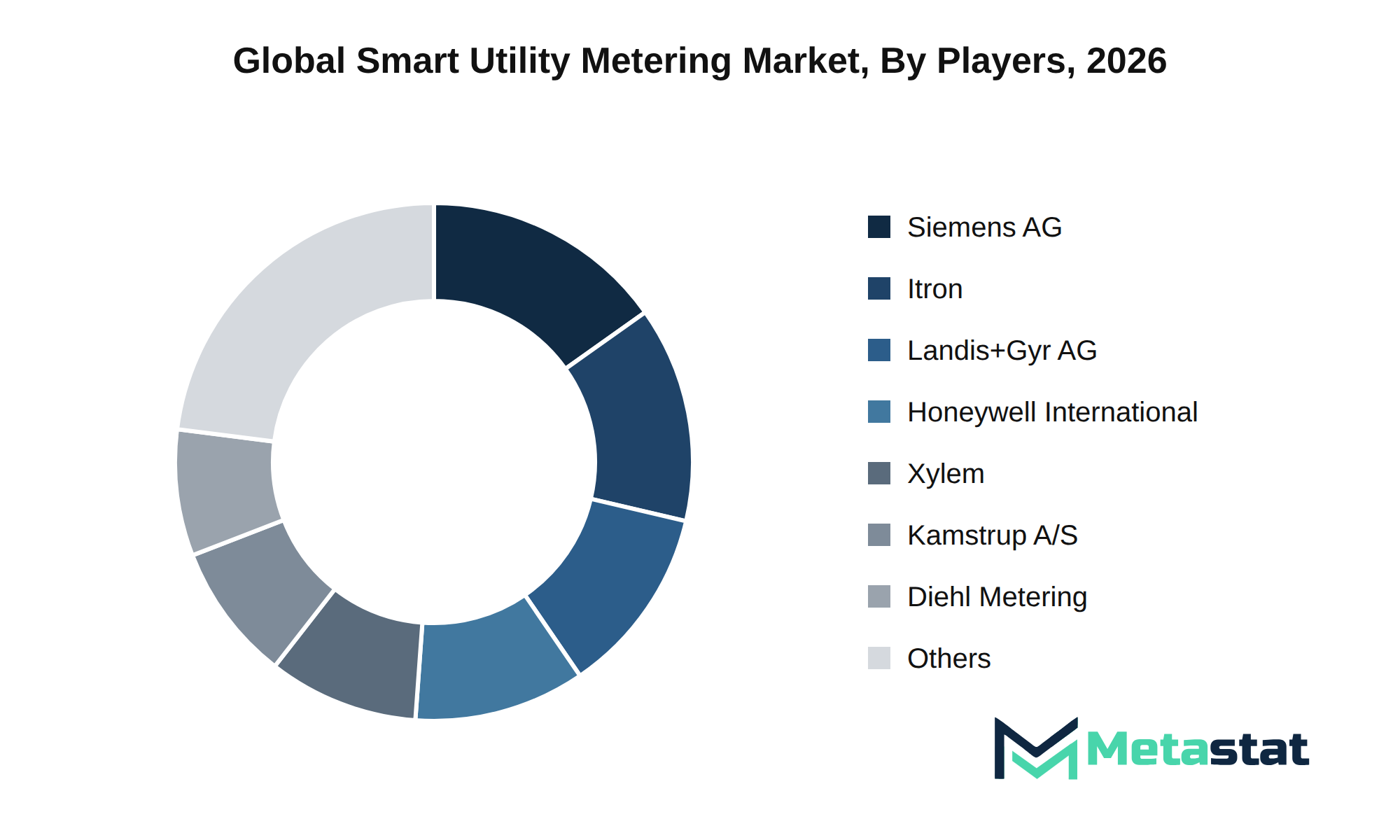
Key players in the Smart Utility Metering market include Siemens AG, Itron, Inc., Landis+Gyr Group AG, Honeywell International Inc., Xylem Inc. - Sensus, Kamstrup A/S, and Diehl Metering GmbH.
Hydrocarbon market size is valued at USD 447.7 billion in 2025 and projected to reach USD 641.7 billion by 2033, growing at a CAGR of 4.6% from 2026 to 2033.
Hydrocarbon market, Hydrocarbon Market Size, Hydrocarbon Market Share, Hydrocarbon Market Analysis, Hydrocarbon Market Growth, Hydrocarbon Market Trends, Hydrocarbon Market Research Report, Hydrocarbon Market Forecast, Hydrocarbon, Hydrocarbon Market Research, Hydrocarbon Industry, Hydrocarbon Industry Report, Hydrocarbon Market Data, Hydrocarbon Statistics, Hydrocarbon Market Statistics, Hydrocarbon Industry Trends, Hydrocarbon Market Report, Hydrocarbon Market Trends, Hydrocarbon Market News, Hydrocarbon Forecasts, Hydrocarbon Market Intelligence Report, Hydrocarbon market 2033, Hydrocarbon market outlook, Hydrocarbon market segmentation, Hydrocarbon market drivers, Hydrocarbon market restraints, Hydrocarbon market opportunities, Hydrocarbon market CAGR, Hydrocarbon suppliers, Hydrocarbon manufacturers, Hydrocarbon market by region, North America Hydrocarbon market, Asia Pacific Hydrocarbon market, Europe Hydrocarbon market, Hydrocarbon market competitive landscape, Hydrocarbon market key players, Aliphatic Hydrocarbon market, Aromatic Hydrocarbon market, Fuel and Combustion Hydrocarbon market, Petrochemical and Chemical Feedstock Hydrocarbon market, Lubricants and Functional Fluids Hydrocarbon market, Solvents and Industrial Process Fluids Hydrocarbon market, Asphalt and Bitumen Production Hydrocarbon market, Transportation and Mobility Hydrocarbon market, Petrochemicals and Chemicals Hydrocarbon market, Power Generation and Utilities Hydrocarbon market, Industrial Manufacturing and Processing Hydrocarbon market, Construction and Infrastructure Hydrocarbon market, Mining Hydrocarbon market.
Asset Integrity Management market size is valued at USD 26.1 billion in 2025 and projected to reach USD 40.6 billion by 2033, growing at a CAGR of 5.7%.
Energy Harvesting Module Market Size, Share, Trends, 2033
Energy Harvesting Module market was valued at USD 707.9 million in 2025 and is projected to reach USD 1,727.8 million by 2033, growing at a CAGR of 11.8%.
Energy Harvesting Module market, Energy Harvesting Module Market Size, Energy Harvesting Module Market Share, Energy Harvesting Module Market Analysis, Energy Harvesting Module Market Growth, Energy Harvesting Module Market Trends, Energy Harvesting Module Market Research Report, Energy Harvesting Module Market Forecast, Energy Harvesting Module, Energy Harvesting Module Market Research, Energy Harvesting Module Industry, Energy Harvesting Module Industry Report, Energy Harvesting Module Market Data, Energy Harvesting Module Statistics, Energy Harvesting Module Market Statistics, Energy Harvesting Module Industry Trends, Energy Harvesting Module Market Report, Energy Harvesting Module Market Trends, Energy Harvesting Module Market News, Energy Harvesting Module Forecasts, Energy Harvesting Module Market Intelligence Report, Energy Harvesting Module market 2033, Energy Harvesting Module market outlook, Energy Harvesting Module market segmentation, Energy Harvesting Module market drivers, Energy Harvesting Module market restraints, Energy Harvesting Module market opportunities, Energy Harvesting Module market CAGR, Energy Harvesting Module suppliers, Energy Harvesting Module manufacturers, Energy Harvesting Module market by region, North America Energy Harvesting Module market, Asia Pacific Energy Harvesting Module market, Europe Energy Harvesting Module market, Energy Harvesting Module market competitive landscape, Energy Harvesting Module market key players, Photovoltaic and Light Energy Harvesting market, Thermoelectric and Heat Energy Harvesting market, Piezoelectric and Vibration Energy Harvesting market, Industrial IoT and Condition Monitoring market, Smart Buildings and Home Automation market
Concentrated Solar Power Market Size, Share, Trends, 2033
Concentrated Solar Power market size is valued at USD 7.5 billion in 2025 and is projected to reach USD 17.3 billion in 2033, at a CAGR of 11.1% from 2026 to 2033.
Concentrated Solar Power Market, Concentrated Solar Power Market Size, Concentrated Solar Power Market Share, Concentrated Solar Power Market Analysis, Concentrated Solar Power Market Growth, Concentrated Solar Power Market Trends, Concentrated Solar Power Market Research Report, Concentrated Solar Power Market Forecast, Concentrated Solar Power, Concentrated Solar Power Market Research, Concentrated Solar Power Industry, Concentrated Solar Power Industry Report, Concentrated Solar Power Market Data, Concentrated Solar Power Statistics, Concentrated Solar Power Market Statistics, Concentrated Solar Power Industry Trends, Concentrated Solar Power Market Report, Concentrated Solar Power Market Trends, Concentrated Solar Power Market News, Concentrated Solar Power Forecasts, Concentrated Solar Power Market Intelligence Report