Global Magnet Wire Market Size, Share, By Material Type (Copper Magnet Wire and Aluminum Magnet Wire), By Insulation Type (Polyurethane (UEW), Polyester (PEW), Polyesterimide (EIW), Polyamide-Imide (AIW), Polyimide (PI), Self-Bonding Magnet Wire and Others), By Application (Electric Motors, Transformers, Generators, Automotive Electrical Systems, Home Appliances, Industrial Equipment, EV Traction Motors and Others), By End-Use Industry (Automotive & E-Mobility, Power & Distribution, Industrial Manufacturing, Consumer Appliances, Electronics, Renewable Energy, HVAC & Refrigeration and Others) Industry Analysis, Growth, Trends, and Forecast, 2026-2033
Report ID
MSI-4850
Published
August 4, 2026
Pages
273 Pages
Format
Market Size 2021
USD 31.7 Billion
Historical
Market Size 2025
USD 38.5 Billion
Base year
Market Size 2033
USD 58.2 Billion
Forecast
CAGR 2025-2033
5.3%
Forecast period
Report Details
Comprehensive Market Analysis And Insights
Market Overview
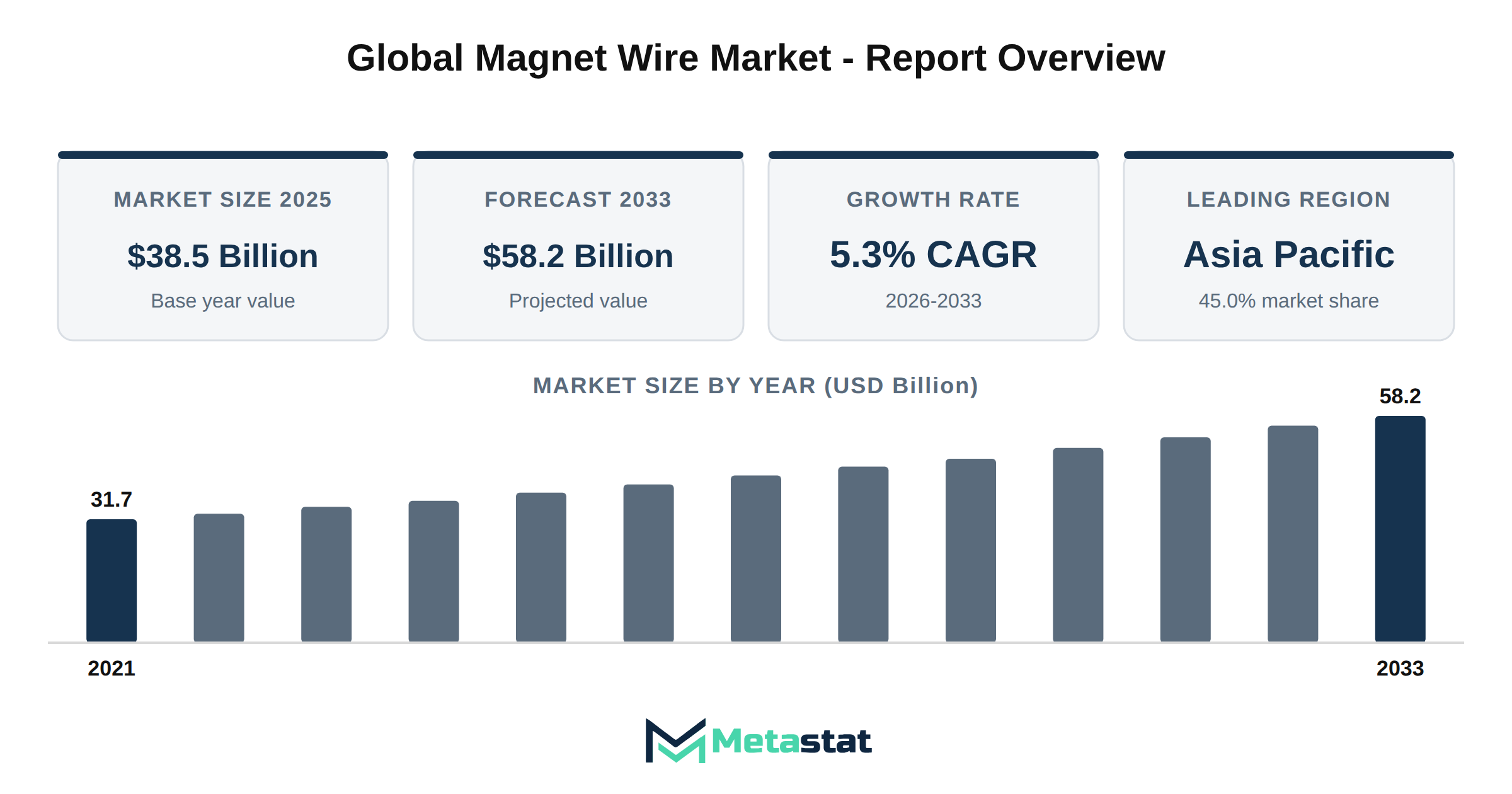
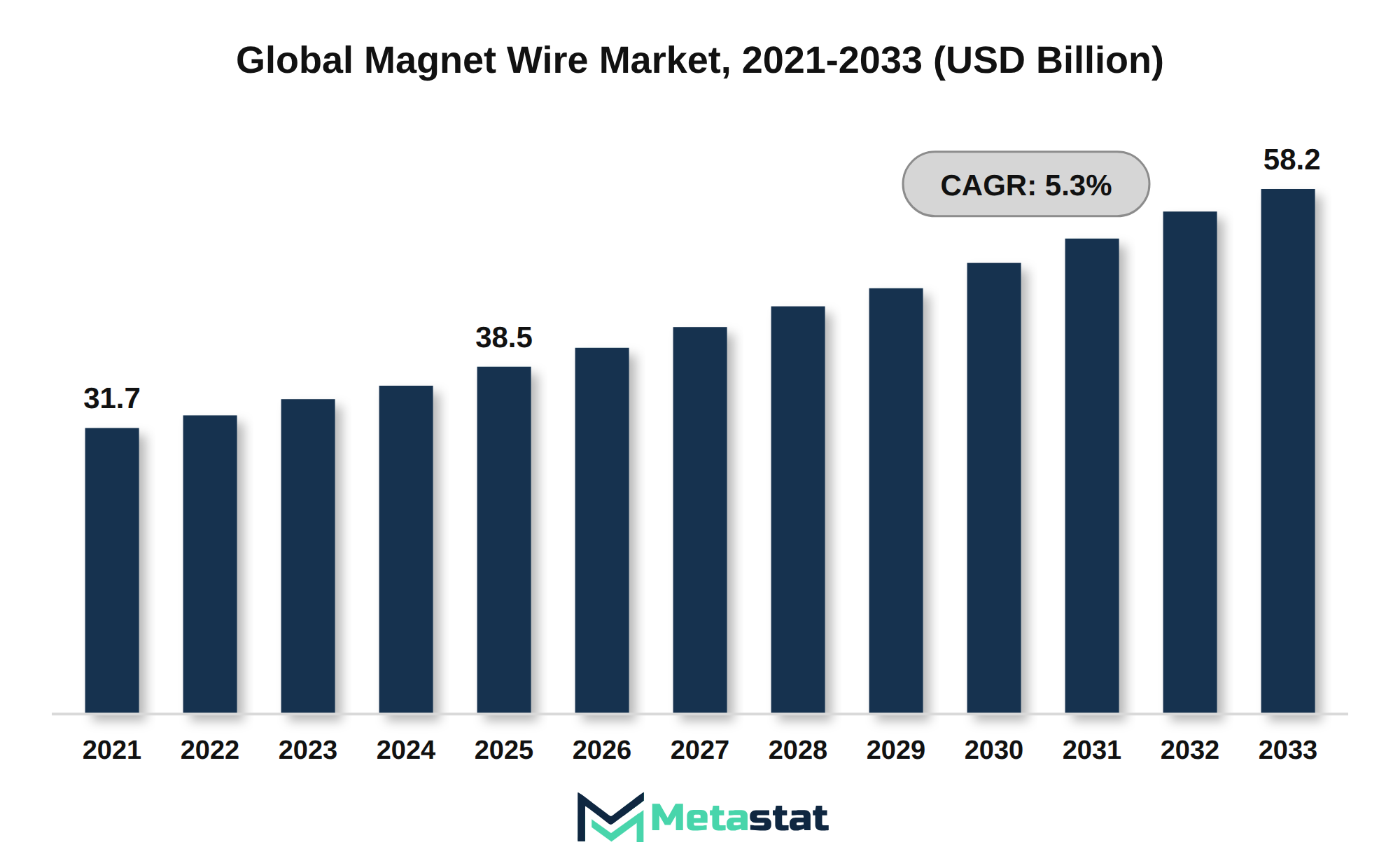
The global Magnet Wire market was valued at USD 38.5 billion in 2025 and is projected to reach USD 58.2 billion by 2033, growing at a CAGR of 5.3% over the forecast period.
The global Magnet Wire market was 3,860 kilotons in 2025 and is projected to reach 5,410 kilotons by 2033 at a CAGR of 4.25% from 2026 to 2033.
The global Magnet Wire market demonstrates significant growth potential, projected to rise from USD 38.5 billion in 2025 to USD 58.2 billion by 2033, reflecting a compound annual growth rate (CAGR) of 5.3%. This upward trend correlates with increasing demand across various applications, particularly in electric motors, transformers, and industrial equipment.
Key factors driving growth in the market include advancements in technology and an uptick in electric vehicle production. The push for energy efficiency and sustainable energy solutions enhances the demand for high-quality magnet wire, which plays a critical role in the performance of electrical components. Industries including automotive and renewable energy sectors particularly benefit from these developments.
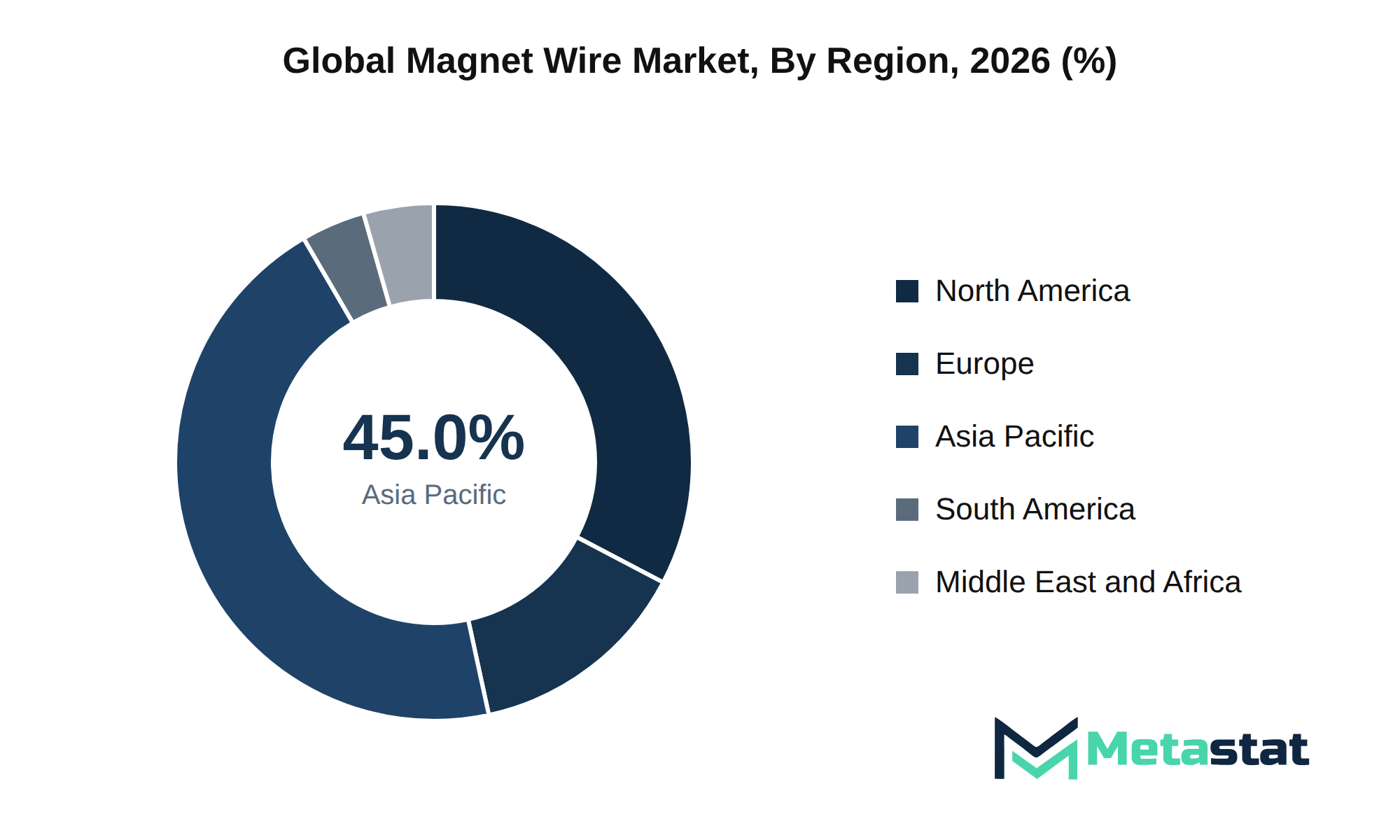
Regional dynamics show that the Asia Pacific region leads the market, contributing 45% of the total share, followed by North America at 32.7%. This distribution highlights the importance of local manufacturing capabilities and the need for efficient supply chain management to meet rising demand in these regions. In North America, a market value of USD 47.1 billion is anticipated by 2033, with a CAGR of 5.3% during the forecast period.
Material types within the market, particularly copper and aluminum magnet wire, exhibit distinct growth trajectories. Copper magnet wire is expected to grow from USD 35.8 billion in 2026 to USD 50.6 billion by 2033, while aluminum magnet wire shows a notable CAGR of 6.7%, reaching USD 7.6 billion by the forecast's end. The differentiation in performance and application suitability between these materials influences their respective market positions.
The Magnet Wire market experiences significant demand across electric motors, transformers, and industrial equipment. This demand arises from the increasing adoption of electric vehicles and the growing need for renewable energy solutions. The automotive and e-mobility sectors contribute substantially to this demand, driven by the push for electrification and reduced carbon emissions.
Raw material trends indicate a shift towards aluminum magnet wire, projected to reach USD 7.6 billion by 2033, growing at a CAGR of 6.7%. This shift reflects rising copper costs and the need for lighter materials in electric vehicle applications. The market anticipates a robust increase in copper magnet wire, with a value of USD 50.6 billion by 2033, growing at a CAGR of 5.1%.
Regulatory compliance and standards play a vital role in shaping the market landscape. Manufacturers face increasing pressure to meet environmental regulations, influencing their material choices and production processes. Geopolitical risk frameworks disrupt supply chains, impacting sourcing strategies and operational costs.
Research and development trajectories focus on next-generation innovation and sustainable transformation. Companies invest in decarbonization strategies and circular economy dynamics to enhance their market positions. This transition requires substantial capital allocation and infrastructure investments to adapt to evolving consumer preferences.
Macroeconomic headwinds, including inflationary pressures and currency volatility, impact the market's growth outlook. These factors contribute to fluctuations in material costs and influence companies' pricing strategies. The future strategic outlook emphasizes the need for high-value recommendations to navigate these challenges and capitalize on emerging opportunities.
Market fragmentation remains evident, with numerous players competing in various segments. M&A dynamics reshape the competitive environment, leading to consolidation among key stakeholders. A focus on customer journey dynamics and procurement strategies ensures that companies remain agile and responsive to market changes.
Market Dynamics
Investment in infrastructure drives market expansion
Increased capital investments in infrastructure development significantly influence the Magnet Wire market. Governments and private entities prioritize upgrading electrical grids and transportation systems, creating robust demand for efficient electrical components, including magnet wire. The focus on renewable energy sources, including wind and solar, necessitates enhanced electrical connections, leading to a surge in magnet wire usage.
The trend towards electrification across various sectors, including automotive and industrial, contributes to rising demand for magnet wire. Electric vehicles, in particular, require efficient wiring solutions to support advanced electrical systems. This shift towards electrification encourages manufacturers to invest in high-quality magnet wire, ensuring reliability and performance in their applications.
Increased consumer awareness regarding sustainability pushes companies to adopt eco-friendly practices. Demand for magnet wire that aligns with environmental, social, and governance (ESG) standards rises, prompting manufacturers to innovate and develop products that minimize environmental impact. This shift enhances the market's growth potential and increases competition among suppliers to meet evolving industry standards.
The Magnet Wire market is projected to experience a compound annual growth rate (CAGR) of 5.3% from 2026 to 2033, indicating strong long-term demand driven by these macro-economic factors and infrastructure initiatives. The anticipated growth reflects the increasing integration of magnet wire in various applications, reinforcing its importance within the broader electrical components market.
Technological integration drives market growth
The Magnet Wire market experiences robust expansion driven by technological integration. Advances in automation and artificial intelligence increase operational efficiency across various manufacturing sectors. Manufacturers adopt new software solutions to enhance productivity, facilitating the digitization of legacy processes and optimizing production lines. This shift supports heightened demand for magnet wire, particularly in electric motors and transformers, because industries recognize the need for enhanced performance and reduced downtime.
The integration of advanced technologies enhances product quality and production capabilities, allowing suppliers to offer innovative magnet wire solutions. This technological evolution attracts significant investment, with companies focusing on research and development to diversify their product offerings and meet evolving customer demands. Enhanced performance and adaptability in manufacturing processes lead to improved operational productivity, reinforcing the growth trajectory of the market.
Investment in smart technologies continues to shape the market landscape, establishing a foundation for sustained growth. Increased reliance on automation and AI correlates with the rising demand for magnet wire across various applications, including automotive electrical systems and renewable energy solutions. While industries embrace these advancements, the Magnet Wire market is projected to expand significantly through 2033, supported by a compound annual growth rate of 5.3 percent.
Inflationary pressures and supply chain disruptions
Inflationary pressures significantly impact the Magnet Wire market, driving up raw material costs and manufacturing expenses. Rising prices for essential materials, coupled with shortages in supply chains, hinder profitability for manufacturers. Suppliers absorb these increased costs, resulting in reduced margins and delayed project timelines. Financial strain affects competitiveness and market dynamics, leading to cautious investment strategies among stakeholders.
Supply chain disruptions complicate logistics and delivery schedules, further exacerbating operational challenges. Global events and geopolitical factors contribute to these disruptions, causing delays in material acquisition and distribution. Industries reliant on timely access to magnet wire, including automotive and renewable energy sectors, face potential project delays and increased costs. These challenges restrict overall market growth and adoption rates, forcing companies to explore alternative sourcing strategies.
The combined effect of inflation and supply chain issues creates a precarious environment for the Magnet Wire market. Manufacturers grapple with rising costs and logistical complications, making strategic planning crucial to maintain market position. Investment in robust supply chain management systems emerges because a priority, enabling companies to adapt to fluctuating market conditions while striving for operational efficiency.
The Magnet Wire market faces significant challenges due to geopolitical fragmentation, which disrupts established supply chains. Trade deficits and tariff friction contribute to increased costs for manufacturers, impacting profitability across the sector. Research and development integrations exacerbate these issues, leading to delays in product innovation and market entry.
Logistics disruptions complicate the operational landscape. Transportation challenges and fluctuating feedstock availability cause uncertainty in production schedules. These factors penalize suppliers with rising input costs, creating margin pressures that hinder competitive positioning. Companies in the market experience difficulties in maintaining consistent pricing, which affects overall market growth.
Technological disruptions present additional challenges, with evolving legal liabilities and compliance overhead emerging owing to significant concerns for market participants. Companies allocate resources to navigate tightening global regulatory standards, diverting attention from core business operations. Intellectual property protection deficits introduce further risks, while cybersecurity threats pose data vulnerabilities that could compromise sensitive information.
The Magnet Wire market adapts to changing downstream demands and market saturation. Consumer preferences shift toward sustainable and environmentally friendly products, compelling manufacturers to invest in decarbonization mandates and sustainability initiatives. Infrastructure gaps and retrofitting barriers slow the transition to more efficient technologies, presenting a challenge for those seeking to innovate while complying with environmental expectations.
Talent retention pressures persist owing to the workforce grappling with skill gaps exacerbated by automation displacements. The market faces an urgent need for skilled professionals capable of managing advanced technologies. These multifaceted challenges necessitate strategic responses from stakeholders to ensure resilience and continued growth within the Magnet Wire market.
Regional demands for Magnet Wire continue to evolve, creating substantial growth avenues across diverse markets. Significant investments in infrastructure modernization contribute to heightened demand in regions including Asia Pacific. This region currently accounts for 45 percent of the market share, reflecting a robust appetite for Magnet Wire in industrial applications, particularly within electric motors and renewable energy sectors.
Technological disruptions, including digital transformation and next-generation innovations, shape market dynamics by enhancing production efficiency and enabling the development of advanced wire types. This transformation aligns with industries focusing on sustainability imperatives and eco-friendly practices, driving adoption among environmentally conscious buyers. The market is projected to reach USD 58.2 billion by 2033, reflecting a compound annual growth rate of 5.3 percent.
Emerging buying behaviors emphasize digital procurement shifts, influencing how companies acquire Magnet Wire. Commercial model transitions toward e-commerce platforms facilitate accessibility and streamline purchasing processes, particularly for small and medium-sized enterprises. This trend enhances competition among suppliers, prompting them to align their offerings with changing consumer preferences.
Supply chain localization strategies are increasingly important, allowing businesses to mitigate risks associated with global dependencies. Streamlining logistics through localized sourcing enhances operational resilience and reduces lead times. Strategic buffering frameworks further fortify supply chains, ensuring consistent availability of Magnet Wire during economic fluctuations.
The focus on asset life-cycle extensions through maintenance upgrades and retrofitting dynamics highlights the importance of maximizing value from existing investments. Companies that adopt these strategies experience operational yield maximization, positively impacting profitability. Consequently, these efforts support the long-term sustainability of the Magnet Wire market, reinforcing resilience against market volatility.
Market Segmentation Analysis
The Global Magnet Wire market is segmented based on Material Type, Insulation Type, Application, and End-Use Industry.
By Material Type, the market is further segmented into:
Copper Magnet Wire
Aluminum Magnet Wire
Copper Magnet Wire
Copper Magnet Wire represents a significant component of the Magnet Wire market, valued at USD 35.8 billion in 2026. This segment is projected to reach USD 50.6 billion by 2033, reflecting a CAGR of 5.1% during the forecast period. The increasing demand for energy-efficient solutions drives growth in this segment, particularly from end-use industries including automotive and renewable energy. The shift towards electric vehicles and green technologies enhances the adoption of copper wire due to its superior conductivity and thermal properties. Technological advancements in manufacturing processes contribute to product evolution, leading to the development of highly efficient and lightweight wire solutions. Regulatory compliance standards further influence the market, driven by manufacturers adapting to sustainability goals and environmental regulations. Cost structures and pricing volatility impact operational margins for suppliers, emphasizing the need for strategic sourcing and supply chain resilience to manage raw material costs. The competitive landscape features several key players, including Essex Solutions Inc., Sumitomo Electric Industries, Ltd., and Fujikura Ltd. These companies invest significantly in research and development to enhance product offerings and improve market positioning. Anticipated growth of the Copper Magnet Wire segment indicates robust investment opportunities, reinforcing its critical role in meeting the evolving demands of the Magnet Wire market.
Aluminum Magnet Wire
Anticipated growth in the Aluminum Magnet Wire segment aligns with increasing demand for lightweight materials across various applications, particularly in the automotive and electronics sectors. Growing environmental awareness and regulatory frameworks promoting energy-efficient technologies further boost this demand. Applications in electric vehicles, renewable energy systems, and consumer electronics drive significant consumption, resulting in a robust expansion trajectory.
Aluminum Magnet Wire benefits from lower material costs compared to copper, leading to a favorable cost structure for manufacturers and end-users alike. Price volatility in raw materials impacts profit margins but continues to attract investment in innovative production techniques that enhance performance and reduce waste. The segment is projected to reach USD 7.6 billion by 2033, at a CAGR of 6.7% during the forecast period.
Strategic partnerships within the supply chain, including collaborations with key players including Sumitomo Electric Industries, Ltd. and Fujikura Ltd., support the development of advanced magnet wire solutions. Investments in research and development focus on enhancing product performance and adapting to evolving industry standards, thereby strengthening the competitive position of aluminum wire in the market. Overall, significant advancements in technology and shifts in consumer preferences position this segment for sustained growth.
By Insulation Type, the market is further segmented into:
Polyurethane (UEW)
Polyester (PEW)
Polyesterimide (EIW)
Polyamide-Imide (AIW)
Polyesterimide-Polyamide-Imide (EI/AIW)
Polyimide (PI)
Self-Bonding Magnet Wire
Others (Corona-Resistant, Fiberglass Covered, and Paper Covered)
Polyurethane (UEW)
Polyurethane (UEW) insulation experiences increasing adoption owing to its excellent thermal properties and chemical resistance, which significantly benefit electrical applications. Demand for this material originates from industries like automotive, renewable energy, and industrial manufacturing, where reliable performance in challenging environments is crucial. The expansion of electric vehicles (EVs) and renewable energy systems drives the need for robust and efficient magnet wire solutions, facilitating market growth.
Technological maturation supports the development of advanced polyurethane insulation, enhancing performance while reducing costs. Next-generation upgrades focus on improving energy efficiency and thermal management, aligning with stricter environmental regulations and consumer preferences for sustainable solutions. Manufacturers engage in product evolution to meet these demands, leading to innovative magnet wire designs that improve overall performance.
Downstream applications vary across multiple sectors, with electric motors and transformers being significant end-users. Regulatory compliance standards shape product specifications, because adherence to safety and environmental guidelines influences manufacturer choices. Cost structures reflect the complexities of raw material sourcing and production processes, impacting pricing strategies and overall market dynamics.
Pricing volatility arises from fluctuations in raw material availability and market demand, creating margin pressures for suppliers. Strategic opportunity windows emerge because new technologies and applications develop, allowing businesses to capture niche markets. A focus on supply chain resilience strengthens the ability to adapt to market changes and maintain competitiveness in the evolving magnet wire sector.
Polyester (PEW)
Technological advancements drive the adoption of Polyester (PEW) insulation within the Magnet Wire market, particularly owing to its favorable properties including thermal resistance and electrical insulation performance. Industries including automotive, electronics, and renewable energy increasingly rely on this insulation type for its efficiency and durability. The automotive sector prioritizes lightweight, high-performance materials to enhance the performance of electric vehicles and hybrid systems.
Consumer preferences shift toward energy-efficient solutions, propelling the demand for Magnet Wire with Polyester (PEW) insulation. This trend aligns with growing regulatory compliance standards aimed at reducing energy consumption and enhancing sustainability. Manufacturers respond by innovating products featuring improved thermal stability and resistance to chemical exposure, ensuring reliability in diverse applications.
Cost structures within the Polyester (PEW) segment reflect fluctuations in raw material prices, impacting manufacturers' margins. Pricing volatility arises from supply chain vulnerabilities and sourcing risks, compelling companies to adopt strategic measures to mitigate operational disruptions. Strategic opportunities exist for firms investing in advanced manufacturing technologies to enhance efficiency and reduce costs, positioning them favorably in a competitive environment.
With ongoing developments in next-generation upgrades, Polyester (PEW) insulation demonstrates a promising trajectory in the Magnet Wire market. The evolution of product formulations and advancements in production processes contribute to enhanced performance characteristics. Continuous investment in research and development supports the segment's growth, addressing emerging demands in various end-use industries, including industrial manufacturing and HVAC systems.
Polyesterimide (EIW)
In the Magnet Wire market, Polyesterimide (EIW) insulation experiences strong adoption owing to its superior thermal resistance and mechanical properties, making it ideal for demanding electrical applications. Primary demand drivers include the growing need for efficient energy solutions, particularly in sectors including automotive, industrial manufacturing, and electronics, where reliable and durable wire insulation is critical.
Segment expansion results from technological maturation and advancements in manufacturing processes, which enhance the performance characteristics of Polyesterimide insulation. Next-gen upgrades focus on improving insulation efficiency and reducing energy losses in electric motors and transformers, leading to increased application across various end-use industries.
Product evolution highlights the continuous development of Polyesterimide insulation to meet stringent regulatory compliance standards. Certifications for environmental sustainability and safety further influence market dynamics, pushing manufacturers to innovate and comply with international benchmarks.
Cost structures remain an important factor, with pricing volatility influenced by fluctuations in raw material sourcing and supply chain resilience. Strategic opportunity windows open for companies investing in research and development to produce advanced Polyesterimide products that cater to shifting consumption patterns.
Downstream application trends indicate a growing preference for high-performance insulating materials, positioning Polyesterimide insulation because a leading choice among manufacturers. Its utilization in electric vehicles and renewable energy applications supports the ongoing shift towards sustainable technologies, enhancing overall market growth.
Polyamide-Imide (AIW)
Polyamide-Imide (AIW) insulation experiences increasing interest in various sectors due to its superior thermal stability and mechanical properties, which enhance the performance of electric motors and transformers. The growing demand for energy-efficient solutions drives adoption across multiple industries, particularly in automotive and renewable energy applications. Technological maturation in manufacturing processes facilitates improved production techniques, allowing for higher quality outputs and reduced defect rates.
Next-generation upgrades in electric vehicles (EVs) and consumer electronics create additional opportunities for Polyamide-Imide insulation, which offers enhanced performance in compact and high-temperature environments. The need for compliance with stringent regulatory standards drives investment in high-performance insulation materials, positioning Polyamide-Imide favorably in the market.
Cost structures impact the overall pricing of Polyamide-Imide insulation, with fluctuations in raw material sourcing affecting margins for manufacturers. Increased focus on supply chain resilience highlights the importance of stable sourcing strategies to mitigate vulnerabilities. Substitution risks from alternative materials remain a consideration. Polyamide-Imide continues to prove advantageous in specific applications due to its unique properties.
Investment in R&D contributes to product evolution, leading to innovations that meet the changing demands of end-use applications. The Magnet Wire market benefits from these developments. Companies seek to optimize their product offerings to cater to diverse consumer needs and preferences. Strategic opportunities arise from the growing emphasis on sustainability, encouraging manufacturers to explore environmentally friendly alternatives while maintaining performance standards.
Polyesterimide-Polyamide-Imide (EI/AIW)
Strong demand for Polyesterimide-Polyamide-Imide (EI/AIW) insulation arises from its excellent thermal stability and mechanical strength properties. Industries including automotive and industrial manufacturing increasingly adopt this insulation type due to its high performance in extreme conditions, driving further investment in advanced applications.
Technological maturation contributes to the segment's growth, with innovations enhancing product functionalities. Manufacturers focus on developing next-generation upgrades that improve efficiency while reducing production costs. This climate of innovation creates a competitive atmosphere in the Magnet Wire market, attracting new entrants and encouraging established players to enhance their offerings.
End-use dynamics show a significant preference for Polyesterimide-Polyamide-Imide in electric motors and transformers. Shifts towards electric vehicles and renewable energy solutions support this trend, leading to increased consumption in these sectors. Regulatory compliance standards regarding energy efficiency and environmental sustainability further influence adoption rates, compelling manufacturers to integrate advanced insulation materials.
Price volatility and margin pressures associated with raw material sourcing challenge producers. Fluctuations in raw material prices affect profit margins, prompting companies to explore alternative sourcing strategies or innovative materials that reduce dependency on traditional inputs. This ongoing evaluation of supply chain resilience ensures that the segment remains competitive amid changing market conditions.
Substitution risks from emerging insulation technologies pose a threat to established products. However, the unique properties of Polyesterimide-Polyamide-Imide create a strategic opportunity window for manufacturers to strengthen their market position. By focusing on product evolution and enhancing existing capabilities, companies navigate these shifts effectively while capitalizing on new growth avenues within the Magnet Wire market.
Polyimide (PI)
Increasing demand for Polyimide (PI) insulation stems from its thermal stability and chemical resistance, making it suitable for high-performance applications. Industries including aerospace, automotive, and electronics increasingly adopt this insulation type owing to its ability to withstand extreme temperatures and harsh environments. The growing interest in electric vehicles and renewable energy sources drives the need for advanced insulation solutions that enhance efficiency and reliability.
Technological maturation is critical in expanding the Polyimide segment, driven by manufacturers focusing on developing innovative production methods that improve performance characteristics and reduce costs. The evolution of products with enhanced mechanical properties and lighter weight aligns with the trend toward miniaturization in electronic devices. Regulatory compliance standards increasingly emphasize the need for materials that meet stringent safety and environmental requirements, further boosting the demand for Polyimide insulation in the market.
Pricing volatility associated with raw materials influences the cost structures of Polyimide products, impacting profitability for manufacturers. Supply chain resilience is critical for mitigating risks linked to material sourcing and logistics vulnerabilities, ensuring steady availability of high-quality inputs. Strategic opportunities arise from advancements in production technologies that enhance efficiency and reduce dependency on traditional materials, positioning Polyimide insulation because a competitive solution in the market.
Self-Bonding Magnet Wire
In the Magnet Wire market, self-bonding magnet wire experiences increasing demand owing to its unique properties that facilitate efficient manufacturing processes. This type of magnet wire offers the ability to bond without the need for adhesives, resulting in reduced assembly times and enhanced reliability in applications. Industries focused on electric motors and transformers particularly favor this product for its efficiency and performance benefits.
Technological maturation in the manufacturing of self-bonding magnet wire contributes to its wider adoption. Continuous advancements in material science lead to improved performance characteristics, allowing manufacturers to integrate this wire into various applications, including automotive electrical systems and industrial equipment. These advancements enhance the wire's durability and thermal resistance, aligning with industry requirements for high-performance insulation materials.
Regulatory compliance standards significantly influence the adoption of self-bonding magnet wire. Stringent regulations regarding environmental impact and product safety within the automotive and electronics sectors necessitate the use of materials that meet these criteria. Certification processes encourage manufacturers to incorporate self-bonding technologies, ensuring the wire adheres to industry standards while optimizing production efficiency.
Cost structures and pricing volatility remain critical factors impacting the self-bonding magnet wire segment. Fluctuations in raw material prices affect the overall profitability for manufacturers. However, operational efficiencies gained from implementing self-bonding technologies offset these costs, providing a strategic advantage in competitive markets.
Strategic opportunity windows arise from the growing demand for electric vehicles and renewable energy systems. These sectors emphasize the need for efficient and reliable components, positioning self-bonding magnet wire because a favorable choice. Its ability to enhance performance while meeting modern regulatory standards aligns with the evolving needs of downstream applications.
Others (Corona-Resistant, Fiberglass Covered, and Paper Covered)
Demand for magnet wire featuring insulation types including corona-resistant, fiberglass covered, and paper covered experiences growth driven by specific applications in varying industries. The unique properties of these insulations provide enhanced resistance against environmental factors, influencing adoption in sectors requiring durable and reliable solutions.
Expansion catalysts include advancements in insulating materials that enhance performance while reducing weight and size, which is attractive in applications like electric motors and transformers. Technological maturation in insulation processes supports this segment, enabling manufacturers to improve product offerings and meet evolving consumer demands.
Downstream applications reflect a diverse use of these magnet wires across industries including automotive, industrial manufacturing, and renewable energy. Shifting consumer preferences towards energy-efficient and sustainable solutions push manufacturers to innovate within this sub-segment to capture market share effectively.
Regulatory compliance standards impact product development, with manufacturers required to adhere to specific guidelines that ensure safety and performance. Certifications related to insulation types enhance credibility, influencing purchasing decisions in the market.
Cost structures in this segment reflect the raw material sourcing challenges, which affect pricing volatility and margin pressures. Supply chain resilience plays a critical role in maintaining stable production rates and meeting market demands.
Strategic opportunity windows exist for companies focusing on next-generation upgrades in insulation technologies. With ongoing investments in research and development, businesses are positioned to leverage new innovations that enhance product performance and reduce long-term operational costs within the market.
By Application, the market is further segmented into:
Growth in the Electric Motors segment of the Magnet Wire market is driven by rising demand for energy-efficient solutions across various industries. The shift towards electric vehicles and renewable energy applications increases adoption of electric motors, requiring high-performance magnet wire for optimal functionality. Technological advancements enhance the efficiency and performance of electric motors, propelling demand for specialized magnet wire products tailored to meet these evolving performance standards.
Product evolution within the segment emphasizes lightweight and space-saving designs, contributing to the development of next-generation electric motors. Manufacturers increasingly focus on integrating advanced materials and insulation types, including Polyimide and Polyesterimide, which improve thermal stability and reduce energy losses in motors. This trend influences end-use dynamics, driven by manufacturers seeking components that enhance the overall efficiency and reliability of electric motor systems.
Regulatory compliance standards regarding energy efficiency and emissions significantly impact the segment's dynamics. Stricter regulations encourage manufacturers to adopt innovative technologies to improve motor efficiency, thereby spurring demand for high-quality magnet wire. Cost structures reflect the need for investment in advanced manufacturing processes and materials, leading to pricing volatility due to fluctuating raw material costs.
Supply chain resilience is crucial for the electric motors segment, particularly owing to manufacturers facing challenges in raw material sourcing and logistics vulnerabilities. Disruptive alternatives and substitution risks exist, particularly with the emergence of new technologies that could impact traditional magnet wire applications. Strategic opportunity windows arise for manufacturers that invest in research and development, enabling them to capitalize on trends and enhance their product offerings in the electric motors market.
Capital investment outlook points to continued growth due to industry players committing resources to innovate and expand their production capabilities. This investment strengthens competitive positioning, allowing companies to leverage advancements and meet the rising demands of the electric motors segment effectively.
Transformers
Investment in infrastructure and renewable energy initiatives drives significant demand for transformers. The global push for sustainable energy solutions contributes to an increased need for efficient transformers that support various applications in electric grids and renewable energy systems. Technological advancements in transformer design enhance efficiency and reliability, further supporting market growth.
High-voltage transformers experience rising adoption in power generation and distribution, primarily due to the expansion of renewable energy sources including wind and solar. This shift necessitates upgrades to existing infrastructure, ensuring transformers meet new operational demands. The integration of smart grid technology presents opportunities for next-generation transformer applications, positioning the market for substantial growth.
Regulatory compliance standards regarding energy efficiency and emissions contribute to the transformation of the market landscape. Suppliers align product development with these standards to meet the evolving requirements of end-user industries. This alignment enhances product acceptance and stimulates investment in advanced technologies.
Pricing volatility in raw materials affects cost structures within the market. Fluctuations in copper and aluminum prices influence the overall pricing strategy for transformers, impacting profit margins for manufacturers. Strategic sourcing and long-term contracts help mitigate these challenges, sustaining competitiveness in a dynamic market environment.
The emergence of disruptive alternatives, including solid-state transformers, presents both challenges and opportunities for traditional transformer manufacturers. Innovations in materials and design lead to enhanced performance and reduced environmental impact, driving a shift in product evolution. Companies that strategically invest in these technologies capture market share and respond effectively to changing customer preferences.
Overall, the continuing evolution of transformer technologies, driven by demand from sectors including renewable energy, highlights the market's resilience and potential for expansion. Capital investment outlook remains positive, reflecting confidence in the long-term growth trajectory of the transformer segment within the Magnet Wire market.
Generators
Investment in renewable energy generation significantly drives demand for magnet wire in generators. The transition towards sustainable energy solutions, including wind and solar power, accelerates the need for efficient electrical components, with generators serving because critical components in these systems. Increased efficiency and performance requirements compel manufacturers to seek advanced magnet wire solutions, enhancing power generation and distribution.
Technological advancements within the energy sector contribute to the expansion of the generators segment. Innovations in generator designs and materials improve overall efficiency, leading to heightened performance standards. This evolution stimulates demand for specialized magnet wire types that support higher performance and reliability in generators, ultimately influencing the broader Magnet Wire market.
End-use dynamics reflect a shift toward more efficient and compact generator designs. Manufacturers prioritize lightweight and high-conductivity materials in response to consumer preferences for energy-efficient solutions. These trends necessitate the adoption of advanced magnet wire technologies, providing opportunities for growth within this segment.
Regulatory compliance and standards governing energy efficiency impact the generators segment directly. Stricter regulations around emissions and energy consumption create pressure for manufacturers to innovate and meet compliance requirements. This scenario necessitates the use of advanced magnet wire that adheres to emerging industry standards, driving continued investment in R&D and product evolution.
Market players focus on strategic opportunity windows to enhance product portfolios specific to generator applications. By investing in next-generation materials and technologies, suppliers position themselves to capitalize on emerging market trends. This proactive approach supports sustained growth and increases competitive advantage within the Magnet Wire market.
Automotive Electrical Systems
Increasing reliance on advanced electrical systems in vehicles drives significant demand for magnet wire within automotive electrical applications. The push for electric vehicles and hybrid models enhances the adoption of lightweight, efficient wiring solutions that improve performance and energy efficiency. Advanced vehicle electronics, including infotainment systems, navigation aids, and driver assistance technologies, require high-quality magnet wire, ensuring reliability and durability under various operating conditions.
Technological maturation within the automotive sector emphasizes the evolution of magnet wire materials and insulation types. Innovations in insulation, including Polyesterimide and Polyamide-Imide, improve thermal performance and resistance to wear, aligning with automotive manufacturers' requirements for higher efficiency and longer lifespan. This trend drives product evolution, resulting in wires that meet stringent regulatory compliance standards and enhance overall performance.
The overall market benefits from robust investments in automotive infrastructure and technological upgrades. Growing consumer preference for electric vehicles influences supply chain resilience, prompting manufacturers to secure raw materials effectively. Strategic opportunity windows arise from shifts in consumer behavior, pushing manufacturers to adapt their offerings to align with emerging trends and demands.
Pricing volatility remains a concern, impacting profit margins across the supply chain. Fluctuations in raw material costs contribute to margin pressures, requiring manufacturers to implement strategic pricing models to maintain competitiveness. Downstream application dynamics necessitate a focus on cost-effective solutions without compromising quality, ensuring that automotive electrical systems evolve in alignment with market demands.
Home Appliances
Demand for magnet wire in the home appliances sector experiences growth driven by the increasing integration of smart technologies into household devices. Enhanced functionality and energy efficiency requirements placed on appliances necessitate the use of advanced electrical components, including high-quality magnet wire. Consumers increasingly prefer devices that demonstrate improved performance and reliability, which influences manufacturers to invest in superior magnet wire products.
Technological maturation within the home appliance industry supports the adoption of next-generation upgrades, promoting the use of magnet wire with superior insulation properties. Efficient insulation materials, including polyurethane and polyesterimide, enhance the operational performance of appliances, contributing to energy savings and reliability. This trend aligns with consumer expectations, leading to heightened market activity.
Product evolution, including the development of energy-efficient appliances, further drives demand for magnet wire. Increased focus on sustainability and energy conservation shapes manufacturing practices, compelling companies to source components that align with these goals. Home appliance manufacturers experience competitive advantages when incorporating advanced magnet wire, thus attracting environmentally conscious consumers.
The end-use dynamics within the home appliances sector emphasize the need for high-performance components. Manufacturers face mounting pressure to comply with regulatory compliance standards and certifications, necessitating the use of reliable magnet wire solutions. This regulatory landscape creates opportunities for suppliers offering innovative products that meet stringent compliance requirements.
Pricing volatility in the raw material market influences cost structures for manufacturers. Fluctuations in copper and aluminum prices affect overall production costs, prompting suppliers to manage pricing strategies effectively. Maintaining competitive pricing while ensuring product quality remains a challenge for manufacturers, impacting their margins within the sector.
The evolving situation of supply chain resilience highlights the significance of sourcing high-quality materials for magnet wire production. Disruptions within global supply chains necessitate strategic partnerships and diversified sourcing strategies to mitigate risks associated with material shortages. By strengthening supply chain frameworks, manufacturers enhance their ability to deliver consistent and reliable products to the market.
Strategic opportunity windows emerge owing to rising investment in home appliances. With consumer preferences shifting towards smart, energy-efficient devices, manufacturers that leverage advanced magnet wire technology capitalize on emerging trends. This proactive approach positions companies favorably within the market, driving growth and innovation.
Industrial Equipment
Growth in the industrial equipment sector significantly influences demand for magnet wire. Factors driving this growth include advancements in automation, increasing efficiency requirements, and heightened standards for energy consumption within manufacturing processes. Enhanced production capabilities and the proliferation of smart factory technologies increase the need for reliable and high-performance magnet wire solutions.
Technological maturation across various industrial equipment applications dictates the demand for next-generation upgrades. These upgrades typically focus on improving energy efficiency, reducing operational costs, and enhancing overall performance. In particular, manufacturers of electric motors, transformers, and generators prioritize magnet wire that supports these efficiency gains, leading to more stringent requirements for material properties, insulation types, and thermal management.
End-use dynamics within the industrial equipment sector highlight a growing emphasis on sustainability and regulatory compliance. The implementation of stringent environmental regulations necessitates the use of materials that not only meet performance benchmarks but align with evolving eco-friendly standards. Certification requirements further complicate the landscape, compelling manufacturers to seek magnet wire that is compliant with industry-specific guidelines.
Cost structures related to magnet wire production continue to evolve. Increasing prices of raw materials introduce pressures that impact profit margins for manufacturers. Strategic sourcing and partnerships often play critical roles in mitigating these costs, influencing market dynamics owing to firms navigating fluctuations in pricing and availability of essential materials.
Market dynamics indicate a heightened interest in substitution risks. Innovative alternatives and disruptive technologies continue to emerge, challenging traditional magnet wire applications. The competitive landscape necessitates ongoing investment in research and development to ensure that existing products remain relevant and competitive against newer, more efficient solutions.
Strategic opportunity windows exist for manufacturers focusing on industrial equipment applications due to demand continuing to grow. Awareness of consumption shifts towards electrification and automation within the sector presents avenues for expansion. Capital investments directed towards enhancing production capabilities and developing new insulation technologies yield significant benefits, aligning manufacturers with the evolving needs of the industrial equipment market.
Inductors & Reactors
Strong demand for inductors and reactors within the Magnet Wire market arises from their critical roles in electrical circuits, where they manage energy flow and stabilize voltage. The increasing complexity of electronic devices drives the need for more advanced inductors and reactors, which require high-performance magnet wire for optimal functionality. The trend toward miniaturization in electronics enhances the demand for compact and efficient inductors, requiring innovation in magnet wire materials and insulation types to meet these needs.
Technological maturation in manufacturing processes, coupled with the development of next-generation inductors and reactors, stimulates segment expansion. Manufacturers invest in research and development to create enhanced wire products that improve the performance and reliability of inductive components. Regulatory compliance standards in various industries necessitate the use of high-quality materials, increasing the emphasis on premium magnet wire solutions that meet stringent safety and efficiency requirements.
Consumption shifts toward renewable energy applications, including wind and solar power, further drive the demand for inductors and reactors. These applications require robust and reliable components that handle the dynamic operating conditions of renewable systems. The transition to electric vehicles and other emerging technologies generates growth opportunities for inductors and reactors, with magnet wire serving because a foundational element in electric motor and battery management systems.
Pricing volatility in raw materials impacts the overall cost structure within the inductors and reactors segment. Fluctuations in copper and aluminum prices influence the competitiveness of different magnet wire products, requiring manufacturers to adopt strategic pricing models to maintain margins. Supply chain resilience remains crucial, particularly in sourcing high-quality raw materials that adhere to evolving industry standards and customer expectations.
Strategic opportunity windows exist for manufacturers willing to innovate and adapt to changing market dynamics. Investment in automation and advanced manufacturing techniques enhances production efficiency, reducing costs and improving product quality. The emergence of disruptive alternatives, including new materials and designs, poses challenges while presenting opportunities for growth and differentiation in the Magnet Wire market.
EV Traction Motors
Electric vehicle (EV) traction motors represent a critical application within the Magnet Wire market. The rising adoption of electric vehicles fuels demand for highly efficient and lightweight magnet wire. Factors including advancements in battery technology and increased investment in charging infrastructure support this trend, enhancing the performance of EV traction motors. Manufacturers focus on developing magnet wire with superior thermal and electrical conductivity, essential for optimizing motor efficiency.
Technological maturation drives this segment, with next-generation upgrades influencing the evolution of magnet wire products. Enhanced performance characteristics, including improved insulation and reduced weight, result in better overall efficiency of traction motors. This shift aligns with growing consumer expectations for electric vehicles, pushing manufacturers to innovate continually.
Regulatory compliance standards regarding emissions and energy efficiency impact production and design processes in the EV sector. Compliance with these standards ensures that vehicles meet performance expectations, directly influencing the demand for high-quality magnet wire. The cost structures associated with producing advanced magnet wire reflect the need for ongoing investment in research and development, addressing pricing volatility arising from fluctuating raw material costs.
Supply chain resilience remains crucial in the EV traction motors segment. Strategic partnerships with raw material suppliers enhance access to essential components, minimizing logistics vulnerabilities. In addition, awareness of substitution risks encourages manufacturers to evaluate alternative materials that offer comparable performance at competitive prices. The emphasis on sustainability and environmental impact drives innovation in raw material sourcing, aligning with broader industry trends toward greener manufacturing practices.
The future outlook for this segment includes a strategic opportunity window for investment in advanced technologies. Capital investment directed toward the development of high-performance magnet wire solutions positions manufacturers to capture a larger share of the growing EV market. Electric vehicle adoption accelerates, and the demand for efficient traction motors is expected to continue shaping the dynamics within the Magnet Wire market.
Others (Compressors, Solenoids, and Ballasts)
Demand for magnet wire in applications including compressors, solenoids, and ballasts is driven by the increasing need for efficient electrical components across various industries. The adoption of advanced technologies in electrical systems enhances operational efficiency and energy management, prompting manufacturers to seek high-quality magnet wire solutions. This segment benefits from significant market expansion owing to industries striving for improved performance and reliability in their electrical systems.
Technological maturation plays a critical role in shaping this segment, with next-generation upgrades enabling manufacturers to innovate and refine their products. Advancements in insulation materials and manufacturing processes contribute to improved performance metrics, attracting end-users across multiple sectors. This evolution directly influences downstream applications, where enhanced operational characteristics drive increased consumption of magnet wire in compressors, solenoids, and ballasts.
Regulatory compliance standards, certifications, and policy headwinds influence the segment by setting benchmarks for safety and performance. Manufacturers invest in meeting these standards, which enhances product quality and consumer confidence. Fluctuations in raw material costs and pricing volatility present challenges, necessitating strategic sourcing and efficient cost structures to maintain competitive advantage while ensuring margins remain intact.
Supply chain resilience becomes essential for manufacturers operating in this segment. Vulnerabilities in logistics and potential substitution risks influence sourcing strategies, pushing companies to explore alternative materials and suppliers. Disruptive alternatives threaten traditional uses of magnet wire, prompting ongoing innovation and adaptation because firms seek to align with industry trends and capitalize on strategic opportunity windows.
The capital investment outlook in the market is positive, with ongoing investments in research and development expected to drive innovation. This focus on product evolution positions manufacturers advantageously, because they continue to address the growing demands of the market and adapt to changing consumer preferences within the compressors, solenoids, and ballasts applications.
By End-Use Industry, the market is further segmented into:
Automotive & E-Mobility
Power & Distribution
Industrial Manufacturing
Consumer Appliances
Electronics
Renewable Energy
HVAC & Refrigeration
Others (Railway, Aerospace, and Marine)
Automotive & E-Mobility
Increasing integration of electric vehicles (EVs) into the automotive sector significantly influences the demand for magnet wire. Adoption of magnet wire in automotive applications accelerates due to rising production of electric and hybrid vehicles that require efficient electrical components. This shift towards electrification drives demand for lightweight, high-performance magnet wire capable of supporting advanced electrical systems.
Technological advancements play a crucial role in segment expansion, with ongoing improvements in magnet wire insulation materials enhancing performance in various automotive applications. Enhanced insulation types, including Polyimide and Polyesterimide, provide superior thermal resistance and durability, aligning with the rigorous requirements of automotive and e-mobility applications.
Cost structures within the industry are under pressure due to fluctuating raw material prices, impacting profit margins for manufacturers. Strategic sourcing of materials and optimization of production processes become essential to maintain competitive pricing in the market. Investments in automation and advanced manufacturing techniques help mitigate these cost pressures, enabling increased efficiency in production.
Regulatory compliance standards associated with vehicle emissions and energy efficiency shape market dynamics. Compliance with stringent regulations regarding vehicle performance necessitates ongoing innovation in magnet wire technologies, creating opportunities for manufacturers to develop next-generation products that meet evolving industry requirements.
Growth in the automotive and e-mobility segment reflects a broader trend towards sustainability and energy efficiency within the industry. The demand for magnet wire in this segment is expected to increase owing to automotive companies prioritizing environmentally friendly technologies and aiming to reduce their carbon footprints.
Power & Distribution
Demand for magnet wire in the Power & Distribution segment thrives on the growing need for reliable and efficient electrical systems. Increased investment in power infrastructure and renewable energy initiatives drives demand from utility companies and energy providers. Rapid urbanization and industrialization further increase the need for high-quality electrical components, including magnet wire, to ensure effective energy transmission and distribution.
Technological advancements contribute significantly to the segment's expansion. The evolution of wire insulation technologies enhances the performance and durability of magnet wire, making it suitable for demanding applications. Adoption of next-generation materials and manufacturing processes improves operational efficiency, attracting an increasing number of players into the market.
Regulatory compliance standards influence the selection of magnet wire in power and distribution applications. Adherence to stringent safety and efficiency guidelines shapes product offerings, ensuring that manufacturers provide optimal solutions. These regulations, alongside rising environmental awareness, drive innovation towards sustainable solutions in the magnet wire market.
The segment encounters challenges related to pricing volatility and margin pressures. Fluctuations in raw material costs, particularly copper and aluminum, affect overall pricing strategies. Strategic opportunity windows arise from shifts in consumption patterns, particularly in regions focused on sustainable energy solutions.
Investment in infrastructure projects strengthens supply chain resilience within the Power & Distribution segment. Companies emphasize securing reliable raw material sourcing to mitigate potential disruptions. This strategic focus enhances operational efficiency and enables firms to better respond to market demands, reinforcing their position within the magnet wire market.
Industrial Manufacturing
In industrial manufacturing, demand for magnet wire reflects the ongoing advancements in production technologies and the growing emphasis on enhancing operational efficiency. The necessity for durable and efficient wiring solutions in machinery and equipment drives manufacturers to seek high-quality magnet wire to optimize performance. Factors including the increasing automation in manufacturing processes and the adoption of advanced machinery further contribute to this demand.
Technological maturation significantly influences this segment, with emerging innovations leading to the development of next-gen magnet wire products that offer improved performance characteristics. These upgrades align with the industry’s focus on reducing energy consumption and enhancing product lifespan. Manufacturers prioritize these enhancements, resulting in higher product adoption rates across various applications within the industrial manufacturing sector.
Cost structures in this segment hinge on raw material sourcing and production methodologies. Fluctuations in material costs influence pricing strategies, thus impacting overall profitability for manufacturers. Pricing volatility remains a significant concern, necessitating robust supply chain resilience to navigate potential disruptions.
Regulatory compliance standards shape operational practices, compelling manufacturers to adopt magnet wire solutions that meet stringent safety and performance requirements. The evolving landscape of environmental regulations influences product development, prompting a shift towards more sustainable materials and manufacturing processes.
Strategic opportunity windows emerge driven by companies exploring innovative applications of magnet wire within the industrial manufacturing sector. This exploration fuels capital investment in advanced manufacturing technologies, ensuring that businesses remain competitive in a changing market environment.
The magnet wire market experiences shifts, reflecting the broader trends in industrial manufacturing, including increased automation and a focus on sustainability. These factors collectively enhance the segment's growth outlook, aligning with global manufacturing trends and the demand for high-performance electrical solutions.
Consumer Appliances
Consumer appliances represent a significant end-use sector within the Magnet Wire market, driven by increasing demand for energy-efficient and technologically advanced home products. The shift towards smart home technologies necessitates the integration of advanced electrical components, prompting manufacturers to adopt higher performance magnet wires. This trend reflects a broader movement within the industry aimed at enhancing appliance functionality and energy efficiency.
Expansion in the consumer appliances segment hinges on technological maturation and product evolution, focusing on features including smart connectivity and energy management. Upgrades to existing appliances facilitate improved performance and reliability. This situation stimulates demand for specialized magnet wires that meet rigorous specifications. Emerging standards for energy efficiency contribute to heightened adoption rates across various appliance categories.
Regulatory compliance standards in energy efficiency and safety play a crucial role in shaping the segment's landscape. Manufacturers investing in compliant technologies gain a competitive edge, while those lagging behind face potential market constraints. Pricing volatility and margin pressures present challenges, with raw material sourcing impacting overall production costs.
Strategic opportunity windows arise from consumer preferences for environmentally friendly and energy-efficient products. The market's responsiveness to these shifts enhances growth potential for manufacturers integrating innovative magnet wire solutions into their products. Supply chain resilience and the ability to adapt to emerging trends will determine competitive positioning within the consumer appliances segment.
Overall, the consumer appliances segment within the Magnet Wire market reflects dynamic growth driven by technological advancements, regulatory frameworks, and evolving consumer expectations. Ongoing investments in next-generation upgrades signal continued expansion opportunities, highlighting the importance of innovation in shaping the future of this sector.
Electronics
Shifts in consumer preferences toward smart and connected devices stimulate growth in the electronics sector. An increase in demand for electronic components including circuit boards, sensors, and communication devices drives this trend. Advanced technologies, including the Internet of Things (IoT) and artificial intelligence (AI), require high-performance magnet wire for efficient operation and energy management.
Technological maturation leads manufacturers to enhance magnet wire properties, focusing on insulation types that offer superior performance and durability. Improvements in thermal resistance, electrical efficiency, and flexibility align with the evolving needs of the electronics market. Next-generation upgrades in electronic devices support the adoption of advanced magnet wire solutions.
Regulatory compliance and environmental standards influence product development within the electronics segment. End-use dynamics reflect a growing emphasis on sustainability, prompting manufacturers to seek eco-friendly materials and production processes. Certifications related to environmental performance become essential for market access and competitiveness.
Cost structures and pricing volatility impact margin pressures in the electronics sector. Fluctuations in raw material prices, particularly copper and aluminum, affect overall profitability. Companies adapt to these conditions, prioritizing innovation and efficiency in production.
Supply chain resilience remains crucial for addressing logistics vulnerabilities inherent in the electronics industry. Disruptive alternatives and substitution risks challenge traditional suppliers to remain competitive. Capital investment reflects a commitment to enhancing manufacturing capabilities and expanding product offerings, positioning businesses favorably within the magnet wire market.
Renewable Energy
Investment in renewable energy technologies drives demand for magnet wire, primarily owing to the growth of wind and solar energy projects. The push for cleaner energy solutions results in a significant increase in the installation of generators and transformers using magnet wire. Regulatory frameworks supporting renewable energy adoption further enhance market potential, with incentives encouraging infrastructure development and integration into existing power grids.
Technological maturation in the renewable energy sector leads to the development of more efficient magnet wire products, improving conductivity and minimizing energy loss. This development aligns with the industry's shift toward higher performance materials, enabling manufacturers to optimize power generation and distribution efficiencies. The market experiences increased adoption of magnet wire in applications including solar inverters and wind turbine generators, expanding the overall ecosystem.
Challenges exist within the segment, including fluctuating raw material prices impacting cost structures. Producers face margin pressures resulting from increased competition and pricing volatility, compelling them to explore cost-effective manufacturing processes and supply chain resilience strategies. Despite these challenges, the renewable energy segment presents strategic opportunity windows for companies aiming to innovate and capture market share in a changing environment.
HVAC & Refrigeration
Demand for magnet wire in HVAC and refrigeration applications arises from the increasing need for energy-efficient climate control systems. The growth of this segment correlates with the rising focus on energy conservation and environmental sustainability, prompting manufacturers to adopt advanced technologies. HVAC systems require high-performance wiring solutions that ensure reliability and efficiency. This drives the demand for magnet wire.
Technological advancements play a critical role in this sector. Innovations in compressor technology and the development of more compact and powerful refrigeration units require magnet wire that meets specific insulation and performance standards. Manufacturers invest in next-generation upgrades to enhance system efficiency. This further fuels the demand for specialized magnet wire in HVAC and refrigeration applications.
Regulatory compliance standards, particularly concerning energy efficiency, influence product development. Stricter regulations push manufacturers to seek higher-quality materials that adhere to these standards, impacting the market dynamics. Cost structures in this segment reflect the need for high-grade materials and innovative insulation technologies. These factors influence pricing strategies and market competitiveness.
Supply chain resilience becomes essential in this arena, given the reliance on specific raw materials required for magnet wire production. Manufacturers face sourcing challenges for copper and aluminum, which are integral to the production process. These challenges lead to pricing volatility and margin pressures within the market. Strategic adjustments are necessary to navigate these fluctuations.
The competition within the HVAC and refrigeration segment is evolving, with numerous players striving to capture market share. Strategic opportunity windows arise from increasing demand for energy-efficient products, pushing companies to innovate and expand their offerings. This environment presents significant potential for growth driven by manufacturers aligning their product portfolios with market trends.
Others (Railway, Aerospace, and Marine)
Growth in the railway, aerospace, and marine industries contributes to the demand for magnet wire, driven by the need for reliable and efficient electrical systems. These sectors increasingly adopt advanced technologies, enhancing performance standards and safety requirements. Investment in infrastructure, sustainable transportation solutions, and modernized fleets creates opportunities for magnet wire applications, supporting innovations in electric propulsion and energy management.
Technological maturation significantly influences this sub-segment, with advancements in materials and insulation techniques improving wire performance and longevity. Companies integrate next-generation upgrades, including lightweight and high-temperature resistant materials, meeting the demands of rigorous operational environments. The evolution of products tailored for these industries facilitates enhanced efficiency and performance.
End-use dynamics reflect a shift in consumption patterns, with a growing emphasis on electrification and automation. Regulatory compliance standards and certifications reinforce the demand for high-quality magnet wire, ensuring safety and performance across applications. These factors create strategic opportunity windows for suppliers and manufacturers aiming to capture market share in the railway, aerospace, and marine sectors.
Pricing volatility within raw material sourcing presents challenges for producers in this segment. Cost structures influenced by fluctuations in copper and aluminum prices affect overall profitability. Strategic investment outlooks focus on supply chain resilience, enabling companies to navigate sourcing challenges effectively while maintaining competitive pricing. The market adapts in response to these pressures and opportunities, driving growth in the magnet wire market.
By Region
Based on geography, the Global Magnet Wire market is divided into North America, Europe, Asia-Pacific, South America, Middle East, and Africa.
North America
North America represents a significant market for magnet wire, contributing 32.7% to the global market share in 2025. The region's market is set to expand at a CAGR of 5.3% within the forecast period, reaching a market size (TAM) of USD 47.1 billion by the end of 2033. Increasing investment in renewable energy technologies and electric vehicle infrastructure drives demand for magnet wire across various applications.
The United States leads in demand due to its robust automotive and industrial manufacturing sectors. Canada and Mexico contribute to this growth through modernization initiatives and nearshoring strategies, enhancing local manufacturing capabilities. Strengthened supply chain dynamics within the region allow for greater production capacity and efficiency.
Emerging markets within North America focus on high-value applications including electric motors and transformers, further increasing magnet wire adoption. Local compliance mandates and geographic regulatory frameworks influence market operations, ensuring adherence to quality and safety standards. Domestic vendors consolidate to enhance competitiveness, leveraging regional resource availability and energy grid resiliency.
Cross-border trade corridors facilitate the movement of magnet wire, promoting trade between the United States, Canada, and Mexico. Cultural nuances shape B2B buying behaviors, influencing procurement strategies and supplier relationships. Overall, the North America magnet wire market benefits from a combination of established infrastructure, evolving demand patterns, and strategic investments in technology and manufacturing.
Europe
Growth in the Magnet Wire market across Europe reflects a strong focus on infrastructure modernization and the increasing demand for energy-efficient technologies, particularly in Germany, France, and the UK. The automotive and industrial sectors significantly influence this demand, with countries prioritizing renewable energy integration and electric vehicle adoption. Germany's robust manufacturing base, alongside France's commitment to sustainable energy solutions, fuels heightened interest in high-performance magnet wire applications.
The region's dynamics show strong competition among local and international players like Essex Solutions Inc. and Sumitomo Electric Industries, Ltd. Ongoing investments in localized manufacturing and supply chain regionalization enhance competitive positioning. The trend toward nearshoring initiatives further supports growth, allowing manufacturers to respond swiftly to market demands while minimizing logistical challenges.
Regulatory frameworks across Europe increasingly favor green technologies, driving investments in energy-efficient solutions. Countries with stringent compliance mandates, including Germany and the UK, create a favorable environment for advanced magnet wire applications, particularly in electric motors and transformers. Emerging markets within Eastern Europe hold potential for growth, presenting investment opportunities attributed to expanding demand for high-quality magnet wire.
Asia-Pacific
The Asia-Pacific region represents 45.00% of the global Magnet Wire market in 2025. China leads the region, supported by its robust industrial base and increasing investments in electric vehicle production. Japan benefits from advanced manufacturing capabilities and high consumer electronics demand, driving the need for high-quality magnet wire. India experiences substantial growth driven by the expanding automotive sector and rising industrial activities that require efficient wire solutions.
South Korea maintains a strong position in the market due to its emphasis on technology and innovation, particularly in electronics and automotive applications. Australia remains a stable contributor, focusing on infrastructure development and renewable energy projects. Southeast Asia and the Rest of Asia Pacific exhibit emerging demand resulting from the modernization of their manufacturing sectors and enhancement of local production capabilities, creating opportunities for suppliers in the market.
Infrastructure modernization significantly shapes the market dynamics. Countries in this region invest heavily in upgrading electrical grids and promoting renewable energy sources, further increasing the demand for magnet wire. The emphasis on localized manufacturing densities and supply chain regionalization enhances competitiveness and operational efficiency for manufacturers.
Cultural nuances and regional B2B buying behaviors influence procurement strategies, creating tailored approaches that meet local demands. The market is projected to experience continuous growth, driven by unwavering investments, high-value replacement cycles, and adaptation to technological advancements across various industries.
South America
Brazil and Argentina dominate the South American Magnet Wire market, collectively representing USD 1,004.1 million of the region. Noteworthy demand for magnet wire arises from sectors including automotive and renewable energy, with both countries investing in infrastructure modernization. The ongoing need for electrification and energy efficiency in industrial applications supports steady growth in this market.
Current trends indicate increasing investment in local manufacturing capacities. Such initiatives enhance supply chain regionalization while tapping into localized procurement dynamics. The market experiences competitive pressure from domestic players, with companies striving for technological advancements in material types, particularly copper and aluminum magnet wire.
Trade corridors between Brazil and Argentina facilitate cross-border commerce, strengthening regional integration. This dynamic emphasizes the importance of regulatory frameworks to ensure market compliance while addressing specific local compliance mandates. The market is poised for growth, driven by strategic foreign direct investment flows and geographic expansion opportunities.
Middle East and Africa
Growth in the Magnet Wire market in the Middle East and Africa is driven by the rapid expansion of the electrical and electronics industries, particularly in Saudi Arabia and the UAE, where infrastructure modernization initiatives support demand for advanced technologies. Investments in renewable energy projects, including solar and wind, further enhance the demand for magnet wire in various applications, including transformers and electric motors.
South Africa serves because another emerging market front-runner, where the need for electrification and power distribution drives the adoption of magnet wire. Localized manufacturing initiatives focus on strengthening supply chains and reducing import dependence. Geopolitical stability and favorable trade policies contribute positively to the market environment, enabling foreign direct investment flows into the region.
The competitive landscape reflects a mix of established players and regional manufacturers. Domestic firms increasingly focus on meeting local compliance requirements and catering to specific regional needs. The market's growth trajectory is supported by regional resource availability, energy grid resiliency, and the readiness of local infrastructure to accommodate new investments.
Competitive Landscape and Strategic Insights
The Magnet Wire market features a dynamic competitive environment shaped by various strategic behaviors among key players. Mergers and acquisitions continue to influence market structure, with companies pursuing strategic consolidation to enhance their market positioning and leverage proprietary technologies. For instance, Sumitomo Electric Industries, Ltd. and Fujikura Ltd. broaden their portfolios through strategic partnerships and joint ventures, facilitating access to new market segments and improving competitiveness.
Product differentiation remains a crucial tactic among manufacturers in the market. Companies like Essex Solutions Inc. and ELEKTRISOLA Dr. Gerd Schildbach GmbH & Co KG focus on developing specialized magnet wire products tailored to specific applications, including electric motors and automotive systems. This approach enhances brand equity and addresses the unique demands of various end-use industries, driving customer retention.
Future outlook and barriers
The competitive outlook for the Magnet Wire market shows a landscape where barriers to entry persist due to high capital requirements and established player dominance. New entrants face significant challenges in overcoming these barriers, which include the need for substantial investment in R&D and technology to compete effectively. Existing players including Southwire Company, LLC. and Proterial, Ltd. maintain strong intellectual property portfolios, providing a technological moat that enhances their market position and provides a competitive advantage in innovation.
Ongoing developments in the market, focusing on strategic growth vectors and value chain integration, indicate a robust environment for both established and emerging players. Continuous evolution in customer preferences and technology will further influence competitive dynamics, emphasizing the importance of agility and adaptability among companies.
Forecast and Future Outlook
Market size is forecast to rise from USD 38.5 billion in 2025 to over USD 58.2 billion by 2033. This growth reflects a compound annual growth rate (CAGR) of 5.3%. The base case outlines a steady increase, driven by advancements in manufacturing processes and rising demand from various end-use industries, including automotive, renewable energy, and industrial manufacturing.
The bull case presents an optimistic outlook, highlighting potential accelerated adoption of next-generation technologies and increased investments in infrastructure, which could further stimulate market growth. Positive regulatory changes and heightened demand for electric vehicles enhance this upward trajectory.
Conversely, the bear case identifies potential risks including supply chain disruptions stemming from geopolitical tensions and economic fluctuations. These factors could hinder growth and dampen investment in the Magnet Wire market, slowing the momentum experienced in recent years.
Overall, the forecast indicates a robust path forward for the market, supported by structural shifts in consumption patterns and ongoing technological integration. Strategic capital allocation and commitment to research and development will play critical roles in navigating future challenges and opportunities.
Magnet Wire Market Key Segments
By Material Type:
Copper Magnet Wire
Aluminum Magnet Wire
By Insulation Type:
Polyurethane (UEW)
Polyester (PEW)
Polyesterimide (EIW)
Polyamide-Imide (AIW)
Polyesterimide-Polyamide-Imide (EI/AIW)
Polyimide (PI)
Self-Bonding Magnet Wire
Others (Corona-Resistant, Fiberglass Covered, and Paper Covered)
By Application:
Electric Motors
Transformers
Generators
Automotive Electrical Systems
Home Appliances
Industrial Equipment
Inductors & Reactors
EV Traction Motors
Others (Compressors, Solenoids, and Ballasts)
By End-Use Industry:
Automotive & E-Mobility
Power & Distribution
Industrial Manufacturing
Consumer Appliances
Electronics
Renewable Energy
HVAC & Refrigeration
Others (Railway, Aerospace, and Marine)
By Region:
North America
Europe
Asia-Pacific
South America
Middle East and Africa
Key Global Magnet Wire Industry Players
Essex Solutions Inc.
ELEKTRISOLA Dr. Gerd Schildbach GmbH & Co KG.
Sumitomo Electric Industries, Ltd.
Fujikura Ltd.
IRCE S.p.A
Tongling Jingda Special Magnet Wire Co., Ltd
Von Roll Holding AG
Sam Dong Co, Ltd.
Proterial, Ltd.
KSH International
Asia Pacific Wire & Cable Corp. Ltd.
GRUPO CONDUMEX (GRUPO CARSO)
Ederfil Becker
Tianjin Jingwei Power Technology Co.,Ltd.
YIDA Wire Industry, Inc.
Shanghai Yuke Industrial Co., Ltd.
SARTORIUS Werkzeuge (SWW Group Magnet Wire Division)
The report strategically identifies and profiles the key market players and analyses their core competencies in each sub-segment of the Magnet Wire market.
Report Attributes
Details
Study Period
2021-2033
Base Year
2025
Estimated Year
2026
Forecast Period
2026-2033
Historical Period
2021-2025
Growth Rate
CAGR 5.3% from 2026 to 2033
Revenue Unit
USD billion
Segmentation
By Material Type, Insulation Type, Application, End-Use Industry, and Region
By Region
North America (By Material Type, Insulation Type, Application, End-Use Industry, and Country)
United States
Canada
Mexico
Europe (By Material Type, Insulation Type, Application, End-Use Industry, and Country)
Germany
France
UK
Italy
Spain
Russia
Rest of the Europe
Asia Pacific (By Material Type, Insulation Type, Application, End-Use Industry, and Country)
China
Japan
India
South Korea
Australia
Southeast Asia
Rest of Asia Pacific
South America (By Material Type, Insulation Type, Application, End-Use Industry, and Country)
Brazil
Argentina
Rest of South America
Middle East and Africa (By Material Type, Insulation Type, Application, End-Use Industry, and Country)
Saudi Arabia
UAE
South Africa
Rest of Middle East and Africa
WHAT REPORT PROVIDES
Key Company Market Share, Revenue and Ranking for the Magnet Wire Market
Market Volume (Kilotons)
Import - Export Landscape
Key Market Leaders and Their Competitive Positioning
Full In-Depth Analysis of the Magnet Wire Industry
Industry Statistics and Market Dynamics Overview
Segmentation Details of the Magnet Wire Market
Historical, Ongoing, and Projected Market Analysis
Assessment of Niche Developments in the Magnet Wire Sector
Find answers to common questions about this report
The Magnet Wire market size was valued at USD 38.5 billion in 2025.
The Magnet Wire market is projected to grow at a CAGR of 5.3% during the forecast period from 2026 to 2033.
The North America Magnet Wire market size is estimated to reach USD 47.1 billion by 2033.
Copper Magnet Wire leads the Magnet Wire market with a projected value of USD 50.6 billion in 2033, significantly surpassing Aluminum Magnet Wire, which is expected to reach USD 7.6 billion in the same year.
Increased capital investments in infrastructure development and the focus on renewable energy sources significantly drive the Magnet Wire market. The trend towards electrification across various sectors, particularly in electric vehicles, enhances demand for efficient wiring solutions, supporting a projected compound annual growth rate of 5.3% from 2026 to 2033.
Asia Pacific holds the dominant share of the Magnet Wire market, accounting for 45 percent of the total market in 2025. This significant share reflects the region's robust industrial activity and demand for electrical applications.
Inflationary pressures and supply chain disruptions significantly restrain Magnet Wire market growth. Rising raw material costs and logistical challenges hinder profitability for manufacturers, leading to cautious investment strategies and potential project delays in key sectors including automotive and renewable energy. Geopolitical fragmentation further complicates supply chains, impacting overall market dynamics.
Increased capital investments in infrastructure development and the focus on renewable energy sources significantly favor product adoption in the Magnet Wire market. The trend towards electrification across sectors, particularly in electric vehicles, drives demand for efficient wiring solutions, enhancing market growth potential.
The Magnet Wire market is estimated to reach a valuation of USD 58.2 billion by 2033.
Key players in the Magnet Wire market include Essex Solutions Inc., Sumitomo Electric Industries, Ltd., Fujikura Ltd., Tongling Jingda Special Magnet Wire Co., Ltd., Southwire Company, LLC., and FURUKAWA ELECTRIC CO., LTD.
The global Magnet Wire market was 3,860 kilotons in 2025 and is projected to reach 5,410 kilotons by 2033 at a CAGR of 4.25% from 2026 to 2033.
Magnetic Encoder and Sensing Rings Market Size, Share, 2033
Global Magnetic Encoder and Sensing Rings market size: USD 333.8 million in 2025, forecast USD 700.3 million by 2033 at a 9.7% CAGR.
Magnetic Encoder and Sensing Rings market, Magnetic Encoder and Sensing Rings Market Size, Magnetic Encoder and Sensing Rings Market Share, Magnetic Encoder and Sensing Rings Market Analysis, Magnetic Encoder and Sensing Rings Market Growth, Magnetic Encoder and Sensing Rings Market Trends, Magnetic Encoder and Sensing Rings Market Research Report, Magnetic Encoder and Sensing Rings Market Forecast, Magnetic Encoder and Sensing Rings, Magnetic Encoder and Sensing Rings Market Research, Magnetic Encoder and Sensing Rings Industry, Magnetic Encoder and Sensing Rings Industry Report, Magnetic Encoder and Sensing Rings Market Data, Magnetic Encoder and Sensing Rings Statistics, Magnetic Encoder and Sensing Rings Market Statistics, Magnetic Encoder and Sensing Rings Industry Trends, Magnetic Encoder and Sensing Rings Market Report, Magnetic Encoder and Sensing Rings Market Trends, Magnetic Encoder and Sensing Rings Market News, Magnetic Encoder and Sensing Rings Forecasts, Magnetic Encoder and Sensing Rings Market Intelligence Report, Magnetic Encoder and Sensing Rings market 2033, Magnetic Encoder and Sensing Rings market outlook, Magnetic Encoder and Sensing Rings market segmentation, Magnetic Encoder and Sensing Rings market drivers, Magnetic Encoder and Sensing Rings market restraints, Magnetic Encoder and Sensing Rings market opportunities, Magnetic Encoder and Sensing Rings market CAGR, Magnetic Encoder and Sensing Rings suppliers, Magnetic Encoder and Sensing Rings manufacturers, Magnetic Encoder and Sensing Rings market by region, North America Magnetic Encoder and Sensing Rings market, Asia Pacific Magnetic Encoder and Sensing Rings market, Europe Magnetic Encoder and Sensing Rings market, Magnetic Encoder and Sensing Rings market competitive landscape, Magnetic Encoder and Sensing Rings market key players, Axial Bipolar Rings market, Diametrical Bipolar Rings market, Angular Position Measurement market, Automotive and E-Mobility market.
Global Smartphone Display market size: USD 69.1 billion in 2025, forecast USD 132.7 billion by 2033 at a 8.5% CAGR, with segment and regional analysis.
Semiconductor Gas Delivery Cabinet Market Size, Share, Trends, 2033
Semiconductor Gas Delivery Cabinet market size is valued at USD 1,308.2 million in 2025 and is projected to reach USD 2,446.2 million in 2033, at a CAGR of 8.1% from 2026 to 2033.
Semiconductor Gas Delivery Cabinet Market, Semiconductor Gas Delivery Cabinet Market Size, Semiconductor Gas Delivery Cabinet Market Share, Semiconductor Gas Delivery Cabinet Market Analysis, Semiconductor Gas Delivery Cabinet Market Growth, Semiconductor Gas Delivery Cabinet Market Trends, Semiconductor Gas Delivery Cabinet Market Research Report, Semiconductor Gas Delivery Cabinet Market Forecast, Semiconductor Gas Delivery Cabinet, Semiconductor Gas Delivery Cabinet Market Research, Semiconductor Gas Delivery Cabinet Industry, Semiconductor Gas Delivery Cabinet Industry Report, Semiconductor Gas Delivery Cabinet Market Data, Semiconductor Gas Delivery Cabinet Statistics, Semiconductor Gas Delivery Cabinet Market Statistics, Semiconductor Gas Delivery Cabinet Industry Trends, Semiconductor Gas Delivery Cabinet Market Report, Semiconductor Gas Delivery Cabinet Market Trends, Semiconductor Gas Delivery Cabinet Market News, Semiconductor Gas Delivery Cabinet Forecasts, Semiconductor Gas Delivery Cabinet Market Intelligence Report