Corporate Travel Management Market Size, Share, By Service Type (Transportation, Ticketing Services, Accommodation Management, Meetings, Events Travel Services, and Others), By Organization Size (Large Enterprises, Small Enterprises, and Medium Enterprises, By Deployment Model (Cloud-based, On-premises, and Hybrid), By Industry Vertical (BFSI, Healthcare, Pharmaceuticals, Manufacturing, Engineering, Hospitality, Tourism, Oil, Gas, Government, Utilities, and Others), Industry Analysis, Growth, Trends, and Forecast, 2026-2033
Report ID
MSI-4731
Published
May 13, 2026
Pages
316 Pages
Format
Report Details
Comprehensive Market Analysis And Insights
Market Overview
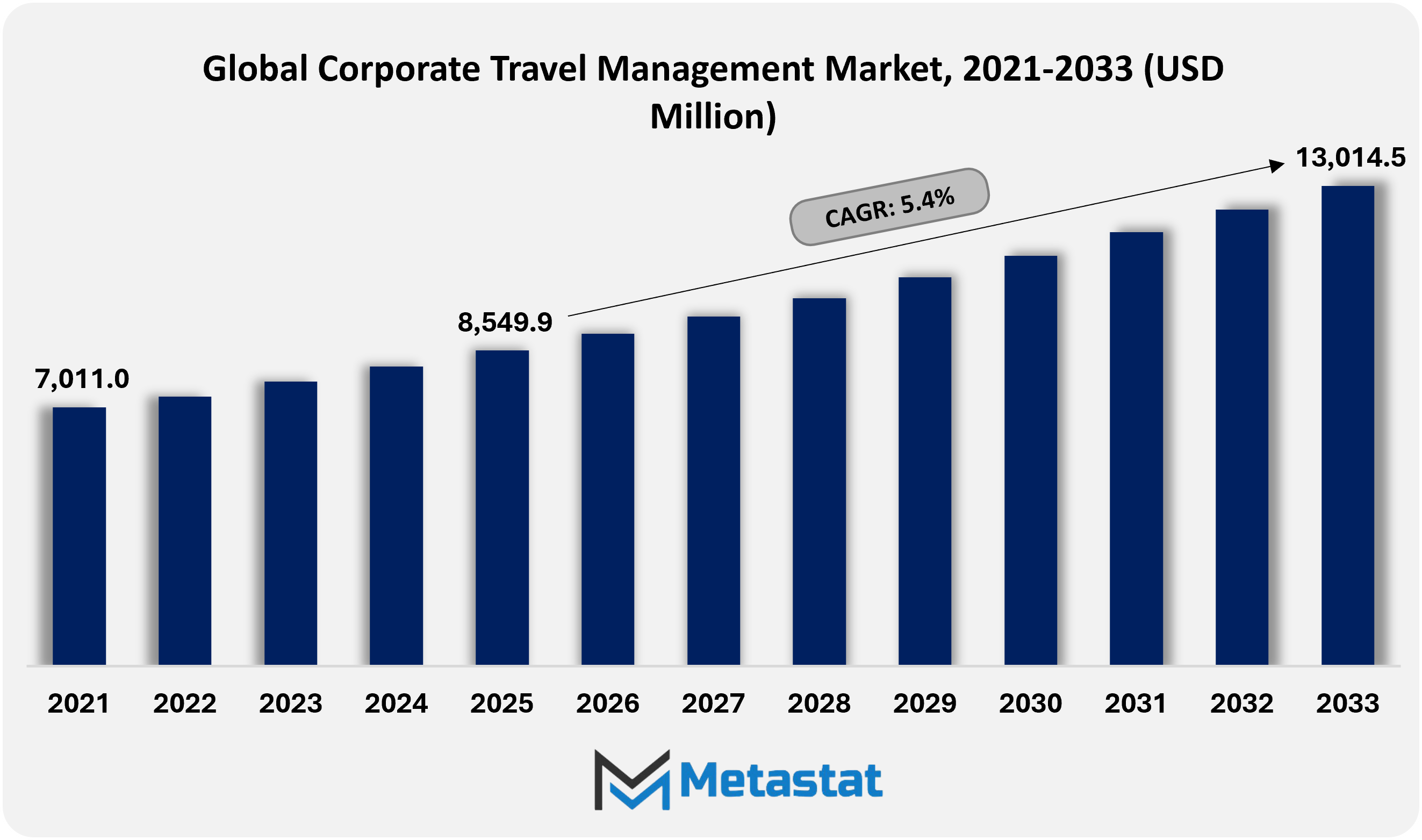
Global Corporate Travel Management market size is valued at USD 8,549.9 million in 2025 and projected to grow at a CAGR of 5.4% during the forecast period, reaching USD 13,014.5 million by 2033.
Global Corporate Travel Management Market: Comprehensive Data-Driven Market Analysis and Strategic Outlook
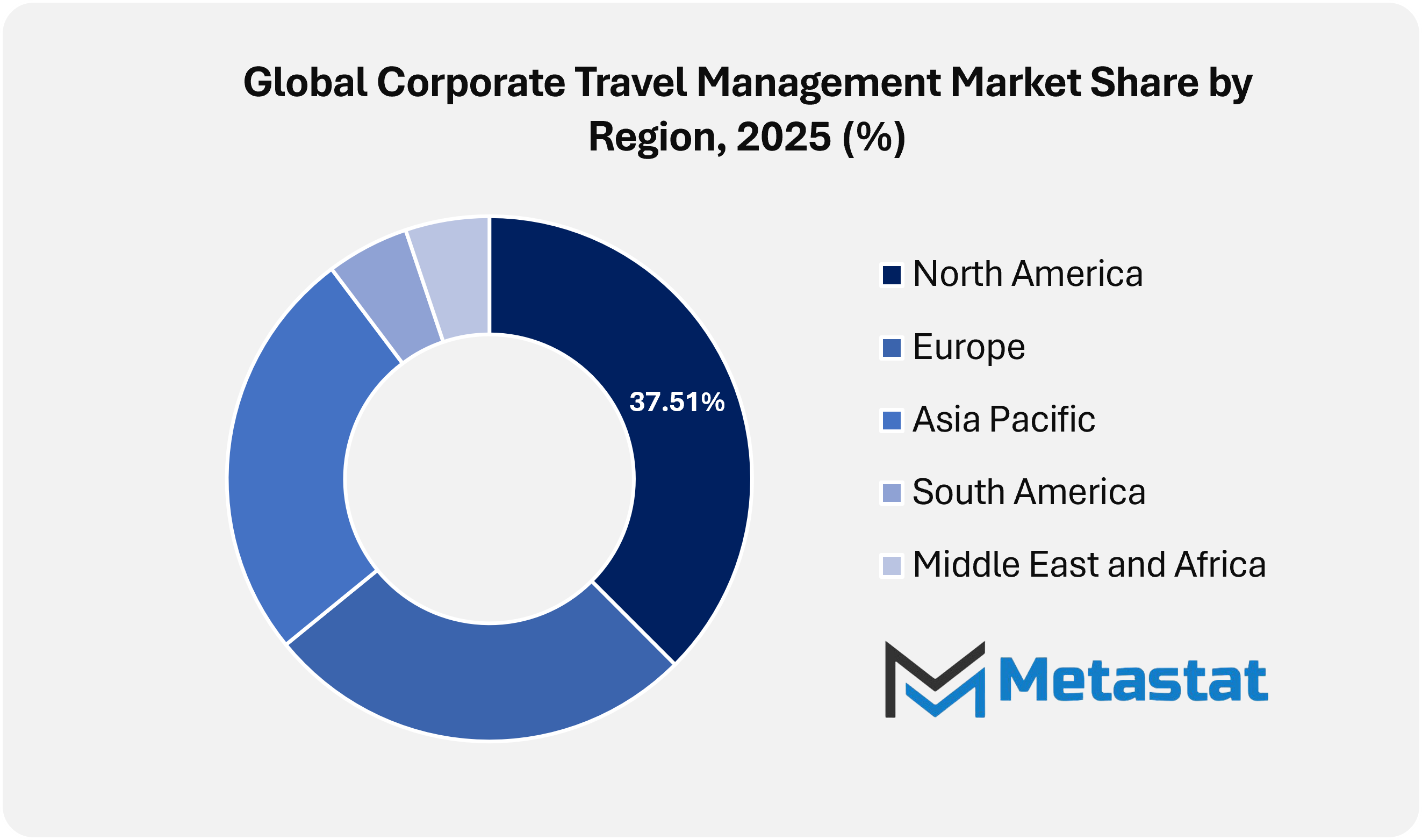
North America holds 37.5% of the global market in 2025, with the U.S. leading the regional market.
Transportation & Ticketing Services segment accounts for a market share of 44.4% in 2025.
Key trends driving growth: Rising focus on travel spend visibility and policy compliance and increasing duty of care requirements and real-time traveller risk oversight.
Opportunities include AI-enabled automation across booking, disruption handling, and expense auditing.
Key insight: Digital transformation and policy-driven cost optimization are reshaping the Global Corporate Travel Management Market amid shifting workforce mobility patterns.
Global Corporate Travel Management Market is evolving beyond airfare booking and hotel procurement into an integrated business travel ecosystem that combines mobility intelligence, workforce analytics, and sustainability management. Over the forecast period, corporate travel programs will function as strategic control centers where data analytics, risk monitoring, and employee experience converge. Travel managers will increasingly rely on predictive tools to anticipate disruption patterns, evaluate geopolitical exposure, and assess cost scenarios before approving itineraries.
Advanced platforms will embed artificial intelligence to personalize itineraries based on traveler behavior, company policy, and regional compliance requirements. Rather than operating only as procurement channels, service providers will integrate duty-of-care dashboards, carbon tracking modules, and automated reimbursement systems into unified digital environments. Organizations will demand seamless integration between enterprise resource planning software and travel platforms to enable real-time budget visibility across global subsidiaries.
Market Dynamics
Growth Drivers:
Rising focus on travel spends visibility and policy compliance.
Greater emphasis on structured travel governance is reshaping corporate travel programs. Organizations are demanding centralized dashboards, predictive budgeting tools, and automated compliance checks to reduce expenditure leakage. The Global Corporate Travel Management Market is benefiting from integrated analytics platforms that monitor booking behavior, flag policy deviations, and align travel decisions with financial objectives, improving cost control and transparency.
Increasing duty of care requirements and real-time traveler risk oversight
Growing corporate accountability is driving the adoption of stronger traveler safety frameworks across global travel operations. Enterprises are investing in monitoring systems, geo-risk alerts, and emergency response coordination platforms. The Global Corporate Travel Management Market is expanding through secure mobility solutions that provide continuous traveler tracking, crisis intelligence, and structured response protocols to protect employees across diverse destinations.
Restraints and Challenges:
Fragmented travel content, supplier contracts, and data interoperability gaps
Fragmented booking channels and inconsistent supplier agreements reduce operational efficiency. Limited data harmonization across airlines, hotels, and ground transport providers complicates reporting accuracy. The Global Corporate Travel Management Market will continue to face integration challenges until standardized content aggregation and unified data frameworks reduce contractual complexity and improve cross-platform connectivity.
Change management friction across travelers, travel desk, and finance workflows
Digital transformation initiatives require behavioral change across travelers, travel desks, and finance teams. Resistance to new booking systems, automated approvals, and centralized expense tools can slow implementation. The Global Corporate Travel Management Market will face adoption hurdles unless structured training programs, stakeholder alignment, and transparent communication strengthen confidence and support coordinated workflow integration.
Opportunities:
AI-enabled automation across booking, disruption handling, and expense auditing
Advanced automation capabilities are redefining business travel operations through predictive booking engines, intelligent itinerary adjustments, and anomaly detection in expense claims. Machine learning algorithms can optimize supplier selection and identify spend irregularities in real time. The Global Corporate Travel Management Market will gain momentum from scalable automation platforms that improve efficiency, reduce manual intervention, and enhance decision accuracy across corporate mobility ecosystems.
Market Segmentation Analysis
The Global Corporate Travel Management market is segmented by Service Type, Organization Size, Deployment Model, and Industry Vertical.
By Service Type, the market is further segmented into:
Transportation & Ticketing Services segment is valued at USD 3,996.4 million in 2026 and is projected to reach USD 5,520.7 million by 2033, at a CAGR of 4.7% during the forecast period.
Transportation & Ticketing Services will transform travel coordination through predictive fare analytics, automated rebooking systems, and integrated mobility platforms. Airlines, rail networks, and ground transport providers will increasingly connect through unified dashboards, enabling optimized route planning, cost monitoring, and policy compliance across the Global Corporate Travel Management Market with improved transparency and cost control.
Accommodation Management
Accommodation Management segment is valued at USD 2,730.3 million in 2026 and is projected to reach USD 4,067 million by 2033, at a CAGR of 5.9% during the forecast period.
Accommodation Management is shifting toward intelligent lodging allocation supported by real-time inventory visibility and negotiated corporate rate automation. Advanced booking engines are matching traveler preferences with company budgets, improving occupancy efficiency and contract performance within the Global Corporate Travel Management Market while strengthening supplier relationships and centralized oversight.
Meetings & Events Travel Services segment is valued at USD 1,392.6 million in 2026 and is projected to reach USD 2,301 million by 2033, at a CAGR of 7.4% during the forecast period.
Meetings & Events Travel Services will increasingly integrate digital event platforms with coordinated group travel planning. Automated attendee scheduling, venue sourcing intelligence, and carbon tracking tools will shape more structured event mobility strategies. Within the Global Corporate Travel Management Market, enterprises will gain stronger visibility into group travel spending and event-related cost management.
Others
Others segment is valued at USD 883.2 million in 2026 and is projected to reach USD 1,125.8 million by 2033, at a CAGR of 3.5% during the forecast period.
Other services, including visa assistance, travel insurance processing, and risk advisory support, will gain greater digital integration through centralized management portals. Data synchronization across service providers will improve compliance and duty of care execution, strengthening service reliability and administrative efficiency across the Global Corporate Travel Management Market.
By Organization Size, the market is divided into:
Large Enterprises
Large Enterprises segment is projected to reach USD 8,961.8 million by 2033, at a CAGR of 4.8% during the forecast period.
Large Enterprises will strengthen structured travel governance through enterprise-grade analytics and centralized procurement platforms. Global mobility programs will increasingly combine expense auditing, supplier negotiation, and sustainability reporting under unified frameworks, improving operational clarity and financial control within the Global Corporate Travel Management Market.
Small & Medium Enterprises (SMEs)
Small & Medium Enterprises (SMEs) segment is projected to reach USD 4,052.7 million by 2033, at a CAGR of 6.7% during the forecast period.
Small & Medium Enterprises (SMEs) will adopt scalable travel platforms that provide subscription-based access to booking engines and policy automation tools. Cost-effective digital solutions will improve spend visibility and traveler tracking, supporting broader adoption across the Global Corporate Travel Management Market without requiring major infrastructure investment.
By Deployment Model, the market is further divided into:
Cloud-based
Cloud-based segment is projected to reach USD 9,181.7 million by 2033.
Cloud-based deployment will drive flexible access, real-time updates, and cross-border data synchronization. Centralized dashboards hosted on secure cloud infrastructure will support remote approvals, automated reporting, and AI-enabled insights, accelerating digital maturity across the Global Corporate Travel Management Market for geographically distributed workforces.
On-premises
On-premises segment is projected to reach USD 1,868.9 million by 2033.
On-premises deployment will remain relevant for organizations requiring greater data sovereignty and internal system control. Customized infrastructure will support strict compliance monitoring, secure information management, and integration with legacy enterprise systems, sustaining demand across the Global Corporate Travel Management Market in regulated industries.
Hybrid
Hybrid segment is projected to reach USD 1,963.9 million by 2033.
Hybrid deployment will combine cloud flexibility with internal data security frameworks. Enterprises will balance operational agility with secure storage requirements, enabling adaptive travel management models. Hybrid architectures will support stronger resilience and continuity planning across the Global Corporate Travel Management Market.
By Industry Vertical, the Global Corporate Travel Management market is divided as:
BFSI
BFSI segment is projected to grow at a CAGR of 5.1% during the forecast period.
BFSI organizations require strict travel governance supported by compliance tracking and secure transaction monitoring. Integrated reporting tools help align travel expenses with regulatory requirements, reinforcing audit transparency and risk oversight within the Global Corporate Travel Management Market.
Healthcare and Pharmaceuticals segment is projected to grow at a CAGR of 6% during the forecast period.
Healthcare and pharmaceutical companies depend on coordinated travel logistics for clinical research, medical conferences, and regulatory inspections. Secure scheduling platforms and traveler health monitoring systems are supporting stronger operational continuity across the Global Corporate Travel Management Market.
Manufacturing and Engineering segment is projected to grow at a CAGR of 5.2% during the forecast period.
Manufacturing and Engineering companies are expanding digitally managed mobility programs for project supervision and service coordination. Digital travel platforms improve workforce deployment accuracy, enabling more efficient international operations within the Global Corporate Travel Management Market.
Hospitality and Tourism segment is projected to grow at a CAGR of 4% during the forecast period.
Hospitality and Tourism organizations are integrating corporate reservation management with internal lodging assets and loyalty programs. Structured analytics are improving revenue forecasting and traveler mobility alignment within the Global Corporate Travel Management Market.
Oil & Gas
Oil & Gas segment is projected to grow at a CAGR of 4.5% during the forecast period.
Oil & Gas companies prioritize secure travel planning for remote site access and rotational workforce movement. Risk intelligence platforms and charter coordination tools are improving operational safety across the Global Corporate Travel Management Market.
Government and Utilities
Government and Utilities segment is projected to grow at a CAGR of 5.9% during the forecast period.
Government and Utilities organizations are implementing standardized travel protocols aligned with public accountability frameworks. Automated approval systems and transparent reporting are strengthening budget discipline within the Global Corporate Travel Management Market.
Others
Others segment is projected to grow at a CAGR of 6.1% during the forecast period.
Other industries, including education and technology services, are adopting centralized booking controls and digital reimbursement systems. Structured data analysis is helping guide procurement strategies and supporting steady expansion across the Global Corporate Travel Management Market.
By Region:
Based on geography, the Global Corporate Travel Management market is divided into North America, Europe, Asia-Pacific, South America, Middle East, and Africa.
North America Corporate Travel Management Market is set to expand at a CAGR of 5.4% within the forecast period, reaching a market size (TAM) of USD 4436.6 million by the end of 2033.
North America drives the Corporate Travel Management Market through strong employer journey budgets and considerable adoption of advanced travel rate control structures.
Europe Corporate Travel Management is supported by mature business travel programs, strong cross-border corporate activity, and increasing emphasis on policy compliance and expense visibility.
Asia Pacific presents strong growth opportunities in the Corporate Travel Management Market, driven by rapid business expansion across India, China, and Southeast Asia, along with increasing demand for structured corporate travel programs.
South America and the Middle East & Africa are witnessing gradual growth in the Corporate Travel Management Market, supported by rising cross-border investment, infrastructure development, and the formalization of corporate travel policies.
Competitive Landscape and Strategic Insights
The global corporate travel management market continues to expand as organizations place greater emphasis on cost control, traveler safety, and seamless travel experiences. Businesses are no longer satisfied with basic ticket booking, hotel reservation services and increasingly expect integrated platforms that can manage policy compliance, real-time expense tracking, reporting, and risk management within a single environment. As companies expand internationally, structured travel programs are becoming essential for maintaining visibility over spending and ensuring duty of care for employees. Digital tools, mobile access, and automated approvals are making travel management faster, more transparent, and more efficient.
Large established players such as American Express Global Business Travel, BCD Travel Services B.V., and Corporate Travel Management Limited continue to lead the market through extensive global networks and long-standing client relationships. Companies such as Flight Centre Travel Group Limited and ATPI Limited support multinational clients with tailored travel programs designed around policy control, cost management, and traveler safety. At the same time, service-focused providers including Direct Travel, Inc., ALTOUR International Inc., and Omega World Travel, Inc. strengthen the market through customized account management and flexible booking solutions for mid-sized and large enterprises.
Technology-driven platforms are also reshaping the competitive landscape. Digital-first companies such as TravelPerk S.L.U., Navan, Inc., and Spotnana Technology, Inc. are building unified platforms that connect booking, expense management, and analytics. Established enterprise software vendors such as SAP through Concur, Emburse, Inc., Coupa Software Inc., Expensify, Inc., TravelBank, Inc., Serko Limited, Rydoo NV, Zoho Corporation Pvt. Ltd., and Ramp Business Corporation are integrating travel booking with finance systems. Such integration helps reduce manual errors, improve compliance, and provide finance teams with real-time spending visibility.
The market also includes travel specialists and support service providers that strengthen the broader travel management ecosystem. Companies such as Reed & Mackay Ltd, Lyft, Inc., Trip.Biz, International SOS Group of Companies S.A., World Travel Protection Limited, World Travel, Inc., Traxo, Inc., Waymo LLC, Christopherson Business Travel, LLC, dnata Travel Management, Egencia LLC, and Thomas Cook Limited contribute through mobility services, risk support, data management, and regional expertise. Together, these players create an interconnected network that supports booking, ground transportation, safety monitoring, and traveler assistance.
Forecast and Future Outlook
Market size is forecast to rise from USD 8,549.9 million in 2025 to over USD 13,014.5 million by 2033.
The market is also expected to expand into hybrid mobility solutions that combine air travel, rail, electric vehicle rentals, and shared mobility networks. Corporate mobility subscriptions will increasingly complement traditional transactional booking models by offering integrated solutions aligned with remote work policies and distributed teams. Advisory services are likely to become more sophisticated, helping organizations navigate regulatory shifts, travel taxation changes, and cross-border data governance requirements. Through these developments, corporate travel management is expected to evolve from an operational function into a strategic intelligence platform that supports financial planning, sustainability goals, and workforce mobility strategies at a global level.
Corporate Travel Management Market Key Segments:
By Service Type:
Transportation & Ticketing Services
Accommodation Management
Meetings & Events Travel Services
Others
By Organization Size:
Large Enterprises
Small & Medium Enterprises (SMEs)
By Deployment Model:
Cloud-based
On-premises
Hybrid
By Industry Vertical:
BFSI
Healthcare and Pharmaceuticals
Manufacturing and Engineering
Hospitality and Tourism
Oil & Gas
Government and Utilities
Others
Key Global Corporate Travel Management Industry Players
This research report categorizes the Corporate Travel Management market based on key segments and regions, forecasts revenue growth, and analyses trends in each submarket. The report analyses the key growth drivers, opportunities, and challenges influencing the Corporate Travel Management market. Recent market developments and competitive strategies such as expansion, product launch, partnership, merger, and acquisition have been included to draw the competitive landscape in the market.
The report strategically identifies and profiles the key market players and analyses their core competencies in each sub-segment of the Corporate Travel Management market.
Report Attributes
Details
Study Period
2021-2033
Base Year
2025
Estimated Year
2026
Forecast Period
2026-2033
Historical Period
2021-2025
Growth Rate
CAGR 5.4% from 2026 to 2033
Revenue Unit
USD million
Segmentation
By Service Type, Organization Size, Deployment Model, Industry Vertical, and Region
By Region
North America (By Service Type, Organization Size, Deployment Model, Industry Vertical, and Country)
United States
Canada
Mexico
Europe (By Service Type, Organization Size, Deployment Model, Industry Vertical, and Country)
Germany
France
UK
Italy
Spain
Russia
Rest of Europe
Asia Pacific (By Service Type, Organization Size, Deployment Model, Industry Vertical, and Country)
China
Japan
India
South Korea
Australia
Southeast Asia
Rest of Asia Pacific
South America (By Service Type, Organization Size, Deployment Model, Industry Vertical, and Country)
Brazil
Argentina
Rest of South America
Middle East and Africa (By Service Type, Organization Size, Deployment Model, Industry Vertical, and Country)
Saudi Arabia
UAE
South Africa
Rest of Middle East and Africa
WHAT REPORT PROVIDES
Enterprise travel program optimization and KPI framework
Managed travel services model, servicing standards, and disruption management
Cost control strategies, leakage reduction, and supplier rate optimization
Travel policy governance, approvals, and compliance monitoring
Technology adoption roadmap covering OBT, content, and mobile servicing
Expense, payments, and ERP integration for end-to-end spend control
Global trends shaping corporate travel, including sustainability and duty of care
Key Company Market Share, Revenue, and Position/Ranking
Key Market Leaders
Full In-Depth Analysis of the Parent Industry
Industry Statistics
Important Changes in Market and Its Dynamics
Segmentation Details of the Market
Historical, On-Going, and Projected Market Analysis
Assessment of Niche Industry Developments
Market Share Analysis
Key Strategies of Major Players
Company Profiles of Key Players
Unique Selling Propositions of Leading Market Players
Emerging Segments and Regional Growth Potential
Key Strategic Recommendations
Competitive Benchmarking
End of Report Overview
Frequently Asked Questions
Find answers to common questions about this report
Top players operating in the Corporate Travel Management industry include American Express Global Business Travel, BCD Travel Services B.V., Corporate Travel Management Limited, Flight Centre Travel Group Limited, and ATPI Limited.
Fragmented travel content, supplier contracts, and data interoperability gaps will hamper the market growth within the forecast period.
Global Corporate Travel Management market is estimated to reach USD 13,014.5 million by 2033.
Rising focus on travel spends visibility and policy compliance and Increasing duty of care requirements and real-time traveler risk oversight are key driving factors, boosting the market.
North America region dominates the market.
The Global Corporate Travel Management market is expected to grow at a CAGR of 5.4% over the forecast period (2026-2033).
The Transportation & Ticketing Services is the leading type segment in the Global market.
The Metastat Insights analysis shows that the North America Corporate Travel Management market size is estimated to be USD 4436.6 million by 2033.
The Metastat Insights study shows that the Global Corporate Travel Management market size was USD 8,549.9 million in 2025.
ISO Tank Container Market Size, Share, Trends, 2033
ISO Tank Container market size is valued at USD 1,404.0 million in 2025 and is projected to reach USD 2,904.0 million by 2033, growing at a CAGR of 9.3%.
ISO Tank Container market, ISO Tank Container Market Size, ISO Tank Container Market Share, ISO Tank Container Market Analysis, ISO Tank Container Market Growth, ISO Tank Container Market Trends, ISO Tank Container Market Research Report, ISO Tank Container Market Forecast, ISO Tank Container, ISO Tank Container Market Research, ISO Tank Container Industry, ISO Tank Container Industry Report, ISO Tank Container Market Data, ISO Tank Container Statistics, ISO Tank Container Market Statistics, ISO Tank Container Industry Trends, ISO Tank Container Market Report, ISO Tank Container Market Trends, ISO Tank Container Market News, ISO Tank Container Forecasts, ISO Tank Container Market Intelligence Report, ISO Tank Container market 2033, ISO Tank Container market outlook, ISO Tank Container market segmentation, ISO Tank Container market drivers, ISO Tank Container market restraints, ISO Tank Container market opportunities, ISO Tank Container market CAGR, ISO Tank Container suppliers, ISO Tank Container manufacturers, ISO Tank Container market by region, North America ISO Tank Container market, Asia Pacific ISO Tank Container market, Europe ISO Tank Container market, ISO Tank Container market competitive landscape, ISO Tank Container market key players, Standard Liquid Tank Containers market, Gas Tank Containers market, Cryogenic Tank Containers market, Food-Grade Tank Containers market, Lined Tank Containers market, Heated Tank Containers market, ISO Tank Container market by capacity, ISO Tank Container market by end-use industry.
Heavy Lifting and Haulage Market Size, Share, Trends, 2033
Heavy Lifting and Haulage market size is valued at USD 267.2 billion in 2025 and projected to reach USD 445.6 billion by 2033, growing at a CAGR of 6.6%.
Heavy Lifting and Haulage market, Heavy Lifting and Haulage Market Size, Heavy Lifting and Haulage Market Share, Heavy Lifting and Haulage Market Analysis, Heavy Lifting and Haulage Market Growth, Heavy Lifting and Haulage Market Trends, Heavy Lifting and Haulage Market Research Report, Heavy Lifting and Haulage Market Forecast, Heavy Lifting and Haulage, Heavy Lifting and Haulage Market Research, Heavy Lifting and Haulage Industry, Heavy Lifting and Haulage Industry Report, Heavy Lifting and Haulage Market Data, Heavy Lifting and Haulage Statistics, Heavy Lifting and Haulage Market Statistics, Heavy Lifting and Haulage Industry Trends, Heavy Lifting and Haulage Market Report, Heavy Lifting and Haulage Market Trends, Heavy Lifting and Haulage Market News, Heavy Lifting and Haulage Forecasts, Heavy Lifting and Haulage Market Intelligence Report, Heavy Lifting and Haulage Market 2033, Heavy Lifting and Haulage Market Outlook, Heavy Lifting and Haulage Market Segmentation, Heavy Lifting and Haulage Market Drivers, Heavy Lifting and Haulage Market Restraints, Heavy Lifting and Haulage Market Opportunities, Heavy Lifting and Haulage Market CAGR, Heavy Lifting and Haulage Suppliers, Heavy Lifting and Haulage Manufacturers, Heavy Lifting and Haulage Market by Region, North America Heavy Lifting and Haulage Market, Asia Pacific Heavy Lifting and Haulage Market, Europe Heavy Lifting and Haulage Market, Heavy Lifting and Haulage Market Competitive Landscape, Heavy Lifting and Haulage Market Key Players, Hydraulic Gantry Systems Market, Heavy Haulage Trailers Market, Construction and Civil Infrastructure Heavy Lifting and Haulage Market, Oil & Gas Heavy Lifting and Haulage Market
Global Motorcycle Protective Riding Apparel market size reached USD 8.8 billion in 2025 and is forecast to hit USD 13.6 billion by 2033 at a 5.6% CAGR.