Coffee Shop Market Size, Share, By Type (Independent Coffee Shops, Chain Coffee Shops, Specialty Coffee Shops, and Drive-Thru Coffee Shops), By Product (Coffee Based Beverages, Non-Coffee Beverages, Food Items, Baked Goods, and Others), By Service (Full Service, Self Service, and Coffee Kiosks), By City Size (Metropolitan, Urban, and Rural), Industry Analysis, Growth, Trends, and Forecast, 2026-2033
Report ID
MSI-4673
Published
April 28, 2026
Pages
315 Pages
Format
Report Details
Comprehensive Market Analysis And Insights
Market Overview
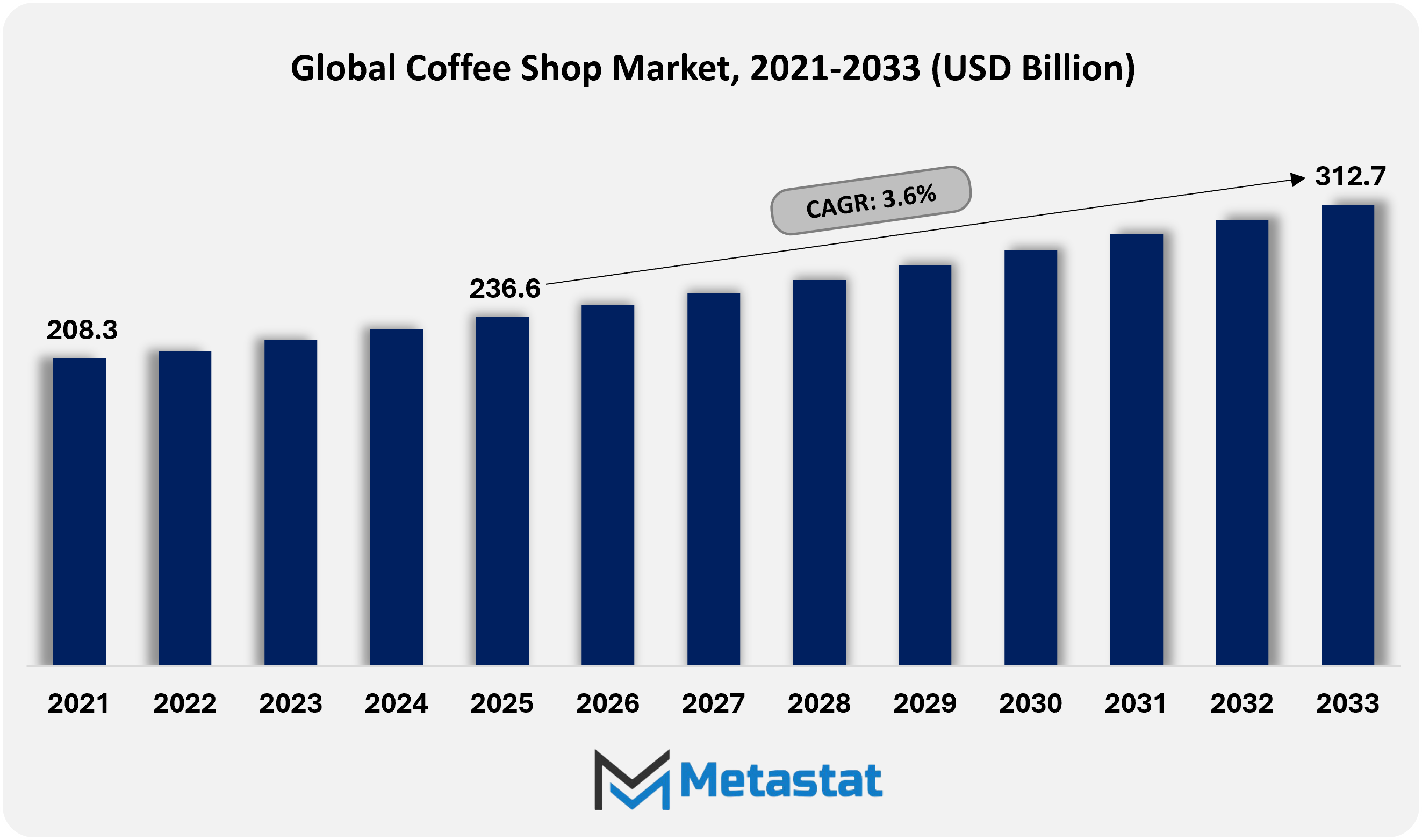
The Global Coffee Shop market size was valued at USD 236.6 billion in 2025 and projected to grow at a CAGR of 3.6% during the forecast period, reaching USD 312.7 billion by 2033.
Global Coffee Shop Market: Comprehensive Data-Driven Market Analysis and Strategic Outlook
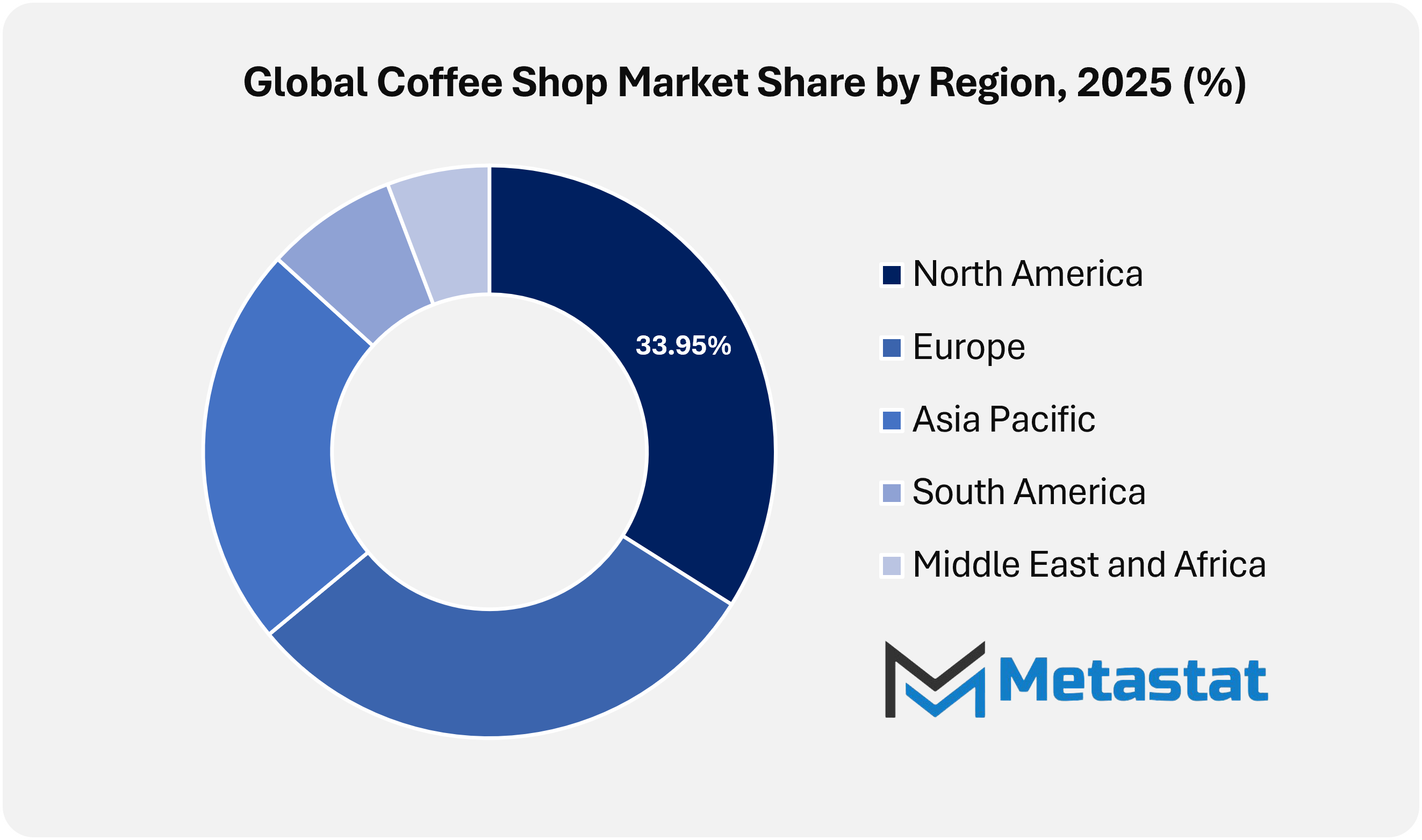
North America accounted for 34.0% of the Global Coffee Shop market in 2025, with the United States leading regional revenue generation.
Independent Coffee Shops accounted for 39.8% of the Global Coffee Shop market in 2025.
Key trends driving growth include rising urban lifestyles and on-the-go consumption, along with the expansion of branded café chains and premium coffee concepts that are increasing consumer spending.
Opportunities include growing demand for specialty, ethically sourced, and experiential café formats across global markets.
Key insight: Premiumization, digital ordering, and experiential consumption are reshaping the Global Coffee Shop market amid cost pressure and operational digitization.
The Global Coffee Shop market within the broader foodservice and hospitality industry is evolving beyond traditional store expansion and routine beverage innovation into a category shaped by brand identity, hybrid formats, and digital consumer engagement. Over the forecast period, operators will increasingly focus on creating café environments that serve as social hubs, remote workspaces, and lifestyle-oriented destinations rather than only beverage sales points. Physical stores are expected to incorporate modular layouts, flexible seating arrangements, and localized design concepts that reflect regional consumer preferences instead of standardized global formats.
Brand strategies will place greater emphasis on origin transparency, roasting expertise, and collaborations with local artists or creators to strengthen consumer connection. Coffee shops are expected to offer curated experiences such as tasting sessions, limited-batch launches, and brewing workshops to improve differentiation. Technology will support these developments through predictive ordering systems, AI-enabled menu personalization, and seamless payment platforms that enhance convenience while preserving the experience associated with specialty coffee culture.
Market Dynamics
Growth Drivers:
Rising urban lifestyles and on-the-go consumption increasing daily coffee intake across demographics.
Rapid urban expansion will continue to influence consumption patterns across major cities and emerging metropolitan areas. Fast-paced work schedules, longer commuting hours, and rising participation of young professionals in formal employment will support frequent café visits. Daily routines will include greater use of takeaway beverages and quick-service formats, strengthening repeat footfall. Digital ordering platforms, mobile payments, and subscription-based beverage models will further improve accessibility, supporting steady growth of the Global Coffee Shop market across multiple consumer groups and income levels.
Expansion of branded café chains and premium coffee concepts enhancing consumer spending
Branded café chains are expected to expand through franchising, strategic partnerships, and entry into tier-2 and tier-3 cities. Premium positioning, curated interiors, and differentiated beverage menus will encourage higher spending per visit. Consumer preference for recognized brands offering consistent quality will support repeat engagement. Product innovation through seasonal offerings, limited-edition blends, and artisanal brewing techniques will improve perceived value. Structured loyalty programs and integrated digital platforms will further strengthen customer retention and support revenue growth in the Global Coffee Shop market.
Restraints and Challenges:
Volatility in coffee bean prices impacting operating margins and menu pricing
Fluctuations in global coffee bean supply caused by climate variability, changes in agricultural yield, and trade policy developments will affect procurement costs. Cost instability is expected to pressure operating margins and lead to frequent menu price adjustments. Independent coffee shops with limited purchasing power will remain more exposed to raw material volatility. Strategic sourcing contracts, inventory management systems, and supplier diversification will become important risk mitigation measures, although margin pressure will continue to be a significant operational challenge across the Global Coffee Shop market.
High rental and labor costs in prime urban locations constraining profitability
Prime commercial districts will maintain premium rental levels driven by high pedestrian traffic and strong brand visibility. Wage inflation, compliance requirements, and workforce training costs will increase overall staff expenditure. Combined pressure from rental and labor costs will narrow profitability, particularly for operators following fixed pricing strategies. Expansion plans are likely to shift toward suburban corridors and mixed-use developments to balance brand visibility with cost efficiency, influencing store network strategies across the Global Coffee Shop market.
Opportunities:
Growing demand for specialty, ethically sourced, and experiential café formats across global markets
Consumer awareness regarding sustainability, fair trade practices, and origin transparency will shape purchasing preferences over the forecast period. Specialty brewing methods, single-origin beans, and traceable supply chains will attract consumers seeking authenticity and quality. Experiential formats featuring live roasting stations, tasting workshops, and community-oriented spaces will strengthen brand differentiation. Investment in sustainable packaging and environmentally responsible operations will improve brand perception, support premium revenue streams, and contribute to the long-term development of the Global Coffee Shop market across global markets.
Market Segmentation Analysis
The Global Coffee Shop market is classified based on Type, Product, Service, and City Size.
By Type, the market is further segmented into:
Independent Coffee Shops
Independent Coffee Shops segment is estimated at USD 97.3 billion in 2026 and is projected to reach USD 115 billion by 2033, at a CAGR of 2.4% during the forecast period.
Independent Coffee Shops in the Global Coffee Shop market will strengthen local positioning through customized menus, regional sourcing, and direct customer engagement. Digital payment systems and selective automation will improve operational efficiency without reducing brand authenticity. Growth will be supported by curated in-store experiences, limited-batch offerings, and community-driven loyalty programs that encourage repeat visits.
Chain Coffee Shops
Chain Coffee Shops segment is estimated at USD 90.7 billion in 2026 and is projected to reach USD 120 billion by 2033, at a CAGR of 4.1% during the forecast period.
Chain Coffee Shops in the Global Coffee Shop market will expand through standardized quality control, integrated supply chains, and data-driven location planning. Advanced customer analytics will support product innovation and more effective promotional strategies. Expansion into emerging districts and transit hubs will improve brand visibility, while economies of scale will help maintain cost efficiency across multiple regions.
Specialty Coffee Shops
Specialty Coffee Shops segment is estimated at USD 41.1 billion in 2026 and is projected to reach USD 57.4 billion by 2033, at a CAGR of 4.9% during the forecast period.
Specialty Coffee Shops in the Global Coffee Shop market will focus on premium beans, traceable sourcing, and brewing precision. Education-led marketing, tasting sessions, and sustainability certifications will shape brand positioning. Investment in advanced roasting equipment and skilled barista training will strengthen product differentiation and attract quality-conscious consumers seeking refined beverage experiences.
Drive-Thru Coffee Shops
Drive-Thru Coffee Shops segment is estimated at USD 15.7 billion in 2026 and is projected to reach USD 20.3 billion by 2033, at a CAGR of 3.7% during the forecast period.
Drive-Thru Coffee Shops in the Global Coffee Shop market will benefit from rising demand for speed and convenience. Smart ordering systems, mobile pre-ordering, and contactless pickup points will reduce wait times and improve service efficiency. Strategic placement near highways, office clusters, and commuter routes will support recurring traffic, while compact store infrastructure will help optimize operating costs.
By Product, the market is divided into:
Coffee Based Beverages
Coffee Based Beverages segment is projected to reach USD 156.7 billion by 2033, at a CAGR of 2.7% during the forecast period.
Coffee-Based Beverages in the Global Coffee Shop market will continue to evolve through plant-based milk alternatives, low-sugar formulations, and functional ingredient additions. Seasonal flavors and regional menu adaptation will strengthen consumer engagement. Automated brewing systems will improve consistency while maintaining taste standards required for brand credibility and expansion.
Non-Coffee Beverages
Non-Coffee Beverages segment is projected to reach USD 51.5 billion by 2033, at a CAGR of 4.4% during the forecast period.
Non-Coffee Beverages in the Global Coffee Shop market will broaden product portfolios through teas, smoothies, and health-oriented drinks. Rising wellness awareness will support demand for low-calorie and vitamin-enriched options. A balanced menu mix will attract non-coffee consumers, widen demographic reach, and support stable revenue generation throughout the year.
Food Items
Food Items segment is projected to reach USD 63.3 billion by 2033, at a CAGR of 4.7% during the forecast period.
Food Items in the Global Coffee Shop market will gain importance through ready-to-eat meals, light snacks, and locally inspired menu offerings. Partnerships with local suppliers will improve freshness perception and menu relevance. Balanced pricing strategies will increase cross-selling opportunities and support higher average order values during breakfast and mid-day consumption periods.
Baked Goods
Baked Goods segment is projected to reach USD 29.8 billion by 2033, at a CAGR of 4.9% during the forecast period.
Baked Goods in the Global Coffee Shop market will remain important through a focus on freshness, visual appeal, and dietary options such as gluten-free and vegan products. In-store baking formats will strengthen sensory appeal and improve purchase conversion. Limited-edition assortments during festive periods will stimulate impulse purchases and support seasonal sales performance.
Others
Others segment is projected to reach USD 11.3 billion by 2033, at a CAGR of 1.8% during the forecast period.
Others in the Global Coffee Shop market will include merchandise, packaged coffee beans, brewing equipment, and subscription kits. Branded retail products will support additional revenue streams beyond in-store sales. E-commerce integration will enable direct-to-consumer distribution, strengthening brand recall and long-term customer engagement.
By Service, the market is further divided into:
Full Service
Full-Service segment is projected to reach USD 134.6 billion by 2033.
Full-Service formats in the Global Coffee Shop market will emphasize hospitality, seating comfort, and longer customer dwell time. Staff training programs will improve service quality, while digital reservation and queue tools will help manage peak hours more efficiently. Such formats will attract meetings, study sessions, and casual gatherings, supporting stronger customer retention.
Self Service
Self Service segment is projected to reach USD 108.1 billion by 2033.
Self Service formats in the Global Coffee Shop market will prioritize speed, digital kiosks, and streamlined ordering processes. Lower staffing requirements will improve cost control while maintaining service efficiency. Integration of loyalty programs will enable personalized offers, encourage repeat transactions, and support more effective queue management.
Coffee Kiosks/Cart
Coffee Kiosks/Cart segment is projected to reach USD 69.9 billion by 2033.
Coffee Kiosks or Carts in the Global Coffee Shop market will expand across high-footfall areas such as malls, transit stations, office parks, and event venues. Compact infrastructure will reduce capital expenditure and improve rollout flexibility. Mobility and lower operating complexity will allow operators to respond more effectively to demand patterns across different urban clusters.
By City Size, the Global Coffee Shop market is divided as:
Metropolitan
Metropolitan segment is projected to grow at a CAGR of 3% during the forecast period.
Metropolitan areas in the Global Coffee Shop market will remain highly competitive owing to dense populations and strong premium pricing potential. Advanced store formats, experiential interiors, and diversified menus will support differentiation. Integration with delivery platforms will ensure consistent order flow across both commercial and residential districts.
Urban
Urban segment is projected to grow at a CAGR of 4.3% during the forecast period.
Urban areas in the Global Coffee Shop market will demonstrate balanced growth supported by rising disposable income and lifestyle changes. Moderate rental levels will improve the feasibility of sustainable outlet expansion. A focus on mid-range pricing and convenient store formats will appeal to students, office workers, and family-oriented consumers.
Rural
Rural segment is projected to grow at a CAGR of 3.5% during the forecast period.
Rural areas in the Global Coffee Shop market will gradually adopt organized café formats supported by improving infrastructure and digital connectivity. Compact stores with simplified menus will help reduce operational risk. Localized flavors and affordable pricing strategies will support market penetration and long-term demand stability.
By Region:
Based on geography, the Global Coffee Shop market is divided into North America, Europe, Asia-Pacific, South America, Middle East, and Africa.
North America Coffee Shop Market is set to expand at a CAGR of 3.6% within the forecast period, reaching a market size (TAM) of USD 99.4 billion by the end of 2033.
North America leads the Global Coffee Shop market through a strong specialty coffee culture and high consumer spending on premium beverages.
North America speeds up the Global Coffee Shop Market with rapid adoption of virtual ordering, loyalty packages, and power-via codecs.
Europe sustains steady growth in the Global Coffee Shop market through established café culture, high demand for premium coffee offerings, and rising consumer interest in specialty beverages, artisanal bakery pairings, and experience-led café formats.
Asia Pacific offers significant opportunities in the Global Coffee Shop market owing to rising urbanization and an expanding middle-class consumer base.
Asia Pacific creates opportunities for the Global Coffee Shop Market via developing café lifestyle amongst youth and growing demand for worldwide coffee brands.
Across Middle East, Africa, and South America, the Global Coffee Shop Market profits momentum from urban retail growth, tourism boom, and evolving client life-style styles.
Competitive Landscape and Strategic Insights
The Global Coffee Shop market has developed into a strong consumer-driven industry shaped by urban lifestyles, rising disposable income, and changing social habits. Coffee shops are no longer limited to beverage sales and increasingly serve as spaces for meetings, remote work, casual interaction, and short daily breaks. In mature markets, café visits form part of regular consumption routines, while in emerging markets they increasingly reflect aspiration and modern lifestyle adoption. Brands are expanding beyond major metropolitan areas into smaller cities, while digital ordering, loyalty programs, and mobile payments continue to influence consumer engagement.
Large global chains continue to play a major role in setting quality benchmarks and shaping brand expectations across the market. Starbucks Corporation remains one of the most recognized names globally, with a strong presence across North America, Europe, and Asia. Luckin Coffee Inc. has demonstrated rapid expansion in China through app-based ordering and competitive pricing. Inspire Brands, Inc. and Restaurant Brands International Inc. leverage their broader foodservice portfolios to strengthen their position in beverage-led formats. Costa Limited maintains a strong footprint in Europe and parts of Asia, while PTT Oil and Retail Business Public Company Limited integrates coffee retailing with fuel stations and convenience-based formats to capture high-footfall demand.
Several regional players continue to build loyal customer bases through localized menus and differentiated store concepts. Doutor Nichires Holdings Co., Ltd. and Komeda Holdings Co., Ltd. maintain strong positions in Japan through distinct service models. Caffè Nero Group Ltd. and Pret a Manger (Europe) Limited focus on urban centers with premium store experiences. Dutch Bros Inc. and Scooter’s Coffee, LLC are expanding drive-thru-oriented formats in the United States to target convenience-driven consumers. Gloria Jean’s Coffees, Caribou Coffee Company, Inc., BIGGBY COFFEE, and Espresso House Group AB also maintain steady growth in their respective markets through regional pricing and menu adaptation.
Specialty and heritage-led brands add further depth to the competitive landscape. The Coffee Bean & Tea Leaf, Blue Bottle Coffee, Inc., and Peet’s Coffee, Inc. emphasize quality sourcing and craft-based preparation. Second Cup Ltd., illycaffè S.p.A., Luigi Lavazza S.p.A., Massimo Zanetti Beverage Group S.p.A., Tchibo GmbH, Caffè Vergnano S.p.A., Coffee Island S.A., and Caffè Pascucci reflect strong coffee traditions while expanding their retail and packaged product presence. Bean traceability, premium blends, and in-store roasting concepts will continue to shape brand identity over the forecast period. Overall, the Global Coffee Shop market will remain highly competitive, with established players and emerging brands refining their formats to meet changing consumer preferences and lifestyle patterns.
Forecast and Future Outlook
Market size is forecast to rise from USD 236.6 billion in 2025 to over USD 312.7 billion by 2033.
In parallel, the competitive landscape is expected to show greater polarization between artisanal independent operators and scaled international chains. Both segments will increasingly invest in stronger brand presentation and more advanced digital loyalty systems. Over the forecast period, the Global Coffee Shop market will be defined less by beverage volume alone and more by experiential value, brand identity, and technology integration, which will shape long-term positioning within the global foodservice industry.
This research report categorizes the Coffee Shop market based on key segments and regions, forecasts revenue growth, and analyses trends in each submarket. The report analyses the key growth drivers, opportunities, and challenges influencing the Coffee Shop market. Recent market developments and competitive strategies such as expansion, product launch, partnership, merger, and acquisition have been included to draw the competitive landscape in the market.
The report strategically identifies and profiles the key market players and analyses their core competencies in each sub-segment of the Coffee Shop market.
Report Attributes
Details
Study Period
2021-2033
Base Year
2025
Estimated Year
2026
Forecast Period
2026-2033
Historical Period
2021-2025
Growth Rate
CAGR 3.6% from 2026 to 2033
Revenue Unit
USD billion
Segmentation
By Type, Product, Service, City Size, and Region
By Region
North America (By Type, Product, Service, City Size, and Country)
United States
Canada
Mexico
Europe (By Type, Product, Service, City Size, and Country)
Germany
France
UK
Italy
Spain
Russia
Rest of Europe
Asia Pacific (By Type, Product, Service, City Size, and Country)
China
Japan
India
South Korea
Australia
Southeast Asia
Rest of Asia Pacific
South America (By Type, Product, Service, City Size, and Country)
Brazil
Argentina
Rest of South America
Middle East and Africa (By Type, Product, Service, City Size, and Country)
Saudi Arabia
UAE
South Africa
Rest of Middle East and Africa
WHAT REPORT PROVIDES
Key Company Market Share, Revenue, and Position/Ranking
Key Market Leaders
Full In-Depth Analysis of the Parent Industry
Industry Statistics
Important Changes in Market and Its Dynamics
Segmentation Details of the Market
Historical, On-Going, and Projected Market Analysis
Assessment of Niche Industry Developments
Market Share Analysis
Key Strategies of Major Players
Company Profiles of Key Players
Unique Selling Propositions of Leading Market Players
Reduced Sugar Food & Beverages market size is valued at USD 793.9 billion in 2025 and projected to reach USD 1,447.9 billion by 2033, growing at a CAGR of 7.8%.
Kazakhstan Frozen Potato Products market size is valued at USD 26.4 million in 2025 and is projected to reach USD 53.0 million in 2033, at a CAGR of 9.0% from 2026 to 2033.
Switzerland Poke Food market size is valued at USD 29.2 million in 2025 and is projected to reach USD 44.5 million in 2033, at a CAGR of 5.5% from 2026 to 2033.
Netherlands Food and Beverages QA, QC, and Compliance Software Solutions Market Size, Share, Trends, 2033
Netherlands F&B QA, QC, and Compliance Software Solutions market size is valued at USD 272.5 million in 2025 and is projected to reach USD 421.3 million in 2033, at a CAGR of 5.6% from 2026 to 2033.
Netherlands F&B QA, QC, and Compliance Software Solutions Market, Netherlands F&B QA, QC, and Compliance Software Solutions Market Size, Netherlands F&B QA, QC, and Compliance Software Solutions Market Share, Netherlands F&B QA, QC, and Compliance Software Solutions Market Analysis, Netherlands F&B QA, QC, and Compliance Software Solutions Market Growth, Netherlands F&B QA, QC, and Compliance Software Solutions Market Trends, Netherlands F&B QA, QC, and Compliance Software Solutions Market Research Report, Netherlands F&B QA, QC, and Compliance Software Solutions Market Forecast, Netherlands F&B QA, QC, and Compliance Software Solutions, Netherlands F&B QA, QC, and Compliance Software Solutions Market Research, Netherlands F&B QA, QC, and Compliance Software Solutions Industry, Netherlands F&B QA, QC, and Compliance Software Solutions Industry Report, Netherlands F&B QA, QC, and Compliance Software Solutions Market Data, Netherlands F&B QA, QC, and Compliance Software Solutions Statistics, Netherlands F&B QA, QC, and Compliance Software Solutions Market Statistics, Netherlands F&B QA, QC, and Compliance Software Solutions Industry Trends, Netherlands F&B QA, QC, and Compliance Software Solutions Market Report, Netherlands F&B QA, QC, and Compliance Software Solutions Market Trends, Netherlands F&B QA, QC, and Compliance Software Solutions Market News, Netherlands F&B QA, QC, and Compliance Software Solutions Forecasts, Netherlands F&B QA, QC, and Compliance Software Solutions Market Intelligence Report