Australia Forklift Rental Market Size, Share, By Load Capacity (Below 3 Tons, 3 to 10 Tons, and Above 10 Tons), By Rental Duration (Short-Term Rental, Medium-Term Rental, and Long-Term Rental), By Propulsion (Internal Combustion Engine, Electric Vehicle, and Hybrid Electric Vehicle), By End Use (Construction, Automotive, Aerospace, Defense, Warehouse, Logistics, and Others), Industry Analysis, Growth, Trends, and Forecast, 2026-2033
Report ID
MSI-4598
Published
April 10, 2026
Pages
320 Pages
Format
Report Details
Comprehensive Market Analysis And Insights
Market Overview
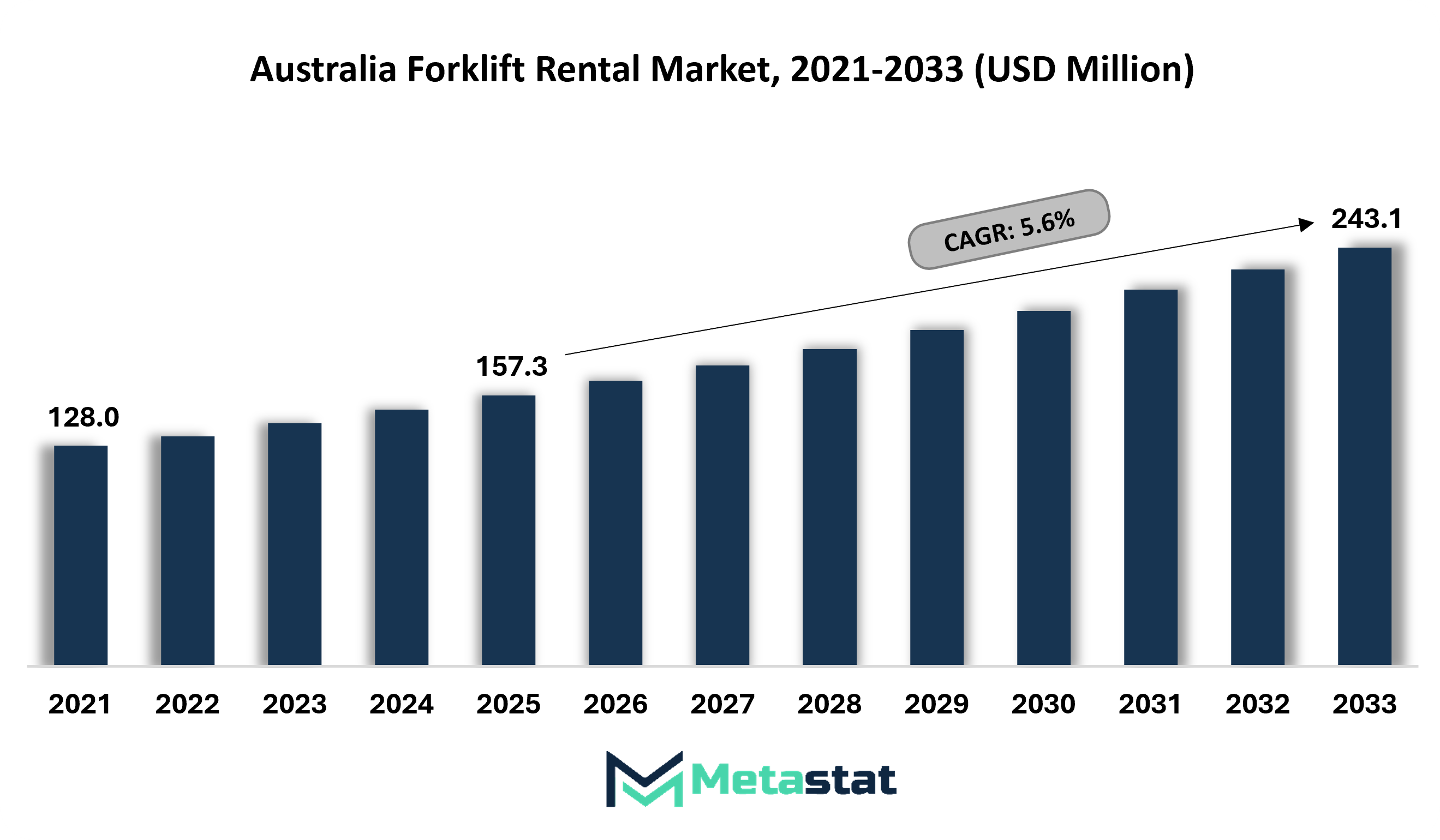
Australia Forklift Rental market size is valued at USD 157.3 million in 2025 and projected to grow at a CAGR of 5.6% during the forecast period, reaching USD 243.1 million by 2033.
Australia Forklift Rental Market: Comprehensive Data-Driven Market Analysis and Strategic Outlook
Australia Forklift Rental market valued at USD 157.3 million in 2025, growing at a CAGR of 5.6% through 2033, with potential to exceed USD 243.1 million.
Below 3 Tons segment account for a market share of 40.4% in 2025.
Key trends driving growth: Growth in warehousing, logistics, and e-commerce handling requirements, along with preference for flexible, maintenance-backed equipment access over ownership.
Opportunities include expansion of electric and lithium-ion forklift rental fleets for indoor and sustainability-led operations.
Key insight: Rapid warehouse automation and e-commerce logistics expansion increase reliance on flexible forklift rental fleets across Australia.
Australia Forklift Rental market remains a critical part of the country’s material handling and logistics ecosystem, supporting the efficient movement, storage, and organization of goods across warehouses, distribution centres, ports, construction sites, and manufacturing facilities. Forklifts continue to be essential for daily operations across industries that require dependable lifting and transport equipment. Rising preference for rental services reflects the need for cost-efficient fleet access, allowing businesses to use modern equipment without committing to high upfront ownership costs.
The forklift rental model allows businesses to align equipment availability with changing operational requirements while reducing maintenance responsibility and long-term asset burden. Rental providers offer a broad mix of forklifts, including electric models for indoor warehouse operations and internal combustion units for demanding outdoor and industrial applications. This flexibility supports companies that require scalable equipment access across seasonal peaks, project-based work, and expanding logistics activity.
Market Dynamics
Growth Drivers:
Growth in warehousing, logistics, and e-commerce handling requirements.
Expansion in warehousing, logistics, and e-commerce activity continues to strengthen demand for forklift rental services across Australia. Distribution centres, fulfilment hubs, and third-party logistics providers require reliable equipment for loading, unloading, stacking, and internal goods movement. Rental forklifts support these operations by providing immediate fleet access, helping operators manage rising throughput requirements without large capital commitments.
Preference for flexible, maintenance-backed equipment access over ownership
Preference for flexible, maintenance-backed equipment access over ownership is becoming a major growth driver in the Australia Forklift Rental market. Many businesses are adopting rental models to avoid the financial burden associated with purchasing forklifts outright. Rental agreements provide the advantage of service support, maintenance coverage, and fleet flexibility, allowing end users to adjust equipment requirements in line with workload, project cycles, and seasonal demand patterns.
Restraints and Challenges:
High fleet acquisition, servicing, and transport cost burden
High fleet acquisition, servicing, and transport costs remain a key challenge for forklift rental providers across Australia. Maintaining a diversified fleet across load capacities and propulsion types requires significant capital investment, while ongoing servicing, compliance, and machine relocation add to operating expenses. These cost pressures can affect pricing competitiveness and place strain on rental margins, particularly in periods of lower fleet utilization.
Utilization volatility across construction, manufacturing, and freight activity
Utilization volatility across construction, manufacturing, and freight activity creates uncertainty for rental operators. Demand for forklifts is closely linked to industrial output, infrastructure execution, and logistics movement, all of which can fluctuate with broader economic conditions. Periods of slower project activity or weaker freight volumes can reduce equipment usage rates and impact the efficiency of fleet deployment strategies.
Opportunities:
Expansion of electric and lithium-ion forklift rental fleets for indoor and sustainability-led operations
Expansion of electric and lithium-ion forklift rental fleets presents a strong opportunity in the Australia Forklift Rental market. Businesses are increasingly adopting cleaner and quieter equipment for indoor operations, particularly across warehousing, retail distribution, and temperature-controlled environments. Lithium-ion forklifts offer benefits such as faster charging, longer operating cycles, and lower maintenance requirements, making them attractive for customers focused on efficiency, safety, and sustainability.
Market Segmentation Analysis
The Australia Forklift Rental market is classified based on Load Capacity, Rental Duration, Propulsion, and End Use.
By Load Capacity, the market is further segmented into:
Below 3 Tons
Below 3 Tons segment is valued at USD 67.1 million in 2026 and is projected to reach USD 101.2 million by 2033, at a CAGR of 6.1% during the forecast period.
Forklifts below 3 tons hold a significant position in the Australia Forklift Rental market owing to their strong suitability for warehouse operations, retail distribution, and light industrial handling. These machines are widely used in facilities that require compact dimensions, high maneuverability, and efficient pallet movement across constrained indoor spaces. Rental demand for this segment remains strong with the continued expansion of e-commerce fulfilment and urban logistics infrastructure across the country.
3 to 10 Tons
3 to 10 Tons segment is valued at USD 74.5 million in 2026 and is projected to reach USD 107.6 million by 2033, at a CAGR of 5.4% during the forecast period.
Forklifts in the 3 to 10 tons category serve a wide range of medium- and heavy-duty material handling requirements across manufacturing sites, freight yards, construction projects, and industrial warehouses. This segment benefits from steady rental demand owing to the need for higher lifting capacity, stronger load stability, and greater operational versatility. Businesses operating across mixed indoor and outdoor environments continue to rely on this category for routine handling of heavy pallets, components, and industrial materials.
Above 10 Tons
Above 10 Tons segment is valued at USD 24.4 million in 2026 and is projected to reach USD 34.3 million by 2033, at a CAGR of 5% during the forecast period.
Forklifts above 10 tons support specialized lifting applications across ports, mining logistics, heavy industry, infrastructure projects, and bulk material handling environments. These machines are used for oversized cargo, large industrial components, and demanding outdoor operations that require substantial lifting strength. Rental demand in this segment is largely project-driven, with customers preferring temporary access to high-capacity equipment rather than maintaining ownership of expensive specialized assets.
By Rental Duration, the market is divided into:
Short-Term Rental
Short-Term Rental segment is projected to reach USD 149.1 million by 2033, at a CAGR of 5% during the forecast period.
Short-term rental remains an important part of the Australia Forklift Rental market, serving businesses that require equipment for temporary operations such as seasonal inventory surges, warehouse relocations, shutdown maintenance, and short-cycle projects. This format offers immediate flexibility and allows companies to manage workload fluctuations without entering long contractual commitments. Strong preference for short-duration access continues across logistics, retail, and construction-linked applications.
Medium-Term Rental
Medium-Term Rental segment is projected to reach USD 55.4 million by 2033, at a CAGR of 5.9% during the forecast period.
Medium-term rental arrangements are commonly used for projects and operational periods that extend over several months, including facility expansions, industrial upgrades, contract logistics assignments, and phased construction activity. This rental format offers a balance between flexibility and cost control, making it suitable for businesses that require sustained forklift access without the long-term commitment of outright purchase or extended lease ownership models.
Long-Term Rental
Long-Term Rental segment is projected to reach USD 38.6 million by 2033, at a CAGR of 7.9% during the forecast period.
Long-term rental agreements are increasingly preferred by businesses that require stable forklift availability across ongoing warehouse, manufacturing, and logistics operations. This model supports predictable budgeting, reduces maintenance management responsibilities, and provides continued access to modern fleets without the burden of ownership. Large end users often rely on long-term rentals to maintain operational continuity while preserving capital for core business functions.
By Propulsion, the market is further divided into:
Internal Combustion Engine
Internal Combustion Engine segment is projected to reach USD 91.6 million by 2033.
Internal combustion engine forklifts continue to hold a strong presence in the Australia Forklift Rental market, particularly across outdoor and heavy-duty applications. These machines are widely used in freight yards, construction environments, industrial sites, and operations that require extended runtime and higher load capability. Their suitability for demanding working conditions supports continued rental demand across sectors that depend on durable lifting performance.
Electric Vehicle
Electric Vehicle segment is projected to reach USD 144 million by 2033.
Electric forklifts are gaining wider adoption across Australia owing to their suitability for indoor warehouse environments, lower emissions profile, reduced noise levels, and lower maintenance requirements. These machines are increasingly used in retail distribution centres, cold storage facilities, and modern logistics operations that prioritize efficiency and workplace safety. Growing focus on cleaner equipment fleets continues to strengthen the rental opportunity for electric forklift categories.
Hybrid Electric Vehicle
Hybrid Electric Vehicle segment is projected to reach USD 7.5 million by 2033.
Hybrid and alternative power forklifts represent a smaller but emerging segment within the Australia Forklift Rental market, supporting users that require a balance of efficiency, runtime, and operational adaptability. Hybrid and alternative power forklifts are relevant in environments with mixed indoor and outdoor handling requirements, where flexibility in power performance can add value. Continued development in energy-efficient forklift technology is expected to support future interest in this segment.
By End Use, the Australia Forklift Rental market is divided as:
Construction
Construction segment is projected to grow at a CAGR of 5.4% during the forecast period.
Construction remains an important end-use segment in the Australia Forklift Rental market, supported by ongoing demand for equipment used in lifting and transporting building materials across active sites. Contractors rely on rental fleets to manage short-term and project-specific requirements without allocating capital to permanent equipment ownership. Forklift rentals support flexibility across changing site conditions, phased project schedules, and varying material movement requirements.
Automotive
Automotive segment is projected to grow at a CAGR of 5.2% during the forecast period.
Automotive-related operations generate consistent demand for forklift rentals across parts handling, industrial storage, workshop logistics, and component movement applications. Businesses in this segment require equipment that can support fluctuating workloads while maintaining operational efficiency across warehouses and service-linked environments. Rental access remains attractive owing to the ability to scale fleet requirements in line with activity levels and supply chain needs.
Aerospace & Defense
Aerospace & Defense segment is projected to grow at a CAGR of 4.8% during the forecast period.
Aerospace and defense applications require dependable forklift access for handling components, maintenance equipment, tooling, and specialized materials within controlled operational settings. Rental solutions are relevant for facilities that need reliable lifting equipment while maintaining flexibility around project schedules and maintenance cycles. This segment supports steady demand for machines that can perform in safety-conscious and technically demanding environments.
Warehouse and Logistics
Warehouse and Logistics segment is projected to grow at a CAGR of 6.3% during the forecast period.
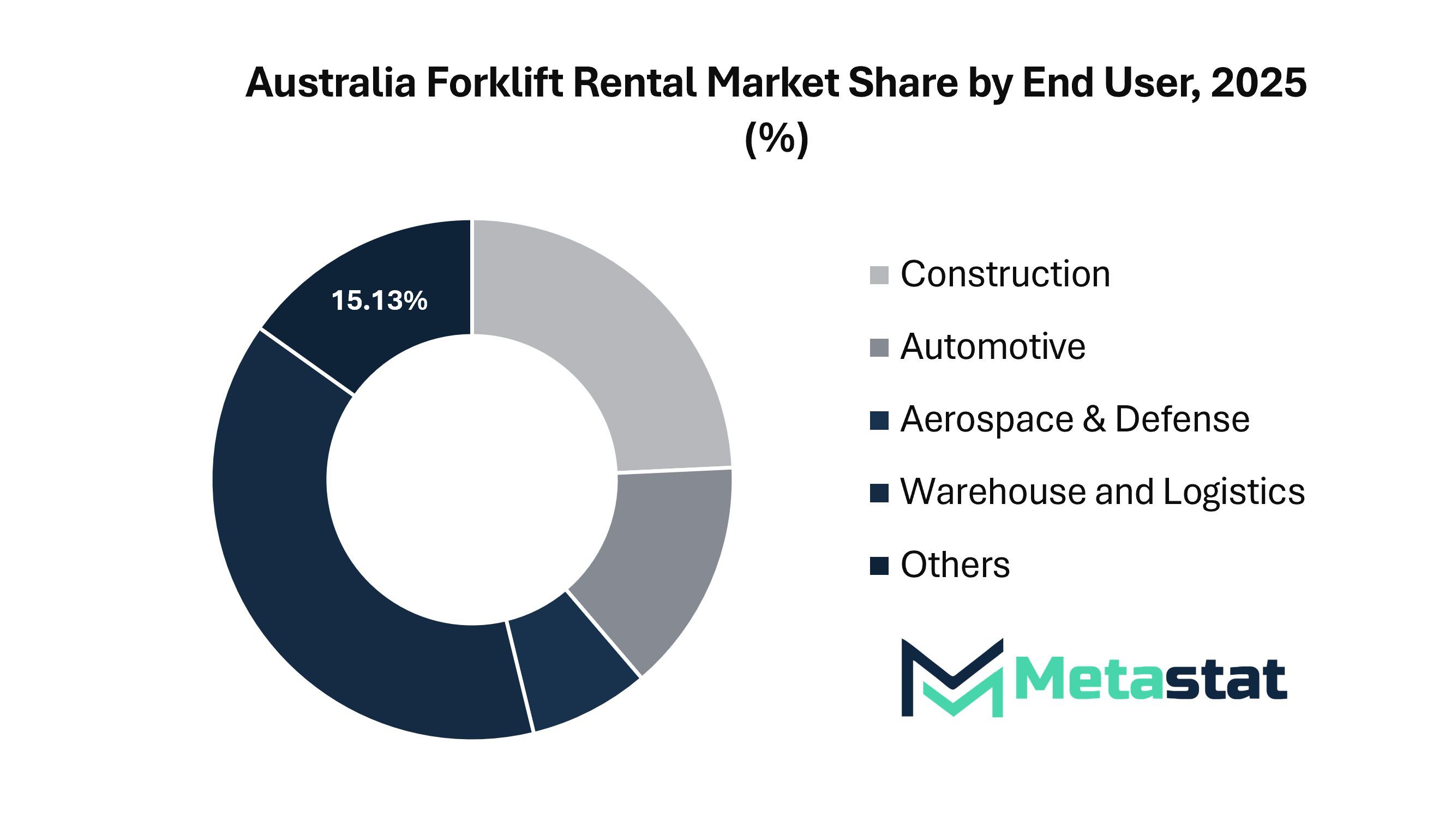
Warehouse and logistics represent the leading end-use segment in the Australia Forklift Rental market, driven by continued growth in e-commerce, third-party logistics, retail distribution, and freight handling activity. Forklift rentals are widely used for pallet movement, loading, unloading, stacking, and internal transport across high-volume operating environments. Expanding distribution infrastructure and rising goods movement continue to support strong rental demand in this segment.
Others
Others segment is projected to grow at a CAGR of 4.8% during the forecast period.
Other end-use sectors, including retail distribution, food processing, port handling, and general industrial operations, contribute to the broad demand base of the Australia Forklift Rental market. These industries require flexible equipment access for routine material movement, temporary workload support, and operational continuity. Rental adoption across these diverse applications strengthens the market’s stability and supports recurring service demand.
Competitive Landscape and Strategic Insights
The Australia forklift rental marketplace will keep to advantage attention as organizations look for flexible material managing solutions without committing to excessive capital investment. Renting forklifts allows organizations to manage quick-term workload modifications, seasonal call for, and undertaking-based totally operations with more efficiency. Warehousing, production, manufacturing, retail distribution, and logistics offerings will remain primary customers of condo fleets throughout Australia. Many agencies decide on apartment agreements because they reduce protection issues and allow easy get entry to trendy equipment. With expanding e-commerce activity and growing warehouse operations, the call for dependable lifting equipment will remain strong, encouraging rental provider carriers to amplify their services.
Operational flexibility may be a key cause behind the growing preference for rental forklifts. Businesses might be capable of scale equipment utilization based on each day operational wishes without buying new machines. Rental providers often include renovation, servicing, and equipment alternative within contracts, if you want to lessen downtime for customers. Companies dealing with more than one throughout Australia will benefit from rental preparations because system may be relocated or upgraded when required. The market can even see rising call for electric powered forklifts, so that you can assist workplace efficiency and decrease working charges through the years.
Service exceptional and gadget availability will form opposition amongst condo carriers. Many operators will consciousness on expanding fleet length and keeping a mixture of electric, diesel, and LPG forklifts to serve one-of-a-kind industries. Companies together with Coates Hire Limited, Toyota Material Handling Australia Pty Limited, Crown Equipment Pty Limited, Komatsu Forklift Australia Pty Ltd, Adaptalift Group, MLA Holdings, Fork Force Australia, and All Lift Forklifts & Access Equipment will retain to bolster their apartment networks throughout fundamental business regions. Waverley Forklifts Pty Ltd, United Equipment Pty Limited, Access Group Australia Pty Ltd, Jungheinrich Partners Australia, and Hystandard Handling and Equipment Pty Ltd may also keep a presence via system leasing, servicing support, and fleet control packages.
Several different individuals will contribute to the improvement of the marketplace through nearby operations and specialized services. Allied Forklifts, Forkcare Australia Pty Ltd, Statewide Forklifts Pty Ltd, Biondo Rentals, Perth Fork Trucks Pty Ltd, Network Forklift Hire Sydney Pty Ltd, Mars Forklift Services Pty Ltd, A-One Lift Truck Services Pty Limited, and Active Forklifts (Australia) Pty Ltd will serve corporations searching for dependable quick-term equipment answers. These companies will often consciousness on customer support, gadget servicing, and short shipping, so one can strengthen lengthy-term customer relationships. Continued enlargement of logistics hubs, commercial parks, and distribution facilities throughout Australia will aid steady interest in forklift condo offerings, helping the market preserve constant momentum inside the coming years.
Forecast and Future Outlook
Market size is forecast to rise from USD 157.3 million in 2025 to over USD 243.1 million by 2033.
Australia Forklift Rental market is expected to record steady growth over the forecast period, supported by continued expansion in warehousing, logistics infrastructure, industrial handling requirements, and project-based equipment demand. Rising adoption of electric forklift fleets, increasing preference for flexible rental models, and ongoing growth in distribution activity are expected to sustain market expansion. Demand is likely to remain strongest across warehouse and logistics applications, with rental providers focusing on fleet modernization, service efficiency, and broader equipment availability.
This research report categorizes the Australia Forklift Rental market based on key segments, forecasts revenue growth, and analyses trends in each submarket. The report analyses the key growth drivers, opportunities, and challenges influencing the Forklift Rental market. Recent market developments and competitive strategies such as expansion, product launch, partnership, merger, and acquisition have been included to draw the competitive landscape in the market.
The report strategically identifies and profiles the key market players and analyses their core competencies in each sub-segment of the Australia Forklift Rental market.
Report Attributes
Details
Study Period
2021-2033
Base Year
2025
Estimated Year
2026
Forecast Period
2026-2033
Historical Period
2021-2025
Growth Rate
CAGR 5.6% from 2026 to 2033
Revenue Unit
USD million
Segmentation
By Load Capacity, Rental Duration, Propulsion, End Use
By Load Capacity
Below 3 Tons
3 to 10 Tons
Above 10 Tons
By Rental Duration
Short-Term Rental
Medium-Term Rental
Long-Term Rental
By Propulsion
Internal Combustion Engine
Electric Vehicle
Hybrid Electric Vehicle
By End Use
Construction
Automotive
Aerospace & Defense
Warehouse and Logistics
Others
WHAT REPORT PROVIDES
Key Company Market Share, Revenue, and Position/Ranking
Key Market Leaders
Full In-Depth Analysis of the Parent Industry
Industry Statistics
Important Changes in Market and Its Dynamics
Segmentation Details of the Market
Historical, On-Going, and Projected Market Analysis
Assessment of Niche Industry Developments
Market Share Analysis
Key Strategies of Major Players
Company Profiles of Key Players
Unique Selling Prepositions of Leading Market Players
Stage Hoist market size is valued at USD 236.3 million in 2025 and is projected to reach USD 395.3 million in 2033, at a CAGR of 6.3% from 2026 to 2033.
Global Taper Lock Bushing market is valued at USD 1,187.8 million in 2025 and is projected to reach USD 1,808.0 million in 2033, at a CAGR of 5.4% from 2026 to 2033
Europe Mini Excavators Market Size, Share, Trends, 2033
Europe Mini Excavators market size is valued at USD 2,162.9 million in 2025 and is projected to reach USD 3,004.1 million in 2033, at a CAGR of 4.2% from 2026 to 2033
Europe Mini Excavators Market, Europe Mini Excavators Market Size, Europe Mini Excavators Market Share, Europe Mini Excavators Market Analysis, Europe Mini Excavators Market Growth, Europe Mini Excavators Market Trends, Europe Mini Excavators Market Research Report, Europe Mini Excavators Market Forecast, Europe Mini Excavators, Europe Mini Excavators Market Research, Europe Mini Excavators Industry, Europe Mini Excavators Industry Report, Europe Mini Excavators Market Data, Europe Mini Excavators Statistics, Europe Mini Excavators Market Statistics, Europe Mini Excavators Industry Trends, Europe Mini Excavators Market Report, Europe Mini Excavators Market Trends, Europe Mini Excavators Market News, Europe Mini Excavators Forecasts, Europe Mini Excavators Market Intelligence Report
Global Switch Actuators market size is valued at USD 18.4 billion in 2025 and is projected to reach USD 30.6 billion in 2033, at a CAGR of 6.6% from 2026 to 2033