Global Axial Flux Motor Market Size, Share, By Type (Dual-rotor Single-stator Type and Single-rotor Dual-stator Type), By Power (1kw-15kw, 15kw-80kw, 80kw-160kw, and Above 160kw), By Cooling Process (Air Cooling, Liquid Cooling, and Others), By Application (Electric Buses, Electric Trucks, Electric Supercars, and Others), Industry Analysis, Growth, Trends, and Forecast, 2026-2033
Report ID
MSI-4636
Published
April 17, 2026
Pages
320 Pages
Format
Report Details
Comprehensive Market Analysis And Insights
Market Overview
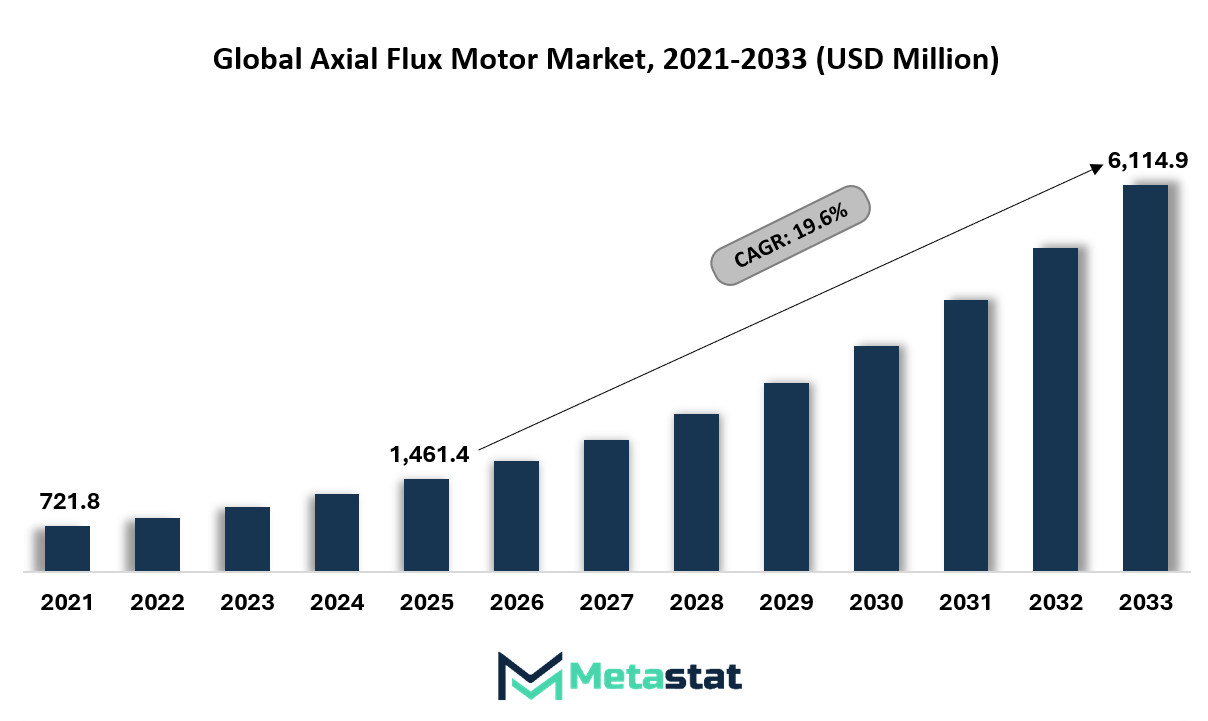
Global Axial Flux Motor market size is valued at USD 1,461.4 million in 2025 and projected to grow at a CAGR of 19.6% during the forecast period, reaching USD 6,114.9 million by 2033.
Global Axial Flux Motor Market: Comprehensive Data-Driven Market Analysis and Strategic Outlook
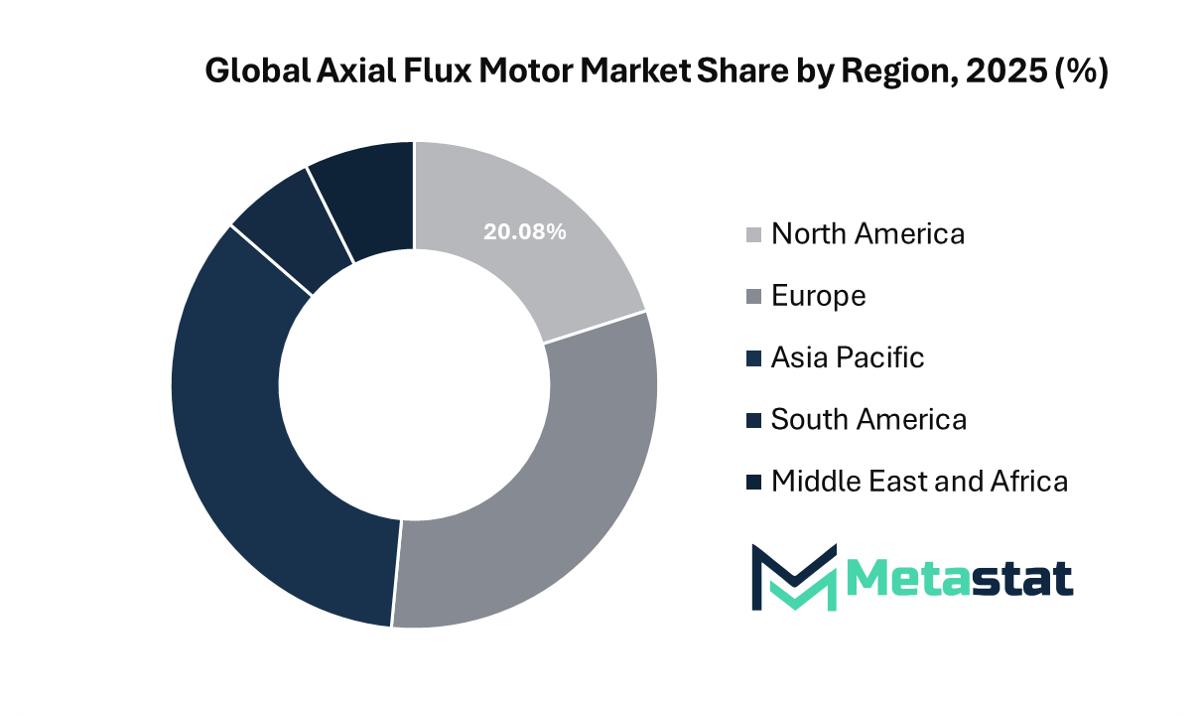
North America accounts for 20.1% of the global Axial Flux Motor market in 2025, with the U.S. holding the largest country-level share within the region.
Dual-rotor Single-stator Type segment accounts for a market share of 56.2% in 2025.
Key trends driving growth: Rising adoption of electric vehicles requiring high power density and compact motor solutions, along with increased demand for energy-efficient and lightweight propulsion systems across industries.
Opportunities include expansion in advanced mobility applications including electric aviation and high-performance EV platforms.
Key insight: Rising electrification across automotive and aerospace sectors is accelerating demand for compact, high torque-density motor designs, positioning axial flux technology as a performance-driven alternative to conventional motor architectures.
Global Axial Flux Motor Market continues to gain traction across advanced electromechanical systems where compact design, high torque density, and efficiency are critical. These motors are increasingly being adopted across electric mobility, industrial automation, and renewable energy systems owing to their ability to deliver better performance in a smaller footprint compared to conventional radial flux motors.
The structural design of axial flux motors, where the magnetic flux flows parallel to the axis of rotation, enables reduced weight and improved energy efficiency. This makes them particularly suitable for electric vehicles and aerospace applications where space optimization and energy efficiency are key operational considerations. As industries shift toward electrification and sustainable energy use, axial flux motors will play a vital role in next-generation propulsion and equipment systems.
Market Dynamics
Growth Drivers:
Rising adoption of electric vehicles requiring high power density and compact motor solutions.
Rising electric vehicle penetration across urban and intercity transport networks is increasing reliance on compact motor architectures that deliver superior torque output within limited space. High power density designs support improved vehicle range, better acceleration, and optimized battery utilization, strengthening demand for the Global Axial Flux Motor market across passenger and commercial mobility segments.
Increased demand for energy-efficient and lightweight propulsion systems across industries
Industries such as automotive, aerospace, and marine are prioritizing propulsion systems that offer reduced weight and improved efficiency to meet sustainability targets. Lightweight motor configurations reduce energy consumption and operating costs while maintaining performance standards, encouraging wider adoption of axial flux motor solutions in applications requiring precision, durability, and energy optimization.
Restraints and Challenges:
Complex manufacturing processes leading to higher production costs
Axial flux motor configurations require specialized materials, precision engineering, and controlled assembly environments. Higher production complexity increases capital expenditure and unit costs, limiting affordability for large-scale deployment and creating barriers for new entrants seeking to scale operations within the Global Axial Flux Motor market supply chain.
Limited large-scale manufacturing infrastructure and standardization challenges
The absence of established large-scale manufacturing infrastructure and uniform technical standards will restrict rapid commercialization. Variations in design specifications and integration requirements across industries will reduce interoperability, delay broader adoption, and create inefficiencies across the Global Axial Flux Motor market value chain.
Opportunities:
Expansion in advanced mobility applications including electric aviation and high-performance EV platforms
Emerging mobility segments such as electric aircraft and high-performance electric vehicles are creating strong demand for compact, high-performance propulsion systems. Continuous innovation in motor design and material technology will support integration into next-generation platforms, positioning the Global Axial Flux Motor market at the center of future transportation advancements focused on performance, efficiency, and reduced environmental impact.
Market Segmentation Analysis
The Global Axial Flux Motor market is classified based on Type, Power, Cooling Process, and Application.
By Type, the market is further segmented into:
Dual-rotor Single-stator Type
Dual-rotor Single-stator Type segment is valued at USD 982.3 million in 2026 and is projected to reach USD 3,551.5 million by 2033, at a CAGR of 20.2% during the forecast period.
The Dual-rotor Single-stator Type segment will gain traction owing to its high torque density and compact structure. Adoption across electric mobility systems will increase where space optimization is critical. Manufacturing advancements will support cost efficiency and wider integration across performance-driven automotive and industrial applications.
Single-rotor Dual-stator Type
Single-rotor Dual-stator Type segment is valued at USD 764.0 million in 2026 and is projected to reach USD 2,563.4 million by 2033, at a CAGR of 18.9% during the forecast period.
The Single-rotor Dual-stator Type segment will offer improved thermal distribution and balanced magnetic flux. Demand will rise across applications requiring consistent output and durability. Engineering improvements will enhance operating stability and support long-term deployment across transport electrification and energy-efficient machinery applications.
By Power, the market is divided into:
1kW-15kW
1kw-15kw segment is projected to reach USD 806.3 million by 2033, at a CAGR of 17% during the forecast period.
1kW-15kW segment will expand with rising demand for compact electric vehicles and light-duty equipment. Growth will be supported by increasing urban mobility solutions and small-scale industrial automation. Efficiency improvements will strengthen adoption across low-power applications requiring reliability and reduced energy consumption.
15kW-80kW
15kw-80kw segment is projected to reach USD 1,695.1 million by 2033, at a CAGR of 18.6% during the forecast period.
The 15kW-80kW segment will serve mid-range electric vehicles and commercial systems. Adoption will rise with expanding logistics electrification and utility vehicle deployment. Technological progress will improve power-to-weight ratio, ensure better performance, and maintain energy efficiency across diverse operating environments.
80kW-160kW
80kw-160kw segment is projected to reach USD 2,242.6 million by 2033, at a CAGR of 20.3% during the forecast period.
80kW-160kW category will experience growth driven by heavy-duty electric transport and industrial machinery. Demand will increase with infrastructure upgrades supporting electrification. Advanced motor architecture will enhance durability and performance, strengthening position in high-load applications requiring sustained power output.
Above 160kW
Above 160kw segment is projected to reach USD 1,371 million by 2033, at a CAGR of 21.5% during the forecast period.
Above 160kW segment will focus on high-performance applications including advanced mobility and specialized industrial systems. Growth will align with demand for powerful propulsion technologies. Continuous innovation will improve efficiency and thermal management, supporting large-scale deployment in energy-intensive operations.
By Cooling Process, the market is further divided into:
Air Cooling
Air Cooling segment is projected to reach USD 2,496.7 million by 2033.
Air cooling systems will remain relevant owing to their simple design and cost efficiency. Adoption will remain steady in applications with moderate thermal requirements. Improvements in airflow management will enhance heat dissipation and ensure reliable performance without increasing system complexity.
Liquid Cooling
Liquid Cooling segment is projected to reach USD 3,169.4 million by 2033.
Liquid cooling will gain prominence across high-performance and heavy-duty applications. Superior thermal management supports stable operation under demanding conditions. Ongoing technological development will improve system integration, efficiency, and durability across advanced electric mobility and industrial equipment applications.
Others
Others segment is projected to reach USD 448.8 million by 2033.
Alternative cooling technologies include hybrid and advanced thermal management solutions. Innovation in this area will improve efficiency and adaptability across diverse operating environments. Adoption will increase in niche applications requiring customized thermal control and stable performance under varying load conditions.
By Application, the Global Axial Flux Motor market is divided as:
Electric Buses
Electric Buses segment is projected to grow at a CAGR of 20.2% during the forecast period.
The Electric Buses segment will witness stronger deployment driven by public transport electrification initiatives. Adoption will increase with rising focus on reducing urban emissions. High torque capability will support efficient passenger transport and improve operational performance across city transit networks.
Electric Trucks
Electric Trucks segment is projected to grow at a CAGR of 20.9% during the forecast period.
The Electric Trucks segment will expand with logistics sector electrification and sustainability goals. Adoption will rise across freight transport applications requiring durable and efficient propulsion systems. Enhanced motor performance will support heavy loads and improve operating efficiency across long-distance and urban delivery networks.
Electric Supercars
Electric Supercars segment is projected to grow at a CAGR of 20.2% during the forecast period.
The Electric Supercars segment will drive innovation in high-speed and high-performance mobility. Demand will increase with rising emphasis on advanced engineering and acceleration capability. Compact motor design will enable superior vehicle dynamics, supporting premium automotive innovation and technological differentiation.
Others
Others segment is projected to grow at a CAGR of 16.3% during the forecast period.
Other applications include aerospace, marine, and industrial automation. Growth in these areas is supported by rising demand for efficient and compact motor solutions. Continuous innovation will expand the application scope and improve adaptability across specialized and emerging use cases.
By Region:
Based on geography, the Global Axial Flux Motor market is divided into North America, Europe, Asia-Pacific, South America, Middle East, and Africa.
Strong integration of axial flux motors in high-performance EVs and aerospace systems is driving regional demand growth in North America.
In North America, rising government incentives and private investments in advanced mobility and defense applications are accelerating technology adoption.
In Europe, strong momentum in electric mobility, performance vehicle engineering, and advanced industrial electrification is supporting adoption of axial flux motor technology.
In Asia-Pacific, large-scale EV production ecosystems in China, Japan, and South Korea create strong commercialization potential for axial flux motors.
Rapid growth in drone technology, renewable energy, and industrial automation is opening new application opportunities for lightweight and energy-efficient motor solutions in Asia-Pacific.
Emerging adoption, supported by smart infrastructure initiatives, renewable energy integration, and gradual industrial expansion, is creating niche yet steadily growing demand pockets across South America, the Middle East, and Africa.
Competitive Landscape and Strategic Insights
The Global Axial Flux Motor Market will attract increasing interest owing to its compact design, higher torque density, and superior efficiency compared to conventional motor configurations. These motors align magnetic flux along the axis of rotation, which helps reduce weight and size while improving performance. Industries focused on electric mobility, aerospace, and industrial automation are increasingly evaluating such designs to meet rising performance expectations and stricter emission standards. Demand will increase from companies seeking to improve battery range and reduce system losses, making axial flux technology a practical option for next-generation applications.
Many manufacturers are working to refine production processes and reduce costs to support wider adoption. Companies such as YASA Limited, Magnax BV, Traxial BV, and Evolito Ltd are actively developing advanced motor systems with improved cooling methods and material efficiency. At the same time, companies such as EMRAX d.o.o., Saietta Electric Drive, Turntide Technologies, Inc., and Phi-Power AG are focusing on performance optimization for electric mobility and aviation platforms. Their efforts will improve output consistency and reliability, which remain key requirements across industries.
Further market expansion will be supported by contributions from ASRUK, Shanghai PanGood Power Technology Co., Ltd., and Tresa Motors Private Limited, each of which is working on scalable solutions for industrial use. Companies such as Coulomb Solutions, Nidec Motor Corporation, and TECO Electric & Machinery Co., Ltd. will strengthen manufacturing capabilities, while Schaeffler AG and Allient Inc. will focus on integration within broader mechanical systems. Innovation is also expected from Sierramotion, Inc., Orbis Electric, and Conifer, which are exploring compact configurations for niche applications.
Emerging participants such as Naxatra Labs, Agni Motors Ltd., Shanghai OE Industrial Co., Ltd., and Anhui Mingteng Permanent-Magnetic Machinery & Electrical Equipment Co., Ltd. will broaden product offerings. In addition, ADATA Technology Co., Ltd., Guangdong SigGear Drive Intelligent Technology Co., Ltd., and Wuxi InfiMotion Propulsion Technology Co., Ltd. will support supply chain development. LaunchPoint Electric Propulsion Solutions, Inc., Infinitum Electric Inc., WEG S.A., and SEMOTOR Co., Ltd. will contribute to research and large-scale deployment, supporting the continued development of the Global Axial Flux Motor Market.
Forecast and Future Outlook
Market size is forecast to rise from USD 1,461.4 million in 2025 to over USD 6,114.9 million by 2033.
The Global Axial Flux Motor Market will witness increasing adoption across electric mobility, automation, and renewable energy systems. Advancements in motor efficiency, compact design, and integration capabilities will support long-term market growth.
This research report categorizes the Axial Flux Motor market based on key segments and regions, forecasts revenue growth, and analyses trends in each submarket. The report analyses the key growth drivers, opportunities, and challenges influencing the Axial Flux Motor market. Recent market developments and competitive strategies such as expansion, product launch, partnership, merger, and acquisition have been included to draw the competitive landscape in the market.
The report strategically identifies and profiles the key market players and analyses their core competencies in each sub-segment of the Axial Flux Motor market.
Report Attributes
Details
Study Period
2021-2033
Base Year
2025
Estimated Year
2026
Forecast Period
2026-2033
Historical Period
2021-2025
Growth Rate
CAGR 19.6% from 2026 to 2033
Revenue Unit
USD million
Sales Volume Unit
Units
Segmentation
By Type, Power, Cooling Process, Application, and Region
By Region
North America (By Type, Power, Cooling Process, Application, and Country)
United States
Canada
Mexico
Europe (By Type, Power, Cooling Process, Application, and Country)
Germany
France
UK
Italy
Spain
Russia
Rest of Europe
Asia Pacific (By Type, Power, Cooling Process, Application, and Country)
China
Japan
India
South Korea
Australia
Southeast Asia
Rest of Asia Pacific
South America (By Type, Power, Cooling Process, Application, and Country)
Brazil
Argentina
Rest of South America
Middle East and Africa (By Type, Power, Cooling Process, Application, and Country)
Saudi Arabia
UAE
South Africa
Rest of Middle East and Africa
WHAT REPORT PROVIDES
Key Company Market Share, Revenue, and Position/Ranking
Key Market Leaders
Full In-Depth Analysis of the Parent Industry
Industry Statistics
Important Changes in Market and Its Dynamics
Segmentation Details of the Market
Historical, On-Going, and Projected Market Analysis
Assessment of Niche Industry Developments
Market Share Analysis
Key Strategies of Major Players
Company Profiles of Key Players
Unique Selling Prepositions of Leading Market Players
Stage Hoist market size is valued at USD 236.3 million in 2025 and is projected to reach USD 395.3 million in 2033, at a CAGR of 6.3% from 2026 to 2033.
Global Taper Lock Bushing market is valued at USD 1,187.8 million in 2025 and is projected to reach USD 1,808.0 million in 2033, at a CAGR of 5.4% from 2026 to 2033
Europe Mini Excavators Market Size, Share, Trends, 2033
Europe Mini Excavators market size is valued at USD 2,162.9 million in 2025 and is projected to reach USD 3,004.1 million in 2033, at a CAGR of 4.2% from 2026 to 2033
Europe Mini Excavators Market, Europe Mini Excavators Market Size, Europe Mini Excavators Market Share, Europe Mini Excavators Market Analysis, Europe Mini Excavators Market Growth, Europe Mini Excavators Market Trends, Europe Mini Excavators Market Research Report, Europe Mini Excavators Market Forecast, Europe Mini Excavators, Europe Mini Excavators Market Research, Europe Mini Excavators Industry, Europe Mini Excavators Industry Report, Europe Mini Excavators Market Data, Europe Mini Excavators Statistics, Europe Mini Excavators Market Statistics, Europe Mini Excavators Industry Trends, Europe Mini Excavators Market Report, Europe Mini Excavators Market Trends, Europe Mini Excavators Market News, Europe Mini Excavators Forecasts, Europe Mini Excavators Market Intelligence Report
Global Switch Actuators market size is valued at USD 18.4 billion in 2025 and is projected to reach USD 30.6 billion in 2033, at a CAGR of 6.6% from 2026 to 2033