
MetaStat Insight, a premier provider of market intelligence and strategic analytics, has released its highly anticipated comprehensive research publication focusing on the Global Robotic Combat Vehicle (RCV) Market. The report underlines an industry transition as remote and independent automated platforms migrate from experimental deployment to operational battlefield integration, reshaping modern warfare paradigms.
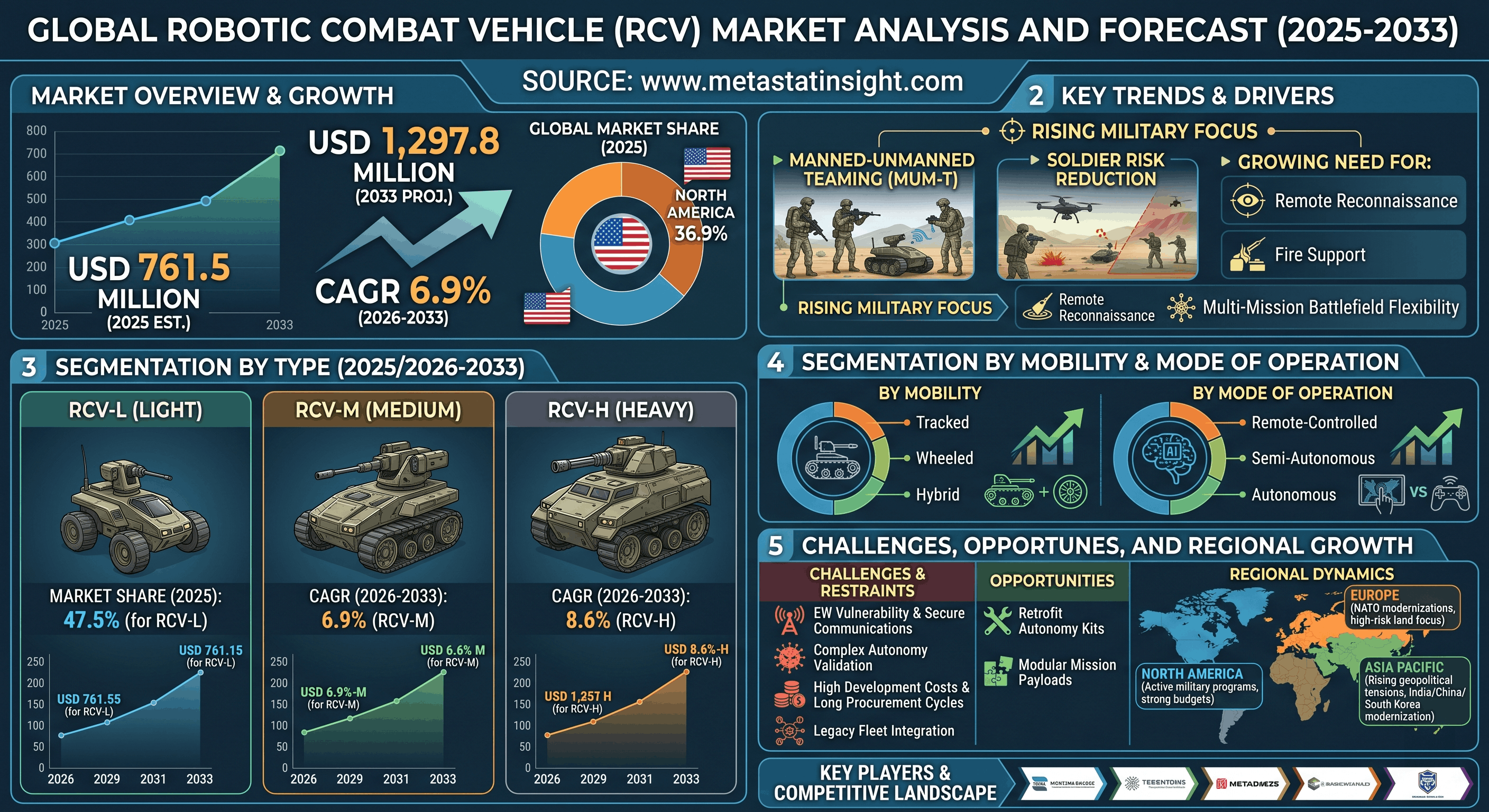
According to the publication, the global market size was valued at USD 761.5 million in 2025 and is projected to expand at a steady CAGR of 6.9% during the forecast timeline, ultimately reaching USD 1,297.8 million by 2033. This strategic expansion is heavily fueled by shifting military philosophies that place an explicit focus on soldier risk reduction, persistent reconnaissance capabilities, and the integration of advanced network-centric ecosystems.
Key Market Dynamics and Strategic Catalysts
-
Manned-Unmanned Teaming (MUM-T) Integration: Defense departments are prioritizing coordinated operations between crewed vehicles and unmanned systems to maximize field survival and situational intelligence.
-
Multi-Mission Tactical Agility: Rising global needs for modular systems capable of switching between target reconnaissance, fire support, and continuous monitoring are accelerating procurement interest.
-
Commercial Barriers: The sector faces challenges including electronic warfare vulnerabilities, jamming threats, long procurement timelines, and the high cost of integration with legacy fleets. However, retrofit autonomy kits and interchangeable payload systems present substantial growth opportunities.
Key Segment Breakdown and Milestones
-
By Type: The RCV-L (Light) segment led the industry with a 47.5% market share in 2025 and is projected to hit USD 589.1 million by 2033. The RCV-M (Medium) and RCV-H (Heavy) segments are expected to follow, tracking CAGRs of 6.2%, 6.9%, and 8.6% respectively.
-
By Mobility:Tracked systems provide necessary rugged terrain traction and are projected to reach USD 615.2 million by 2033, while the high-velocity Wheeled segment is on track for USD 483.2 million. The flexible Hybrid mobility segment will post the fastest growth rate at a 9.7% CAGR.
-
By Mode of Operation:Remote-Controlled platforms remain highly vital for direct human oversight, trending toward USD 517.4 million by 2033. Semi-Autonomous systems (USD 452.4 million) and Autonomous vehicles (USD 328.0 million) represent major operational shifts.
-
By End-Use:Defense applications retain a dominant stance (6.6% CAGR), though Homeland Security will show rapid growth with a 9.0% CAGR through 2033 due to border surveillance needs.
Regional Outlook and Competitive Ecosystem
North America led the global market with a 36.9% share in 2025, driven primarily by extensive defense programs within the United States. Europe tracks closely due to NATO-aligned land modernization initiatives, whereas the Asia-Pacific region represents a high-potential expansion avenue backed by increasing modernization initiatives in China, India, and South Korea.