
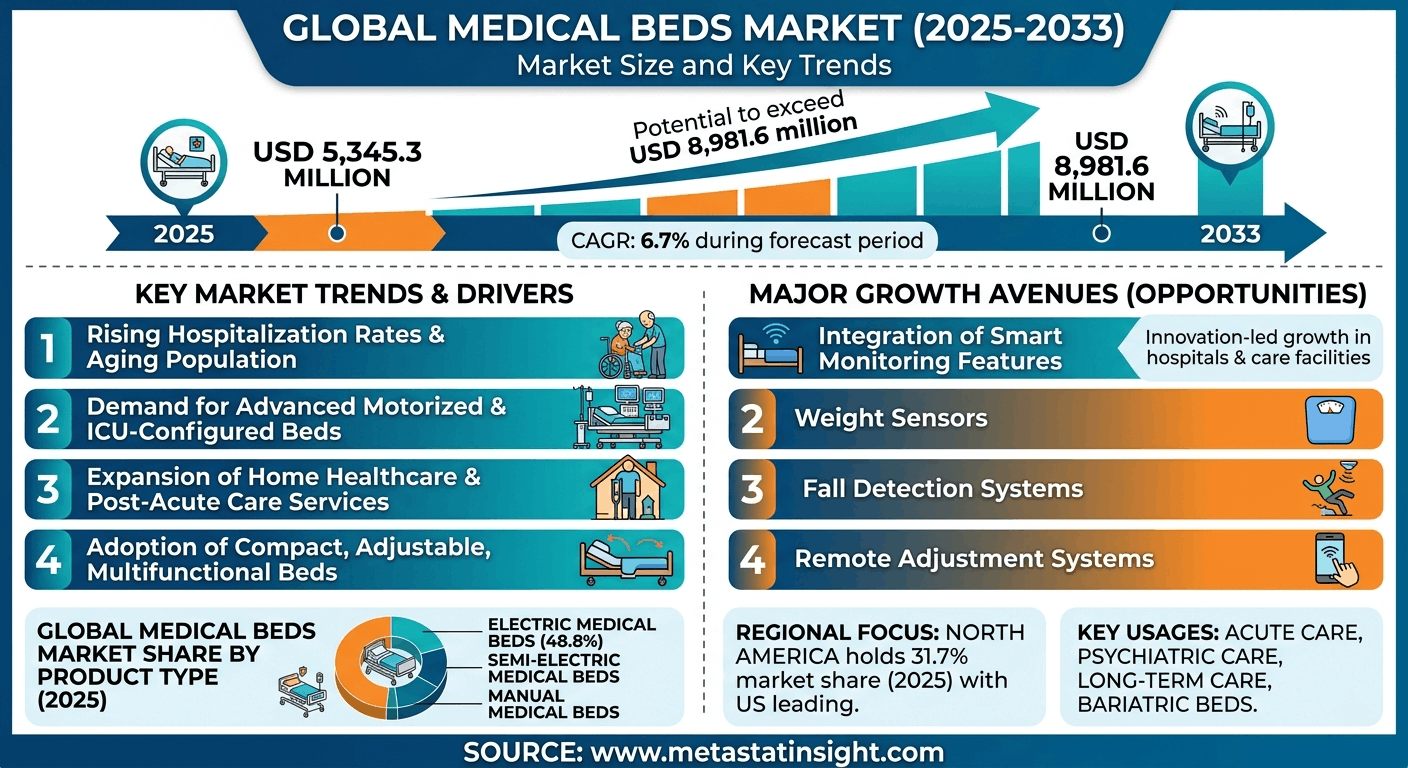
A comprehensive market intelligence study published by Metastat Insights reveals that the Global Medical Beds Market is on a strong growth trajectory. The industry is valued at USD 5,345.3 million in 2025 and is projected to expand at a Compound Annual Growth Rate (CAGR) of 6.7%, ultimately reaching USD 8,981.6 million by 2033. This growth highlights a major evolution in global healthcare infrastructure, where procurement priorities are shifting toward advanced patient support platforms.
Key Market Dynamics & Regional Dominance
Geographically, North America represents the leading landscape, securing a 31.7% market share in 2025, with the United States driving the majority of regional procurement. The North American segment is on track to hit a market size of USD 2,580.4 million by the end of 2033, rising at a 6.7% CAGR.
Product analysis shows that the Electric Medical Beds Market segment captured a dominant 48.8% market share in 2025. This high demand is sustained by automated positioning, ease of operation, and rising clinical adoption over conventional alternatives.
Primary Growth Drivers and Market Segmentation
According to the report, the market is powered by rising hospitalization rates, an aging population base, and the significant expansion of home healthcare and post-acute recovery services. Over the forecast period, procurement is expanding beyond traditional hospitals to include dedicated rehabilitation centers, nursing homes, and residential care settings.
The market is segmented across critical operational areas:
-
Product Type: Electric models lead the revenue generation, projected to reach USD 4,851 million by 2033 at an 8.3% CAGR. Meanwhile, Semi-Electric Medical Beds offer a balanced cost-to-functionality alternative, expected to reach USD 2,492.4 million by 2033. Manual beds remain essential for resource-constrained locations, tracking toward USD 1,638.2 million.
-
Usages & Applications: Acute care beds lead specialized demand, tracking toward USD 3,286.8 million by 2033. Long-term care beds follow strongly with a projected USD 2,941.5 million at an .8.3% CAGR. Specialty areas like bariatric beds and niche Medical Pediatric Beds continue to expand. Additionally, non-intensive care beds continue to hold a massive share, projected to hit USD 5,294.7 million by 2033.
-
End Users: While hospitals remain the largest buyer segment (growing at a 5.4% CAGR), alternative care channels are accelerating rapidly. Elderly care facilities lead growth with an anticipated CAGR of 8.6%, followed by nursing homes at 8.3% and home care settings at 8.1%.
Strategic Challenges and Opportunities
Despite robust metrics, high initial acquisition and maintenance costs for fully electric units restrain adoption across budget-sensitive facilities. Furthermore, capital constraints within public health systems tend to delay the replacement cycles of manual inventories.
However, strong innovation-led avenues are opening up through the integration of smart monitoring features, such as integrated weight sensors, remote adjustment systems, and fall detection. Moving forward, competitive differentiation will depend heavily on integrating these connected health capabilities with sustainable, lightweight, and durable designs.
About Metastat Insights
Metastat Insights provides data-driven market analysis, competitive benchmarking, and strategic outlooks across diverse global sectors, helping organizations make well-informed, objective business decisions.