
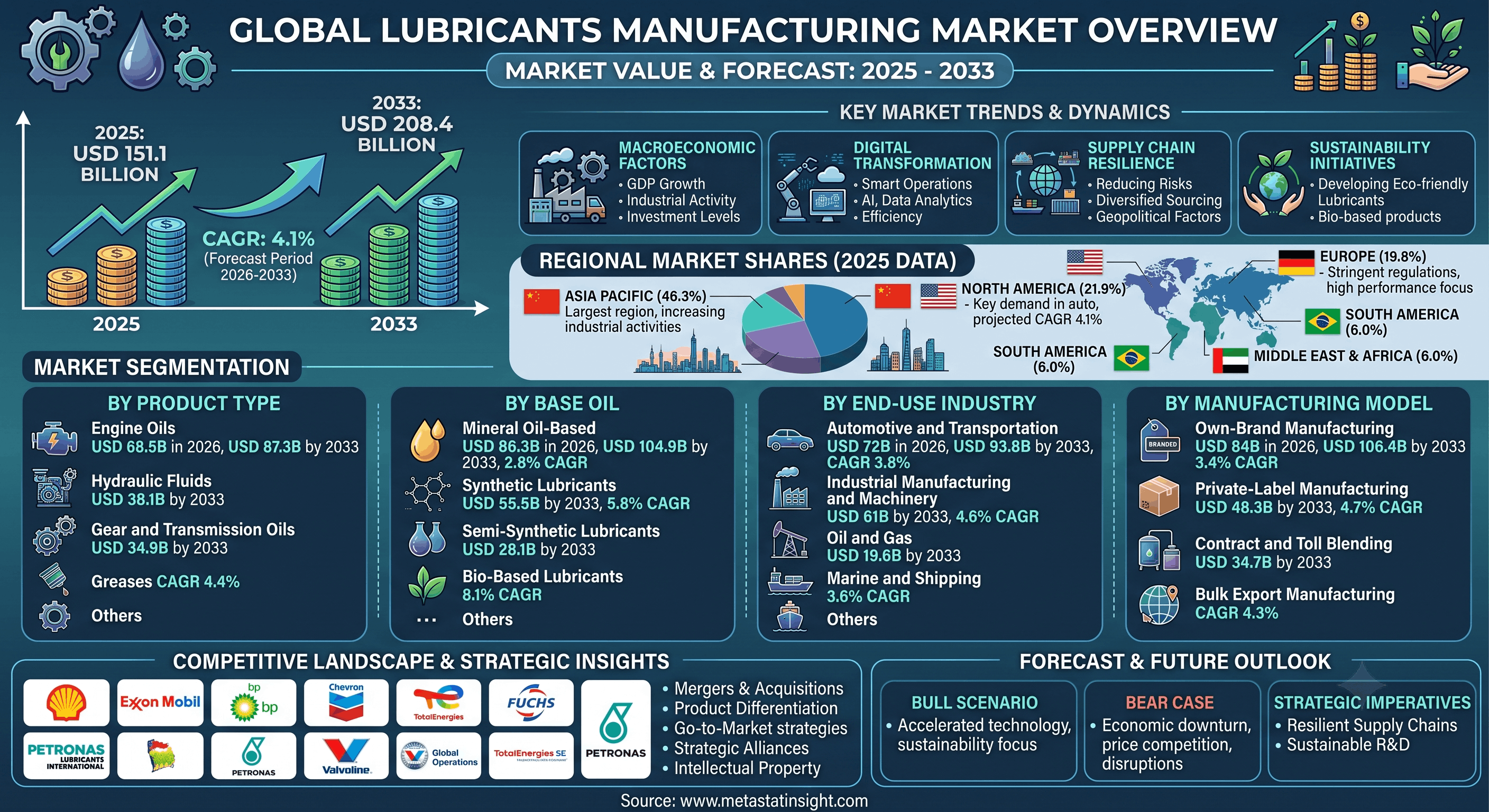
Metastat Insights announces the release of its report on the global lubricants manufacturing market, forecasting growth from USD 151.1 billion in 2025 to USD 208.4 billion by 2033, at a CAGR of 4.1%.
Metastat Insights has published "Global Lubricants Manufacturing Market Size, Share, By Product Type (Engine Oils, Hydraulic Fluids, Gear and Transmission Oils, Greases and Others), By Base Oil (Mineral Oil-Based Lubricants, Synthetic Lubricants, Semi-Synthetic Lubricants and Bio-Based Lubricants), By End-Use Industry (Automotive and Transportation, Industrial Manufacturing and Machinery, Oil and Gas, Marine and Shipping), By Manufacturing Model (Own-Brand Manufacturing, Private-Label Manufacturing, Contract and Toll Blending and Bulk Export Manufacturing), Industry Analysis, Growth, Trends, and Forecast, 2026-2033", followed by the headline figures (USD 151.1 billion in 2025, USD 208.4 billion by 2033, 4.1% CAGR).
What is driving Lubricants Manufacturing demand
The Lubricants Manufacturing market is poised for consistent expansion, with both North America and Asia Pacific contributing significantly. North America is expected to represent 21.9% of the overall market in 2025. Notably, the United States is forecasted to dominate market share in 2026. Asia Pacific is the largest region, holding 46.3% of the market, fueled by rising industrial activity and a robust automotive sector in nations like China and India. Europe, accounting for 19.8% of the market, is shaped by strict regulations and a demand for high-performance lubricants.
What is holding the market back
Challenges in the Lubricants Manufacturing market stem from substantial capital investment needs and rising operational expenses. Manufacturers are confronted with increasing raw material and production costs, which can pressure profit margins. Furthermore, instability in supply chains, exacerbated by geopolitical tensions, leads to higher operational costs and logistical complexities. Companies are striving to enhance supply chain resilience, yet these strategies require detailed financial planning and adjustments that can affect competitiveness.
How the market splits by segment and region
The market is categorized by product type, base oil, end-use industry, and manufacturing model. For product types, engine oils are predicted to rise from USD 68.5 billion in 2026 to USD 87.3 billion by 2033, propelled by the demand for advanced lubricants in the automotive sector. The hydraulic fluids segment is estimated to reach USD 38.1 billion by 2033, growing at a CAGR of 4.3%. In terms of base oil, synthetic lubricants are projected to expand at a CAGR of 5.8%, achieving USD 55.5 billion by 2033, reflecting a growing preference for high-performance alternatives.
 Who competes in the market
The competitive dynamics of the Lubricants Manufacturing market exhibit fragmentation, with many players vying for market share. Prominent companies like Shell plc, Exxon Mobil Corporation, BP p.l.c., and Chevron Corporation leverage their well-established brands and distribution networks to sustain competitive advantages. As the market progresses, mergers and acquisitions are becoming increasingly prevalent as firms aim to strengthen their product offerings and broaden their market presence. This vibrant environment stimulates innovation and strategic partnerships, benefiting end-users.
For more detailed insights and analysis, readers are invited to explore the full report: Global Lubricants Manufacturing Market.