
The global industrial landscape is undergoing a significant transformation, moving far beyond conventional switching mechanism standards. According to a comprehensive, data-driven analysis published by Metastat Insight, the Global Push Buttons and Signaling Devices Market size was valued at USD 2,287.9 million in 2025 and is projected to expand at a steady CAGR of 5.1% during the forecast horizon, ultimately reaching an estimated valuation of USD 3,404.1 million by 2033.
This market evolution highlights a crucial architectural transition: these interface units are no longer functioning solely as basic isolators or mechanical switches. Instead, modern industrial push buttons and signaling networks are acting as fully integrated communication nodes within advanced automated environments. By operating as high-visibility touchpoints, they enable accelerated operator response times, enhanced operational clarity, and ultra-reliable process security across demanding environments.
Key Market Performance & Strategic Metrics
-
Regional Dominance:North America held a prominent position in 2025, capturing 26.9% of the global market share, with the United States operating as the primary revenue generator.
-
Segment Leadership:Momentary Push Buttons secured the largest singular foothold by type in 2025, accounting for 27.9% of the global market.
-
Technological Shift: Product engineering is explicitly shifting away from legacy arrays toward intelligent, compact, and highly modular structural frameworks utilizing LED components, rugged physical housings, and remote monitoring capabilities.
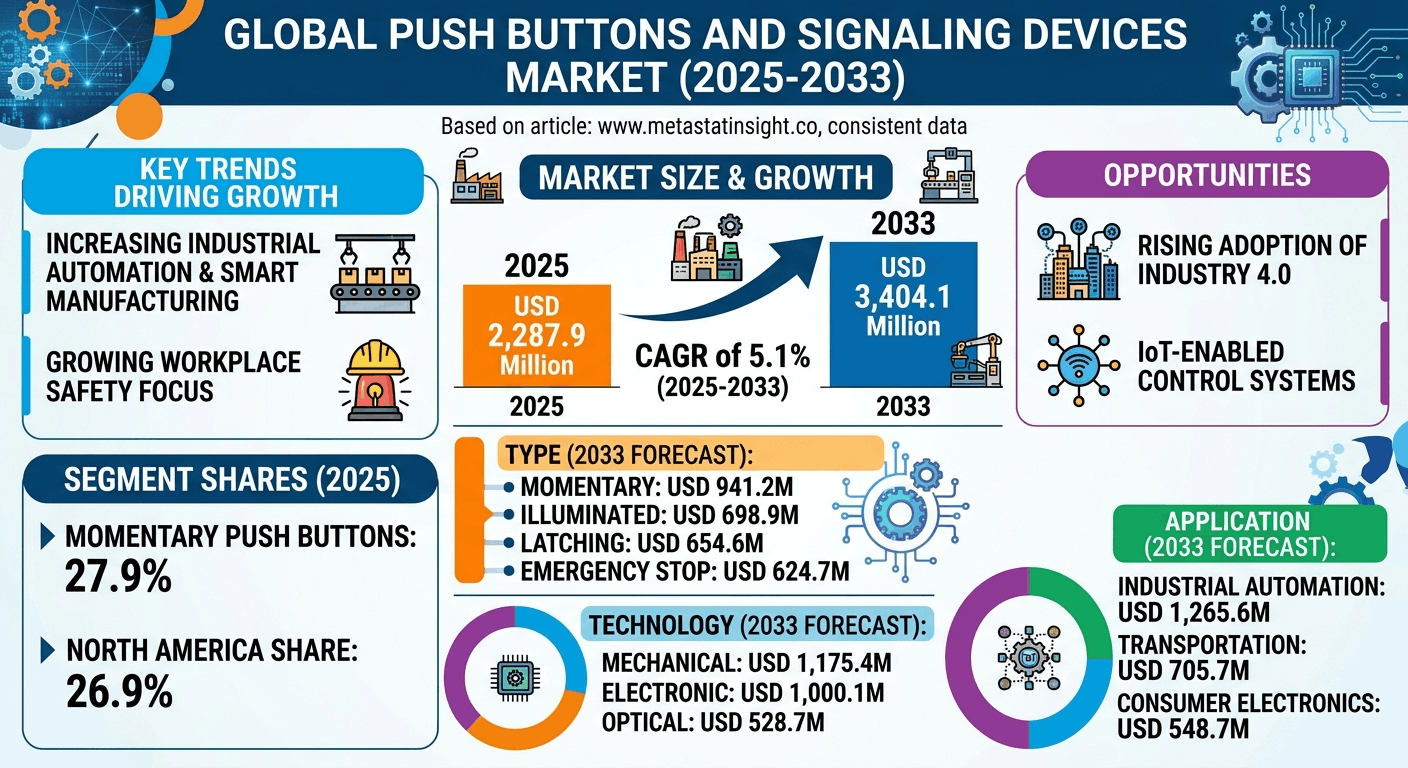
Core Catalysts & Market Restraints
Major Growth Drivers:
-
Accelerated Industrial Automation & Smart Production: The rapid deployment of robotic assembly networks, sensor-driven production floors, factory modernizations, and data-centric maintenance routines is escalating the immediate demand for robust push buttons, interface indicators, and acoustic/visual alarms. This is heavily visible across the machinery, automotive, packaging, food processing, and electronics sectors.
-
Strict Regulatory Standards for Workplace Safety: Escalating global compliance goals, hazard prevention guidelines, and real-time operational tracking standards require immediate fault-notification systems. The strategic deployment of warning lights, sirens, buzzers, emergency stops, and visual status towers helps facilities mitigate overpressure, overheating, and mechanical faults instantly.
Restraints & Growth Barriers:
-
Price Sensitivity in Developing Regions: Budget-conscious procurement cycles in emerging manufacturing hubs frequently favor lower-cost local alternatives with basic utility functions, impacting profit margins for premium tier-one hardware suppliers.
-
Legacy Systems Integration Bottlenecks: Older physical wiring architectures, outdated control consoles, and compatibility challenges often slow down standard replacement timelines, pushing industrial facilities to stretch existing components until broader capital budgets get approved.
Competitive Landscape & Strategic Alignment
The global space remains highly competitive yet consolidated around top-tier industrial electronics providers. Recognized market leaders include Schneider Electric SE, Siemens AG, ABB Ltd., Eaton Corporation plc, and Rockwell Automation, Inc. specialized manufacturers such as OMRON Corporation, IDEC Corporation, and Fuji Electric Co., Ltd. sustain dominance through core human-machine interface components.
Furthermore, players like Phoenix Contact GmbH & Co. KG, Pilz GmbH & Co. KG, Pepperl+Fuchs SE, Carlo Gavazzi Holding AG, and LOVATO Electric S.p.A. provide safety-oriented, regionalized options that offer dependable alternatives for buyers emphasizing continuous uptime, localized support, and mandatory safety certifications.
About Metastat Insight
Metastat Insight is a premier global provider of comprehensive, data-driven market research reports and strategic advisory services. Serving over 500+ Fortune companies worldwide, we offer precise business intelligence and long-term sector forecasts across all major industrial verticals, enabling business leaders, planners, and procurement professionals to make calculated, high-impact growth decisions.