
MetaStat Insight, a premier provider of global market intelligence, has released its comprehensive research study on the Automotive Wiring Harness Market. The report reveals that the global market, which was valued at USD 41.6 billion in 2022, is projected to reach USD 58.3 billion by 2030, expanding at a steady Compound Annual Growth Rate (CAGR) of 4.3% over the forecast period.
An automotive wiring harness serves as the vital infrastructure of modern vehicles, functioning as a precisely organized set of wires, connectors, and terminals. This crucial network provides power and seamless connectivity to an array of electrical systems and components, including engine control systems, instrumentation, and vehicle lighting.
Crucial Drivers and Market Challenges
According to the analysis by MetaStat Insight, the steady expansion of the global market is anchored by rising vehicle manufacturing volumes across the globe. Concurrently, a surge in demand for electric and hybrid vehicles is reshaping the industry. These advanced propulsion platforms require increasingly complex and sophisticated wiring harness systems compared to legacy vehicles.
However, the industry faces clear operational hurdles. Volatility in the price of essential raw materials, particularly copper and aluminum, directly affects manufacturing costs and can impact market growth. Furthermore, manufacturers must continuously adapt to stringent government regulations focused on vehicle safety and emissions.
Despite these challenges, profitable new avenues are emerging. The expansion of wiring harness technologies into alternative transport segments, such as commercial vehicles and the marine sector, is expected to unlock highly lucrative opportunities in the coming years.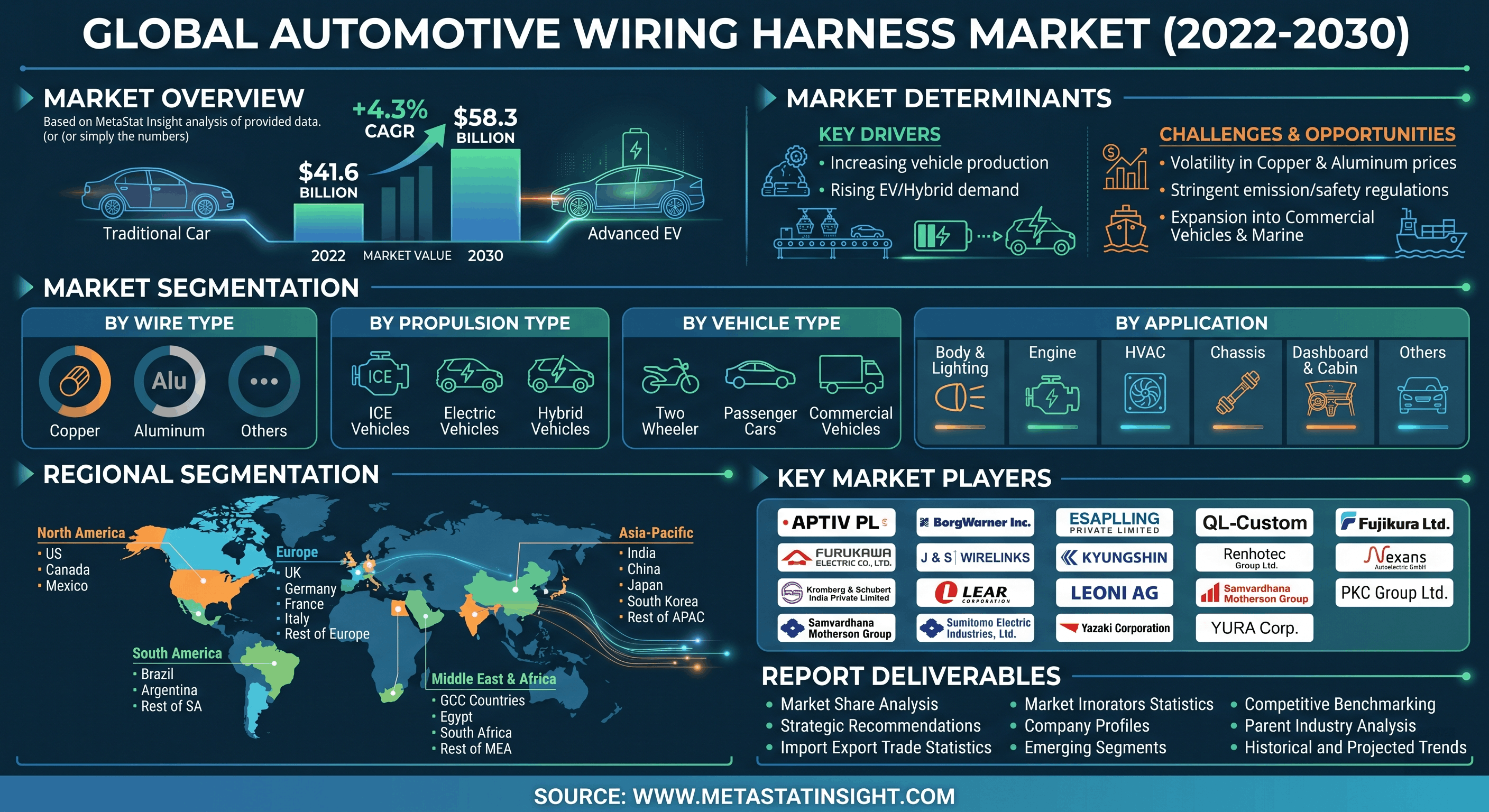
Comprehensive Segmentation and Insights
The MetaStat Insight report provides an in-depth breakdown of the industry across major structural categories:
-
Wire Type: Segmented into Copper, Aluminum, and Others.
-
Propulsion Type: Divided into ICE Vehicles, Electric Vehicles, and Hybrid Vehicles.
-
Vehicle Type: Classified into Two-Wheelers, Passenger Cars, and Commercial Vehicles.
-
Application: Broken down by Body & Lighting, Engine, HVAC, Chassis, Dashboard & Cabin, and Others.
The study delivers extensive geographical analysis across key regions, tracking development in North America, Europe, Asia-Pacific, South America, and the Middle East & Africa. Key deliverables provided in the publication include deep parent industry analysis, company market share data, import-export trade statistics, and strategic recommendations for major market leaders.