
A fresh market study published by Metastat Insight indicates that the global alcohol interlock systems market is undergoing an era of significant regulatory momentum and evolutionary technical advancement. Evaluated at a market valuation of USD 1,405.7 million in 2025, this industry vertical is forecasted to grow at a Compound Annual Growth Rate (CAGR) of 9.2% during the tracking forecast period spanning 2026 to 2033, ultimately expanding to reach an overall market size of USD 2,840.7 million by 2033.
Alcohol interlock systems have rapidly transformed into indispensable elements within modern road safety infrastructure. Government agencies, risk insurers, commercial transport organizations, and private fleet supervisors are proactively leaning into the utilization of preventative architectures to reduce the catastrophic consequences associated with impaired driving behavior. Contemporary systems have advanced beyond rudimentary tools to embrace highly sophisticated setups containing integrated breath testing, real-time data logs, GPS tracking capabilities, and anti-tamper mechanisms to boost operational oversight and ensure strict driver accountability.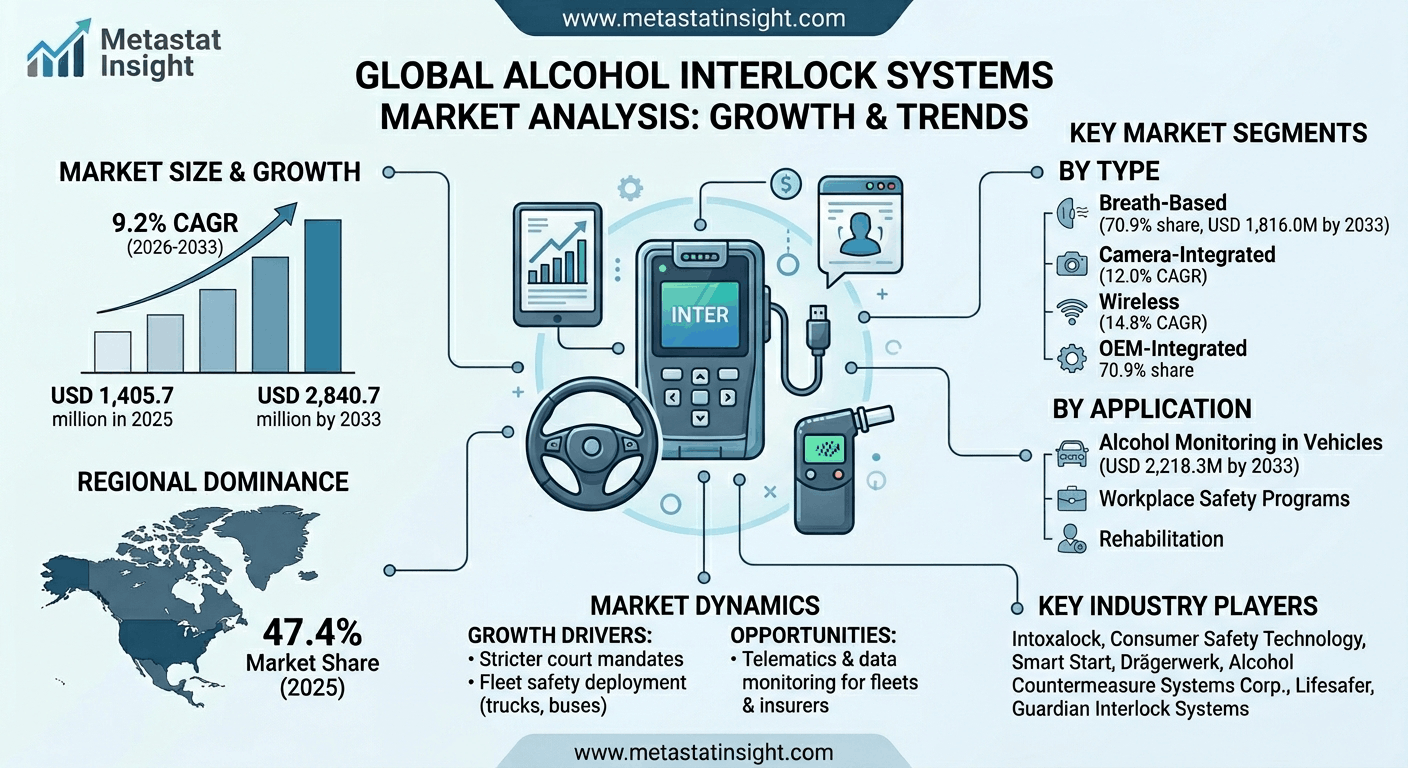
Key Structural Highlights & Segmentation Performance:
-
Regional Dominance: Geographically, North America held an authoritative market share of 47.4% in 2025, a regional sector strongly fueled by established national service networks, mature judicial enforcement schemes, and broad state-level legal mandates. The United States continues to maintain its stance as the frontrunner within this geography.
-
Dominant System Variations: Based on type, Breath-Based Interlock Systems command the vast majority of consumer selection, locking down a market share of 70.9% in 2025. This foundational segment is estimated at USD 1,087.7 million in 2026 and is on track to arrive at USD 1,816.0 million by 2033, moving forward at a CAGR of 7.6%. This dominance is heavily supported by direct breath validation mechanics, quick operational feedback loops, compact sizing parameters, and wide legal legitimacy.
-
High-Growth Sub-Segments: Fast-paced modernization is driving remarkable demand toward advanced product archetypes. Wireless Interlock Systems are pegged at USD 136.1 million in 2026 and are anticipated to touch USD 356.8 million by 2033 at an accelerated CAGR of 14.8%, driven by cloud-based supervision parameters and mobile integration. Concurrently, Camera-Integrated Interlock Systems are slated to grow at a 12% CAGR from an estimated value of USD 227.7 million in 2026 to USD 504.2 million by 2033, providing digital evidentiary records and biometric facial capture capabilities to courts and fleet controllers. Furthermore, OEM-Integrated Interlock Systems are expected to see a 10.4% CAGR, rising from USD 81.9 million in 2026 to USD 163.6 million by 2033 due to expanding factory-fitted arrangements among automakers.
-
Technological Projections: By technology, accuracy demands favor Fuel Cell Technology, which is anticipated to scale to USD 2,107.5 million by 2033 at a CAGR of 9.9%. Semiconductor Technology remains the preferred budget-friendly option for cost-conscious buyers, evaluated to hit USD 501.1 million by 2033 at a CAGR of 6.5%. Specialized non-contact monitoring will lead Infrared Technology to touch USD 232.1 million by 2033 with a 9.4% CAGR.
-
Primary Application Targets: On the application front, Alcohol Monitoring in Vehicles maintains the highest share, pacing toward an expected valuation of USD 2,218.3 million by 2033. Emerging deployment fields such as Workplace Safety Programs (projected at USD 336.9 million by 2033) and Rehabilitation & Medical Treatment (poised to reach USD 285.5 million by 2033) showcase a expanding landscape where alcohol restriction systems are utilized for risk reduction across dangerous work settings and legal behavior tracking.
Market Dynamics: Crucial Catalysts and Hurdles
The primary market growth catalysts are centered heavily around tightening court-mandated offender tracking programs alongside broader corporate fleet safety protocols across buses, school transit, commercial trucks, and enterprise employer vehicle frameworks. Fleet operators are utilizing these defensive systems to mitigate heavy legal liabilities, control collision exposures, and negotiate premium insurance pricing advantages via real-time telematics integration.
Conversely, the global industry faces distinctive structural constraints. High recurring deployment costs, routine calibration charges, and frequent service fees create visible financial strain across smaller fleet operators and individual consumers. Furthermore, administrative complexities linked with diverse legal standards across distinct states or international boundaries add operational friction for international suppliers seeking to scale cross-border manufacturing activities efficiently.
Future Industry Outlook
The long-term trajectory for alcohol ignition systems indicates a clear transition toward compact, smart architectures characterized by automated reporting tools, responsive sensors, and reduced calibration delays. The landscape is moving well beyond standard court sentences into voluntary consumer adoption, proactive organizational risk mitigation, and automated telematics platforms that supply real-time tracking data to insurers and managers alike. Companies that prioritize simple consumer interfaces, transparent maintenance models, and robust service availability are ideally positioned to lock down recurring commercial contracts and build long-term trust.
About Metastat Insight
Metastat Insight is a premier global market research and business intelligence organization specializing in high-fidelity industry studies and strategic market intelligence reporting across 17+ core economic sectors. Delivering meticulous, data-backed analysis, Metastat Insight empowers corporate leaders, institutional investors, and strategic planners worldwide to navigate complex business landscapes, mitigate market risks, and uncover sustainable commercial growth channels.