
The global landscape for lithium-ion battery manufacturing is undergoing an architectural transition. According to a comprehensive data-driven industry study published by MetaStat Insight, the global Lithium Iron Phosphate (LFP) cathode material market size was valued at USD 5.7 billion in 2025 and is projected to expand at a compound annual growth rate (CAGR) of 10.3%, ultimately reaching an estimated valuation of USD 12.5 billion by 2033.
The comprehensive evaluation, accessible via MetaStat Insight, notes that the industry is steadily moving past basic capacity expansions. Instead, major producers are strategically prioritizing upstream iron phosphate processing and direct lithium refining integration to improve long-term margin stability and secure reliable supply agreements with cell manufacturers.
Technological Advancements Catalyzing Structural Growth
Market development indicates a technical divergence in material choices. Battery manufacturers are actively refining particle morphology engineering, surface coating optimization, and advanced nano-structuring techniques to maximize performance. These innovations optimize ionic conductivity without diminishing structural or thermal safety profiles. Consequently, the Nano-LFP Cathode Material segment is valued at USD 2.5 billion in 2026 and is forecasted to hit USD 5.7 billion by 2033, leading the growth trajectory at a robust CAGR of 12.6%.
Concurrently, Common-LFP Cathode Material maintains a commanding presence due to its baseline affordability and predictable electrochemical durability. Valued at USD 3.8 billion in 2026, it is projected to grow at an 8.7% CAGR to reach USD 6.8 billion by 2033, reinforcing its critical role in baseline energy backup systems and mid-range electric vehicle architectures.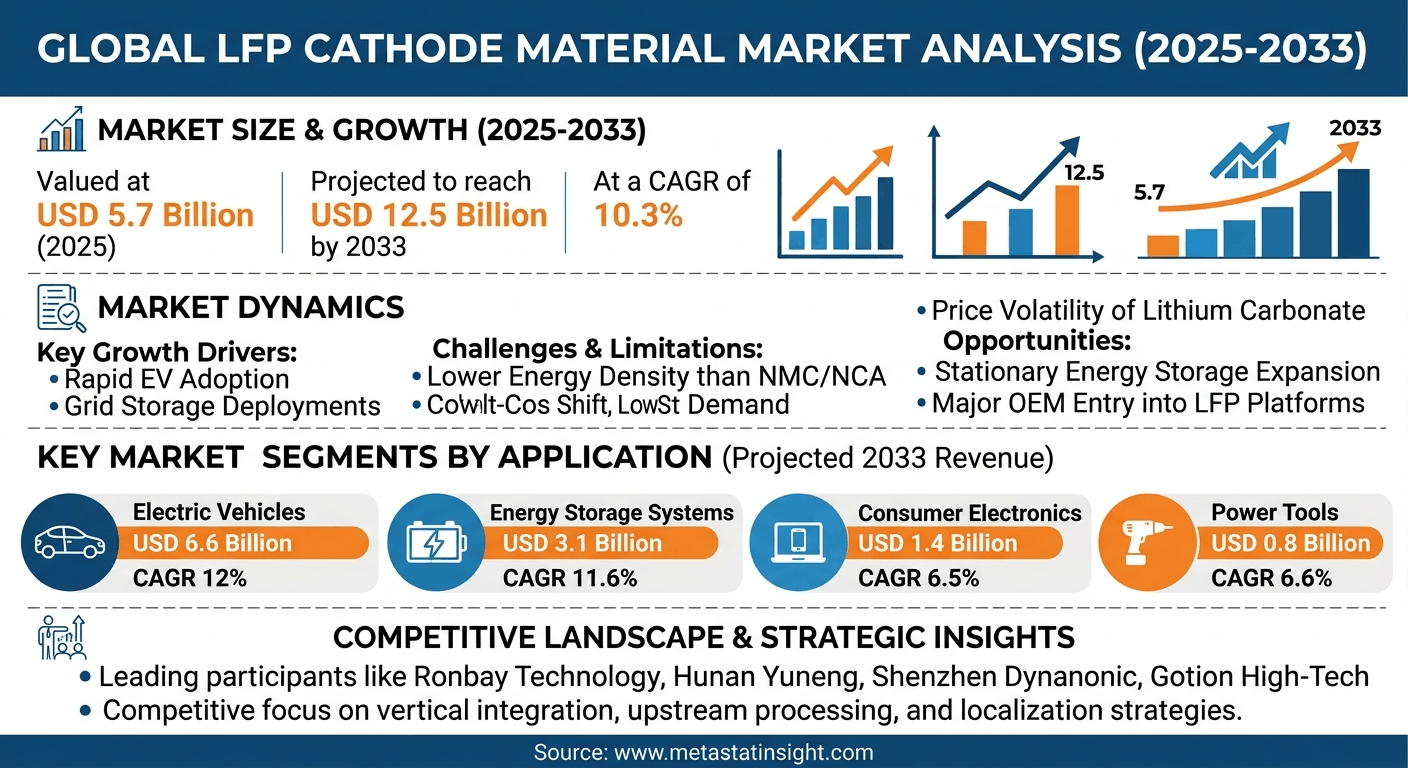
Diverse Industry Applications and End-User Demands
The report details a comprehensive segmentation of the industry by application and end user:
-
Electric Vehicles: Projected to hit USD 6.6 billion by 2033 with a 12% CAGR, propelled by automotive OEMs shifting rapidly toward cobalt-free battery formulations to minimize exposure to volatile metal pricing and ethical supply vulnerabilities.
-
Energy Storage Systems (ESS): Forecasted to expand to USD 3.1 billion by 2033 at an 11.6% CAGR, acting as a crucial component for grid balancing, utility-scale renewable energy integration, and decentralized networks.
-
Consumer Electronics & Power Tools: Combined, these technical segments are expected to constitute a market size of USD 2.2 billion by 2033, utilizing LFP for enhanced thermal resistance, lifecycle extension, and fast-charging capabilities.
From an end-user perspective, the Automotive segment commands the highest direct material consumption, anticipated to reach USD 7.0 billion by 2033. This is closely followed by the Energy Sector at USD 2.3 billion and Electronics at USD 1.8 billion, demonstrating broad diversification across multiple operational domains.
While constraints like lower peak energy density relative to high-nickel alternatives cap LFP's entry into luxury, premium long-range EV segments, its exceptional lifecycle safety drives widespread mass-market penetration. Geographically, manufacturing infrastructure continues to localize across North America and Europe to counter supply chain vulnerabilities, while the Asia Pacific region retains its dominant position in cost-centered production scaling.
About MetaStat Insight
MetaStat Insight is a premier global market research and strategic consulting firm. We specialize in delivering data-driven market evaluations, identifying niche sector transformations, and providing granular competitive benchmarking across global industrial landscapes. Our expert analysis supports major corporations, financial institutions, and public entities in making optimized, long-term strategic commercialization decisions.