Youth Sports Performance Training Market Size, Share, By Training Type (Strength, Conditioning, Speed, Agility Training, Endurance Training, Flexibility, Mobility Training, Core Stability Training, Recovery, Regeneration Programs, and Others), By Sport Category (Team Sports, Individual Sports, Court Sports, Field Sports, Endurance Sports, and Combat Sports), By Age Group (Early Childhood, Pre-Teens, and Teenagers), By Delivery Mode (In Person Training, Online Training Programs, and Hybrid Training Models), Industry Analysis, Growth, Trends, and Forecast, 2026-2033
Report ID
MSI-4574
Published
April 7, 2026
Pages
312 Pages
Format
Report Details
Comprehensive Market Analysis And Insights
Market Overview
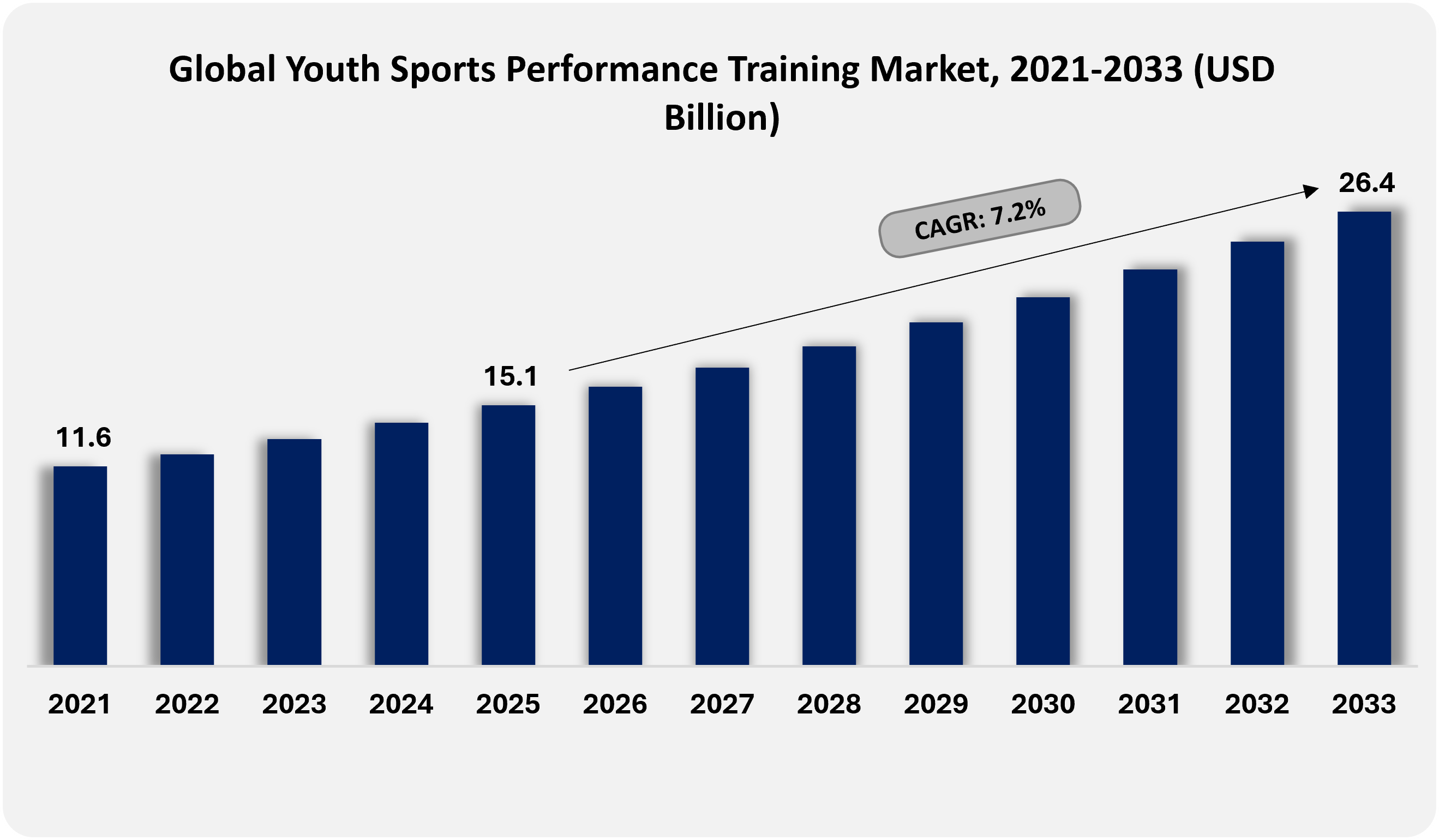
The Global Youth Sports Performance Training market size was valued at USD 15.1 billion in 2025. The market is projected to grow from USD 16.2 billion in 2026 to USD 26.4 billion by 2033, exhibiting a CAGR of 7.2% during the forecast period.
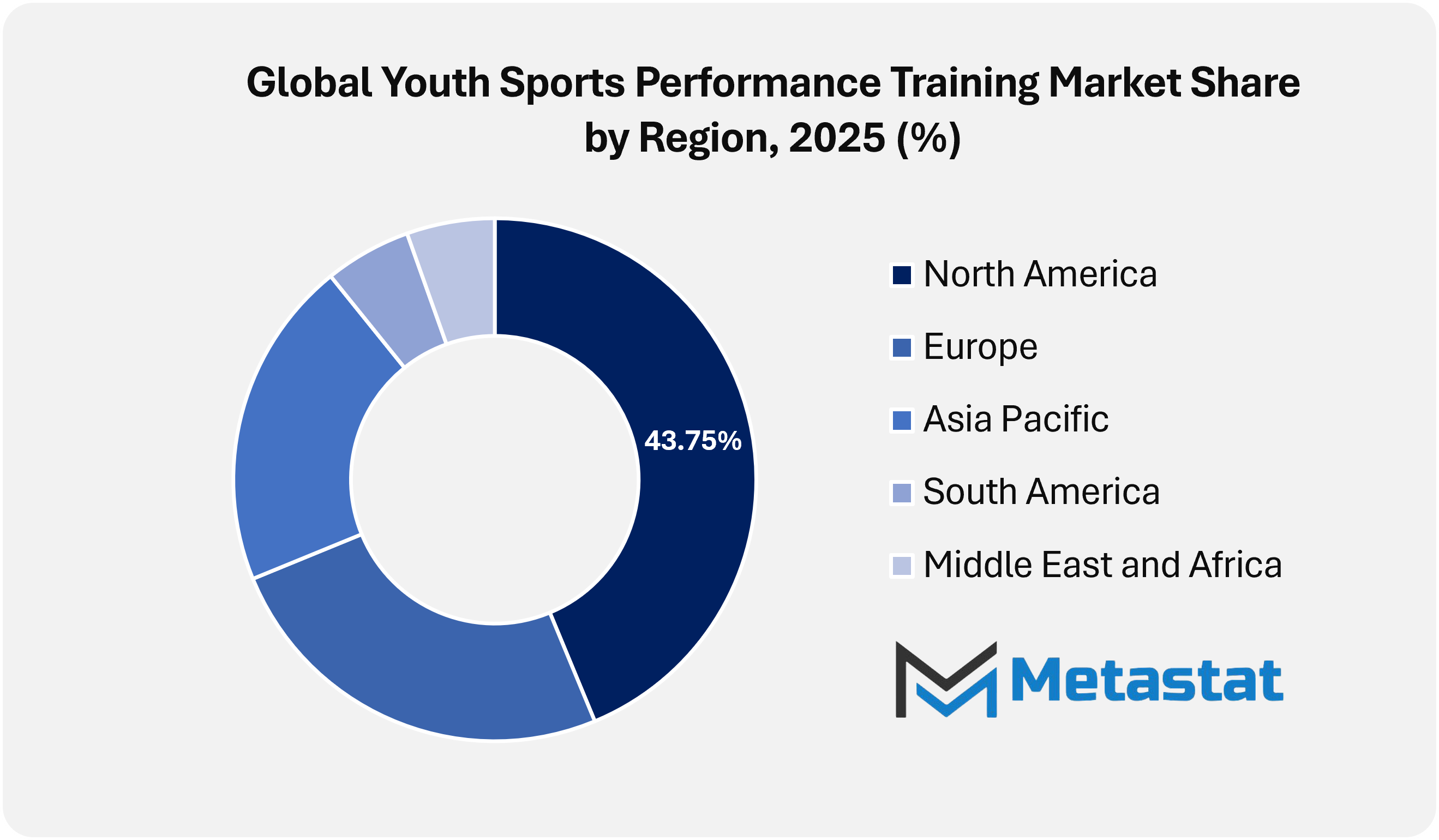
North America accounted for a 43.75% share in 2025, led by the United States.
Strength and Conditioning segment accounted for a 26.72% share in 2025.
Key trends driving growth: Rising participation in organized youth sports and competitive athletics and Growing Awareness of Injury Prevention and Long-Term Athletic Development.
Opportunities include Expansion of Hybrid and Digital Training Programs for Youth Athletes.
Key insight: The Global Youth Sports Performance Training Market is advancing through structured early-age athletic programs, while affordability challenges and safety concerns shape adoption patterns and innovation focus.
The global youth sports performance training market within the sports education and athletic development ecosystem will evolve beyond basic physical conditioning into a personalized and data-driven training environment. Training models will have an increasing focus on long-term athlete pathways in preference to short-term competitive effects, aligning bodily guidance with cognitive readiness, emotional resilience, and lifestyle areas. Performance programs will be structured by biological maturity, neuromuscular development, and athlete response patterns, enabling safer progression and sustainable improvement.
Future education environments will combine biomechanics, recovery technology, and behaviour evaluation into everyday workouts. Coaches and institutions will use motion capture, wearable diagnostics, and fatigue modeling to design sessions aligned with youth physiology while improving sport-specific skills. Instead of emphasizing volume, training intensity and timing will be adjusted using predictive indicators, reducing burnout and dropout rates. Skill acquisition will be supported via simulation-based learning where virtual and augmented environments enable repetition of complex movement patterns with lower physical load.
Market Dynamics
Growth Drivers
Rising Participation in Organized Youth Sports and Competitive Athletics.
The global youth sports performance training market will be driven by expanding enrolments in structured leagues, academies, and school competitions. The increased focus of parents on physical development and measurable outcomes will increase the demand for specialized conditioning programs. Vocational pathways and early talent identification will further accelerate its adoption in urban and semi-urban locations.
Growing Awareness of Injury Prevention and Long-Term Athletic Development
Educational outreach and sports technology integration highlight the significance of movement mechanics, recovery protocols, and age-suitable conditioning. Training programs emphasize joint stability, flexibility, and neuromuscular control to reduce long-term injury risk. Evidence-based training frameworks support progressive overload and age-appropriate conditioning, strengthening durability and consistent performance improvement.
Restraints & Challenges
High Program Costs and Limited Accessibility in Certain Regions
Premium education, advanced equipment, and specialized facilities elevate participation prices. Rural and lower-income regions face limited access to certified coaches and structured programs. Infrastructure gaps reduce consistent training exposure, slowing equitable market expansion and limiting athlete development across wider population segments.
Concerns Over Overtraining and Lack of Qualified Coaching
Unregulated schooling depth and inadequate training certification boost concerns around physical stress and burnout. Inconsistent adherence to age-unique education concepts impacts safety outcomes. Absence of standardized training schooling frameworks creates quality issues, influencing trust tiers amongst guardians and institutional stakeholders.
Opportunities
Expansion of Hybrid and Digital Training Programs for Youth Athletes
Technology-enabled education structures, virtual checks, and mixed training models beautify reach and affordability. Remote steering, paired with periodic one-on-one classes, helps flexibility and scalability.
Market Segmentation Analysis
The Global Youth Sports Performance Training market is classified based on Training Type, Sport Category, Age Group, and Delivery Mode.
By Training Type, the market is segmented into:
Strength and Conditioning
Strength and Conditioning segment was valued at USD 4.32 billion in 2026 and is projected to reach USD 6.90 billion by 2033, at a CAGR of 6.9% during the forecast period.
Strength and conditioning training within the global youth sports performance training market will emphasize controlled load management, injury prevention and gradual strength development. Training programs will integrate body weight resistance, functional strength routines and monitoring progress frameworks. Sports institutions and academies will increasingly adopt evidence-based conditioning systems aligned with youth development stages and performance consistency.
·Speed and Agility Training
Speed and Agility Training segment was valued at USD 3.97 Billion in 2026 and is projected to reach USD 6.69 Billion by 2033, at a CAGR of 7.8% during the forecast period.
Speed and agility training will take precedence through reaction drills, movement mechanics refinement and neuromuscular coordination programs. Advanced timing systems, motion tracking and agility ladders will shape structured arrangements. Future demand will arise from competitive sports environments demanding faster acceleration, directional control and sport-specific movement efficiency among young athletes.
·Endurance Training
Endurance Training segment was valued at USD 2.94 Billion in 2026 and is projected to reach USD 4.63 Billion by 2033, at a CAGR of 6.7% during the forecast period.
Endurance training will focus on cardiovascular capacity, aerobic efficiency and fatigue resistance through age-appropriate conditioning cycles. Interval-based routines, endurance-building exercises and monitored workload programs will guide performance optimization. Long-term athletic development models will promote the adoption of competitive and recreational youth sports programs globally.
·Flexibility and Mobility Training
Flexibility and Mobility Training segment was valued at USD 2.45 Billion in 2026 and is projected to reach USD 4.02 Billion by 2033, at a CAGR of 7.3% during the forecast period.
Flexibility and mobility training will support joint health, muscle balance and improved range of motion. Dynamic stretching protocols, mobility circuits and posture correction practices will be featured prominently. Sports training centers will prioritize mobility frameworks to reduce the risk of strain and support fluid athletic movement across different sporting disciplines.
·Others (Core Stability Training, Recovery and Regeneration Programs)
Others (Core Stability Training, Recovery and Regeneration Programs) segment was valued at USD 2.54 billion in 2026 and is projected to reach USD 4.15 billion by 2033, at a CAGR of 7.3% during the forecast period.
Core stability training and recovery-focused programs will be expanded through integrated balance exercises, regeneration planning and muscle recovery systems. Foam rolling, guided cooldown routines and structured rest cycles will strengthen physical flexibility. Future training models will treat recovery as a strategic performance component rather than a supplemental activity.
By Sport Category the market is divided into:
Team Sports
Team Sports segment is projected to reach USD 8.35 Billion by 2033, at a CAGR of 7.1% during the forecast period.
Coordination, collective strategy implementation and synchronized physical conditioning will be given priority in team sports training. Performance programs will combine tactical exercises with fitness development tailored to group dynamics. Youth leagues and academies will invest in a structured training ecosystem that supports teamwork efficiency and consistent athletic readiness.
·Individual Sports
Individual Sports segment is projected to reach USD 4.89 Billion by 2033, at a CAGR of 7.3% during the forecast period.
Individual sports training will focus on individual performance metrics, discipline-specific conditioning and mental focus enhancement. Customized development plans will guide progression based on the demands of the game. Market growth will reflect increasing participation in athletics, swimming, gymnastics and similar performance-driven individual activities.
·Court Sports
Court Sports segment is projected to reach USD 4.18 Billion by 2033, at a CAGR of 7.3% during the forecast period.
Court sports training will emphasize explosive speed, lateral agility, and quick reaction conditioning. Specific exercises targeting footwork accuracy and reaction time will dominate the program design. The training facilities will adopt court-specific performance modules to support competitive development in basketball, badminton, volleyball and tennis.
·Field Sports
Field Sports segment is projected to reach USD 3.61 Billion by 2033, at a CAGR of 7.1% during the forecast period.
Field sports training will integrate endurance conditioning, spatial awareness exercises, and strength development tailored to outdoor sport requirements. Performance systems will address various terrain adaptations and match-duration endurance. Youth participation in football, hockey and similar sports will continue to demand structured field-based training.
·Endurance Sports
Endurance Sports segment is projected to reach USD 3.28 Billion by 2033, at a CAGR of 7.3% during the forecast period.
Endurance sports training will focus on sustained power production, speed control and cardiovascular conditioning. Progressive workload planning and recovery alignment will guide performance stability. Participation growth in long-distance running, cycling and swimming will support the continued expansion of endurance-focused youth training frameworks.
·Combat Sports
Combat Sports segment is projected to reach USD 2.07 Billion by 2033, at a CAGR of 7.5% during the forecast period.
Strength balance, flexibility, reflex development and controlled power execution will be prioritized in combat sports training. Safety-focused conditioning and disciplined movements will guide the development of the training program. Rising interest in martial arts and structured combat disciplines will shape targeted youth performance development models.
By Age Group the market is further divided into:
Early Childhood
Early Childhood segment is projected to reach USD 5.02 Billion by 2033 with a share of 20.3% in 2025.
Early childhood training will emphasize motor skill development, balance enhancement and movement familiarity through play-based formats. The programs will focus on coordination development rather than competitive intensity. Educational institutions and sports centers will integrate foundational training to support healthy physical development pathways.
·Pre-Teens
Pre-Teens segment is projected to reach USD 7.87 Billion by 2033 with a share of 30.1% in 2025.
Pre-Teens training will introduce structured conditioning, technique learning, and discipline-specific performance. Physical literacy development will guide program design. Market growth will reflect increased parental and institutional focus on early performance preparation without excessive physical stress.
·Teenagers
Teenagers segment is projected to reach USD 13.5 Billion by 2033 with a share of 49.6% in 2025.
Teenage training programs will adopt advanced conditioning, sport specialization and performance tracking systems. Strength development, endurance planning and recovery integration will feature prominently. Competitive participation levels will drive demand for professional-grade youth training solutions tailored to long-term athletic goals.
By Delivery Mode the market is further divided into:
·In Person Training
In-Person Training segment is projected to grow at a CAGR of 7.01% during 2026-2033.
In-person training will remain central through direct coaching interactions, supervised practice, and facility-based performance monitoring. Sports academies and training centers will continue to invest in infrastructure and coaching expertise to provide practical development experiences that support skill precision and physical safety.
·Online Training Programs
Online Training Programs segment is projected to grow at a CAGR of 8.01% during 2026-2033.
Online training programs will expand reach through digital coaching platforms, instructional materials and remote performance guidance. Technology-enabled feedback systems will support flexibility and scalability. Market growth will reflect the increasing acceptance of virtual training models among young athletes and training providers.
·Hybrid Training Models
Hybrid Training Models segment is projected to grow at a CAGR of 7.8% during 2026-2033.
Hybrid training models will combine physical coaching sessions with digital performance tracking and remote guidance tools. The integrated program will balance supervision with flexibility. Future adoption will be strengthened through demand for adaptable training structures that accommodate diverse geographic and lifestyle needs within organized youth sports development.
By Region:
Based on geography, the Global Youth Sports Performance Training market is divided into North America, Europe, Asia-Pacific, South America, Middle East, and Africa.
North America Youth Sports Performance Training Market is set to expand at a CAGR of 6.8% within the forecast period, reaching a market size (TAM) of USD 11.2 billion by the end of 2033.
In North America, increasing parental investment in structured athletic development and early talent identification drives demand for youth sports performance training programs.
In North America, strong school sports systems and widespread access to professional coaching facilities have accelerated the adoption of advanced performance training models
In the Asia Pacific region, growing urban youth populations and growing interest in organized sports create strong opportunities for scalable performance training academies.
In the Asia Pacific region, increasing spending on sports infrastructure and growing awareness of physical fitness have opened new avenues for specialized youth performance training services
In the Middle East, Africa, and South America, improving grassroots sports initiatives and the gradual professionalization of youth athletics help the continued expansion of the youth sports performance training market.
Competitive Analysis
The Global Youth Sports Performance Training Market reflects a shift toward structured athletic development across early growth stages. Training centers prioritize strength, speed, coordination, and confidence through programs aligned with varied talent levels and maturity profiles. Parents and schools increasingly view performance training as a pathway to long-term fitness, discipline, and injury risk reduction. Market expansion is supported by community-based facilities, private academies, and hybrid digital platforms that extend access beyond informal sports participation.
Several established providers shape the competitive landscape through standardized yet flexible training formats. D1 Training, Parisi Speed School, Athletic Republic, Velocity Sports Performance, and Exos maintain strong recognition for science-backed programs focused on movement quality and athletic fundamentals. IMG Academy and Sports Academy attract global attention through integrated environments combining coaching, education, and exposure. Their presence raises service standards across local markets and encourages smaller facilities to strengthen program quality.
A huge organization of specialised companies adds intensity to the enterprise with the aid of focusing on specific educational desires or age groups. TOCA Football, TrainHeroic Youth, Bommarito Performance Systems, P3 Peak Performance Project, and Cressey Sports Performance emphasize game-precise conditioning and statistics-driven development tracking. Redline Athletics, Athletes Acceleration, Apex Athletic Performance, Elite Athlete Training Services, UPSWING, and TopVelocity build robust nearby networks via personalized education. Their techniques appeal to families seeking focused development without large academy settings.
Innovation and accessibility remain central themes among emerging and diversified players. Micro Recovery Plus Athlete & Family Gym, Landow Performance, Results Fitness, Athlete’s Edge, Overtime Athletes, Grit Athletic Performance, Athletic Lab, ETS Performance, The Sports Farm, Next Level Athletics, Face Your Fears Athletics, Pure Performance Training, and Spire Academy broaden reach through community engagement and modern training tools. These providers support market growth by making youth performance training more approachable, safety-aligned, and outcomes-focused.
Forecast and Future Outlook
Market size is forecast to rise from USD 15.1 billion in 2025 to over USD 26.4 billion by 2033.
Over time, the global youth sports performance training market will redefine the metrics of success. Advancement will be measured through durability, adaptability, and long-term athletic health rather than initial expertise or short-term achievements. Such an approach would establish youth performance training as a foundational pillar of lifelong physical literacy, shaping athletes who remain competitive, resilient and engaged well beyond their formative years.
Youth Sports Performance Training Market Key Segments:
By Training Type:
Strength and Conditioning
Speed and Agility Training
Endurance Training
Flexibility and Mobility Training
Others (Core Stability Training, Recovery and Regeneration Programs)
By Sport Category:
Team Sports
Individual Sports
Court Sports
Field Sports
Endurance Sports
Combat Sports
By Age Group:
Early Childhood
Pre-Teens
Teenagers
By Delivery Mode:
In Person Training
Online Training Programs
Hybrid Training Models
Key Global Youth Sports Performance Training Industry Players
This research report categorizes the Youth Sports Performance Training market based on key segments and regions, forecasts revenue growth, and analyses trends in each submarket. The report analyses the key growth drivers, opportunities, and challenges influencing the Youth Sports Performance Training market. Recent market developments and competitive strategies such as expansion, type launch, development, partnership, merger, and acquisition have been included to draw the competitive landscape in the market.
The report strategically identifies and profiles the key market players and analyses their core competencies in each sub-segment of the Youth Sports Performance Training market.
Report Attributes
Details
Study Period
2021-2033
Base Year
2025
Estimated Year
2026
Forecast Period
2026-2033
Historical Period
2021-2025
Growth Rate
CAGR 7.2% from 2026 to 2033
Revenue Unit
USD billion
Segmentation
By Training Type, Sport Category, Age Group, Delivery Mode, and Region
By Region
North America (By Training Type, Sport Category, Age Group, Delivery Mode, and Country)
United States
Canada
Mexico
Europe (By Training Type, Sport Category, Age Group, Delivery Mode, and Country)
Germany
France
UK
Italy
Spain
Russia
Rest of the Europe
Asia-Pacific (By Training Type, Sport Category, Age Group, Delivery Mode, and Country)
China
Japan
India
South Korea
Australia
Southeast Asia
Rest of Asia Pacific
South America (By Product Type, Category Positioning, Consumer Group, Distribution Channel, and Country)
Brazil
Argentina
Rest of South America
Middle East and Africa (By Product Type, Category Positioning, Consumer Group, Distribution Channel, and Country)
Saudi Arabia
UAE
South Africa
Rest of Middle East and Africa
WHAT REPORT PROVIDES
Full In-Depth Analysis of the Parent Industry
Important Changes in Market and Its Dynamics
Segmentation Details of the Market
Historical, Ongoing, and Forecast Market Analysis in Terms of Value
Assessment Of Niche Industry Developments
Market Share Analysis
Key Strategies of Major Players
Company Profiles of Key Players
Unique Selling Propositions of Major Market Players
UAE Pet Boarding Services Market Size, Share, Trends, 2033
UAE Pet Boarding Services market size is valued at USD 32.3 million in 2025 and is projected to reach USD 66.6 million in 2033, at a CAGR of 9.3% from 2026 to 2033.
UAE Pet Boarding Services Market, UAE Pet Boarding Services Market Size, UAE Pet Boarding Services Market Share, UAE Pet Boarding Services Market Analysis, UAE Pet Boarding Services Market Growth, UAE Pet Boarding Services Market Trends, UAE Pet Boarding Services Market Research Report, UAE Pet Boarding Services Market Forecast, UAE Pet Boarding Services, UAE Pet Boarding Services Market Research, UAE Pet Boarding Services Industry, UAE Pet Boarding Services Industry Report, UAE Pet Boarding Services Market Data, UAE Pet Boarding Services Statistics, UAE Pet Boarding Services Market Statistics, UAE Pet Boarding Services Industry Trends, UAE Pet Boarding Services Market Report, UAE Pet Boarding Services Market Trends, UAE Pet Boarding Services Market News, UAE Pet Boarding Services Forecasts, UAE Pet Boarding Services Market Intelligence Report
Global STEM Summer Programs market size is valued at USD 2,656.3 million in 2025 and is projected to reach USD 5,819.3 million in 2033, at a CAGR of 10.3% from 2026 to 2033
Global Marketing Services market size is valued at USD 444.9 billion in 2025 and is projected to reach USD 661.9 billion in 2033, at a CAGR of 5.1% from 2026 to 2033
Food and Beverage Consulting Market Size, Share, Trends, 2033
Global Food and Beverage Consulting market is valued at USD 6.3 billion in 2025 and is projected to reach USD 10.8 billion in 2033, at a CAGR of 6.9% from 2026 to 2033
Food and Beverage Consulting Market, Food and Beverage Consulting Market Size, Food and Beverage Consulting Market Share, Food and Beverage Consulting Market Analysis, Food and Beverage Consulting Market Growth, Food and Beverage Consulting Market Trends, Food and Beverage Consulting Market Research Report, Food and Beverage Consulting Market Forecast, Food and Beverage Consulting, Food and Beverage Consulting Market Research, Food and Beverage Consulting Industry, Food and Beverage Consulting Market Data, Food and Beverage Consulting Statistics, Food and Beverage Consulting Market Statistics, Food and Beverage Consulting Industry Trends