United States Kids Wear Market Size, Share, By Product Type (Apparel, Footwear, Accessories, and Others), By Age Group (Infants, Toddlers, Preschoolers, School Age, and Preteens), By Gender (Boys, Girls, and Unisex), By Distribution Channel (Supermarkets, Hypermarkets, Specialty Stores, Exclusive Stores, Online, and Others), Industry Analysis, Growth, Trends, and Forecast, 2026-2033
Report ID
MSI-4618
Published
April 14, 2026
Pages
320 Pages
Format
Report Details
Comprehensive Market Analysis And Insights
Market Overview
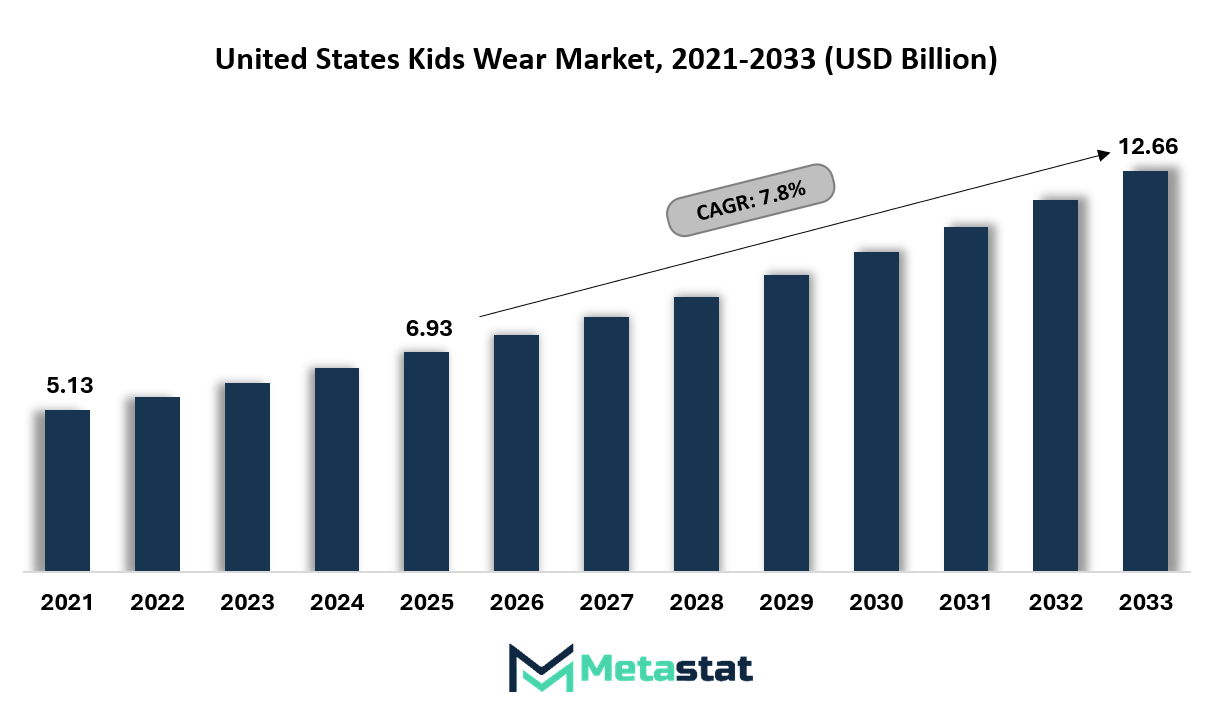
United States Kids Wear market size is valued at USD 6.9 billion in 2025 and projected to grow at a CAGR of 7.8% during the forecast period, reaching USD 12.7 billion by 2033.
United States Kids Wear Market: Comprehensive Data-Driven Market Analysis and Strategic Outlook
Apparel segment accounts for a market share of 59.8% in 2025.
Key trends driving growth: Rising disposable income and growing parental preference for branded and premium children’s apparel are strengthening category expansion, along with increasing influence of social media trends and fast fashion is accelerating product innovation and seasonal demand cycles.
Opportunities include expansion of sustainable, organic, and ethically produced kidswear collections presents strong growth potential amid rising environmental awareness.
Key insight: The United States Kids Wear market is transitioning toward premiumization and sustainability, supported by evolving consumer preferences and digital retail transformation.
The United States Kids Wear market continues to evolve with changing consumer expectations regarding quality, safety, and style. Parents are increasingly seeking products that combine comfort with aesthetic appeal, leading to stronger demand for well-designed apparel, footwear, and accessories.
Retail channels are undergoing transformation, with online platforms gaining significant traction owing to convenience, product variety, and competitive pricing. Brands are investing in digital storefronts, personalization tools, and targeted marketing strategies to enhance customer engagement. Product innovation remains a key component, with manufacturers focusing on skin-friendly fabrics, functional designs, and seasonal collections. These trends are strengthening the overall growth trajectory of the United States Kids Wear market.
Market Dynamics
Growth Drivers:
Rising disposable income and growing parental preference for branded and premium children’s apparel are strengthening category expansion.
Higher household income is increasing spending on quality-focused children’s clothing. Brand-conscious buying behavior is supporting demand for premium fabrics, improved durability, and design-led collections, enabling retailers to expand product lines that align with evolving family lifestyle preferences and long-term consumption patterns.
Increasing influence of social media trends and fast fashion is accelerating product innovation and seasonal demand cycles.
Digital platforms will continue shaping purchase decisions through visual appeal and trend influence. Rapid fashion shifts will encourage frequent product refresh cycles, prompting manufacturers to adopt agile production strategies and diverse collections that align with changing consumer preferences and sustain engagement across multiple retail channels.
Restraints and Challenges:
High price sensitivity among consumers in emerging economies limits penetration of premium kidswear brands.
The United States Kids Wear market faces limited expansion across price-sensitive segments, where affordability remains a decisive factor. Limited willingness to spend on higher-priced clothing restricts adoption of premium offerings, compelling manufacturers to rethink pricing strategies, optimize supply chains, and introduce value-driven alternatives to maintain broader accessibility.
Rapid size changes owing to children’s growth cycles reduce repeat usage duration and affect long-term value perception.
Frequent size changes affect purchasing frequency and consumer perception of product longevity. Short usage cycles discourage high-value spending, encouraging demand for flexible sizing, adjustable designs, and cost-effective alternatives that address practicality while sustaining regular sales momentum across product categories.
Opportunities:
Expansion of sustainable, organic, and ethically produced kidswear collections presents strong growth potential amid rising environmental awareness.
Sustainability-focused innovation will open new avenues for differentiation. Increasing awareness regarding environmental impact will drive demand for organic materials and responsible manufacturing practices, encouraging brands to adopt transparent sourcing, eco-friendly processes, and ethical positioning to attract conscious consumers and strengthen long-term brand loyalty.
Market Segmentation Analysis
The United States Kids Wear market is classified based on Product Type, Age Group, Gender, and Distribution Channel.
By Product Type, the market is further segmented into:
Apparel
Apparel segment is valued at USD 4.5 billion in 2026 and is projected to reach USD 7.1 billion by 2033, at a CAGR of 6.8% during the forecast period.
The apparel segment will witness sustained demand, supported by frequent size changes among children. Fabric innovation will improve comfort, durability, and skin protection. Seasonal collections will gain traction, with brands introducing adaptive apparel and sustainable materials to strengthen long-term product relevance across diverse consumer preferences.
Footwear
Footwear segment is valued at USD 1.6 billion in 2026 and is projected to reach USD 3 billion by 2033, at a CAGR of 9.7% during the forecast period.
The footwear segment will expand through ergonomic design and growing awareness of foot health. Lightweight materials and flexible soles will gain preference. Smart footwear concepts with tracking features will also emerge, improving utility. Demand will rise for durable options suitable for active routines and varied outdoor conditions.
Accessories
Accessories segment is valued at USD 1 billion in 2026 and is projected to reach USD 1.9 billion by 2033, at a CAGR of 10.1% during the forecast period.
The accessories segment will gain importance through practical and aesthetic appeal. Products such as bags, caps, and belts will evolve with safety-focused materials and child-friendly designs. Personalization trends will influence buying decisions, encouraging brands to offer customizable options that align with evolving fashion preferences.
Others
Others segment is valued at USD 0.5 billion in 2026 and is projected to reach USD 0.7 billion by 2033, at a CAGR of 5.6% during the forecast period.
The others segment will diversify through product categories such as sleepwear and occasion-based items. Demand will grow for multipurpose clothing designed for comfort and practicality. Manufacturers will introduce innovative fabric blends and smart textiles, enabling improved usability and comfort across daily routines and special occasions.
By Age Group, the market is divided into:
Infants
Infants segment is projected to reach USD 1.7 billion by 2033, at a CAGR of 5.8% during the forecast period.
The infants segment will be driven by demand for soft fabrics and safety-certified materials. Growth will depend on rising awareness regarding skin sensitivity and hygiene. Demand for organic cotton and hypoallergenic products will increase, encouraging manufacturers to enhance product safety standards and offer gentle apparel solutions.
Toddlers
Toddlers segment is projected to reach USD 2.5 billion by 2033, at a CAGR of 7.1% during the forecast period.
The toddlers segment will grow through durable and easy-to-wear apparel. Designs will focus on flexibility and comfort to support movement. Functional features such as adjustable sizing and easy fastening systems will gain attention, improving convenience for caregivers while preserving product longevity.
Preschoolers
Preschoolers segment is projected to reach USD 2.3 billion by 2033, at a CAGR of 8.5% during the forecast period.
The preschoolers segment will grow through vibrant designs and character-based clothing. Educational themes and interactive elements will gain popularity. Apparel durability suited to active routines will encourage repeat purchases and support long-term customer engagement.
School Age
School Age segment is projected to reach USD 4.1 billion by 2033, at a CAGR of 8.8% during the forecast period.
The school age segment will see steady demand, driven by school uniform requirements and casualwear needs. Product development will emphasize comfort, affordability, and durability. Brands will introduce versatile designs suitable for educational settings and extracurricular activities, strengthening market penetration.
Preteens
Preteens segment is projected to reach USD 2 billion by 2033, at a CAGR of 7.9% during the forecast period.
The preteens segment will evolve rapidly through style-conscious options influenced by social trends. Demand will increase for stylish and expressive apparel. Brands will focus on bridging childrenswear and teen fashion preferences, offering products that align with identity formation and changing lifestyle patterns.
By Gender, the market is further divided into:
Boys
Boys segment is projected to reach USD 3.7 billion by 2033.
The Boys segment will maintain steady growth through practical and durable clothing. Demand will focus on activewear and casual apparel designed for outdoor activities. Functional designs with reinforced materials will gain traction, supporting long-term usability and repeated wear cycles.
Girls
Girls segment is projected to reach USD 6.1 billion by 2033.
The girls segment will expand through diverse fashion options and frequent style updates. Demand will rise for occasion wear and trend-driven clothing. Brands will introduce innovative designs, focusing on comfort and aesthetics while addressing evolving customer expectations.
Unisex
Unisex segment is projected to reach USD 2.9 billion by 2033.
The unisex segment will witness growing adoption, driven by shifting consumer attitudes toward gender-neutral fashion. Demand will grow for versatile designs suitable across preferences. Brands will respond with inclusive collections, promoting flexibility and broader usability across different consumer segments.
By Distribution Channel, the United States Kids Wear market is divided as:
Supermarkets/Hypermarkets
Supermarkets/Hypermarkets segment is projected to grow at a CAGR of 5.7% during the forecast period.
The supermarkets/hypermarkets segment will benefit from accessibility and competitive pricing. Consumers will prefer one-stop shopping experiences, driving volume sales. Retailers will expand product assortments and improve in-store layouts to enhance visibility and convenience for buyers.
Specialty Stores
Specialty Stores segment is projected to grow at a CAGR of 6.5% during the forecast period.
The specialty stores segment will strengthen through curated assortments and personalized services. Consumers will value expert guidance and product variety. Retailers will enhance customer experience through exclusive collections and focused merchandising strategies.
Exclusive Stores
Exclusive Stores segment is projected to grow at a CAGR of 5.7% during the forecast period.
The exclusive stores segment will grow through outlets representing individual brands. Strong brand identity and consistent quality will attract loyal consumers. Retailers will invest in store aesthetics and customer engagement, creating immersive shopping experiences that strengthen brand positioning.
Online
Online segment is projected to grow at a CAGR of 11.9% during the forecast period.
The online segment will expand rapidly, driven by convenience and wide product availability. Digital channels will offer advanced filtering tools and personalized recommendations. E-commerce growth will encourage brands to optimize logistics and enhance user experience.
Others
Others segment is projected to grow at a CAGR of 6.1% during the forecast period.
The others distribution segment will diversify through channels such as pop-up stores and local retailers. Flexible retail formats will support niche demand and local preferences. Businesses will explore innovative selling approaches to reach broader audiences and adapt to changing customer behavior.
Competitive Landscape and Strategic Insights
The United States Kids Wear market will continue growing with changing lifestyles, rising focus on comfort, and the strong influence of fashion trends across all age groups. Parents are no longer purchasing clothing only for basic needs; they are paying close attention to quality, material safety, and design. Social media, celebrity culture, and easy access to global styles are shaping buying behavior, making kidswear more trend-driven than before. Seasonal collections, character-based apparel, and coordinated family outfits are gaining stronger interest, particularly among younger parents who value both fashion and practicality.
Retail channels will also play a major role in shaping the market. Online platforms will see steady growth owing to convenience, wider selection, and frequent discounts, while physical stores will continue attracting consumers who prefer to check fabric and fit before purchase. Many brands will focus on creating a seamless shopping experience across both online and offline platforms. Personalization, easy returns, and fast delivery are becoming essential factors influencing purchase decisions. At the same time, sustainability is gaining importance, with parents showing increasing interest in organic fabrics and responsibly made clothing.
Companies such as Carter’s, Inc., The Children’s Place, Inc., Gymboree, Janie and Jack LLC, Hanna Andersson, LLC, Tea Collection LLC, Primary Kids, Inc., Monica and Andy, Inc., RuffleButts, LLC, Kidpik Corp., Gerber Childrenswear LLC, The Burt’s Bees Products Company, J.Crew Group, Abercrombie & Fitch Co., Ralph Lauren Corporation, PVH Corp., Levi Strauss & Co., Hanesbrands Inc., Fruit of the Loom, Inc., Nike, Inc., adidas AG, PUMA SE, Under Armour, Inc., New Balance Athletics, Inc., Reebok, Skechers U.S.A., Inc., Crocs, Inc., Converse Inc., VF Corporation, Columbia Sportswear Company, Patagonia, Inc., L.L.Bean, Inc., Carhartt, Inc., and Target Corporation will continue strengthening their presence through product innovation, brand positioning, and expansion strategies.
Looking ahead, the market will see steady development driven by changing consumer expectations and rising demand for fashionable yet practical clothing for children. Brands that focus on comfort, affordability, and responsible production will gain stronger acceptance among modern families. The balance between fashion and practicality will define long-term success, while robust distribution networks and clear brand identity will help companies remain competitive in a crowded market.
Forecast and Future Outlook
Market size is forecast to rise from USD 6.9 billion in 2025 to over USD 12.7 billion by 2033.
The United States Kids Wear market is expected to witness steady growth driven by increasing consumer demand for quality, comfort, and fashionable children’s clothing. Future trends indicate strong adoption of sustainable materials, digital retail expansion, and personalized shopping experiences. Brands are likely to focus on eco-friendly production, advanced fabric technologies, and enhanced customer engagement strategies.
This research report categorizes the United States Kids Wear market based on key segments and regions, forecasts revenue growth, and analyses trends in each submarket. The report analyses the key growth drivers, opportunities, and challenges influencing the Kids Wear market. Recent market developments and competitive strategies such as expansion, product launch, partnership, merger, and acquisition have been included to draw the competitive landscape in the market.
The report strategically identifies and profiles the key market players and analyses their core competencies in each sub-segment of the United States Kids Wear market.
Report Attributes
Details
Study Period
2021-2033
Base Year
2025
Estimated Year
2026
Forecast Period
2026-2033
Historical Period
2021-2025
Growth Rate
CAGR 7.8% from 2026 to 2033
Revenue Unit
USD billion
Segmentation
By Product Type, Age Group, Gender, Distribution Channel, and Region
Product Type
Apparel
Footwear
Accessories
Others
Age Group
Infants
Toddlers
Preschoolers
School Age
Preteens
Gender
Boys
Girls
Unisex
Distribution Channel
Supermarkets/Hypermarkets
Specialty Stores
Exclusive Stores
Online
Others
WHAT REPORT PROVIDES
Key Company Market Share, Revenue, and Position/Ranking
Key Market Leaders
Full In-Depth Analysis of the Parent Industry
Industry Statistics
Important Changes in Market and Its Dynamics
Segmentation Details of the Market
Historical, On-Going, and Projected Market Analysis
Assessment of Niche Industry Developments
Market Share Analysis
Key Strategies of Major Players
Company Profiles of Key Players
Unique Selling Prepositions of Leading Market Players
Australia Cat Litter Market Size, Share, Trends, 2033
Australia Cat Litter market size is valued at USD 361.1 million in 2025 and is projected to reach USD 671.8 million in 2033, at a CAGR of 7.3% from 2026 to 2033
Australia Cat Litter Market, Australia Cat Litter Market Size, Australia Cat Litter Market Share, Australia Cat Litter Market Analysis, Australia Cat Litter Market Growth, Australia Cat Litter Market Trends, Australia Cat Litter Market Research Report, Australia Cat Litter Market Forecast, Australia Cat Litter, Australia Cat Litter Market Research, Australia Cat Litter Industry, Australia Cat Litter Industry Report, Australia Cat Litter Market Data, Australia Cat Litter Statistics, Australia Cat Litter Market Statistics, Australia Cat Litter Industry Trends, Australia Cat Litter Market Report, Australia Cat Litter Market Trends, Australia Cat Litter Market News, Australia Cat Litter Forecasts, Australia Cat Litter Market Intelligence Report
India Naruto Merchandise Market Size, Share, Trends, 2033
India Naruto Merchandise market size is valued at USD 25.3 million in 2025 and is projected to reach USD 61.8 million in 2033, at a CAGR of 11.8% from 2026 to 2033.
India Naruto Merchandise Market, India Naruto Merchandise Market Size, India Naruto Merchandise Market Share, India Naruto Merchandise Market Analysis, India Naruto Merchandise Market Growth, India Naruto Merchandise Market Trends, India Naruto Merchandise Market Research Report, India Naruto Merchandise Market Forecast, India Naruto Merchandise, India Naruto Merchandise Market Research, India Naruto Merchandise Industry, India Naruto Merchandise Industry Report, India Naruto Merchandise Market Data, India Naruto Merchandise Statistics, India Naruto Merchandise Market Statistics, India Naruto Merchandise Industry Trends, India Naruto Merchandise Market Report, India Naruto Merchandise Market Trends, India Naruto Merchandise Market News, India Naruto Merchandise Forecasts, India Naruto Merchandise Market Intelligence Report
UK Pilates Reformer Market Size, Share, Trends, 2033
UK Pilates Reformer market size is valued at USD 141.1 million in 2025 and is projected to reach USD 260.3 million in 2033, at a CAGR of 7.5% from 2026 to 2033.
UK Pilates Reformer Market, UK Pilates Reformer Market Size, UK Pilates Reformer Market Share, UK Pilates Reformer Market Analysis, UK Pilates Reformer Market Growth, UK Pilates Reformer Market Trends, UK Pilates Reformer Market Research Report, UK Pilates Reformer Market Forecast, UK Pilates Reformer, UK Pilates Reformer Market Research, UK Pilates Reformer Industry, UK Pilates Reformer Industry Report, UK Pilates Reformer Market Data, UK Pilates Reformer Statistics, UK Pilates Reformer Market Statistics, UK Pilates Reformer Industry Trends, UK Pilates Reformer Market Report, UK Pilates Reformer Market Trends, UK Pilates Reformer Market News, UK Pilates Reformer Forecasts, UK Pilates Reformer Market Intelligence Report
Global Lab-Grown Diamond Jewelry market size is valued at USD 14.01 billion in 2025 and is projected to reach USD 34.68 billion in 2033, at a CAGR of 12.0% from 2026 to 2033
Global Lab-Grown Diamond Jewelry Market, Global Lab-Grown Diamond Jewelry Market Size, Global Lab-Grown Diamond Jewelry Market Share, Global Lab-Grown Diamond Jewelry Market Analysis, Global Lab-Grown Diamond Jewelry Market Growth, Global Lab-Grown Diamond Jewelry Market Trends, Global Lab-Grown Diamond Jewelry Market Research Report, Global Lab-Grown Diamond Jewelry Market Forecast, Global Lab-Grown Diamond Jewelry, Global Lab-Grown Diamond Jewelry Market Research, Global Lab-Grown Diamond Jewelry Industry, Global Lab-Grown Diamond Jewelry Industry Report, Global Lab-Grown Diamond Jewelry Market Data, Global Lab-Grown Diamond Jewelry Statistics, Global Lab-Grown Diamond Jewelry Market Statistics, Global Lab-Grown Diamond Jewelry Industry Trends, Global Lab-Grown Diamond Jewelry Market Report, Global Lab-Grown Diamond Jewelry Market Trends, Global Lab-Grown Diamond Jewelry Market News, Global Lab-Grown Diamond Jewelry Forecasts, Global Lab-Grown Diamond Jewelry Market Intelligence Report