United Kingdom Offshore Decommissioning Market Size, Share, By Services (Project Management, Engineering & Planning, Permitting & Regulatory Compliance, Platform Preparation, Well Plugging & Abandonment, Conductor Removal, Mobilization & Demobilization Of Derrick Barges, Platform Removal, Pipeline & Power Cable Decommissioning, and Others), By Water Depth (Shallow, Deep Water, and Ultra Deep Water), By Structure (Topsides, Substructures, and Subsea Infrastructure), By Industry Analysis, Growth, Trends, and Forecast, 2026-2033
Report ID
MSI-4672
Published
April 28, 2026
Pages
315 Pages
Format
Report Details
Comprehensive Market Analysis And Insights
Market Overview
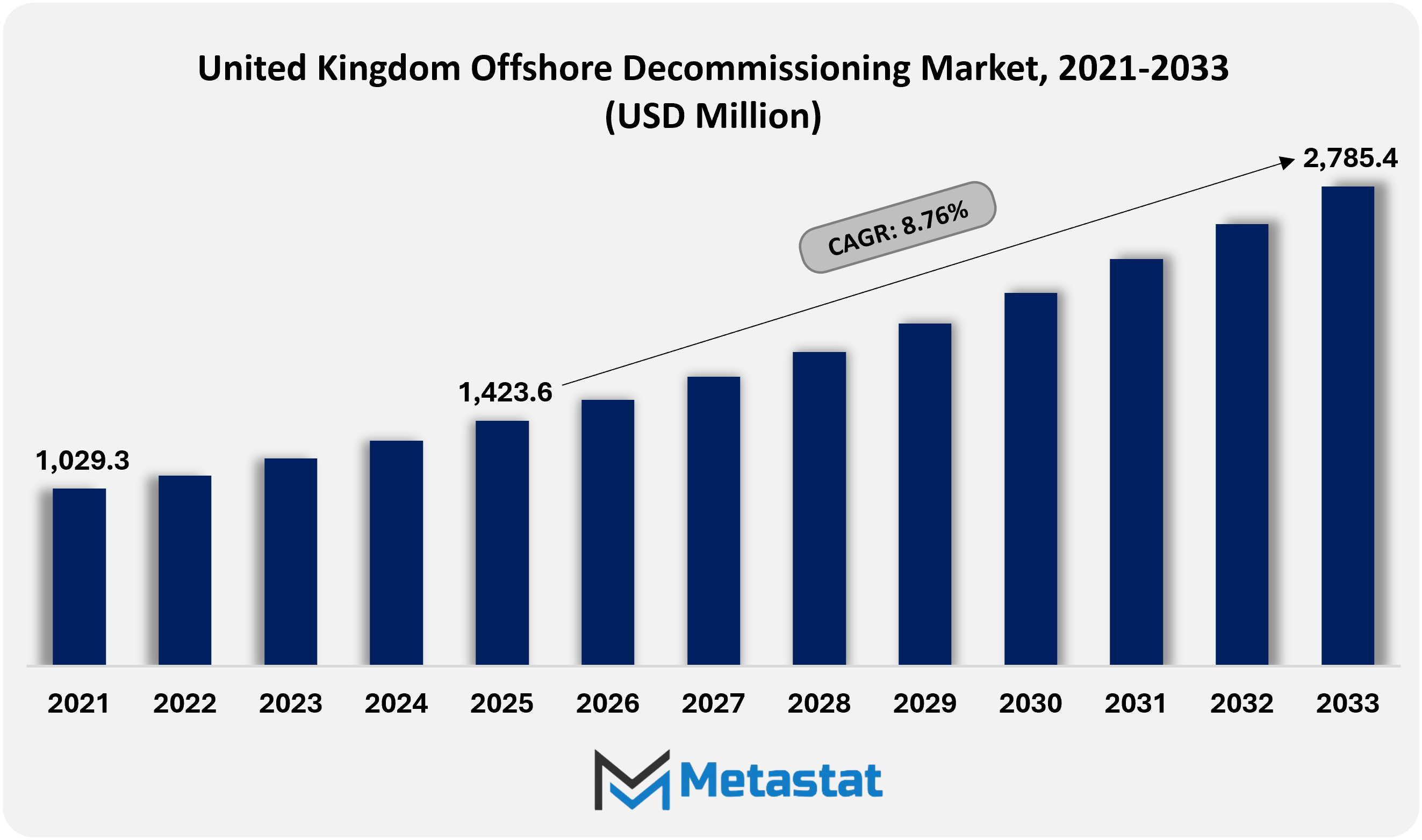
The United Kingdom Offshore Decommissioning market size was valued at USD 1,423.6 million in 2025 and projected to grow at a CAGR of 8.8% during the forecast period, reaching USD 2,785.4 million by 2033.
United Kingdom Offshore Decommissioning Market: Comprehensive Data-Driven Market Analysis and Strategic Outlook
The Project Management segment accounted for 5.9% of the market in 2025.
Key trends driving growth include a rising number of ageing offshore oil and gas assets reaching end-of-life across mature basins and increasing regulatory pressure to ensure safe abandonment and environmental restoration.
Opportunities include growing adoption of recycling, reuse, and rig-to-reef programs improving sustainability and cost efficiency.
Key insight: Ageing North Sea infrastructure, stricter abandonment obligations, and rising environmental accountability are accelerating activity across the United Kingdom Offshore Decommissioning market.
The United Kingdom Offshore Decommissioning Market is evolving beyond the traditional scope of platform removal and well plugging toward a broader framework of offshore asset retirement, marine site restoration, and infrastructure transition. Over the coming years, operators will increasingly assess ageing offshore assets not only for safe dismantling, but also for selective reuse, partial retention where technically and regulatorily viable, and integration into wider marine energy and environmental management systems. Jackets, subsea systems, and related offshore infrastructure will support future applications linked to carbon storage monitoring, offshore wind connectivity, and circular material recovery, extending value beyond hydrocarbon production.
Engineering execution in the United Kingdom Offshore Decommissioning Market will increasingly rely on digital twins, structural integrity modelling, advanced subsea robotics, and remote-operated systems to improve planning precision and reduce offshore exposure. Greater use of automated cutting technologies, real-time monitoring tools, and predictive maintenance analytics will strengthen dismantling efficiency across mature North Sea assets. At the same time, coastal ports and dismantling yards will expand their role as circular economy hubs, supporting material traceability, controlled recycling, and environmentally compliant disposal processes.
Market Dynamics
Growth Drivers:
Rising number of ageing offshore oil and gas assets reaching end-of-life across mature basins.
The United Kingdom Offshore Decommissioning Market is expected to expand steadily owing to a rising number of ageing offshore platforms, wells, pipelines, and subsea assets nearing the end of their productive life across mature basins such as the North Sea. Structural fatigue, declining production economics, and increasing maintenance intensity are encouraging operators to formalize retirement programs. Early-stage planning, budget allocation, and coordinated contractor engagement will strengthen the long-term project pipeline across engineering, marine logistics, and environmental services.
Increasing regulatory pressure to ensure safe abandonment and environmental restoration
The United Kingdom Offshore Decommissioning Market is also gaining momentum from increasing regulatory pressure to ensure safe well abandonment, seabed clearance, waste control, and marine habitat protection. Regulatory authorities are placing stronger emphasis on transparent reporting, environmental accountability, and technically compliant project execution. This will support demand for advanced compliance services, monitoring systems, environmental assessment capabilities, and certified disposal solutions across the market.
Restraints and Challenges:
High project costs and complex technical challenges associated with deepwater and heavy-lift operations
The market continues to face challenges linked to high project costs and complex offshore engineering requirements, particularly in deeper-water zones where heavy-lift vessels, subsea intervention technologies, and specialized dismantling systems are required. Corroded infrastructure, variable weather conditions, and complex structural configurations will increase execution risk and pressure project budgets. Strong cost discipline, digital planning tools, and modular dismantling approaches will remain essential for maintaining commercial viability.
Lengthy permitting processes and cross-border regulatory approvals delaying project execution
Project execution will be affected by lengthy permitting procedures, environmental review requirements, and coordination across multiple regulatory bodies. Approval timelines, stakeholder consultations, and operational compliance obligations can delay vessel mobilization and field activity. Improved documentation systems, better regulatory coordination, and digital compliance workflows will help reduce execution delays over time.
Opportunities:
Growing adoption of recycling, reuse, and rig-to-reef programs improving sustainability and cost efficiency
The United Kingdom Offshore Decommissioning Market is creating new value through higher adoption of recycling, material recovery, asset refurbishment, and sustainability-led dismantling models. Recovery of steel and reusable equipment, combined with improved waste segregation and controlled disposal practices, can reduce total disposal costs and improve environmental performance. These developments are strengthening the role of circular economy principles across offshore decommissioning activity in the United Kingdom.
Market Segmentation Analysis
The United Kingdom Offshore Decommissioning market is classified based on Services, Water Depth, and Structure.
By Services, the market is further segmented into:
Project Management
Project Management segment is estimated at USD 90.6 million in 2026 and is projected to reach USD 121.4 million by 2033, at a CAGR of 4.3% during the forecast period.
Project Management in the United Kingdom Offshore Decommissioning Market will focus on integrated execution planning, contractor coordination, cost tracking, regulatory alignment, and risk control. Wider use of digital dashboards, predictive analytics, and centralized reporting systems will improve transparency and operational efficiency across complex offshore retirement programs.
Engineering & Planning
Engineering & Planning segment is estimated at USD 189.1 million in 2026 and is projected to reach USD 317 million by 2033, at a CAGR of 7.7% during the forecast period.
Engineering and Planning will remain a critical service area, supported by demand for structural assessments, dismantling design, environmental studies, load analysis, and recovery planning. Data-driven modelling and advanced simulation tools will improve planning accuracy, safety outcomes, and timeline optimization across decommissioning campaigns.
Permitting & Regulatory Compliance
Permitting & Regulatory Compliance segment is estimated at USD 99.0 million in 2026 and is projected to reach USD 189.4 million by 2033, at a CAGR of 9.7% during the forecast period.
Permitting and Regulatory Compliance will gain importance owing to strict marine regulations, environmental clearance requirements, waste handling standards, and stakeholder engagement obligations. Operators will increasingly rely on specialized support for impact assessments, regulatory documentation, and compliance management across United Kingdom offshore projects.
Platform Preparation
Platform Preparation segment is estimated at USD 128.2 million in 2026 and is projected to reach USD 205.6 million by 2033, at a CAGR of 7% during the forecast period.
Platform Preparation will involve hydrocarbon cleaning, system isolation, hazardous material handling, and structural stabilization prior to removal operations. Increased use of remote inspection tools and robotics will improve worker safety and reduce exposure in high-risk offshore environments.
Well, Plugging & Abandonment
Well, Plugging & Abandonment segment is estimated at USD 358 million in 2026 and is projected to reach USD 724.8 million by 2033, at a CAGR of 10.6% during the forecast period.
Well, Plugging and Abandonment will remain the leading service segment, driven by the need for permanent well isolation, pressure control, and long-term integrity assurance. Advanced cementing solutions, verification methods, and monitoring systems will support environmental protection and regulatory compliance across mature offshore fields.
Conductor Removal
Conductor Removal segment is estimated at USD 110.3 million in 2026 and is projected to reach USD 175.2 million by 2033, at a CAGR of 6.8% during the forecast period.
Conductor Removal will require precision cutting systems, subsea extraction tools, lifting support, and debris containment methods to ensure efficient removal with limited seabed disruption. Continued innovation in underwater tooling and monitoring systems will improve operational accuracy and safety.
Mobilization & Demobilization of Derrick Barges
Mobilization & Demobilization of Derrick Barges segment is estimated at USD 140.8 million in 2026 and is projected to reach USD 230.4 million by 2033, at a CAGR of 7.3% during the forecast period.
Mobilization and Demobilization of Derrick Barges will depend on effective marine logistics, port scheduling, weather-responsive deployment strategies, and vessel utilization planning. Digital tracking tools and fuel-efficiency programs will support better cost management and operational readiness.
Platform Removal
Platform Removal segment is estimated at USD 253.8 million in 2026 and is projected to reach USD 459.0 million by 2033, at a CAGR of 8.8% during the forecast period.
Platform Removal will involve heavy-lift operations, sectional dismantling, structural separation, and real-time load monitoring. Greater use of modular removal techniques and recycling-oriented dismantling flows will improve material recovery and reduce project risk.
Pipeline & Power Cable Decommissioning
Pipeline & Power Cable Decommissioning segment is estimated at USD 119.0 million in 2026 and is projected to reach USD 257.3 million by 2033, at a CAGR of 11.6% during the forecast period.
Pipeline and Power Cable Decommissioning will expand through seabed surveys, trenching removal methods, corrosion assessment, remote-operated vehicle deployment, and post-removal verification. Environmental restoration and seabed rehabilitation will remain important parts of execution standards.
Others
Others segment is estimated at USD 58 million in 2026 and is projected to reach USD 105.4 million by 2033, at a CAGR of 8.9% during the forecast period.
Other services in the United Kingdom Offshore Decommissioning Market will include waste management, site remediation, marine surveys, environmental verification, and recycling support. Growth in these areas will be supported by increasing sustainability reporting requirements and broader adoption of digital asset tracking systems.
By Water Depth, the market is divided into:
Shallow
Shallow segment is projected to reach USD 1,301.5 million by 2033, at a CAGR of 6.9% during the forecast period.
In the United Kingdom Offshore Decommissioning market, shallow-water activity will continue to account for a significant share of project volume owing to the concentration of ageing infrastructure in relatively accessible offshore zones. Lower operational complexity, shorter mobilization cycles, and established contractor capabilities will support continued activity in this segment.
Deep Water
Deep Water segment is projected to reach USD 973 million by 2033, at a CAGR of 10.5% during the forecast period.
Deep-water decommissioning projects will require specialized lifting vessels, advanced subsea robotics, high-capacity transport systems, and detailed seabed mapping. Technical precision and deeper engineering expertise will play a central role in successful execution across these projects.
Ultra Deep Water
Ultra Deep Water segment is projected to reach USD 511 million by 2033, at a CAGR of 10.9% during the forecast period.
Ultra-deep-water activity will involve higher technical complexity, greater structural risk, and stronger dependence on autonomous underwater systems and high-performance cutting tools. Collaboration among specialized offshore engineering contractors will remain important for safe and efficient execution.
By Structure, the market is further divided into:
Topsides
Topsides segment is projected to reach USD 924.3 million by 2033.
Topsides decommissioning will involve modular separation, hazardous material removal, structural weight optimization, and heavy-lift coordination. Expansion of onshore dismantling and recycling capacity will improve turnaround time and material recovery outcomes.
Substructures
Substructures segment is projected to reach USD 848.6 million by 2033.
Substructure removal will require jacket cutting, pile extraction, seabed clearance, and underwater lifting support. Abrasive cutting systems, lifting frames, and post-removal monitoring will help ensure efficient removal and seabed stability.
Subsea Infrastructure
Subsea Infrastructure segment is projected to reach USD 1,012.5 million by 2033.
Subsea infrastructure decommissioning will cover manifolds, templates, umbilicals, cables, and associated underwater systems. Remote-operated vehicles, digital seabed mapping tools, and environmental verification processes will remain essential to support accurate and compliant extraction.
Competitive Landscape and Strategic Insights
The competitive landscape of the United Kingdom Offshore Decommissioning Market is being shaped by a combination of offshore asset owners, engineering contractors, well abandonment specialists, subsea service providers, dismantling yards, recycling companies, and marine logistics operators. As mature North Sea assets move toward retirement, competition is increasingly centered on technical capability, regulatory compliance, execution efficiency, environmental performance, and access to specialized offshore equipment.
Asset owners such as Shell U.K. Limited, EnQuest PLC, and Perenco UK Limited are central to project initiation and retirement planning across mature offshore portfolios. Engineering and advisory firms including John Wood Group PLC, Xodus Group Limited, and AquaTerra Energy Limited provide structural studies, execution planning, cost modelling, and regulatory support, while Baker Hughes Company and Archer Limited contribute specialized well plugging and abandonment capabilities.
Offshore heavy-lift and subsea execution is supported by companies such as Allseas Group S.A., Heerema Marine Contractors Nederland SE, Subsea 7 S.A., Royal Boskalis Westminster N.V., Helix Energy Solutions Group, Inc., DeepOcean Group Holding AS, DOF Subsea AS, and Scaldis Salvage & Marine Contractors NV. These participants bring vessel capacity, marine engineering expertise, subsea intervention capability, and transport solutions that are essential for complex platform and infrastructure removal programs.
Onshore dismantling, waste treatment, and material recovery form the final stage of the decommissioning value chain. ABLE UK Limited, John Lawrie Metals Limited, Veolia Environmental Services UK PLC, and Augean North Sea Services Limited support dismantling, recycling, and disposal processes, while ports such as Port of Aberdeen, Lerwick Port Authority, Peterhead Port Authority, Port of Blyth, and Kishorn Port Limited provide critical staging, logistics, and handling infrastructure for removed offshore structures.
Forecast and Future Outlook
Market size is forecast to rise from USD 1,423.6 million in 2025 to over USD 2,785.4 million by 2033.
Over time, coverage architecture will probably inspire hybrid offshore zones in which decommissioned fields transition into carbon seize storage web sites or renewable strength interconnection nodes. Such repositioning will region the UK Offshore Decommissioning Market on the intersection of power transition logistics, marine ecology healing, and strategic supply chain remodel, extending its feature properly beyond stop-of-existence asset retirement.
Offshore Decommissioning Market Key Segments:
By Services:
Project Management
Engineering & Planning
Permitting & Regulatory Compliance
Platform Preparation
Well Plugging & Abandonment
Conductor Removal
Mobilization & Demobilization of Derrick Barges
Platform Removal
Pipeline & Power Cable Decommissioning
Others
By Water Depth:
Shallow
Deep Water
Ultra Deep Water
By Structure:
Topsides
Substructures
Subsea Infrastructure
Key United Kingdom Offshore Decommissioning Industry Players
This research report analyzes the United Kingdom Offshore Decommissioning market by Services, Water Depth, and Structure. It forecasts revenue growth across each segment and evaluates the major drivers, restraints, opportunities, and competitive developments shaping the market. The study also profiles key participants and assesses their role across planning, offshore execution, dismantling, waste management, and recycling activities.
The report identifies and profiles key market participants and analyzes their service capabilities, strategic positioning, and operational strengths across the United Kingdom Offshore Decommissioning value chain.
Report Attributes
Details
Study Period
2021-2033
Base Year
2025
Estimated Year
2026
Forecast Period
2026-2033
Historical Period
2021-2025
Growth Rate
CAGR 8.8% from 2026 to 2033
Revenue Unit
USD million
Segmentation
By Services, Water Depth, and Structure
By Services
Project Management
Engineering & Planning
Permitting & Regulatory Compliance
Platform Preparation
Well Plugging & Abandonment
Conductor Removal
Mobilization & Demobilization of Derrick Barges
Platform Removal
Pipeline & Power Cable Decommissioning
Others
By Water Depth
Shallow
Deep Water
Ultra Deep Water
By Structure
Topsides
Substructures
Subsea Infrastructure
WHAT REPORT PROVIDES
Key Company Market Share, Revenue, and Position/Ranking
Key Market Leaders
Full In-Depth Analysis of the Parent Industry
Industry Statistics
Important Changes in Market and Its Dynamics
Segmentation Details of the Market
Historical, On-Going, and Projected Market Analysis
Assessment of Niche Industry Developments
Market Share Analysis
Key Strategies of Major Players
Company Profiles of Key Players
Unique Selling Propositions of Leading Market Players
Energy Harvesting Module Market Size, Share, Trends, 2033
Energy Harvesting Module market size is valued at USD 707.9 billion in 2025 and is projected to reach USD 1,727.8 billion by 2033, growing at a CAGR of 11.8%.
Energy Harvesting Module market, Energy Harvesting Module Market Size, Energy Harvesting Module Market Share, Energy Harvesting Module Market Analysis, Energy Harvesting Module Market Growth, Energy Harvesting Module Market Trends, Energy Harvesting Module Market Research Report, Energy Harvesting Module Market Forecast, Energy Harvesting Module, Energy Harvesting Module Market Research, Energy Harvesting Module Industry, Energy Harvesting Module Industry Report, Energy Harvesting Module Market Data, Energy Harvesting Module Statistics, Energy Harvesting Module Market Statistics, Energy Harvesting Module Industry Trends, Energy Harvesting Module Market Report, Energy Harvesting Module Market Trends, Energy Harvesting Module Market News, Energy Harvesting Module Forecasts, Energy Harvesting Module Market Intelligence Report, Energy Harvesting Module market 2033, Energy Harvesting Module market outlook, Energy Harvesting Module market segmentation, Energy Harvesting Module market drivers, Energy Harvesting Module market restraints, Energy Harvesting Module market opportunities, Energy Harvesting Module market CAGR, Energy Harvesting Module suppliers, Energy Harvesting Module manufacturers, Energy Harvesting Module market by region, North America Energy Harvesting Module market, Asia Pacific Energy Harvesting Module market, Europe Energy Harvesting Module market, Energy Harvesting Module market competitive landscape, Energy Harvesting Module market key players, Photovoltaic and Light Energy Harvesting market, Thermoelectric and Heat Energy Harvesting market, Piezoelectric and Vibration Energy Harvesting market, Industrial IoT and Condition Monitoring market, Smart Buildings and Home Automation market
Concentrated Solar Power Market Size, Share, Trends, 2033
Concentrated Solar Power market size is valued at USD 7.5 billion in 2025 and is projected to reach USD 17.3 billion in 2033, at a CAGR of 11.1% from 2026 to 2033.
Concentrated Solar Power Market, Concentrated Solar Power Market Size, Concentrated Solar Power Market Share, Concentrated Solar Power Market Analysis, Concentrated Solar Power Market Growth, Concentrated Solar Power Market Trends, Concentrated Solar Power Market Research Report, Concentrated Solar Power Market Forecast, Concentrated Solar Power, Concentrated Solar Power Market Research, Concentrated Solar Power Industry, Concentrated Solar Power Industry Report, Concentrated Solar Power Market Data, Concentrated Solar Power Statistics, Concentrated Solar Power Market Statistics, Concentrated Solar Power Industry Trends, Concentrated Solar Power Market Report, Concentrated Solar Power Market Trends, Concentrated Solar Power Market News, Concentrated Solar Power Forecasts, Concentrated Solar Power Market Intelligence Report
Global Leak Detection Software market size is valued at USD 985.8 million in 2025 and is projected to reach USD 1,713.0 million in 2033, at a CAGR of 7.1% from 2026 to 2033
Global Leak Detection Software Market, Global Leak Detection Software Market Size, Global Leak Detection Software Market Share, Global Leak Detection Software Market Analysis, Global Leak Detection Software Market Growth, Global Leak Detection Software Market Trends, Global Leak Detection Software Market Research Report, Global Leak Detection Software Market Forecast, Global Leak Detection Software, Global Leak Detection Software Market Research, Global Leak Detection Software Industry, Global Leak Detection Software Industry Report, Global Leak Detection Software Market Data, Global Leak Detection Software Statistics, Global Leak Detection Software Market Statistics, Global Leak Detection Software Industry Trends, Global Leak Detection Software Market Report, Global Leak Detection Software Market Trends, Global Leak Detection Software Market News, Global Leak Detection Software Forecasts, Global Leak Detection Software Market Intelligence Report
Renewable Energy market size is valued at USD 1,738.8 billion in 2025 and is projected to reach USD 5,698.6 billion in 2033, at a CAGR of 15.8% from 2026 to 2033.
Renewable Energy Market, Renewable Energy Market Size, Renewable Energy Market Share, Renewable Energy Market Analysis, Renewable Energy Market Growth, Renewable Energy Market Trends, Renewable Energy Market Research Report, Renewable Energy Market Forecast, Renewable Energy, Renewable Energy Market Research, Renewable Energy Industry, Renewable Energy Industry Report, Renewable Energy Market Data, Renewable Energy Statistics, Renewable Energy Market Statistics, Renewable Energy Industry Trends, Renewable Energy Market Report, Renewable Energy Market Trends, Renewable Energy Market News, Renewable Energy Forecasts, Renewable Energy Market Intelligence Report