Online Jewelry Market Size, Share, By Product Type (Necklace, Ring, Earring, Bracelet, Anklet, and Others), By Material (Gold, Silver, Platinum, Diamond, and Others), By Category (Fine Jewelry, Fashion Jewelry, and Personalized Jewelry), By End-User (Men and Women), Industry Analysis, Growth, Trends, and Forecast, 2026-2033
Report ID
MSI-4674
Published
April 28, 2026
Pages
312 Pages
Format
Report Details
Comprehensive Market Analysis And Insights
Market Overview
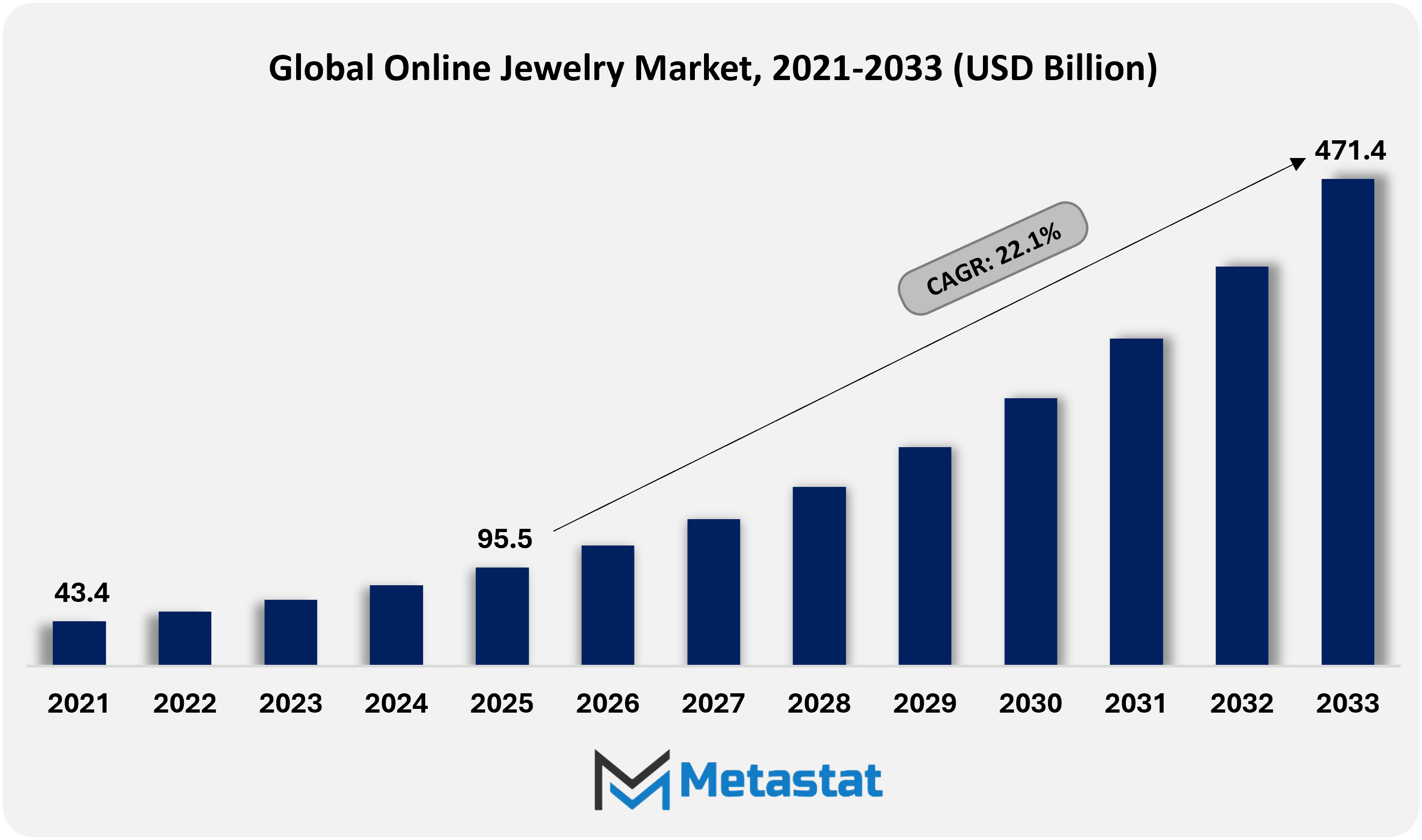
The Global Online Jewelry market size was valued at USD 95.5 billion in 2025 and projected to grow at a CAGR of 22.1% during the forecast period, reaching USD 471.4 billion by 2033.
Global Online Jewelry Market: Comprehensive Data-Driven Market Analysis and Strategic Outlook
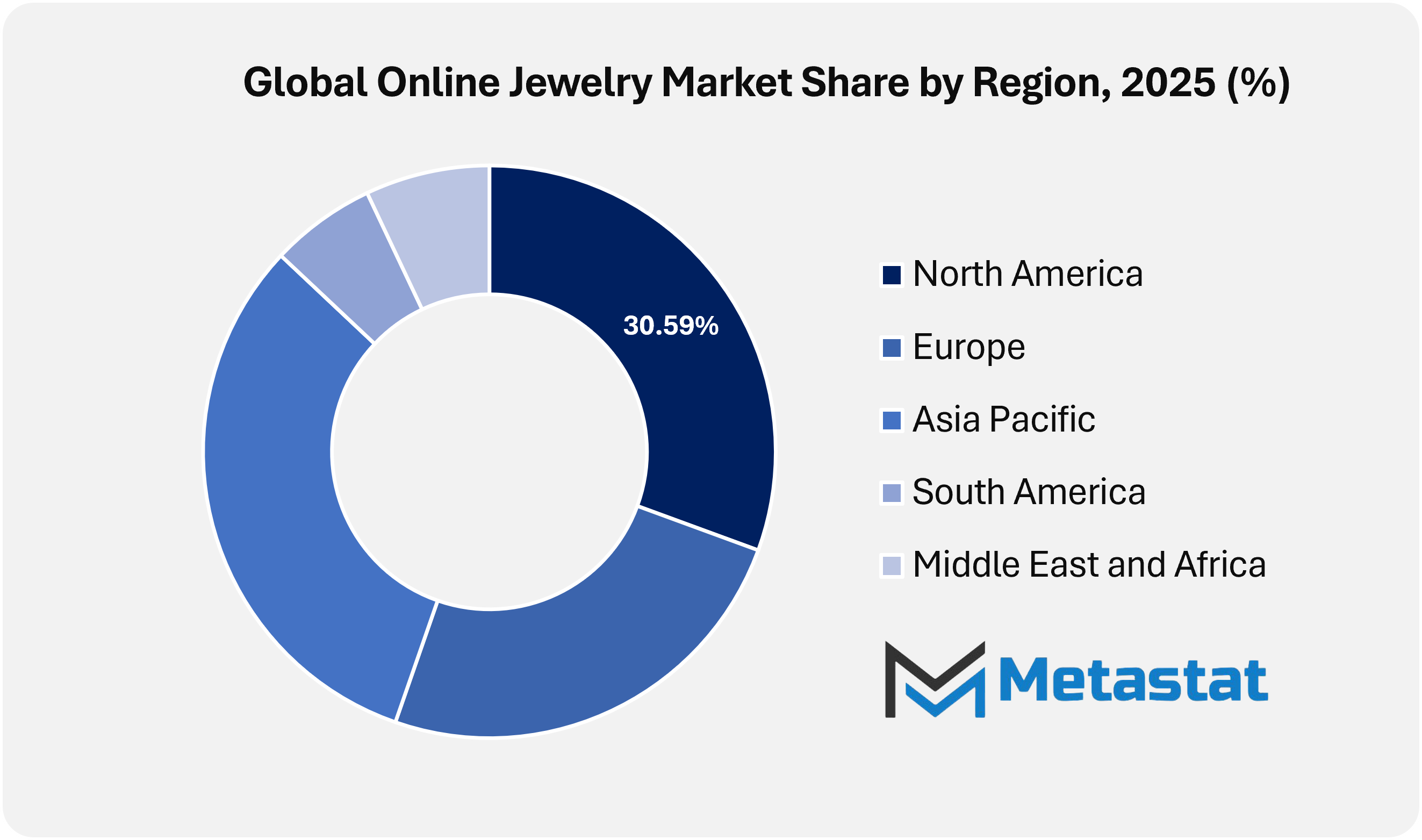
North America held 30.6% of the global market in 2025, with the U.S. leading the regional market.
Ring segment accounted for the largest market share of 29.94% in 2025.
Key trends driving growth: Rapid growth of e-commerce and increasing digital adoption, enabling customers to browse and buy jewelry online with convenience and personalized recommendations, social media and influencer marketing expanding brand visibility and engagement, especially among younger shoppers
Opportunities include adoption of AR/VR tools to simulate wearing jewelry online offers potential to improve engagement, reduce returns, and expand online purchase conversion rates
Key insight: Digital-first retail models and personalization trends are reshaping the competitive landscape of the Global Online Jewelry Market.
Within the broader fashion and accessories retail industry, the Global Online Jewelry Market is evolving from a conventional product-display model into a digitally driven shopping ecosystem shaped by data intelligence and immersive commerce. Traditional catalog-style listings are being replaced by algorithm-led storefronts that adapt in real time to browsing patterns, lifestyle preferences, and purchase behavior. Retailers are strengthening their digital presence through merchandising, limited-edition online launches, and interactive lookbooks that recreate boutique-style engagement across online platforms.
Consumer interaction with jewelry is moving beyond static product imagery toward highly visual and interactive digital experiences. Augmented reality try-on tools, facial mapping, and size-calibration features are improving product visualization and helping buyers assess fit, finish, and styling before purchase. High-resolution 3D rendering is narrowing the gap between online and in-store evaluation, while flexible payment options, secure digital transactions, and cross-border checkout capabilities are making online jewelry purchases more seamless and accessible.
Market Dynamics
Growth Drivers:
Rapid growth of e-commerce and increasing digital adoption, enabling customers to browse and buy jewelry online with convenience and personalized recommendations.
Rapid expansion of e-commerce platforms and rising digital adoption across urban and semi-urban areas continue to strengthen the Global Online Jewelry Market. Advanced recommendation engines, secure payment gateways, and data-driven personalization are improving customer journeys across digital storefronts. Seamless browsing, detailed product catalogs, and reliable home delivery services are enhancing purchase confidence and supporting sustained market expansion.
Social media and influencer marketing expanding brand visibility and engagement, especially among younger shoppers
The growing influence of social media platforms and digital creators is expanding brand visibility across the Global Online Jewelry Market. Interactive campaigns, live product showcases, and targeted advertising are attracting younger consumers seeking trend-led jewelry designs. Continued engagement through short-form content, creator partnerships, and community-driven promotions is strengthening brand recall and encouraging repeat purchases.
Restraints and Challenges:
Consumer concerns about authenticity, trust, and quality due to inability to physically inspect high-value products.
Ongoing concerns regarding authenticity and product quality remain a key restraint for the Global Online Jewelry Market. The inability to physically inspect jewelry before purchase can create hesitation, particularly in premium and high-value categories. Stronger certification transparency, digital verification systems, and detailed product disclosures are becoming essential for building trust and reducing buyer skepticism.
Lack of physical touch-and-feel experience that can deter purchases of premium jewelry items.
Limited physical evaluation of high-value products remains a structural challenge for the Global Online Jewelry Market. Premium buyers often prefer to assess craftsmanship, finish, and material quality before making final purchase decisions. High-resolution imagery, 360-degree product views, and responsive customer support are playing an important role in addressing this experiential limitation.
Opportunities:
Adoption of AR/VR tools to simulate wearing jewelry online offers potential to improve engagement, reduce returns, and expand online purchase conversion rates
Integration of augmented reality and virtual visualization tools is creating strong growth opportunities in the Global Online Jewelry Market. Virtual try-on solutions and immersive product simulations help shoppers evaluate size, design, and styling with greater accuracy. Better engagement, lower return rates, and higher conversion performance are making these tools an important source of competitive advantage for online jewelry brands.
Market Segmentation Analysis
The Global Online Jewelry market is segmented based on Product Type, Material, Category, and End-User.
By Product Type, the market is further segmented into:
Necklace
Necklace segment is estimated at USD 27.2 billion in 2026 and is projected to reach USD 103.4 billion by 2033, at a CAGR of 21% during the forecast period.
Online visibility for necklaces is improving through high-definition product displays and virtual try-on features that support style comparison and purchase confidence. Personalized pendants, layered styles, and symbolic designs are attracting strong interest across urban consumer groups. Lightweight designs and modular styling are supporting repeat purchases, while digital-first launches are helping brands attract fashion-conscious buyers.
Ring
Ring segment is estimated at USD 34.7 billion in 2026 and is projected to reach USD 135.9 billion by 2033, at a CAGR of 21.5% during the forecast period.
Ring sales are being supported by rising interest in engagement jewelry, gifting occasions, and self-purchase trends across online channels. Augmented visualization tools are helping buyers assess fit, design details, and finish before purchase. Ethical sourcing claims and certification transparency are influencing purchase decisions, while ring-size guidance tools are helping reduce return rates and improve buyer confidence.
Earring
Earring segment is estimated at USD 24.2 billion in 2026 and is projected to reach USD 109 billion by 2033, at a CAGR of 24% during the forecast period.
Earrings continue to attract strong online demand owing to accessible price points and broad styling versatility. Minimalist designs, geometric patterns, and daily-wear collections are resonating with younger shoppers. Fast delivery options are supporting impulse purchases, while curated seasonal collections are helping brands align product offerings with changing fashion preferences.
Bracelet
Bracelet segment is estimated at USD 17.3 billion in 2026 and is projected to reach USD 71.7 billion by 2033, at a CAGR of 22.5% during the forecast period.
Bracelet sales are benefiting from charm-based customization, stackable styling, and gifting-led demand across digital retail platforms. Online engraving options are strengthening emotional purchase appeal, personalized gifting categories. Limited-edition releases and interactive product previews are improving engagement and helping brands communicate design value more effectively.
Anklet
Anklet segment is estimated at USD 4 billion in 2026 and is projected to reach USD 19.4 billion by 2033, at a CAGR of 25.4% during the forecast period.
Anklets are gaining gradual traction owing to rising interest in fusion fashion, seasonal styling, and occasion-based accessorizing. Lightweight metal designs and gemstone-accented variants are appealing to holiday and festival buyers. Social media promotion is improving visibility, while culturally inspired collections are helping brands connect with diverse regional audiences.
Others
Others segment is estimated at USD 9.1 billion in 2026 and is projected to reach USD 32 billion by 2033, at a CAGR of 19.6% during the forecast period.
Products such as brooches, nose pins, body chains, and cufflinks are gaining online visibility through niche targeting and category-specific merchandising. Limited-edition launches are supporting collector interest, while presentation around craftsmanship and design heritage is improving perceived product value. Broader portfolio diversification is helping brands address evolving accessory preferences across different consumer groups.
By Material, the market is divided into:
Gold
Gold segment is projected to reach USD 197.6 billion by 2033, at a CAGR of 21.1% during the forecast period.
Gold jewelry continues to maintain strong online traction owing to its cultural relevance, gifting appeal, and long-term value perception. Transparent pricing mechanisms and live rate-linked pricing are improving buyer trust across digital channels. Lightweight contemporary designs are attracting younger consumers, while purity certification and traceable sourcing are becoming important purchase drivers.
Silver
Silver segment is projected to reach USD 93.9 billion by 2033, at a CAGR of 22% during the forecast period.
Silver jewelry is expanding strongly within affordable luxury and fashion-led categories across online platforms. Oxidized finishes, minimalist styling, and trend-driven collections are resonating with style-conscious consumers. Frequent design refreshes are supporting repeat purchases, while bundled product offerings are helping retailers improve average order value.
Platinum
Platinum segment is projected to reach USD 18.1 billion by 2033, at a CAGR of 18.3% during the forecast period.
Platinum jewelry is gaining visibility in premium engagement and wedding categories, supported by its durability, exclusivity, and premium positioning. Educational content around metal quality and long-term wear is helping consumers make informed purchase decisions. Online sellers are also investing in better product visualization to highlight finish, texture, and craftsmanship.
Diamond segment is projected to reach USD 133.5 billion by 2033, at a CAGR of 23.9% during the forecast period.
Diamond jewelry is benefiting from improved grading transparency, stronger digital certification support, and rising acceptance of lab-grown alternatives. Interactive verification tools are enhancing customer assurance, while customizable settings are strengthening premium personalization. Ethical sourcing communication is also becoming more important in attracting value-conscious and informed buyers.
Others
Others segment is projected to reach USD 28.3 billion by 2033, at a CAGR of 24.6% during the forecast period.
Alternative materials such as titanium, pearls, mixed alloys, and recycled inputs are expanding the design scope of online jewelry portfolios. Sustainability-linked materials are drawing stronger interest from environmentally conscious buyers. Limited-batch production and innovation-driven material use are helping brands create exclusivity and differentiate their online offerings.
Fine Jewelry segment is projected to reach USD 235.2 billion by 2033.
Fine jewelry continues to attract strong online demand supported by hallmark certification, premium craftsmanship presentation, and trust-led branding. Investment-oriented buying behavior is contributing to higher average transaction values. Exclusive digital previews and private online launches are also helping luxury brands drive early demand across domestic and cross-border markets.
Fashion Jewelry
Fashion Jewelry segment is projected to reach USD 169.6 billion by 2033.
Fashion jewelry is witnessing rapid turnover driven by short trend cycles, influencer-led promotion, and strong visual merchandising across digital channels. Competitive pricing is improving accessibility among younger buyers, while fast product refresh cycles are helping brands stay aligned with changing fashion preferences. Data-led forecasting is also supporting better inventory planning and assortment management.
Custom/Personalized Jewelry
Custom/Personalized Jewelry segment is projected to reach USD 66.6 billion by 2033.
Personalized jewelry is gaining momentum through AI-assisted design support, engraving services, and made-to-order digital customization tools. Consumers are increasingly seeking symbolic products linked to identity, gifting, and life milestones. Direct-to-consumer production models are helping shorten fulfillment timelines, while interactive customization interfaces are improving retention and purchase engagement.
By End-User, the Global Online Jewelry market is divided as:
Men
Men segment is projected to grow at a CAGR of 24.2% during the forecast period.
Men’s jewelry is gaining wider acceptance through minimalist rings, bracelets, chains, and utility-led accessories designed for both professional and casual wear. Neutral finishes and durable materials are influencing purchase preferences. Targeted digital campaigns and dedicated online collections are helping improve visibility and category penetration among male buyers.
Women
Women segment is projected to grow at a CAGR of 21.3% during the forecast period.
Women continue to represent the largest consumer base across engagement, fashion, self-purchase, and gifting segments in the online jewelry market. Multi-occasion product collections are supporting repeat purchases throughout the year. Recommendation algorithms and personalized merchandising are improving conversion rates, while digital retail infrastructure is expanding access to global design trends.
By Region:
Based on geography, the Global Online Jewelry market is divided into North America, Europe, Asia-Pacific, South America, Middle East, and Africa.
North America Online Jewelry Market is set to expand at a CAGR of 22.1% within the forecast period, reaching a market size (TAM) of USD 127.5 billion by the end of 2033.
In North America, high digital payment adoption and strong consumer trust in e-commerce platforms are supporting robust expansion in the Online Jewelry Market.
Rising demand for personalized and premium jewelry through direct-to-consumer brands is further strengthening market expansion across North America.
In Europe, strong demand for certified fine jewelry, growing preference for sustainable and ethically sourced collections, and rising cross-border e-commerce activity are supporting steady growth in the Online Jewelry Market.
In Asia Pacific, rising middle-class spending and rapid smartphone adoption are creating significant growth opportunities for the Online Jewelry Market.
The growing influence of social commerce, live selling, and celebrity-led digital campaigns is unlocking new revenue potential across Asia Pacific.
Across the Middle East, Africa, and South America, enhancing internet access, growing youngsters' population, and growing choice for branded ornaments through virtual platforms help consistent advancement inside the Online Jewelry Market.
Competitive Landscape and Strategic Insights
The global online jewelry market has developed into a strong retail channel in which heritage brands and digital-first players compete side by side. Online platforms have transformed how consumers discover, compare, and purchase fine and fashion jewelry. Buyers now expect detailed product imagery, transparent pricing, certification support, flexible return policies, and reliable delivery. Established luxury houses and mass-market brands are responding by strengthening their digital presence, improving website experience, and investing in direct-to-consumer strategies. Competitive intensity remains centered on trust, brand equity, craftsmanship, and customer experience.
Several globally recognized companies continue to lead the premium and luxury segment of the online jewelry market. De Beers Group, Cartier, Tiffany & Co., Van Cleef & Arpels, Graff Diamonds Ltd., Boucheron, Dior, Hermes International SA, Louis Vuitton Malletier SAS, Chopard, and Jacob & Co. have built strong brand equity over time. Their online platforms emphasize exclusivity through digital consultations, curated collections, and personalized services. Forever mark and Chow Tai Fook Jewellery Group Ltd. also maintain strong visibility, particularly through diamond-led positioning and heritage branding. Continued investment in digital storytelling and premium customer engagement is likely to support their market presence.
In the mid-range and mass-market segment, companies such as Pandora Jewelry LLC, Signet Jewelers Ltd., Titan Company Limited, Swarovski AG, Malabar Gold and Diamonds, Kalyan Jewellers India Limited, Zales, PC Jeweller Ltd., Thomas Sabo GmbH & Co. KG, and Bijou Brigitte Fashionable Accessories AG serve a broad consumer base. Online growth in this segment is supported by affordability, frequent product launches, and promotional pricing strategies. Many of these brands operate through both physical stores and e-commerce platforms, creating an integrated shopping experience. Their digital strategies remain focused on expanding assortment depth, improving fulfillment speed, and strengthening customer loyalty programs.
Regional and specialized brands are also playing an important role in shaping competitive dynamics. YES Jewelry, Apart, W.Kruk SA, Klenota, Granát Turnov, Chimera Ekszer, Teilor, OLA online s.r.o. (ALO diamonds), and Damiani S.p.A. serve niche markets with distinct design positioning. Some focus on handcrafted collections, while others emphasize certified diamonds or customized engagement jewelry. Their online growth depends on strong branding, clear communication of authenticity, and focused digital marketing across search and social media channels.
As digital jewelry shopping becomes more mainstream, market participants will continue investing in secure payment systems, virtual try-on tools, and personalized recommendations supported by consumer data. Brand trust and product transparency remain central to long-term success in this market. Companies that balance heritage, innovation, and buyer confidence will strengthen their online presence and capture sustained growth.
Forecast and Future Outlook
Market size is forecast to rise from USD 95.5 billion in 2025 to over USD 471.4 billion by 2033.
Global Online Jewelry Market dynamics are increasingly integrating social commerce features, influencer-led storefront models, and community-driven review ecosystems. Data analytics is helping brands interpret consumer sentiment and design preferences more quickly, allowing faster collection refresh cycles. Sustainability positioning is also moving beyond brand messaging toward visible proof points such as sourcing transparency and certification support. The market is no longer replicating physical retail in digital form; it is building a hybrid commerce model in which personalization, authenticity, and immersive shopping experience define competitive advantage.
This research report categorizes the Online Jewelry market based on key segments and regions, forecasts revenue growth, and analyses trends in each submarket. The report analyses the key growth drivers, opportunities, and challenges influencing the Online Jewelry market. Recent market developments and competitive strategies such as expansion, product launch, partnership, merger, and acquisition have been included to draw the competitive landscape in the market.
The report strategically identifies and profiles the key market players and analyses their core competencies in each sub-segment of the Online Jewelry market.
Report Attributes
Details
Study Period
2021-2033
Base Year
2025
Estimated Year
2026
Forecast Period
2026-2033
Historical Period
2021-2025
Growth Rate
CAGR 22.1% from 2026 to 2033
Revenue Unit
USD billion
Sales Volume Unit
Thousand Units
Segmentation
By Product Type, Material, Category, End-User, and Region
By Region
North America (By Product Type, Material, Category, End-User, and Country)
United States
Canada
Mexico
Europe (By Product Type, Material, Category, End-User, and Country)
Germany
France
UK
Italy
Spain
Russia
Rest of Europe
Asia Pacific (By Product Type, Material, Category, End-User, and Country)
China
Japan
India
South Korea
Australia
Southeast Asia
Rest of Asia Pacific
South America (By Product Type, Material, Category, End-User, and Country)
Brazil
Argentina
Rest of South America
Middle East and Africa (By Product Type, Material, Category, End-User, and Country)
Saudi Arabia
UAE
South Africa
Rest of Middle East and Africa
WHAT REPORT PROVIDES
Digital Wholesale Sourcing Platforms Reshaping Jewelry Procurement
Expansion of B2B Online Marketplaces for Global Jewelry Trade
Cross-Border E-commerce Facilitating International Jewelry Transactions
Supply Chain Transparency Through Blockchain and Digital Traceability
Platform-Driven Integration of Manufacturers, Wholesalers, and Retailers
Data-Enabled Price Discovery and Inventory Optimization in Jewelry Commerce
Transformation of Global Jewelry Trade Through End-to-End Digital Ecosystems
Key Company Market Share, Revenue, and Position/Ranking
Key Market Leaders
Full In-Depth Analysis of the Parent Industry
Industry Statistics
Important Changes in Market and Its Dynamics
Segmentation Details of the Market
Historical, On-Going, and Projected Market Analysis
Assessment of Niche Industry Developments
Market Share Analysis
Key Strategies of Major Players
Company Profiles of Key Players
Unique Selling Propositions of Leading Market Players
Australia Cat Litter Market Size, Share, Trends, 2033
Australia Cat Litter market size is valued at USD 361.1 million in 2025 and is projected to reach USD 671.8 million in 2033, at a CAGR of 7.3% from 2026 to 2033
Australia Cat Litter Market, Australia Cat Litter Market Size, Australia Cat Litter Market Share, Australia Cat Litter Market Analysis, Australia Cat Litter Market Growth, Australia Cat Litter Market Trends, Australia Cat Litter Market Research Report, Australia Cat Litter Market Forecast, Australia Cat Litter, Australia Cat Litter Market Research, Australia Cat Litter Industry, Australia Cat Litter Industry Report, Australia Cat Litter Market Data, Australia Cat Litter Statistics, Australia Cat Litter Market Statistics, Australia Cat Litter Industry Trends, Australia Cat Litter Market Report, Australia Cat Litter Market Trends, Australia Cat Litter Market News, Australia Cat Litter Forecasts, Australia Cat Litter Market Intelligence Report
India Naruto Merchandise Market Size, Share, Trends, 2033
India Naruto Merchandise market size is valued at USD 25.3 million in 2025 and is projected to reach USD 61.8 million in 2033, at a CAGR of 11.8% from 2026 to 2033.
India Naruto Merchandise Market, India Naruto Merchandise Market Size, India Naruto Merchandise Market Share, India Naruto Merchandise Market Analysis, India Naruto Merchandise Market Growth, India Naruto Merchandise Market Trends, India Naruto Merchandise Market Research Report, India Naruto Merchandise Market Forecast, India Naruto Merchandise, India Naruto Merchandise Market Research, India Naruto Merchandise Industry, India Naruto Merchandise Industry Report, India Naruto Merchandise Market Data, India Naruto Merchandise Statistics, India Naruto Merchandise Market Statistics, India Naruto Merchandise Industry Trends, India Naruto Merchandise Market Report, India Naruto Merchandise Market Trends, India Naruto Merchandise Market News, India Naruto Merchandise Forecasts, India Naruto Merchandise Market Intelligence Report
UK Pilates Reformer Market Size, Share, Trends, 2033
UK Pilates Reformer market size is valued at USD 141.1 million in 2025 and is projected to reach USD 260.3 million in 2033, at a CAGR of 7.5% from 2026 to 2033.
UK Pilates Reformer Market, UK Pilates Reformer Market Size, UK Pilates Reformer Market Share, UK Pilates Reformer Market Analysis, UK Pilates Reformer Market Growth, UK Pilates Reformer Market Trends, UK Pilates Reformer Market Research Report, UK Pilates Reformer Market Forecast, UK Pilates Reformer, UK Pilates Reformer Market Research, UK Pilates Reformer Industry, UK Pilates Reformer Industry Report, UK Pilates Reformer Market Data, UK Pilates Reformer Statistics, UK Pilates Reformer Market Statistics, UK Pilates Reformer Industry Trends, UK Pilates Reformer Market Report, UK Pilates Reformer Market Trends, UK Pilates Reformer Market News, UK Pilates Reformer Forecasts, UK Pilates Reformer Market Intelligence Report
Global Lab-Grown Diamond Jewelry market size is valued at USD 14.01 billion in 2025 and is projected to reach USD 34.68 billion in 2033, at a CAGR of 12.0% from 2026 to 2033
Global Lab-Grown Diamond Jewelry Market, Global Lab-Grown Diamond Jewelry Market Size, Global Lab-Grown Diamond Jewelry Market Share, Global Lab-Grown Diamond Jewelry Market Analysis, Global Lab-Grown Diamond Jewelry Market Growth, Global Lab-Grown Diamond Jewelry Market Trends, Global Lab-Grown Diamond Jewelry Market Research Report, Global Lab-Grown Diamond Jewelry Market Forecast, Global Lab-Grown Diamond Jewelry, Global Lab-Grown Diamond Jewelry Market Research, Global Lab-Grown Diamond Jewelry Industry, Global Lab-Grown Diamond Jewelry Industry Report, Global Lab-Grown Diamond Jewelry Market Data, Global Lab-Grown Diamond Jewelry Statistics, Global Lab-Grown Diamond Jewelry Market Statistics, Global Lab-Grown Diamond Jewelry Industry Trends, Global Lab-Grown Diamond Jewelry Market Report, Global Lab-Grown Diamond Jewelry Market Trends, Global Lab-Grown Diamond Jewelry Market News, Global Lab-Grown Diamond Jewelry Forecasts, Global Lab-Grown Diamond Jewelry Market Intelligence Report