MEA Revenue Management System Market Size, Share, By Component (Solution and Services), By Deployment (Cloud Based, On-Premise, and Hybrid), By Enterprise Size (Small Enterprises, Medium Enterprises, and Large Enterprises ), By End Users (IT, Telecom, Hospitality, Travel, Tourism, Retail, E-commerce, Banking, Healthcare, Insurance, Media, and Entertainment), Industry Analysis, Growth, Trends, and Forecast, 2026-2033
Report ID
MSI-4599
Published
April 13, 2026
Pages
320 Pages
Format
Report Details
Comprehensive Market Analysis And Insights
Market Overview
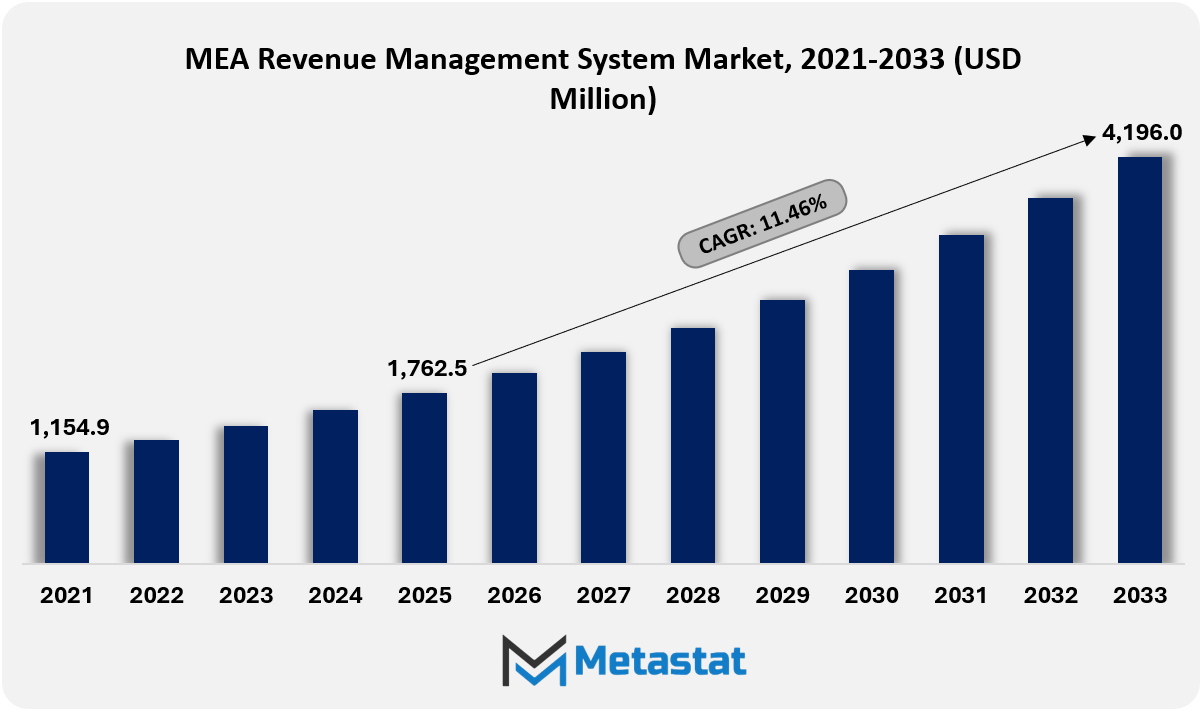
MEA Revenue Management System market size is valued at USD 1,762.5 million in 2025 and projected to grow at a CAGR of 11.5% during the forecast period, reaching USD 4,196.0 million by 2033.
MEA Revenue Management System Market: Comprehensive Data-Driven Market Analysis and Strategic Outlook
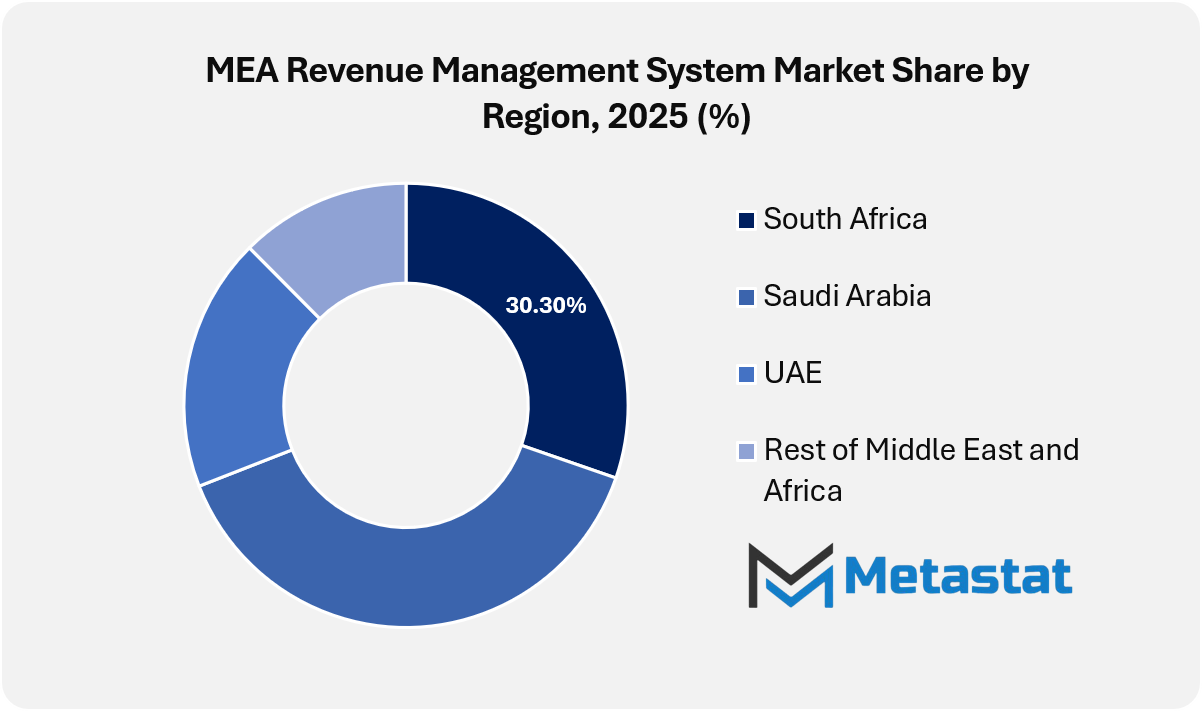
South Africa holds 30.3% share of the MEA Revenue Management System market in 2025 and remains the leading country market.
Solution segment accounts for a 64.2% market share in 2025.
Key trends driving growth: Growing adoption of dynamic pricing and data-driven decision-making across hospitality, airlines, retail, and transportation sectors, along with increasing integration of AI, machine learning, and predictive analytics to optimize pricing accuracy and demand forecasting.
Opportunities include expansion of cloud-based and SaaS-driven RMS solutions enabling scalable adoption across mid-sized and emerging enterprises.
Key insight: Digital transformation across hospitality, aviation, and telecom sectors fuels strategic adoption of advanced pricing intelligence in MEA Revenue Management System market.
The MEA Revenue Management System market within the hospitality and travel technology industry will expand beyond conventional pricing dashboards and occupancy optimization tools. It will increasingly position itself as a strategic control layer that influences how hotels, resorts, airlines, and mixed-use tourism assets design commercial strategies across different geographies in the Middle East and Africa. Rather than functioning only as a yield management engine, these systems will integrate behavioral forecasting, demand clustering by micro-segment, and scenario modeling aligned with regional tourism cycles, religious travel flows, and large-scale event calendars.
Over the coming years, operators will expect these solutions to support portfolio-level capital planning decisions. Systems will connect revenue signals with asset refurbishment timing, contract renegotiations with distribution partners, and dynamic packaging strategies linked to aviation routes and destination marketing campaigns. In Gulf Cooperation Council markets, where giga-project developments are reshaping tourism infrastructure, revenue intelligence will inform pre-opening positioning, long-stay product calibration, and hybrid hospitality formats that combine residential and short-term inventory.
Market Dynamics
Growth Drivers:
Growing adoption of dynamic pricing and data-driven decision-making across hospitality, airlines, retail, and transportation sectors.
Rising competition across hospitality, aviation, retail, and transport industries will accelerate the adoption of structured pricing strategies supported by analytics. Organizations will increasingly rely on automated revenue tools to adjust prices based on demand patterns, seasonal shifts, and customer behavior. Within the MEA Revenue Management System market, forward-looking companies will strengthen profitability through continuous assessment of booking trends and purchasing indicators.
Increasing integration of AI, machine learning, and predictive analytics to optimize pricing accuracy and demand forecasting.
Advanced technologies will transform forecasting capabilities by processing historical data, market signals, and customer trends with greater precision. Artificial intelligence and machine learning models will refine price optimization and inventory management through predictive simulations. The MEA Revenue Management System market will witness stronger reliance on intelligent automation to reduce pricing errors and improve long-term revenue visibility across multiple sectors.
Restraints and Challenges:
High initial implementation and integration costs, particularly for SMEs with legacy systems.
Significant capital investment required for software deployment, infrastructure upgrades, and system alignment will create barriers for small and mid-sized enterprises. Legacy platforms will require extensive customization and migration planning. In the MEA Revenue Management System market, financial constraints and gaps in technical readiness will slow adoption among organizations operating with limited digital budgets.
Data security concerns and complexity in managing large, multi-source datasets.
Expanding statistics volumes generated from booking engines, cellular structures, and business enterprise structures will increase governance demands. Security frameworks would require non-stop enhancement to defend pricing intelligence and patron records. The MEA Revenue Management System market will face operational pressure from regulatory compliance standards and integration demanding situations related to fragmented facts environments.
Opportunities:
Expansion of cloud-based and SaaS-driven RMS solutions enabling scalable adoption across mid-sized and emerging enterprises.
Expanding data volumes generated from booking engines, mobile platforms, and enterprise systems will increase governance requirements. Security frameworks will require continuous enhancement to protect pricing intelligence and customer data. The MEA Revenue Management System market will face operational pressure from regulatory compliance standards and integration challenges associated with fragmented data environments.
Market Segmentation Analysis
The MEA Revenue Management System market is classified based on Component, Deployment, Enterprise Size, and End Users.
By Component, the market is further segmented into:
Solution
Solution segment is valued at USD 1,260.1 million in 2026 and is projected to reach USD 2,685.9 million by 2033, at a CAGR of 11.4% during the forecast period.
The solution segment will focus on intelligent pricing engines, demand forecasting modules, and integrated analytics platforms. Future development will emphasize automation, real-time data synchronization, and predictive modeling to improve revenue capture. Advanced dashboards, AI-driven recommendations, and scalable architecture will strengthen operational control across various industry verticals.
Services
Services segment is valued at USD 702.5 million in 2026 and is projected to reach USD 1,510.1 million by 2033, at a CAGR of 11.6% during the forecast period.
The services segment will expand through consulting, system integration, customization, and long-term support contracts. Growing digital transformation initiatives across the Middle East and Africa will increase demand for managed services, performance optimization, and continuous monitoring. Training programs and advisory frameworks will enhance implementation success and measurable revenue outcomes.
By Deployment, the market is divided into:
Cloud Based
Cloud Based segment is projected to reach USD 2,487.8 million by 2033, at a CAGR of 11.5% during the forecast period.
Cloud-based deployment will accelerate owing to cost efficiency, scalability, and remote accessibility. Subscription models will encourage adoption among emerging enterprises seeking minimal infrastructure investment. Enhanced cybersecurity layers, automated updates, and multi-tenant environments will support faster innovation and seamless regional expansion strategies.
On-Premise
On-Premise segment is projected to reach USD 1,315.3 million by 2033, at a CAGR of 11.8% during the forecast period.
On-premise deployment will remain relevant among organizations prioritizing strict data governance and internal control. Financial institutions and government-linked entities will prefer localized infrastructure to meet compliance requirements. Future improvements will focus on enhanced security architecture, customizable integrations, and stronger data ownership frameworks.
Hybrid
Hybrid segment is projected to reach USD 393.0 million by 2033, at a CAGR of 9.9% during the forecast period.
Hybrid deployment models will combine the flexibility of cloud environments with the security of on-site systems. Enterprises operating across multiple jurisdictions will adopt hybrid architectures to balance regulatory compliance with operational agility. Integration tools, workload distribution capabilities, and adaptive resource management will strengthen long-term digital resilience.
By Enterprise Size, the market is further divided into:
Small and Medium Enterprises
Small and Medium Enterprises segment is projected to reach USD 1,452.7 million by 2033.
Small and Medium Enterprises will adopt simplified, subscription-driven platforms offering automated pricing and demand analytics. Affordable implementation models and modular capabilities will reduce entry barriers. Rising digital maturity across regional markets will support technology adoption, improving profit margins and financial visibility.
Large Enterprises
Large Enterprises segment is projected to reach USD 2,743.4 million by 2033.
Large enterprises will invest in advanced analytics, AI-driven forecasting, and cross-functional integration. Complex revenue streams and multinational operations will require highly customizable platforms. Enterprise-wide deployment strategies will prioritize scalability, compliance management, and centralized revenue intelligence for sustained competitive advantage.
By End Users, the MEA Revenue Management System market is divided as:
IT & Telecom
IT & Telecom segment is projected to grow at a CAGR of 12.1% during the forecast period.
IT and telecom companies will leverage dynamic pricing engines to manage subscription models, bundled services, and network usage billing. Rising data consumption patterns will drive the need for accurate forecasting and automated revenue assurance. Advanced analytics will enhance customer segmentation and margin optimization.
Hospitality
Hospitality segment is projected to grow at a CAGR of 12.1% during the forecast period.
Hospitality companies will apply predictive pricing tools to optimize room rates, occupancy strategies, and seasonal demand planning. Tourism expansion across regional hubs will support technology integration. Revenue optimization platforms will improve booking patterns, customer retention metrics, and profitability management.
Travel and Tourism
Travel and Tourism segment is projected to grow at a CAGR of 10.3% during the forecast period.
Travel and tourism operators will implement intelligent fare management, demand forecasting, and route profitability analysis. Increasing cross-border travel will encourage adoption of automated revenue planning tools. Data-driven decision frameworks will strengthen yield management and improve long-term financial sustainability.
Retail and E-commerce
Retail and E-commerce segment is projected to grow at a CAGR of 10.9% during the forecast period.
Retail and e-commerce participants will utilize real-time pricing algorithms and inventory-based revenue controls. Expansion of digital markets and online payments will support wider adoption. Personalized promotion engines and customer behavior analytics will strengthen margin protection and revenue forecasting accuracy.
Banking
Banking segment is projected to grow at a CAGR of 12.7% during the forecast period.
Banking institutions will deploy advanced analytics to optimize fee structures, interest-based products, and service pricing models. Regulatory oversight and risk management requirements will shape implementation strategies. Integrated financial dashboards will support revenue monitoring and strategic planning efficiency.
Healthcare
Healthcare segment is projected to grow at a CAGR of 12.3% during the forecast period.
Healthcare organizations will integrate billing optimization systems, insurance claim analytics, and patient revenue cycle management tools. Expanding private healthcare infrastructure across regional economies will accelerate adoption. Data transparency, compliance alignment, and automated reporting systems will strengthen operational profitability.
Insurance
Insurance segment is projected to grow at a CAGR of 9.2% during the forecast period.
Insurance companies will implement predictive premium modeling, claims revenue monitoring, and risk-based pricing analytics. Expansion of digital insurance platforms will encourage automated underwriting integration. Advanced reporting mechanisms will improve financial forecasting and strengthen revenue stability.
Media & Entertainment
Media & Entertainment segment is projected to grow at a CAGR of 9.5% during the forecast period.
Media and entertainment companies will adopt subscription analytics, advertising revenue optimization, and audience monetization tools. Expansion of digital streaming across the Middle East and Africa will stimulate investment in dynamic pricing strategies. Data intelligence systems will enhance content valuation and diversify revenue generation models.
By Region:
Saudi Arabia is emerging as a high-potential market for revenue management systems, supported by rapid expansion in hospitality, aviation, retail, and digital service industries.
The UAE represents a technologically advanced market for revenue management systems, with strong adoption across hotels, airlines, travel platforms, and commercial service providers.
South Africa holds a significant position in the MEA Revenue Management System market, supported by established hospitality infrastructure, expanding aviation activity, and rising use of analytics-led commercial tools.
The Rest of Middle East and Africa market is witnessing gradual adoption of revenue management systems across emerging hospitality destinations, telecom operators, and service-led enterprises.
Competitive Landscape and Strategic Insights
The MEA Revenue Management System market is gaining steady momentum as companies across the Middle East and Africa focus on improving pricing accuracy and revenue performance. Businesses in sectors such as hospitality, aviation, utilities, and telecom are adopting structured revenue strategies to manage demand fluctuations and changing customer expectations. Companies are no longer relying on manual spreadsheets or static pricing models. Instead, they are investing in software platforms that use data analytics, forecasting tools, and automation to support better decision-making. As competition intensifies and customer behavior becomes increasingly data-driven, revenue management systems will play a critical role in helping organizations protect margins and improve operational efficiency.
In the Middle East, strong growth in tourism and aviation will continue to drive adoption of advanced revenue management systems. Hotels, resorts, and airlines are under pressure to optimize room rates and ticket prices in real time. Global technology providers such as Amadeus IT Group, S.A., Sabre GLBL Inc., PROS Holdings, Inc., IDeaS Revenue Solutions, LLC, Duetto Research, Inc., and RateGain Travel Technologies Limited are expanding their presence across the region. These companies offer AI-based forecasting, demand sensing, and dynamic pricing solutions that help organizations respond quickly to market changes. Their platforms support revenue leaders in monitoring booking patterns, competitor pricing, and seasonal demand without increasing operational complexity.
In Africa, the market is supported by both regional and international players that understand local challenges such as infrastructure gaps and regulatory differences. Companies including MetGovis (Pty) Ltd, Munsoft (Pty) Ltd, Globetom (Pty) Ltd, WeBill (Pty) Ltd, Powercom Metering Africa (Pty) Ltd, PEC Utilities (Pty) Ltd, and ICR Utility Management (Pty) Ltd maintain a strong presence in utility billing and revenue assurance. Technology providers such as Techno Brain Group Limited and CompuLynx Ltd are also helping governments and service operators strengthen billing accuracy and reduce revenue leakage. These systems improve transparency, support compliance, and enhance customer service across municipalities and utility networks.
At the same time, hospitality-focused solution providers such as Atomize AB, Beonprice, S.L., FLYR, Inc., Revenue Cloud Solutions GmbH, Blastness S.p.A., TakeUp, LLC, Aiosell Technologies Pvt. Ltd., Revnomix Solutions Private Limited, PriceLabs, Inc., AxisRooms Travel Distribution Solutions Pvt. Ltd., RMS Cloud Pty Ltd., and Cendyn Group, LLC are expanding their footprint across MEA. These companies offer cloud-based tools that are scalable and cost-effective, making them attractive to mid-sized hotels and independent properties. Fetcherr Ltd and Accelya Solutions India Limited are contributing advanced pricing intelligence, particularly within the aviation segment. As digital transformation expands across the region, adoption of cloud deployment models will rise, and integration with existing ERP and booking systems will become standard practice.
Overall, the MEA Revenue Management System market will continue to grow as organizations recognize the financial impact of data-driven pricing. Companies will invest further in predictive analytics, automation, and AI-supported forecasting to remain competitive. Regional providers will strengthen their position through local market knowledge, while global players will expand through partnerships and direct investments. Over the next few years, revenue optimization will evolve from a specialized function into a core business strategy across hospitality, aviation, utilities, and other service industries in the region.
Forecast and Future Outlook
Market size is forecast to rise from USD 1,762.5 million in 2025 to over USD 4,196.0 million by 2033.
The MEA Revenue Management System market will increasingly influence organizational design and commercial decision-making. Revenue teams will shift toward centralized operating models supported by algorithmic oversight and human review frameworks tailored to regional market conditions. Over time, competitive advantage will depend not only on occupancy metrics, but also on how effectively companies convert predictive insight into disciplined distribution management and stronger brand positioning across diverse tourism ecosystems.
This research report categorizes the MEA Revenue Management System market based on key segments and regions, forecasts revenue growth, and analyses trends in each submarket. The report analyses the key growth drivers, opportunities, and challenges influencing the Revenue Management System market. Recent market developments and competitive strategies such as expansion, product launch, partnership, merger, and acquisition have been included to draw the competitive landscape in the market.
The report strategically identifies and profiles the key market players and analyses their core competencies in each sub-segment of the MEA Revenue Management System market.
Report Attributes
Details
Study Period
2021-2033
Base Year
2025
Estimated Year
2026
Forecast Period
2026-2033
Historical Period
2021-2025
Growth Rate
CAGR 11.5% from 2026 to 2033
Revenue Unit
USD million
Segmentation
By Component, Deployment, Enterprise Size, End Users, and Region
By Region
Middle East and Africa (By Component, Deployment, Enterprise Size, End Users, and Country)
Saudi Arabia
UAE
South Africa
Rest of Middle East and Africa
WHAT REPORT PROVIDES
Key Company Market Share, Revenue, and Position/Ranking
Key Market Leaders
Full In-Depth Analysis of the Parent Industry
Industry Statistics
Important Changes in Market and Its Dynamics
Segmentation Details of the Market
Historical, On-Going, and Projected Market Analysis
Assessment of Niche Industry Developments
Market Share Analysis
Key Strategies of Major Players
Company Profiles of Key Players
Unique Selling Propositions of Leading Market Players
New Zealand Optical Encryption Market Size, Share, Trends, 2033
New Zealand Optical Encryption market size is valued at USD 34.5 million in 2025 and is projected to reach USD 76.9 million in 2033, at a CAGR of 10.3% from 2026 to 2033.
New Zealand Optical Encryption Market, New Zealand Optical Encryption Market Size, New Zealand Optical Encryption Market Share, New Zealand Optical Encryption Market Analysis, New Zealand Optical Encryption Market Growth, New Zealand Optical Encryption Market Trends, New Zealand Optical Encryption Market Research Report, New Zealand Optical Encryption Market Forecast, New Zealand Optical Encryption, New Zealand Optical Encryption Market Research, New Zealand Optical Encryption Industry, New Zealand Optical Encryption Industry Report, New Zealand Optical Encryption Market Data, New Zealand Optical Encryption Statistics, New Zealand Optical Encryption Market Statistics, New Zealand Optical Encryption Industry Trends, New Zealand Optical Encryption Market Report, New Zealand Optical Encryption Market Trends, New Zealand Optical Encryption Market News, New Zealand Optical Encryption Forecasts, New Zealand Optical Encryption Market Intelligence Report
Generative AI in Analytics Market Size, Share, Trends, 2033
Generative AI in Analytics market size is valued at USD 1.6 billion in 2025 and is projected to reach USD 10.9 billion in 2033, at a CAGR of 26.8% from 2026 to 2033.
Generative AI in Analytics Market, Generative AI in Analytics Market Size, Generative AI in Analytics Market Share, Generative AI in Analytics Market Analysis, Generative AI in Analytics Market Growth, Generative AI in Analytics Market Trends, Generative AI in Analytics Market Research Report, Generative AI in Analytics Market Forecast, Generative AI in Analytics, Generative AI in Analytics Market Research, Generative AI in Analytics Industry, Generative AI in Analytics Industry Report, Generative AI in Analytics Market Data, Generative AI in Analytics Statistics, Generative AI in Analytics Market Statistics, Generative AI in Analytics Industry Trends, Generative AI in Analytics Market Report, Generative AI in Analytics Market Trends, Generative AI in Analytics Market News, Generative AI in Analytics Forecasts, Generative AI in Analytics Market Intelligence Report
Retail Project Management Software market size is valued at USD 1,505.5 million in 2025 and is projected to reach USD 3,524.9 million in 2033, at a CAGR of 11.2% from 2026 to 2033.
UK Immersive Entertainment & Experiential Property Market Size, Share, Trends, 2033
UK Immersive Entertainment & Experiential Property Market size is valued at USD 6.17 billion in 2025 and is projected to reach USD 26.16 billion in 2033, at a CAGR of 19.5% from 2026 to 2033
UK Immersive Entertainment & Experiential Property Market, UK Immersive Entertainment & Experiential Property Market Size, UK Immersive Entertainment & Experiential Property Market Share, UK Immersive Entertainment & Experiential Property Market Analysis, UK Immersive Entertainment & Experiential Property Market Growth, UK Immersive Entertainment & Experiential Property Market Trends, UK Immersive Entertainment & Experiential Property Market Research Report, UK Immersive Entertainment & Experiential Property Market Forecast, UK Immersive Entertainment & Experiential Property, UK Immersive Entertainment & Experiential Property Market Research, UK Immersive Entertainment & Experiential Property Industry, UK Immersive Entertainment & Experiential Property Industry Report, UK Immersive Entertainment & Experiential Property Market Data, UK Immersive Entertainment & Experiential Property Statistics, UK Immersive Entertainment & Experiential Property Market Statistics, UK Immersive Entertainment & Experiential Property Industry Trends, UK Immersive Entertainment & Experiential Property Market Report, UK Immersive Entertainment & Experiential Property Market Trends, UK Immersive Entertainment & Experiential Property Market News, UK Immersive Entertainment & Experiential Property Forecasts, UK Immersive Entertainment & Experiential Property Market Intelligence Report