Intelligent Automation Market Size, Share, By Deployment Mode (On‑Premises and Cloud), By Technology (Robotic Process Automation, Artificial Intelligence, Machine Learning, Natural Language Processing, and Others), By Application (Business Process Automation, IT Operations, Customer Service, Finance and Accounting, Human Resources, Supply Chain Management, and Others), By End-User (BFSI, Healthcare, Retail and E-commerce, Manufacturing, IT, Telecommunications, Government, and Others), Industry Analysis, Growth, Trends, and Forecast, 2026-2033
Report ID
MSI-4657
Published
April 21, 2026
Pages
309 Pages
Format
Report Details
Comprehensive Market Analysis And Insights
Market Overview
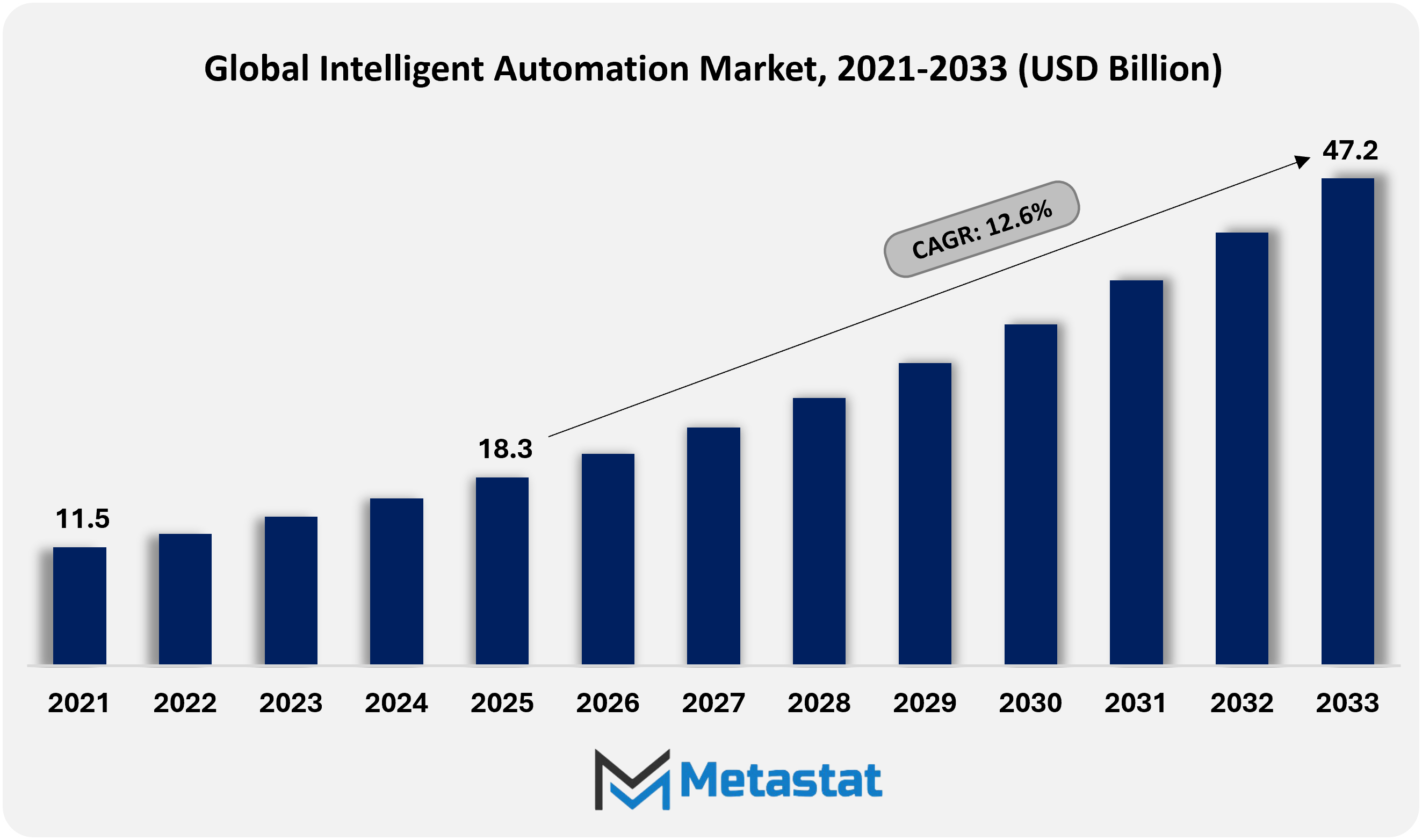
Global Intelligent Automation market size is valued at USD 18.3 billion in 2025 and projected to grow at a CAGR of 12.6% during the forecast period, reaching USD 47.2 billion by 2033.
Global Intelligent Automation Market: Comprehensive Data-Driven Market Analysis and Strategic Outlook
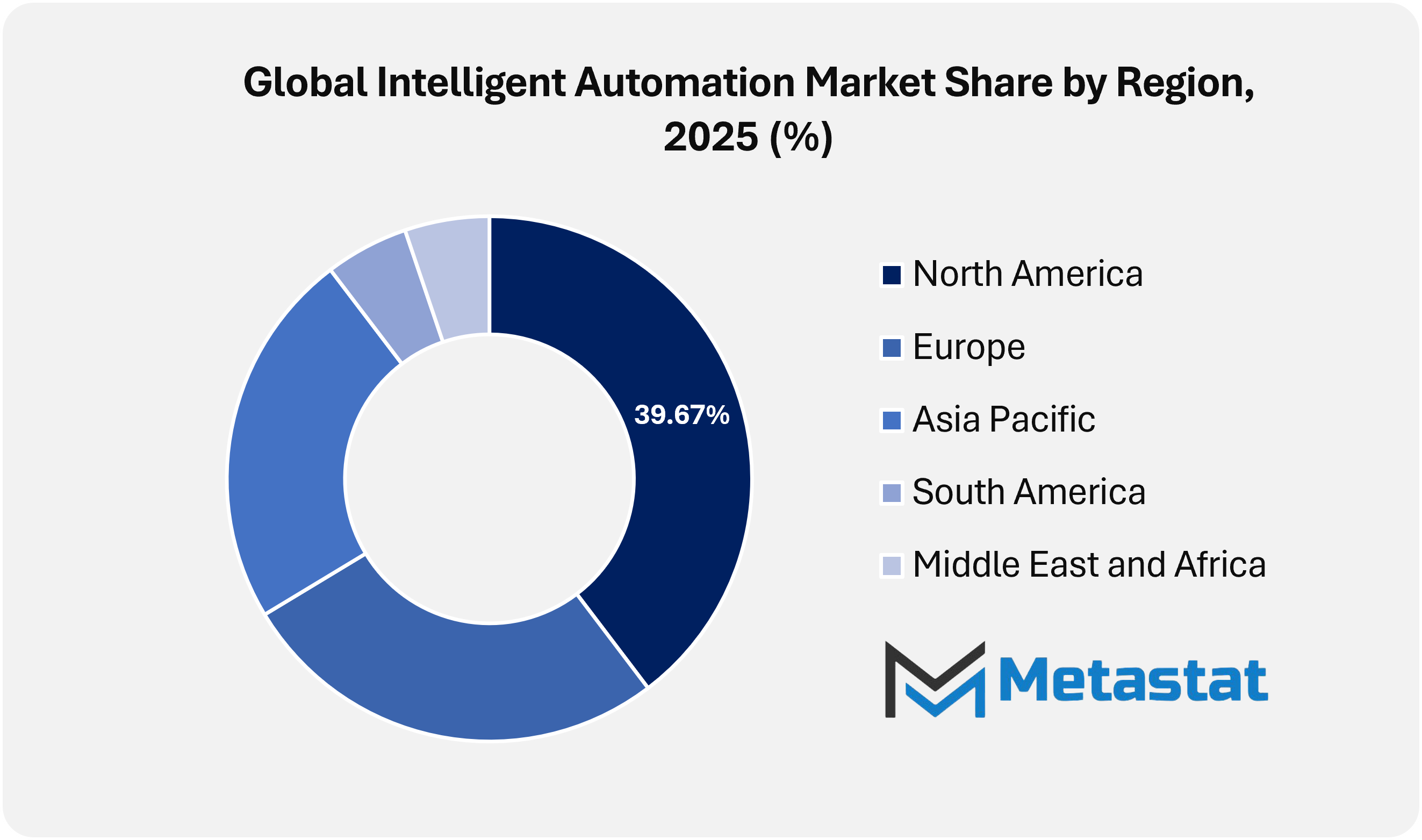
North America holds 39.7% in 2025 with US leading the market share in 2025.
OnPremises segment account for a market share of 34.4% in 2025.
Key trends driving growth: AI-enabled productivity uplift across back office and customer operations, Compliance, auditability, and process standardization at enterprise scale.
Opportunities include agentic AI combined with process intelligence and orchestration for end-to-end automation.
Key insight: Enterprise-wide digital transformation accelerates adoption across the Global Intelligent Automation market.
The Global Intelligent Automation market within the enterprise technology and digital transformation industry is moving far beyond conventional task automation and cost optimization. It is steadily emerging as a foundational layer across corporate governance, product innovation, and customer value creation. Rather than remaining limited to back-office streamlining, intelligent automation platforms are being designed to coordinate decision environments in which predictive analytics, AI agents, and adaptive workflows operate in an integrated manner. Organizations are deploying these platforms not only to automate processes, but also to improve strategic planning, assess risk exposure, and reconfigure operating models in near real time.
Across advanced manufacturing environments, autonomous production networks are integrating intelligent automation with digital twins to simulate process changes before physical implementation on factory floors. In financial services, algorithmic compliance frameworks are helping institutions interpret regulatory updates and embed policy logic into transaction workflows with reduced manual intervention. Healthcare organizations are also adopting adaptive scheduling and diagnostic triage solutions that respond to patient inflow patterns while improving resource allocation and operational efficiency.
Market Dynamics
Growth Drivers:
AI-enabled productivity uplift across back office and customer operations.
Rising deployment of artificial intelligence across administrative and customer-facing workflows is improving operational speed, accuracy, and cost efficiency in the Global Intelligent Automation market. Automated document processing, predictive service routing, and decision-support systems are reducing manual dependency, improving service consistency, and supporting scalable performance across finance, human resources, procurement, and contact center operations.
Compliance, auditability, and process standardization at enterprise scale
Expanding regulatory pressure and internal governance requirements are increasing the adoption of intelligent automation across large enterprises, strengthening the Global Intelligent Automation market. Intelligent monitoring, traceable workflow execution, and embedded control frameworks support transparent reporting, reduce compliance risk, and enable standardized operating procedures across multi-country operations and regulated business environments.
Restraints and Challenges:
Legacy system complexity and integration fragmentation
Deeply embedded legacy infrastructure and disconnected enterprise applications are slowing transformation initiatives in the Global Intelligent Automation market. Fragmented data architecture, incompatible platforms, and limited interoperability increase deployment timelines and integration costs, requiring structured modernization strategies and phased system alignment before intelligent automation programs can achieve full operational maturity.
Automation engineering and governance talent gap
Limited availability of experienced automation architects, AI engineers, and governance specialists is constraining scalable adoption in the Global Intelligent Automation market. Advanced workflow design, risk management frameworks, and ethical AI oversight require specialized capability development, structured training ecosystems, and long-term workforce investment to maintain resilient and compliant automation environments.
Opportunities:
Agentic AI combined with process intelligence and orchestration for end-to-end automation
The integration of autonomous AI agents with process mining, workflow orchestration, and adaptive decision engines is creating significant growth opportunities in the Global Intelligent Automation market. End-to-end automation architectures enable dynamic task coordination, predictive optimization, and continuous process improvement, supporting enterprise-wide digital transformation with measurable productivity gains and stronger operational agility.
Market Segmentation Analysis
The Global Intelligent Automation market is classified based on Deployment Mode, Technology, Application, and End-User.
By Deployment Mode, the market is further segmented into:
On‑Premises
On‑Premises segment is valued at USD 7.1 billion in 2026 and is projected to reach USD 8 billion by 2033, at a CAGR of 1.8% during the forecast period.
On-Premises deployment in the Global Intelligent Automation market remains relevant for organizations requiring strict control over data governance, regulatory compliance, and infrastructure management. Large enterprises operating with legacy environments continue to invest in secure internal automation frameworks to support structured integration, stronger audit capabilities, and long-term operational stability across mission-critical functions.
Cloud
Cloud segment is valued at USD 13.5 billion in 2026 and is projected to reach USD 39.2 billion by 2033, at a CAGR of 16.5% during the forecast period.
Cloud deployment in the Global Intelligent Automation market is expanding rapidly owing to scalability, lower upfront investment, and easier remote accessibility. Enterprises are adopting subscription-based automation platforms to accelerate digital initiatives, improve cross-border collaboration, and enable real-time analytics, supporting agile transformation across distributed business environments.
By Technology, the market is divided into:
Robotic Process Automation
Robotic Process Automation segment is projected to reach USD 9.7 billion by 2033, at a CAGR of 5.9% during the forecast period.
Robotic Process Automation in the Global Intelligent Automation market continues to streamline repetitive, rules-based tasks across departments. Future adoption is centered on unattended bots, stronger orchestration capabilities, and seamless integration with enterprise applications, helping organizations improve efficiency while reducing manual workload and processing errors in structured workflows.
Artificial Intelligence
Artificial Intelligence segment is projected to reach USD 14.2 billion by 2033, at a CAGR of 15.7% during the forecast period.
Artificial Intelligence is strengthening decision-making capabilities across the Global Intelligent Automation market. Advanced cognitive systems are helping enterprises interpret patterns, support predictive analysis, and improve business forecasting. Continued model refinement and ethical governance frameworks are shaping responsible AI deployment across core enterprise operations.
Machine Learning
Machine Learning segment is projected to reach USD 11.1 billion by 2033, at a CAGR of 16.1% during the forecast period.
Machine Learning in the Global Intelligent Automation market is enabling systems to improve performance through data-driven learning and continuous optimization. Adaptive algorithms are supporting demand forecasting, fraud detection, and operational planning, generating measurable business value through automated model training and intelligent recommendation engines.
Natural Language Processing segment is projected to reach USD 8.3 billion by 2033, at a CAGR of 15.5% during the forecast period.
Natural Language Processing is transforming communication and information handling across the Global Intelligent Automation market. Language models are being used to interpret customer queries, analyze sentiment, and automate document-heavy workflows. Improved contextual understanding is strengthening digital assistants and conversational systems across enterprise environments.
Others
Others segment is projected to reach USD 3.8 billion by 2033, at a CAGR of 9.9% during the forecast period.
Other technologies in the Global Intelligent Automation market include computer vision, process mining, and advanced analytics tools. Integration of visual recognition systems and workflow discovery platforms is improving end-to-end process visibility and accelerating enterprise-wide automation maturity.
By Application, the market is further divided into:
Business Process Automation
Business Process Automation segment is projected to reach USD 11.4 billion by 2033.
Business Process Automation continues to represent a major application area in the Global Intelligent Automation market. Standardized digital workflows improve operational consistency, reduce turnaround time, and strengthen compliance monitoring. Intelligent orchestration tools also coordinate multiple automated tasks across departments, increasing execution efficiency at scale.
IT Operations
IT Operations segment is projected to reach USD 8.8 billion by 2033.
IT Operations in the Global Intelligent Automation market is advancing through automated incident response, predictive maintenance, and infrastructure monitoring. Automation frameworks are helping organizations detect anomalies in real time, optimize server performance, and strengthen cybersecurity resilience across enterprise networks.
Customer Service
Customer Service segment is projected to reach USD 8.1 billion by 2033.
Customer Service applications in the Global Intelligent Automation market are expanding through digital assistants, chatbots, and automated ticket resolution systems. Intelligent routing and sentiment analysis improve response accuracy, enhance customer engagement, and strengthen service-level performance across support functions.
Finance and Accounting
Finance and Accounting segment is projected to reach USD 6.1 billion by 2033.
Finance and Accounting functions in the Global Intelligent Automation market are increasingly adopting automated reconciliation, invoice processing, and compliance reporting systems. Predictive analytics supports risk assessment, cash flow forecasting, and fraud monitoring, reinforcing financial governance and process efficiency.
Human Resources
Human Resources segment is projected to reach USD 3.8 billion by 2033.
Human Resources functions in the Global Intelligent Automation market are adopting automation across recruitment screening, payroll administration, and performance management. Intelligent systems analyze workforce data patterns, supporting talent planning, operational consistency, and stronger employee engagement strategies.
Supply Chain Management
Supply Chain Management segment is projected to reach USD 5.6 billion by 2033.
Supply Chain Management in the Global Intelligent Automation market is benefiting from predictive demand modeling, inventory optimization, and logistics tracking systems. Automated coordination between suppliers, distributors, and internal teams improves transparency and reduces the risk of operational disruptions.
Others
Others segment is projected to reach USD 3.4 billion by 2033.
Other applications in the Global Intelligent Automation market include marketing automation, compliance management, and research analytics. Data-driven automation frameworks support targeted campaign execution, structured regulatory reporting, and better coordination across diverse business functions.
By End-User, the Global Intelligent Automation market is divided as:
BFSI
BFSI segment is projected to grow at a CAGR of 10.1% during the forecast period.
BFSI organizations in the Global Intelligent Automation market are investing in automated credit assessment, fraud detection, and regulatory reporting systems. Intelligent automation improves transaction monitoring, risk modeling, and digital banking efficiency across highly competitive financial environments.
Healthcare
Healthcare segment is projected to grow at a CAGR of 13.3% during the forecast period.
Healthcare providers in the Global Intelligent Automation market are adopting automated patient record management, diagnostic support tools, and billing systems. Predictive analytics is improving treatment planning, operational efficiency, and regulatory adherence across hospitals and clinical institutions.
Retail and E-commerce
Retail and E-commerce segment is projected to grow at a CAGR of 16% during the forecast period.
Retail and E-commerce companies in the Global Intelligent Automation market are deploying intelligent pricing engines, personalized recommendation systems, and automated inventory management solutions. Data-driven insights are improving customer retention strategies and optimizing order fulfillment and delivery coordination.
Manufacturing
Manufacturing segment is projected to grow at a CAGR of 11% during the forecast period.
Manufacturing companies in the Global Intelligent Automation market are integrating predictive maintenance, robotics coordination, and quality inspection systems. Smart production environments reduce downtime, improve output precision, and support data-centric operational planning across industrial facilities.
IT and Telecommunications
IT and Telecommunications segment is projected to grow at a CAGR of 14.2% during the forecast period.
IT and Telecommunications providers in the Global Intelligent Automation market are automating network optimization, service provisioning, and cybersecurity monitoring. Intelligent systems improve uptime, strengthen infrastructure reliability, and support efficient delivery of digital services.
Government
Government segment is projected to grow at a CAGR of 13.1% during the forecast period.
Government agencies in the Global Intelligent Automation market are adopting automated record verification, citizen service portals, and compliance monitoring systems. Digital governance initiatives are improving administrative transparency and supporting faster and more efficient public service delivery.
Others
Others segment is projected to grow at a CAGR of 9.8% during the forecast period.
Other end-user industries in the Global Intelligent Automation market are adopting intelligent automation across energy management, education systems, and transportation planning. Advanced analytics integration is improving operational coordination and supporting long-term digital transformation objectives.
By Region:
Based on geography, the Global Intelligent Automation market is divided into North America, Europe, Asia-Pacific, South America, Middle East, and Africa.
North America Intelligent Automation Market is set to expand at a CAGR of 12.6% within the forecast period, reaching a market size (TAM) of USD 16.0 billion by the end of 2033.
In North America, strong enterprise adoption of AI-driven platforms and continued investment by major technology providers are accelerating demand in the Intelligent Automation market.
Rising pressure to improve operational efficiency across BFSI and healthcare is further strengthening deployment of advanced automation solutions across North America.
In Europe, rising demand for compliance-driven automation, process optimization, and AI-enabled enterprise workflows is supporting steady growth in the Intelligent Automation market.
In Asia Pacific, expanding digital transformation initiatives across China, India, Japan, and Southeast Asia are creating significant growth opportunities in the Intelligent Automation market.
Increased adoption of cloud-based automation tools among small and medium enterprises is further widening the addressable market for solution providers across the region.
Across South America and the Middle East & Africa, gradual enterprise modernization and public sector digitization initiatives are supporting steady adoption of intelligent automation systems across banking, telecommunications, and government services.
Competitive Landscape and Strategic Insights
The Global Intelligent Automation market is expanding steadily as organizations seek to improve efficiency, reduce operating costs, and increase accuracy across enterprise functions. Intelligent automation combines robotic process automation, artificial intelligence, machine learning, and analytics to manage repetitive tasks and support faster decision-making. Companies across banking, healthcare, retail, telecommunications, and manufacturing are investing in these solutions to modernize legacy environments and streamline workflows. Continued digital transformation will strengthen demand across customer service, finance operations, compliance management, and IT support.
Enterprises are no longer viewing automation as a short-term cost-saving tool. It is becoming a long-term operating model that reduces human error, improves process speed, and enhances visibility across business data. Intelligent automation also enables employees to focus on higher-value tasks requiring judgment and strategic thinking. Small and medium enterprises are increasingly adopting cloud-based automation tools owing to lower upfront costs and easier deployment. With remote and hybrid work models remaining common, automation platforms will play a central role in maintaining productivity and consistency.
The competitive landscape includes a mix of established technology companies and specialized automation providers. Major participants such as UiPath Inc., Automation Anywhere, Inc., SS&C Technologies, Inc., Microsoft Corporation, International Business Machines Corporation, SAP SE, ServiceNow, Inc., Pegasystems Inc., and Appian Corporation continue to strengthen their automation portfolios. Other notable companies include WorkFusion, NICE Ltd., Nintex, Tungsten Automation, ABBYY, Hyperscience, Celonis SE, AutomationEdge, OpenText Corporation, Google Cloud, Broadcom Inc., Redwood Software, Stonebranch, Inc., Camunda, Oracle Corporation, Boomi, Salesforce, Inc., Workato, AntWorks, AiFA Labs, Bizagi, Laiye, and Aiwozo. These companies are focusing on product innovation, partnerships, and acquisitions to expand market presence and strengthen customer reach.
Over the coming years, the market will witness stronger integration between automation platforms and advanced AI capabilities. Predictive analytics, natural language processing, and intelligent document processing will improve automation outcomes and enable more complex workflows. Regulatory compliance requirements and rising data volumes will further support adoption. Although integration complexity and data security concerns will restrict deployment in some sectors, continued investment in research and development will support long-term growth. Intelligent automation will remain a core pillar of digital transformation strategies across industries worldwide.
Forecast and Future Outlook
Market size is forecast to rise from USD 18.3 billion in 2025 to over USD 47.2 billion by 2033.
As cross-border data regulations become stricter, future deployments are expected to require sovereign data architectures and embedded ethical audit trails. These developments will position intelligent automation as more than a software category, making it a foundational layer of digital business infrastructure that supports resilience, transparency, and competitive differentiation over the coming decade.
Intelligent Automation Market Key Segments:
By Deployment Mode:
On Premises
Cloud
By Technology:
Robotic Process Automation
Artificial Intelligence
Machine Learning
Natural Language Processing
Others
By Application:
Business Process Automation
IT Operations
Customer Service
Finance and Accounting
Human Resources
Supply Chain Management
Others
By End-User:
BFSI
Healthcare
Retail and E-commerce
Manufacturing
IT and Telecommunications
Government
Others
Key Global Intelligent Automation Industry Players
This research report categorizes the Intelligent Automation market based on key segments and regions, forecasts revenue growth, and analyses trends in each submarket. The report analyses the key growth drivers, opportunities, and challenges influencing the Intelligent Automation market. Recent market developments and competitive strategies such as expansion, product launch, partnership, merger, and acquisition have been included to draw the competitive landscape in the market.
The report strategically identifies and profiles the key market players and analyses their core competencies in each sub-segment of the Intelligent Automation market.
Report Attributes
Details
Study Period
2021-2033
Base Year
2025
Estimated Year
2026
Forecast Period
2026-2033
Historical Period
2021-2025
Growth Rate
CAGR 12.6% from 2026 to 2033
Revenue Unit
USD billion
Segmentation
By Deployment Mode, Technology, Application, End-User, and Region
By Region
North America (By Deployment Mode, Technology, Application, End-User, and Country)
United States
Canada
Mexico
Europe (By Deployment Mode, Technology, Application, End-User, and Country)
Germany
France
UK
Italy
Spain
Russia
Rest of Europe
Asia Pacific (By Deployment Mode, Technology, Application, End-User, and Country)
China
Japan
India
South Korea
Australia
Southeast Asia
Rest of Asia Pacific
South America (By Deployment Mode, Technology, Application, End-User, and Country)
Brazil
Argentina
Rest of South America
Middle East and Africa (By Deployment Mode, Technology, Application, End-User, and Country)
New Zealand Optical Encryption Market Size, Share, Trends, 2033
New Zealand Optical Encryption market size is valued at USD 34.5 million in 2025 and is projected to reach USD 76.9 million in 2033, at a CAGR of 10.3% from 2026 to 2033.
New Zealand Optical Encryption Market, New Zealand Optical Encryption Market Size, New Zealand Optical Encryption Market Share, New Zealand Optical Encryption Market Analysis, New Zealand Optical Encryption Market Growth, New Zealand Optical Encryption Market Trends, New Zealand Optical Encryption Market Research Report, New Zealand Optical Encryption Market Forecast, New Zealand Optical Encryption, New Zealand Optical Encryption Market Research, New Zealand Optical Encryption Industry, New Zealand Optical Encryption Industry Report, New Zealand Optical Encryption Market Data, New Zealand Optical Encryption Statistics, New Zealand Optical Encryption Market Statistics, New Zealand Optical Encryption Industry Trends, New Zealand Optical Encryption Market Report, New Zealand Optical Encryption Market Trends, New Zealand Optical Encryption Market News, New Zealand Optical Encryption Forecasts, New Zealand Optical Encryption Market Intelligence Report
Generative AI in Analytics Market Size, Share, Trends, 2033
Generative AI in Analytics market size is valued at USD 1.6 billion in 2025 and is projected to reach USD 10.9 billion in 2033, at a CAGR of 26.8% from 2026 to 2033.
Generative AI in Analytics Market, Generative AI in Analytics Market Size, Generative AI in Analytics Market Share, Generative AI in Analytics Market Analysis, Generative AI in Analytics Market Growth, Generative AI in Analytics Market Trends, Generative AI in Analytics Market Research Report, Generative AI in Analytics Market Forecast, Generative AI in Analytics, Generative AI in Analytics Market Research, Generative AI in Analytics Industry, Generative AI in Analytics Industry Report, Generative AI in Analytics Market Data, Generative AI in Analytics Statistics, Generative AI in Analytics Market Statistics, Generative AI in Analytics Industry Trends, Generative AI in Analytics Market Report, Generative AI in Analytics Market Trends, Generative AI in Analytics Market News, Generative AI in Analytics Forecasts, Generative AI in Analytics Market Intelligence Report
Retail Project Management Software market size is valued at USD 1,505.5 million in 2025 and is projected to reach USD 3,524.9 million in 2033, at a CAGR of 11.2% from 2026 to 2033.
UK Immersive Entertainment & Experiential Property Market Size, Share, Trends, 2033
UK Immersive Entertainment & Experiential Property Market size is valued at USD 6.17 billion in 2025 and is projected to reach USD 26.16 billion in 2033, at a CAGR of 19.5% from 2026 to 2033
UK Immersive Entertainment & Experiential Property Market, UK Immersive Entertainment & Experiential Property Market Size, UK Immersive Entertainment & Experiential Property Market Share, UK Immersive Entertainment & Experiential Property Market Analysis, UK Immersive Entertainment & Experiential Property Market Growth, UK Immersive Entertainment & Experiential Property Market Trends, UK Immersive Entertainment & Experiential Property Market Research Report, UK Immersive Entertainment & Experiential Property Market Forecast, UK Immersive Entertainment & Experiential Property, UK Immersive Entertainment & Experiential Property Market Research, UK Immersive Entertainment & Experiential Property Industry, UK Immersive Entertainment & Experiential Property Industry Report, UK Immersive Entertainment & Experiential Property Market Data, UK Immersive Entertainment & Experiential Property Statistics, UK Immersive Entertainment & Experiential Property Market Statistics, UK Immersive Entertainment & Experiential Property Industry Trends, UK Immersive Entertainment & Experiential Property Market Report, UK Immersive Entertainment & Experiential Property Market Trends, UK Immersive Entertainment & Experiential Property Market News, UK Immersive Entertainment & Experiential Property Forecasts, UK Immersive Entertainment & Experiential Property Market Intelligence Report