
LEAD ANALYST
Utkarsh Khirodkar is a Lead Market Research Analyst at MetaStat Insight, specializing in market intelligence, technology sector assessments, and competitive strategy.

Infrared Pyrometer Market Size, Share, Impact Analysis, By Type (Portable Infrared Pyrometers, Fixed Infrared Pyrometers, and Others), By End-User Industry (Metals & Mining, Glass, Ceramics & Cement, Others), By Application (Temperature Measurement, Heat Treatment, and Others), and Regional Forecast, 2026-2033
Report ID
MSI-2263
Published
February, 2026
Pages
303 Pages
Format
USD Million
Report Details
Choose Your License
Infrared Pyrometer Market
Global Infrared Pyrometer market valued at USD 490.9 million in 2025, growing at a CAGR of 8.2% through 2033, with potential to exceed USD 915.5 million.
North America holds 31.3% in 2025 with US leading the market share in 2026.
An infrared pyrometer is a non-contact temperature measurement device that determines surface temperature by detecting and analyzing infrared radiation emitted by an object. Adoption remains strong across industrial, scientific, and commercial use cases where contact-based temperature measurement is impractical or undesirable.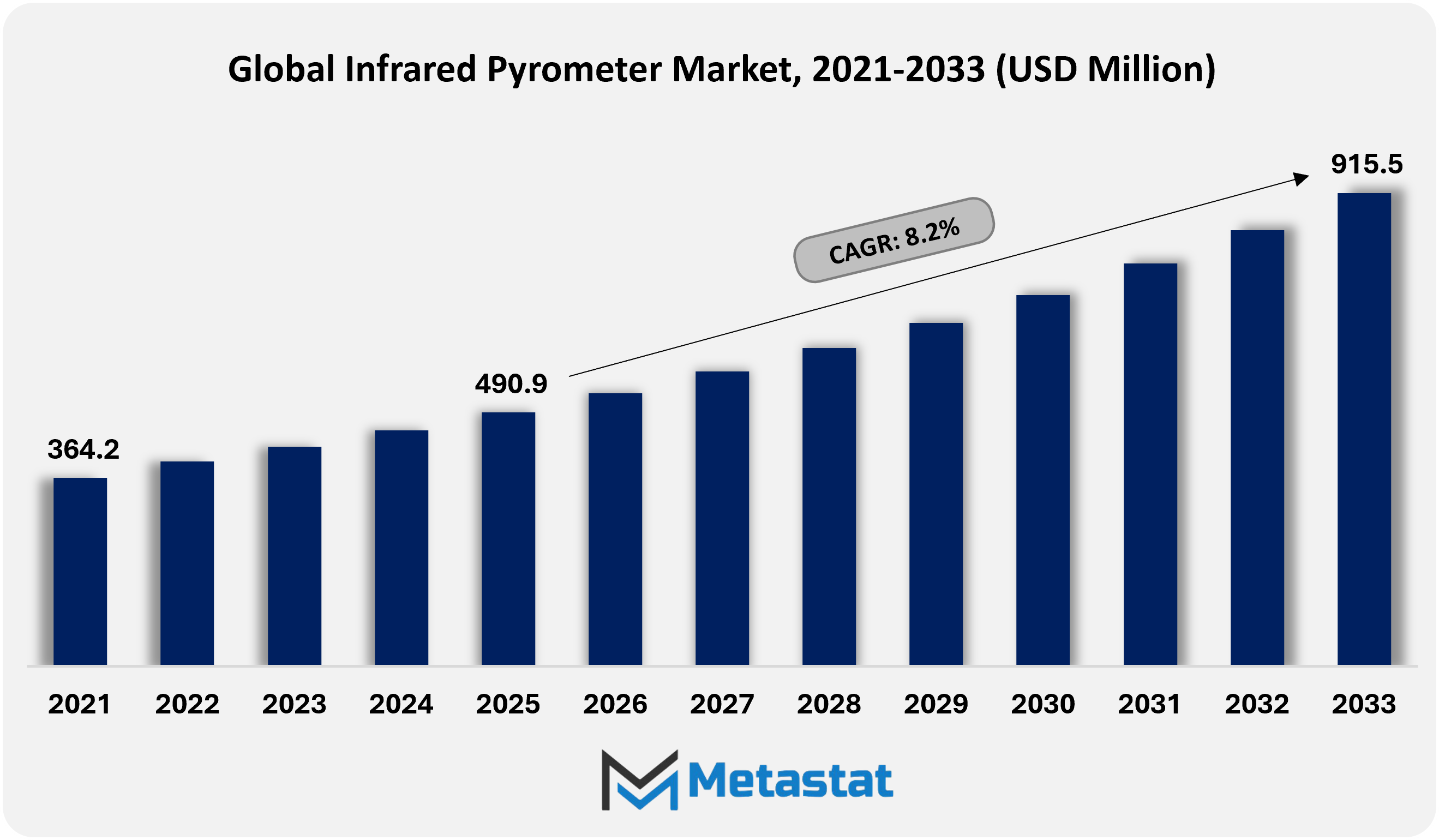
Increased Strategic Initiatives by Prominent Players to Drive Growth Trajectory
Energy-efficiency programs across industrial facilities are elevating the role of infrared pyrometers in monitoring heat exchangers and energy-intensive equipment. Temperature intelligence supports system optimization and energy conservation, strengthening procurement interest across process plants. Portfolio expansion via mergers and acquisitions remains a visible approach among leading participants, alongside initiatives centered on novel technologies and customer-specific technical support models.
Automation and Industry 4.0 Integration
Integration of infrared pyrometers with automation systems and Industry 4.0 practices is strengthening market momentum. Interfacing with IoT networks and automated workflows enables real-time monitoring, data capture, deviation alerts, and predictive maintenance planning. Manufacturing, energy, and materials processing operations are increasingly using such integrations to improve process control, reduce downtime, and elevate quality management through analytics-driven optimization.
Increased Industrial Automation Across Diverse Sectors
Industrial operators seek non-contact temperature measurement for efficient monitoring and control in high-temperature processes, which is propelling adoption of infrared pyrometry technology.
Material Variability and Emissivity Challenges
Measurement accuracy is linked to emissivity, a material property influencing infrared radiation emission and absorption. Materials with low emissivity or reflective surfaces may produce inconsistent readings. Coatings, contaminants, and surface-condition variability also affect emissivity and calibration requirements, limiting accuracy in applications requiring precise control unless calibration and material-specific settings are managed carefully.
Based on type, the market is segmented into Portable Infrared Pyrometers, Fixed Infrared Pyrometers, and Others.
Fixed Infrared Pyrometers held a significant share in 2022, supported by their role in automation and process control with continuous temperature monitoring aligned with quality consistency and process optimization. Portable infrared pyrometers represent a substantial share as a cost-effective option in applications where continuous monitoring is not required.
Fixed Infrared Pyrometers segment is estimated at USD 266.8 million in 2026 and is projected to reach USD 455.7 million by 2033, at a CAGR of 8% during the forecast period.
Based on end-user industry, the market is segmented into Metals, Mining, Glass, Ceramics, Cement, and Others.
Metals and Mining accounts for the maximum market share. Infrared pyrometers are used to measure molten metal temperatures, furnace atmospheres, and high-temperature objects, alongside surface inspection for defects. Segment expansion is supported by increased metals usage across construction, automotive, and electrical and electronics industries.
Glass is positioned as a significant segment. Infrared pyrometers support molten glass and kiln temperature measurement, plus defect inspection. Increased consumption of glass, ceramics, and cement across construction, automotive, and packaging supports segment traction. Precise temperature measurement reduces material waste by maintaining optimal firing and cooling cycles.
Metals & Mining segment is projected to reach USD 448.1 million by 2033, at a CAGR of 8.7% during the forecast period.
Based on application, the market is segmented into Temperature Measurement, Heat Treatment, and Others.
Temperature measurement holds the largest share, supported by broad adoption across metals and mining, glass, ceramics and cement, and related industries where safety and quality assurance require accurate monitoring of hot objects. Heat treatment represents a key application area across manufacturing, metallurgy, and materials processing where precise temperature control supports desired material properties.
Temperature Measurement segment is projected to reach USD 604.6 million by 2033.
Based on region, the global market is segmented into North America, Europe, Asia Pacific, South America, Middle East, and Africa.
Asia Pacific was valued at USD 134.6 million in 2022 and is estimated to hold a dominant share over the study period. Rapid industrialization and expanding manufacturing output in China, Japan, and India are supporting adoption for process efficiency, product quality, and energy conservation. Electronics and automotive manufacturing are notable adoption areas where temperature control and real-time monitoring are critical.
North America is poised to be the second-largest market. Manufacturing, automotive, and aerospace industries are major demand centers, supported by quality control priorities and process-optimization initiatives. Industry 4.0 adoption across factories is accelerating device utilization for data-driven decision-making and operational efficiency.
Europe is expected to depict notable growth over the forecast period, supported by improved measurement accuracy from advancements in infrared sensor technology and signal processing, enabling precise readings in challenging environments.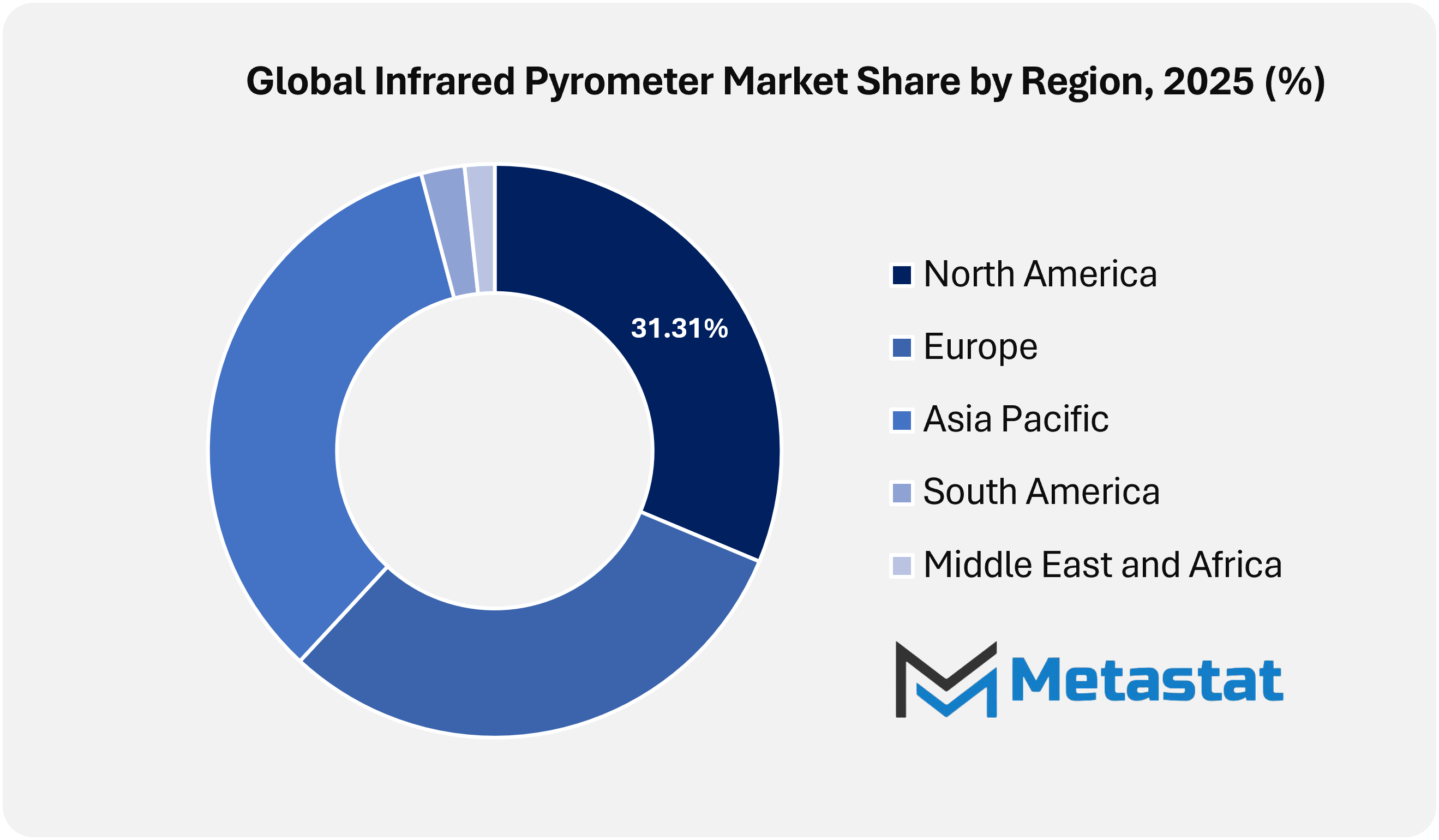
The global market remains highly fragmented with national and international participants. Several companies hold strong positions supported by brand presence, customer base, and diversified offerings. Strategic collaborations and product innovations are supporting expansion for additional participants.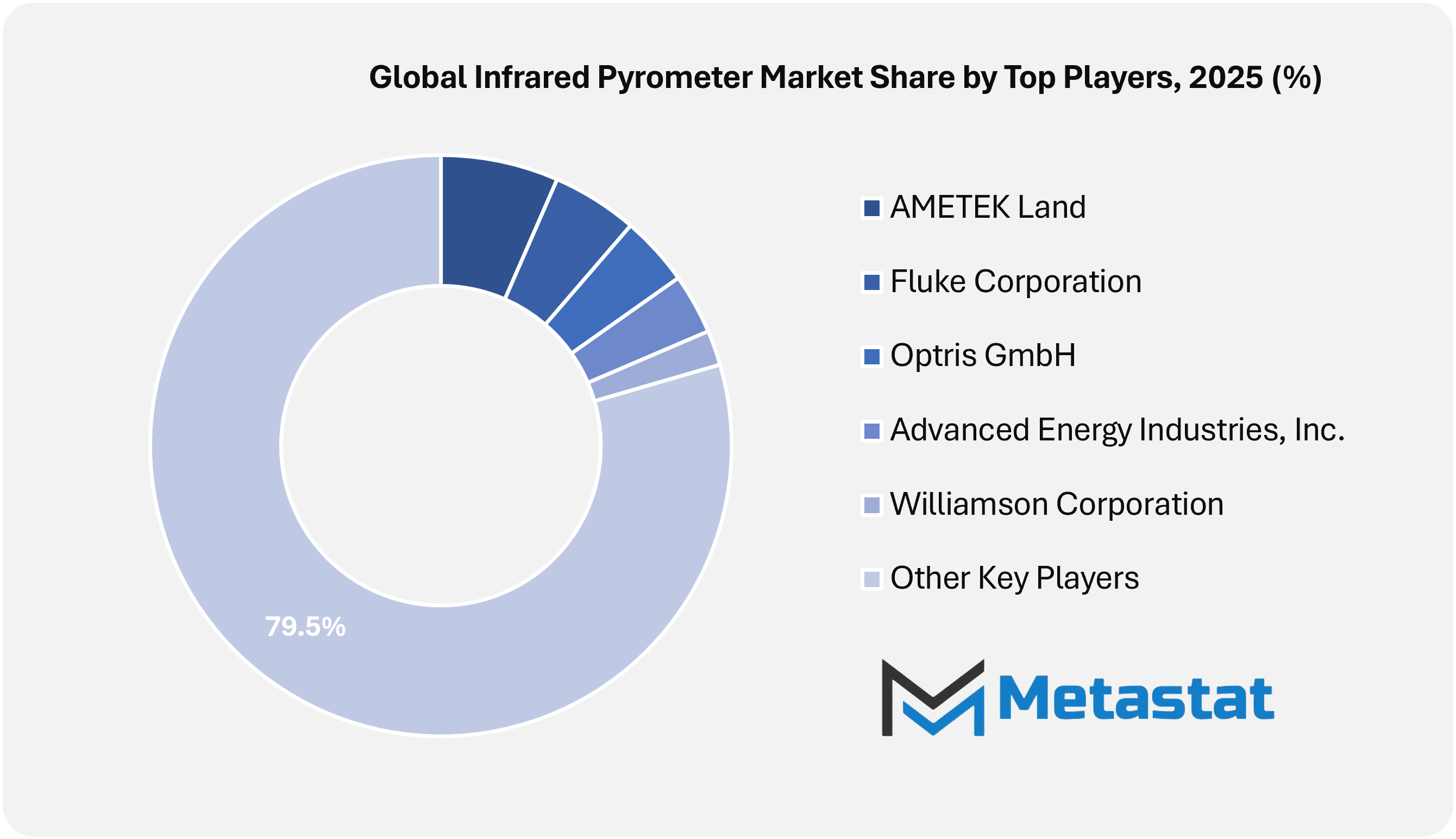
By Type:
By End-User Industry:
By Application:
Key Global Infrared Pyrometer Industry Players
|
Report Attributes |
Details |
|
Study Period |
2021-2033 |
|
Base Year |
2025 |
|
Estimated Year |
2026 |
|
Forecast Period |
2026-2033 |
|
Historical Period |
2021-2025 |
|
Growth Rate |
CAGR 8.2% from 2026 to 2033 |
|
Revenue Unit |
USD Million |
|
Sales Volume Unit |
Thousand Units |
|
Segmentation |
By Type, End-User Industry, Application, and Region |
|
By Type |
|
|
By End-User Industry |
|
|
By Application |
|
|
By Region |
North America (By Type, End-User Industry, Application, and Country)
|
|
|
Europe (By Type, End-User Industry, Application, and Country)
|
|
|
Asia Pacific (By Type, End-User Industry, Application, and Country)
|
|
|
South America (By Type, End-User Industry, Application, and Country)
|
|
|
Middle East and Africa (By Type, End-User Industry, Application, and Country)
|
Find answers to common questions about this report
The Metastat Insights study shows that the Global Infrared Pyrometer market size was USD 490.9 million in 2025.
Global Infrared Pyrometer market is expected to grow at a CAGR of 8.2% over the forecast period (2026-2033).
Metastat Insights analysis shows that the North America Infrared Pyrometer market size is estimated to be USD 280.8 million by 2033.
Global Infrared Pyrometer market is estimated to reach USD 915.5 million by 2033.
The analysts below cover Electronics and Semiconductor research at Metastat Insights.
LEAD ANALYST
Utkarsh Khirodkar is a Lead Market Research Analyst at MetaStat Insight, specializing in market intelligence, technology sector assessments, and competitive strategy.

PRINCIPAL CONSULTANT - ENTERPRISE AI & EMERGING TECHNOLOGIES
Banking & Finance · Electronics and Semiconductor · Energy and Power · Healthcare IT · Information & Technology · Professional Services
Vijay Gunti is a Principal Consultant at MetaStat Insight, bringing over two decades of experience across enterprise digital transformation, technology strategy, and intelligent systems.

PRINCIPAL CONSULTANT - QUALITY SYSTEMS & COMPLIANCE
Electronics and Semiconductor · Machinery & Equipment · Professional Services
Omkar Phadtare is an Industry Consultant at MetaStat Insight, specializing in quality systems, regulatory compliance, and standards benchmarking to drive data-driven market intelligence and strategic industry research.

ENERGY & INFRASTRUCTURE INDUSTRY CONSULTANT
Automotive and Transportation · Electronics and Semiconductor · Energy and Power · Machinery & Equipment
Saurabh Vasant Ganvir consults for Energy & Infrastructure Industry at MetaStat Insight, specializing in renewable energy, solar EPC, and electric vehicle (EV) infrastructure markets.

LEAD CONSULTANT - COMMUNICATION, TELECOM, AND IT
Electronics and Semiconductor · Information & Technology · Machinery & Equipment · Professional Services
Ravindra Sathe Consultants for Communication, Telecom, and IT at MetaStat Insight. He leads the firm's industry research initiatives across telecommunications infrastructure, digital connectivity, enterprise networking, and emerging information technology domains.
Tracking ceramic matrix composite adoption in high-bypass aero engines requires strict attention to material qualification cycles and FAA airworthiness testing milestones. The MetaStat Insight team provided a detailed timeline of silicon carbide fiber manufacturing capacity and commercial foundry lead times. Having clear visibility into upstream thermal barrier coating supply helped us stress-test our long-term component procurement strategy.
Transitioning ultra-class mining haul trucks to alternative power requires concrete data on remote hydrogen refueling infrastructure economics. The report evaluated megawatt-scale electrolyzer installation expenses, onsite storage safety mandates, and heavy-duty fuel cell stack degradation under continuous duty cycles. That technical rigor helped our engineers benchmark realistic total operating cost horizons for off-highway fleet decarbonization.
Enterprise zero-trust network rollouts are often slowed down by multi-cloud transit latency and proprietary hardware retirement schedules. This study provided realistic total cost of ownership models comparing cloud-delivered security edge solutions against traditional hardware refreshes. The analysis of contract renewal lengths and software maintenance fees gave us clear visibility into enterprise replacement cycles over the next three to five years.
Explore related market intelligence reports worth reading alongside this one.