In-Line Rippers Market Size, Share, By Product Type (Mounted In-Line Rippers, Pull-Type In-Line Rippers, and Others), By Application (Agriculture, Construction, Mining, and Others), By Distribution Channel (Online Stores, Specialty Stores, Direct Sales, and Others), Industry Analysis, Growth, Trends, and Forecast, 2026-2033
Report ID
MSI-4615
Published
April 14, 2026
Pages
320 Pages
Format
Report Details
Comprehensive Market Analysis And Insights
Market Overview
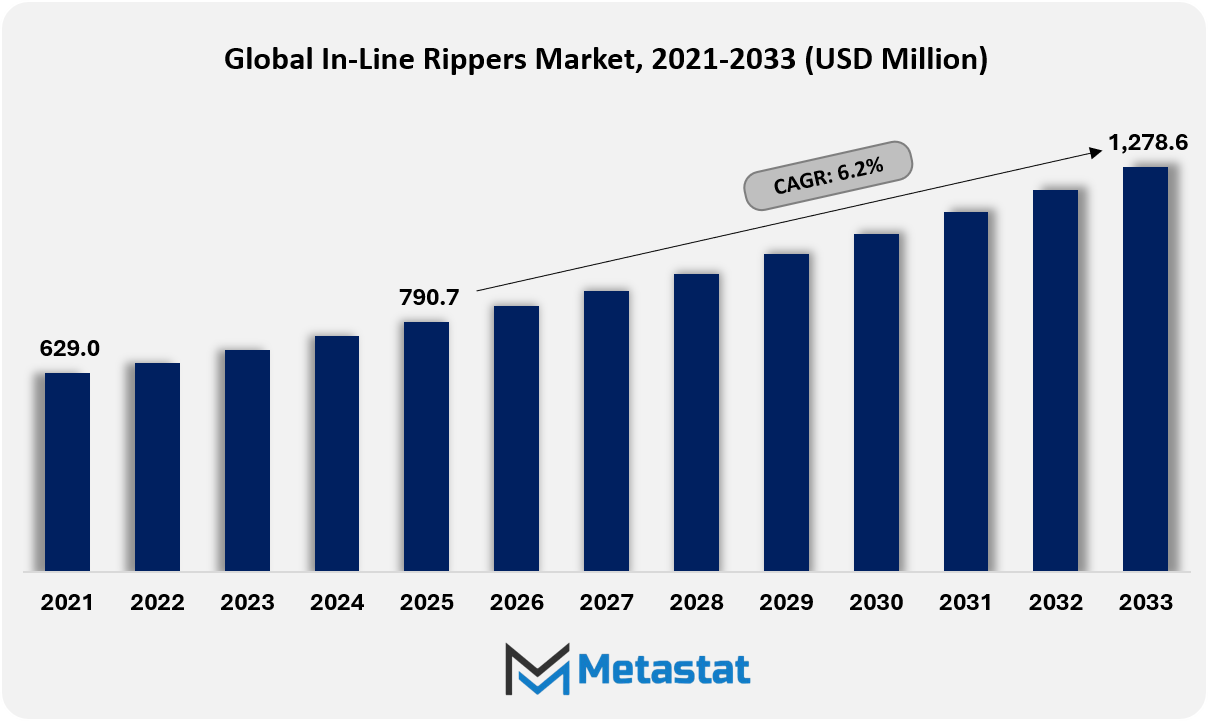
Global In-Line Rippers market size is valued at USD 790.7 million in 2025 and projected to grow at a CAGR of 6.2% during the forecast period, reaching USD 1,278.6 million by 2033.
Global In-Line Rippers Market: Comprehensive Data-Driven Market Analysis and Strategic Outlook
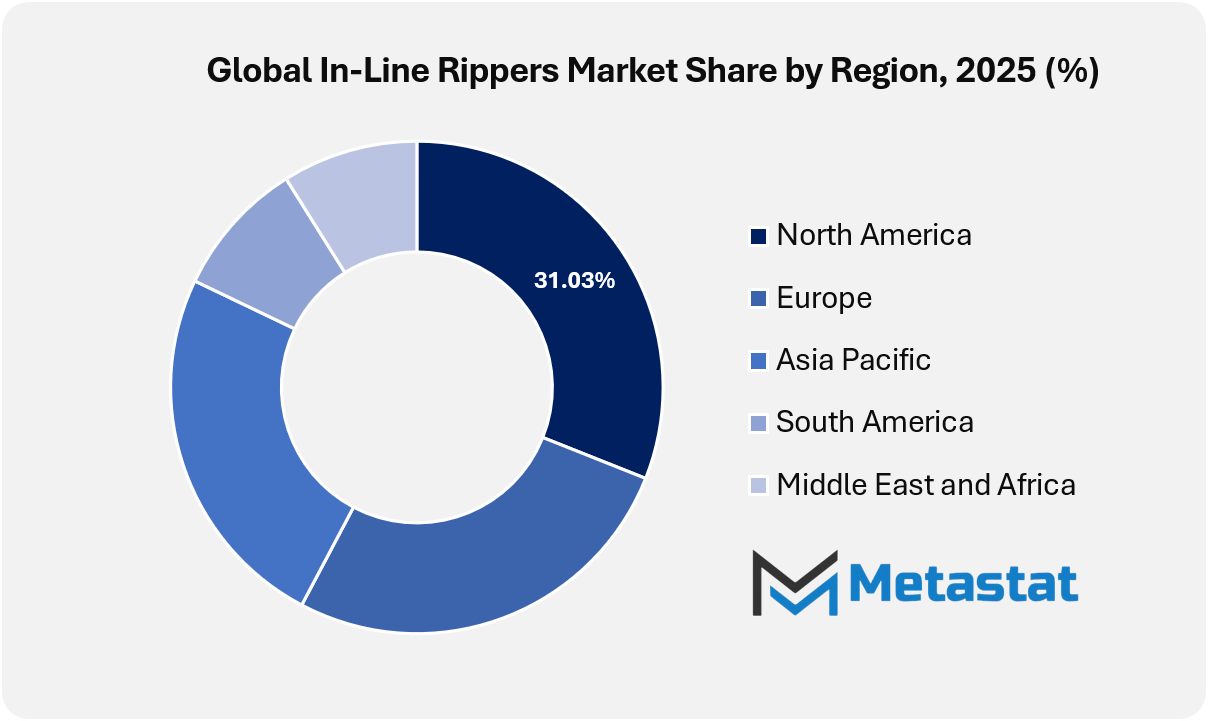
North America holds 31.0% of the global market in 2025, with the United States leading the regional market share.
Mounted In-Line Rippers segment accounts for a market share of 58.5% in 2025.
Key trends driving growth: Rising Need for Soil Compaction Management, along with Higher Adoption of Conservation and Minimum-Tillage Systems.
Opportunities include Precision-Integrated Deep Tillage and Low-Disturbance Root-Zone Management.
Key insight: Expansion of infrastructure projects and mining operations continues to drive consistent demand for high-performance ripping equipment, strengthening the Global In-Line Rippers market outlook.
The Global In-Line Rippers market plays an important role across agriculture, construction, and mining applications where effective ground penetration and subsurface loosening are essential. These machines are used to break compacted soil, hardpan layers, and resistant ground surfaces before tillage, excavation, grading, or site preparation. Rising activity in infrastructure development, mining operations, and commercial farming continues to support demand for reliable, high-performance ripping equipment.
Manufacturers are focusing on improving product durability, operating efficiency, and adaptability across different terrain conditions. Modern in-line rippers are designed to deliver consistent penetration performance while reducing wear and maintenance requirements. Advancements in tooth design, shank geometry, and hydraulic support systems are improving productivity under demanding operating conditions. Rising investment in infrastructure development, mining expansion, and agricultural land preparation continues to support the Global In-Line Rippers market, creating long-term demand for advanced and durable ripping solutions across multiple regions.
Market Dynamics
Growth Drivers:
Rising Need for Soil Compaction Management.
Large-scale infrastructure projects such as highways, railways, and urban development require effective soil and rock preparation. In-line rippers help break compacted surfaces efficiently, improving site readiness and supporting faster construction activity.
Higher Adoption of Conservation and Minimum-Tillage Systems
The shift toward sustainable farming practices is supporting wider adoption of conservation and minimum-tillage systems. Farmers are increasingly seeking equipment that minimizes surface disturbance while improving subsoil conditions. Integration of in-line ripping with minimum-tillage practices supports moisture retention, residue management, and root-zone improvement, strengthening demand in the Global In-Line Rippers market.
Restraints and Challenges:
High Horsepower Requirement and Fuel Cost Burden
In-line ripping systems often require tractors and equipment with substantial horsepower capacity. Deep tillage operations also increase fuel consumption, raising overall operating costs for end users. These cost pressures can limit adoption among small-scale farmers and price-sensitive buyers, creating a barrier to wider expansion in the Global In-Line Rippers market.
Purchase Cost and Wear-Part Replacement Expense
The initial purchase cost of in-line rippers remains high, influencing buying decisions across cost-sensitive agricultural and land development sectors. Continuous exposure to abrasive soil and hard ground conditions accelerates wear on critical components, leading to frequent replacement cycles. Over time, these maintenance expenses can reduce profitability and slow adoption momentum in the Global In-Line Rippers market.
Opportunities:
Precision-Integrated Deep Tillage and Low-Disturbance Root-Zone Management
Advancements in precision agriculture are creating opportunities for targeted deep tillage and low-disturbance root-zone management. Integration of GPS-guided systems, field mapping tools, and depth-control technologies can optimize ripping intensity and field application. These innovations improve resource utilization while preserving soil structure, creating strong growth opportunities for the Global In-Line Rippers market in advanced farming environments.
Market Segmentation Analysis
The Global In-Line Rippers market is classified based on Product Type, Application, and Distribution Channel.
By Product Type, the market is further segmented into:
Mounted In-Line Rippers
Mounted In-Line Rippers segment is valued at USD 490.8 million in 2026 and is projected to reach USD 769.6 million by 2033, at a CAGR of 6.6% during the forecast period.
Mounted In-Line Rippers will gain traction through compatibility with advanced tractor systems and precision-control capabilities. Product design will focus on durability, easy attachment, and consistent field performance. Adoption will increase across established farming operations where efficiency and soil-conditioning accuracy remain important for long-term productivity.
Pull-Type In-Line Rippers
Pull-Type In-Line Rippers segment is valued at USD 264.7 million in 2026 and is projected to reach USD 390.4 million by 2033, at a CAGR of 5.7% during the forecast period.
Pull-Type In-Line Rippers will witness demand from large-scale operations that require high field coverage and compatibility with heavy-duty equipment. Product development will focus on improved traction stability, operating durability, and reduced soil disturbance. These systems are well suited for broad-acre applications that prioritize steady output and lower downtime across extensive agricultural land.
Others
Others segment is valued at USD 83.4 million in 2026 and is projected to reach USD 118.7 million by 2033, at a CAGR of 5.2% during the forecast period.
Other product variants include customized and hybrid configurations developed for specialized operating requirements. Innovation in this segment will focus on adaptable designs suitable for varied soil conditions, terrain profiles, and end-use needs. Manufacturers will introduce flexible models that support multiple attachments and broader operating versatility.
By Application, the market is divided into:
Agriculture
Agriculture segment is projected to reach USD 1,063.2 million by 2033, at a CAGR of 6.4% during the forecast period.
Agriculture will remain the leading application segment owing to the increasing focus on soil health management, compaction relief, and yield optimization. Adoption of in-line rippers will expand as awareness of deep tillage benefits continues to grow. These systems support improved water infiltration, nutrient movement, and root development, strengthening their role in sustainable agricultural output.
Construction
Construction segment is projected to reach USD 92.2 million by 2033, at a CAGR of 4.8% during the forecast period.
Construction applications will grow with rising infrastructure development and land preparation activity. In-line rippers support ground penetration in compacted surfaces, helping improve site readiness and development efficiency. Future demand will align with urban expansion and civil engineering projects where effective land conditioning contributes to faster project execution and stronger foundation preparation.
Mining
Mining segment is projected to reach USD 65.3 million by 2033, at a CAGR of 4.5% during the forecast period.
Mining applications will expand with increasing demand for surface material loosening and better site accessibility. In-line rippers can reduce reliance on blasting in selected operating conditions, offering a more controlled ground preparation method. Future adoption will emphasize safety, productivity, and cost efficiency, supported by equipment designed for harsh mining environments.
Others
Others segment is projected to reach USD 57.9 million by 2033, at a CAGR of 7.5% during the forecast period.
Other applications include landscaping, forestry, and land rehabilitation, where in-line rippers support soil restructuring and terrain improvement. Demand in these areas will rise alongside environmental restoration projects and specialized land development activity. Their ability to operate across varied terrain conditions will support broader use in non-core application areas.
By Distribution Channel, the market is further divided into:
Online Stores
Online Stores segment is projected to reach USD 96.4 million by 2033.
Online Stores will gain traction through digital transformation and broader access to equipment catalogs. Buyers benefit from transparent pricing, product comparison tools, and easier access to technical specifications. Future growth in this channel will depend on stronger digital platforms, virtual product demonstrations, and improved logistics support for heavy equipment delivery.
Specialty Stores
Specialty Stores segment is projected to reach USD 519.6 million by 2033.
Specialty Stores will remain relevant through expert consultation, application-specific guidance, and product demonstrations. Their physical presence supports buyer confidence in equipment selection, evaluation, and service support. Future channel strength will depend on integrated after-sales assistance and long-term customer relationships.
Direct Sales
Direct Sales segment is projected to reach USD 589.6 million by 2033.
Direct Sales will remain a key channel through manufacturer-led engagement and customized equipment offerings. Direct interaction allows suppliers to better understand buyer requirements and provide application-specific solutions. Future expansion in this channel will be supported by stronger distribution networks and long-term contracts with large-scale customers.
Others
Others segment is projected to reach USD 73.0 million by 2033.
Other distribution channels include dealer networks and regional distributors that support localized demand and service access. Channel diversification helps improve market reach and buyer accessibility across fragmented geographies. Future strategies will include hybrid distribution models that combine physical presence with digital support to strengthen customer acquisition and retention.
By Region:
Based on geography, the Global In-Line Rippers market is divided into North America, Europe, Asia-Pacific, South America, Middle East, and Africa.
Strong infrastructure renewal, advanced mechanization, and sustained mining and construction activity continue to support demand for high-performance in-line rippers across North America.
Demand in Europe is supported by advanced agricultural mechanization, replacement of aging equipment, and rising focus on efficient soil management and land preparation practices.
Rapid urbanization, expanding infrastructure projects, and rising construction and mining equipment demand are driving growth of the In-Line Rippers market across Asia-Pacific.
Growth in South America is supported by expanding agricultural operations, mining activity, and increasing use of mechanized equipment for land preparation and soil conditioning.
Government-led infrastructure development and expansion of mining and land development activities are creating steady demand for in-line rippers across the Middle East & Africa.
Competitive Landscape and Strategic Insights
The Global In-Line Rippers market will grow steadily as end users seek more effective solutions for soil conditioning, land preparation, and subsurface loosening. In agriculture, these machines help address compacted soil layers, improve root penetration, and support water movement within the soil profile. Their role is becoming increasingly important in regions where intensive land use and repeated field activity have reduced soil structure and field productivity.
Technology will play an important role in shaping how in-line rippers are deployed across modern operating systems. Product development will focus on better depth control, improved durability, and compatibility with advanced tractors and support equipment. Buyers will prefer machines that cover larger areas efficiently while reducing fuel use and maintenance needs. Precision farming practices will further influence purchasing decisions, encouraging manufacturers to offer models suited to both medium-scale and large-scale operations.
The market will remain competitive, with established manufacturers and regional players focusing on product development, channel expansion, and application-specific equipment offerings. Companies such as CNH Industrial America LLC, KUHN Group, Landoll Company, LLC, Blu-Jet, John Deere, Väderstad AB, AGCO Corporation, Wil-Rich LLC, Rovic Leers, Agrico, and Erdvark will strengthen their product portfolios to address changing end-user requirements.
Regional demand will vary according to soil conditions, crop patterns, infrastructure activity, and the level of mechanization. In developed markets, replacement demand and equipment upgrades will support sales, while in developing regions, first-time adoption will contribute to market expansion. Government support for modern farming methods and better access to financing are also likely to influence equipment purchasing decisions, especially among small and medium-scale buyers.
Looking ahead, the market will move toward more efficient, durable, and operator-friendly designs that improve field performance and reduce maintenance effort. Manufacturers will focus on equipment that is easy to maintain and adaptable to varying field and ground conditions. As sustainability gains importance, machines that support soil conservation and efficient land preparation will gain stronger preference. The Global In-Line Rippers market is therefore projected to advance steadily, supported by innovation, rising awareness, and the need for consistent productivity across end-use sectors.
Forecast and Future Outlook
Market size is forecast to rise from USD 790.7 million in 2025 to over USD 1,278.6 million by 2033.
The Global In-Line Rippers market will witness steady growth supported by rising agricultural mechanization, infrastructure expansion, and mining development activity. Demand for efficient ground preparation and subsurface loosening equipment will remain strong as end users prioritize productivity, durability, and operating efficiency.
This research report categorizes the In-Line Rippers market based on key segments and regions, forecasts revenue growth, and analyses trends in each submarket. The report analyses the key growth drivers, opportunities, and challenges influencing the In-Line Rippers market. Recent market developments and competitive strategies such as expansion, product launch, partnership, merger, and acquisition have been included to draw the competitive landscape in the market.
The report strategically identifies and profiles the key market players and analyses their core competencies in each sub-segment of the In-Line Rippers market.
Report Attributes
Details
Study Period
2021-2033
Base Year
2025
Estimated Year
2026
Forecast Period
2026-2033
Historical Period
2021-2025
Growth Rate
CAGR 6.2% from 2026 to 2033
Revenue Unit
USD million
Sales Volume Unit
Thousand Units
Segmentation
By Product Type, Application, Distribution Channel, and Region
By Region
North America (By Product Type, Application, Distribution Channel, and Country)
United States
Canada
Mexico
Europe (By Product Type, Application, Distribution Channel, and Country)
Germany
France
UK
Italy
Spain
Russia
Rest of Europe
Asia Pacific (By Product Type, Application, Distribution Channel, and Country)
China
Japan
India
South Korea
Australia
Southeast Asia
Rest of Asia Pacific
South America (By Product Type, Application, Distribution Channel, and Country)
Brazil
Argentina
Rest of South America
Middle East and Africa (By Product Type, Application, Distribution Channel, and Country)
Saudi Arabia
UAE
South Africa
Rest of Middle East and Africa
WHAT REPORT PROVIDES
Key Company Market Share, Revenue, and Position/Ranking
Key Market Leaders
Full In-Depth Analysis of the Parent Industry
Industry Statistics
Important Changes in Market and Its Dynamics
Segmentation Details of the Market
Historical, On-Going, and Projected Market Analysis
Assessment of Niche Industry Developments
Market Share Analysis
Key Strategies of Major Players
Company Profiles of Key Players
Unique Selling Prepositions of Leading Market Players
Stage Hoist market size is valued at USD 236.3 million in 2025 and is projected to reach USD 395.3 million in 2033, at a CAGR of 6.3% from 2026 to 2033.
Global Taper Lock Bushing market is valued at USD 1,187.8 million in 2025 and is projected to reach USD 1,808.0 million in 2033, at a CAGR of 5.4% from 2026 to 2033
Europe Mini Excavators Market Size, Share, Trends, 2033
Europe Mini Excavators market size is valued at USD 2,162.9 million in 2025 and is projected to reach USD 3,004.1 million in 2033, at a CAGR of 4.2% from 2026 to 2033
Europe Mini Excavators Market, Europe Mini Excavators Market Size, Europe Mini Excavators Market Share, Europe Mini Excavators Market Analysis, Europe Mini Excavators Market Growth, Europe Mini Excavators Market Trends, Europe Mini Excavators Market Research Report, Europe Mini Excavators Market Forecast, Europe Mini Excavators, Europe Mini Excavators Market Research, Europe Mini Excavators Industry, Europe Mini Excavators Industry Report, Europe Mini Excavators Market Data, Europe Mini Excavators Statistics, Europe Mini Excavators Market Statistics, Europe Mini Excavators Industry Trends, Europe Mini Excavators Market Report, Europe Mini Excavators Market Trends, Europe Mini Excavators Market News, Europe Mini Excavators Forecasts, Europe Mini Excavators Market Intelligence Report
Global Switch Actuators market size is valued at USD 18.4 billion in 2025 and is projected to reach USD 30.6 billion in 2033, at a CAGR of 6.6% from 2026 to 2033