Home Accessibility Solutions Market Size, Share, By Type (Stairlifts, Residential Elevators, Home Lifts, Vertical Platform Lifts, Wheelchair Ramps, Modular Access Systems, and Others), By Sales Channel (D2C, Authorized Dealers, Installers, Home Modification Contractors, Remodelers, Durable Medical Equipment Providers, and Others), Industry Analysis, Growth, Trends, and Forecast, 2026-2033
Report ID
MSI-4662
Published
April 27, 2026
Pages
316 Pages
Format
Report Details
Comprehensive Market Analysis And Insights
Market Overview
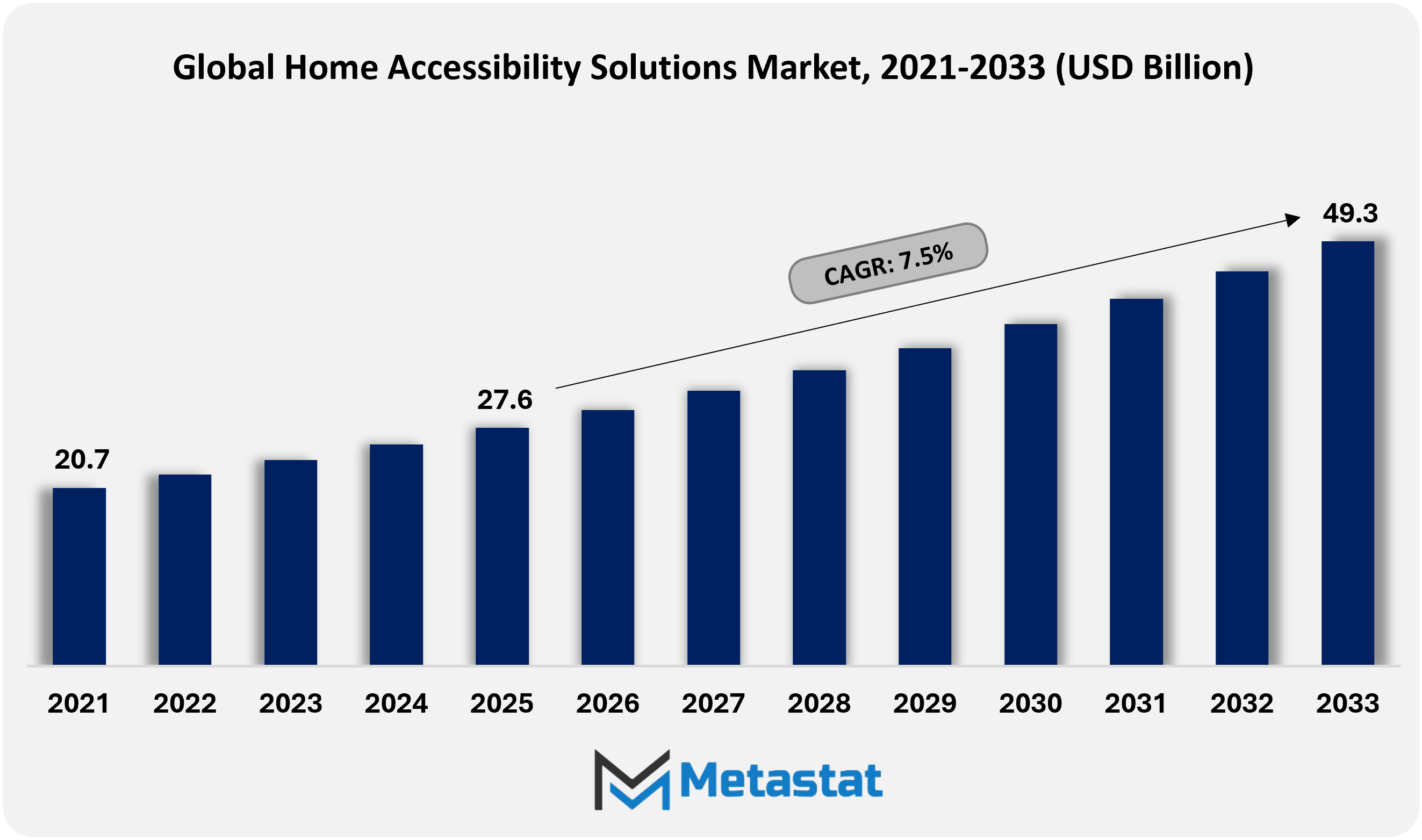
The global home accessibility solutions market size was valued at USD 27.6 billion in 2025 and is projected to reach USD 49.3 billion by 2033, at a CAGR of 7.5% from 2025 to 2033.
Global Home Accessibility Solutions Market: Comprehensive Data-Driven Market Analysis and Strategic Outlook
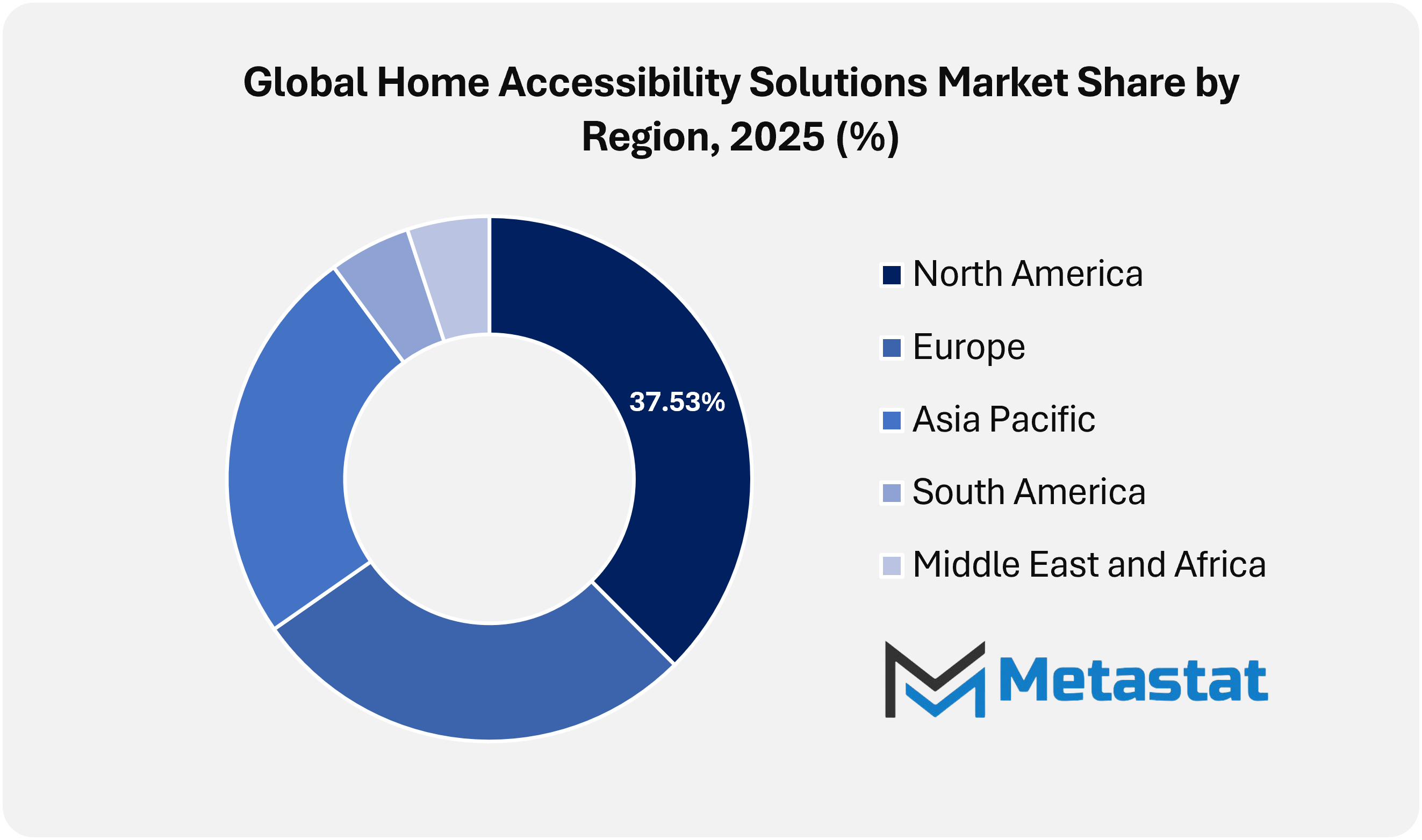
North America holds 33.1% share in 2025, led by the United States.
Stairlifts segment accounts for a market share of 27.5% in 2025.
Key trends driving growth include a rising aging population that increases demand for mobility aids, stairlifts, and barrier-free home modifications, along with rising awareness of independent living among people with disabilities that accelerates adoption of accessible home infrastructure.
Key opportunity includes smart home integration with accessibility solutions that opens new revenue streams through connected and assistive technologies.
Key insight: Growing focus on independent living and age-friendly housing positions home accessibility solutions as a long-term structural growth market.
The global home accessibility solutions market within the residential assisted living industry moves beyond product installation and enter a phase shaped by systems-level thinking and long-term housing planning. Market participants are focusing on integrating accessibility into daily residential life rather than treating it as an afterthought. Solutions are designed to adapt quietly to home routines, enabling mobility, security, and independence without signaling medical dependency. Design language is shifting toward subtlety, with architectural and interior standards blending supportive features that homeowners accept with minimal resistance. In the coming years, technology alignment will redefine how accessibility solutions are delivered. Home accessibility providers will work with smart home platforms to create environments that respond predictively to occupant behavior. Motion-sensing, spatial mapping, and voice-controlled navigation will support residents whose needs change over time. Data privacy and ethical use will gain importance, encouraging vendors to develop closed-loop systems that operate locally rather than relying on external data processing.
Market Dynamics
Growth Drivers:
Rapid growth in the aging population increases demand for mobility aids, stair lifts, and barrier-free home modifications.
Rising share of older adults is increasing requirements for mobility aids, stairlifts, and barrier-free home modifications. Longer life expectancy is extending in-home living duration, increasing focus on safety, comfort, and ease of movement. Residential environments increasingly prioritize independence and reduced reliance on institutional care facilities.
Rising awareness of independent living among people with disabilities accelerates adoption of accessible home infrastructure.
Rising focus on independent living among people with disabilities is accelerating adoption of accessible home infrastructure. Advocacy initiatives, improved information access, and inclusion-focused policies are influencing residential design priorities. Homes increasingly reflect functional layouts that support autonomy, dignity, and day-to-day efficiency, encouraging wider acceptance of accessibility-centered solutions.
Restraints and Challenges:
High installation and customization costs limit adoption across price-sensitive households.
High installation and customization costs continue to restrict adoption in cost-sensitive households. Specialized equipment, structural changes, and skilled labor increase total project costs. Budget constraints in middle-income residential areas delay purchase decisions, slowing large-scale deployment of advanced accessibility solutions in private housing environments.
Limited reimbursement coverage and inconsistent regulatory frameworks slow market penetration.
Limited reimbursement coverage and inconsistent regulatory frameworks slow market penetration. Insurance policies often exclude residential accessibility upgrades, increasing out-of-pocket burden. Regulatory variation across regions complicates compliance planning for providers, reducing standardization and discouraging scalable go-to-market strategies in fragmented housing markets.
Opportunities:
Smart home integration with accessibility solutions that opens new revenue streams through connected and assistive technologies.
Smart home integration with accessibility solutions will open new revenue streams through connected and assistive technologies. Voice-controlled systems, sensor-based monitoring, and automated mobility functions will strengthen residential accessibility. Technology-driven ecosystems will support predictive assistance, remote configuration, and improved user experience across digitally enabled homes.
Market Segmentation Analysis
The Global Home Accessibility Solutions market is classified based on Type and Sales Channel.
By Type, the market is further segmented into:
Stairlifts
Stairlifts segment is estimated at USD 8.2 billion in 2026 and is projected to reach USD 12.3 billion by 2033, at a CAGR of 6.1% during the forecast period.
The stairlifts segment is gaining traction in the global home accessibility solutions market, driven by rising demand for non-intrusive mobility support in private homes. Future product development emphasizes compact engineering, stepped forward protection sensors, and clever control integration, supporting long-time period unbiased living at the same time minimizing architectural alterations across multi-level housing systems.
Residential Elevators and Home Lifts
Residential Elevators and Home Lifts segment is estimated at USD 6.8 billion in 2026 and is projected to reach USD 13.3 billion by 2033, at a CAGR of 10% during the forecast period.
Residential elevators and domestic lifts constitute a top-class yet increasing number of doable phase-driven with the city's vertical housing boom. Advanced substances, quieter force mechanisms, and strength-efficient structures will assist broader adoption. Long-term demand will strengthen through layout customization options, aligning accessibility with indoor aesthetics and asset value enhancement.
Vertical Platform Lifts segment is estimated at USD 3.7 billion in 2026 and is projected to reach USD 6.9 billion by 2033, at a CAGR of 9.4% during the forecast period.
Vertical platform lifts experience expanding use in houses requiring wheelchair-pleasant vertical mobility without full elevator installations. Future installations will prioritize area efficiency, modular production, and speedy deployment. Regulatory compliance and protection certification advancements will further enable vertical platform lifts to function as dependable accessibility infrastructure within present-day residential environments.
Wheelchair Ramps and Modular Access Systems
Wheelchair Ramps and Modular Access Systems segment is estimated at USD 7.3 billion in 2026 and is projected to reach USD 11.3 billion by 2033, at a CAGR of 6.5% during the forecast period.
Wheelchair ramps and modular get entry to systems maintain steady relevance due to price performance and setup flexibility. Future offerings will focus on light-weight composites, weather-resistant surfaces, and adaptable configurations. Modular engineering enables rapid customization throughout varied access layouts, helping to meet regular access standards in residential planning.
Others
Others segment is estimated at USD 3.7 billion in 2026 and is projected to reach USD 5.4 billion by 2033, at a CAGR of 5.5% during the forecast period.
Other accessibility solutions include transfer aids, bathroom mobility fixtures, and adaptive door systems. Continuous innovation will support ergonomic improvements and seamless integration into residential layouts. Demand growth will be supported by rising population trends and housing policies that encourage inclusive design principles in new and renovated homes.
By Sales Channel, the market is divided into:
D2C
D2C segment is projected to reach USD 7.9 billion by 2033, at a CAGR of 12.9% during the forecast period.
D2C channels within the global home accessibility solutions market are strengthened through digital platforms that offer product transparency and customization tools. Virtual consultations, online configuration interface, and direct installation scheduling will streamline purchasing trips. Future growth depends on trust-building through warranties, remote support services, and post-installation monitoring solutions.
Authorized Dealers and Installers
Authorized Dealers and Installers segment is projected to reach USD 15.8 billion by 2033, at a CAGR of 6.4% during the forecast period.
Authorized dealers and installers maintain strong relevance through technical expertise and compliance assurance. Digital diagnostics, faster installation cycles, and certified training programs will be integrated into future operations. Regional expansion strategies will focus on service reliability, regulatory alignment, and long-term maintenance contracts supporting continued customer relationships.
Home Modification Contractors and Remodelers
Home Modification Contractors and Remodelers segment is projected to reach USD 11.8 billion by 2033, at a CAGR of 7% during the forecast period.
Home modification contractors and remodelers play a central role in the integrated access plan. Future demand will arise from full-scale renovation projects that align mobility solutions with structural upgrades. Collaboration with accessibility manufacturers will enable harmonious design execution while meeting safety standards and expectations of future-ready residential living.
Durable Medical Equipment Providers
Durable Medical Equipment Providers segment is projected to reach USD 9.4 billion by 2033, at a CAGR of 6.9% during the forecast period.
Durable medical equipment providers increasingly diversify into permanent residential accessibility solutions. Future positions include clinical assessment integration, funding guidance, and compliance documentation. Expansion into long-term care planning services will strengthen market presence while supporting medically aligned home access needs.
Others
Others segment is projected to reach USD 4.4 billion by 2033, at a CAGR of 6.2% during the forecast period.
Other sales channels include specialized advisors and institutional purchasing partners supporting specific residential needs. Future relevance will increase through partnerships with housing authorities and assisted living developers. Exclusive advisory services and bundled solutions will address complex access requirements in the evolving residential infrastructure models.
By Region:
Based on geography, the Global Home Accessibility Solutions market is divided into North America, Europe, Asia-Pacific, South America, Middle East, and Africa.
North America Home Accessibility Solutions Market is projected to reach a market size (TAM) of USD 16.3 billion by 2033.
In North America, a rising senior population is increasing demand for stairlifts, ramps, and home mobility modification solutions.
In North America, strong healthcare spending and insurance-supported home care are supporting adoption of advanced home accessibility technologies.
In Asia-Pacific, rapid urbanization and rising middle-class incomes are opening opportunities for affordable and modular home accessibility solutions.
In Asia Pacific, expanding awareness of inclusive living and government-supported elder care initiatives creates growth potential for access-focused household upgrades.
Across the Middle East and Africa and South America, improving housing infrastructure and expanding private healthcare investments are supporting steady adoption of basic home accessibility solutions.
Competitive Landscape and Strategic Insights
The global market for home accessibility solutions continues to grow with an aging population, growing disability awareness, and a strong desire for independent living shaping household decisions. Solutions that help with mobility, safety, and comfort are increasingly in demand from homeowners and caregivers without disruption. As technology becomes increasingly ingrained in our lives, there will be a growing demand for practical products that fit within a modern home aesthetic. These will help people with physical disabilities live comfortably in their own homes. The adoption of government assistance programs is expected in other areas, including insurance coverage for residential retrofitting.
Providers of stairlifts and home lifts are well placed in the market as demand for multi-storey homes continues to grow. Innovation and expansion in the market will be witnessed by all companies offering stair lifts, home elevators, and other similar mobility products such as Stannah Stairlifts, Acorn Stairlifts, Bruno Independent Living Aids, Harmar Mobility, HandiCare, Otolift, Platinum Stairlifts, AmeriGlide, Savaria, Garaventa Lift, and many others. These players have compact designs, easy installation processes, and quiet operation that make accessibility improvements more attractive for homes. Mobility and patient transfer solutions also play a key role in shaping the competitive landscape. EZ-ACCESS, Prairie View Industries (PVI), Guldmann, SureHands Lift and Care Systems, Invacare, Pride Mobility Products, Sunrise Medical, and Drive DeVilbiss Healthcare address day-by-day movement demanding situations through ramps, switch systems, and powered mobility aids. Their services assist both brief-term recovery desires and long-term care, making them critical for homes adapting to changing physical situations. Product durability and simplicity of use will continue to be key decision elements for consumers. Bathroom safety and comfort solutions form any other critical segment of the market. Brands consisting of Moen, KOHLER Walk-In Bath, Jacuzzi Bath Remodel, American Standard, and Safe Step cognizance on decreasing fall risk while improving personal care independence. Walk-in tubs, grab bars, and slip-resistant furnishings will see regular demand as clients prioritize safer dwelling spaces. Collectively, these companies are accelerating the shift toward inclusive, practical, and user-friendly home environments that support dignity and independence across life stages.
Forecast and Future Outlook
Market size is forecast to rise from USD 27.6 billion in 2025 to over USD 49.3 billion by 2033.
The global home accessibility solutions market will rise to the fore in urban redevelopment discussions, especially in areas with aging housing stock. Policymakers and insurers will evaluate access through a cost-savings lens, linking preventive home adaptations to reduced health care stress. Cultural attitudes toward independent aging will influence adoption patterns, leading manufacturers to emphasize dignity-driven design rather than clinical status. Over time, accessibility will be considered less as a corrective measure and more as a permanent component of resilient housing infrastructure.
Home Accessibility Solutions Market Key Segments:
By Type:
Stairlifts
Residential Elevators and Home Lifts
Vertical Platform Lifts
Wheelchair Ramps and Modular Access Systems
Others
By Sales Channel:
D2C
Authorized Dealers and Installers
Home Modification Contractors and Remodelers
Durable Medical Equipment Providers
Others
Key Global Home Accessibility Solutions Industry Players
This research report categorizes the Home Accessibility Solutions market based on key segments and regions, forecasts revenue growth and analyzes trends in each submarket. The report analyzes the key growth drivers, opportunities, and challenges influencing the Home Accessibility Solutions market. Recent market developments and competitive strategies such as expansion, product launch, partnership, merger, and acquisition have been included to draw the competitive landscape in the market.
The report strategically identifies and profiles the key market players and analyses their core competencies in each sub-segment of the Home Accessibility Solutions market.
Report Attributes
Details
Study Period
2021-2033
Base Year
2025
Estimated Year
2026
Forecast Period
2026-2033
Historical Period
2021-2025
Growth Rate
CAGR 7.5% from 2026 to 2033
Revenue Unit
USD billion
Sales Volume Unit
Thousand Units
Segmentation
By Type, Sales Channel, and Region
Europe (By Type, Sales Channel, and Country)
Germany
France
UK
Italy
Spain
Russia
Rest of the Europe
Asia Pacific (By Type, Sales Channel, and Country)
China
Japan
India
South Korea
Australia
Southeast Asia
Rest of Asia Pacific
South America (By Type, Sales Channel, and Country)
Brazil
Argentina
Rest of South America
Middle East and Africa (By Type, Sales Channel, and Country)
Saudi Arabia
UAE
South Africa
Rest of Middle East and Africa
WHAT REPORT PROVIDES
Key Company Market Share, Revenue, and Position/Ranking
Key Market Leaders
Full In-Depth Analysis of the Parent Industry
Industry Statistics
Important Changes in Market and Its Dynamics
Segmentation Details of the Market
Historical, Ongoing, and Projected Market Analysis
Assessment of Niche Industry Developments
Market Share Analysis
Key Strategies of Major Players
Company Profiles of Key Players
Unique Selling Propositions of Leading Market Players
India Human Dermal and Amniotic Tissue Market Size, Share, Trends, 2033
India Human Dermal and Amniotic Tissue market size is valued at USD 119.1 million in 2025 and is projected to reach USD 351.1 million in 2033, at a CAGR of 14.5% from 2026 to 2033
India Human Dermal and Amniotic Tissue Market, India Human Dermal and Amniotic Tissue Market Size, India Human Dermal and Amniotic Tissue Market Share, India Human Dermal and Amniotic Tissue Market Analysis, India Human Dermal and Amniotic Tissue Market Growth, India Human Dermal and Amniotic Tissue Market Trends, India Human Dermal and Amniotic Tissue Market Research Report, India Human Dermal and Amniotic Tissue Market Forecast, India Human Dermal and Amniotic Tissue, India Human Dermal and Amniotic Tissue Market Research, India Human Dermal and Amniotic Tissue Industry, India Human Dermal and Amniotic Tissue Industry Report, India Human Dermal and Amniotic Tissue Market Data, India Human Dermal and Amniotic Tissue Statistics, India Human Dermal and Amniotic Tissue Market Statistics, India Human Dermal and Amniotic Tissue Industry Trends, India Human Dermal and Amniotic Tissue Market Report, India Human Dermal and Amniotic Tissue Market Trends, India Human Dermal and Amniotic Tissue Market News, India Human Dermal and Amniotic Tissue Forecasts, India Human Dermal and Amniotic Tissue Market Intelligence Report
Undenatured Type II Collagen Market Size, Share, Trends, 2033
Global Undenatured Type II Collagen market size is valued at USD 1,449.4 million in 2025 and is projected to reach USD 2,397.3 million in 2033, at a CAGR of 6.5% from 2026 to 2033
Undenatured Type II Collagen Market, Undenatured Type II Collagen Market Size, Undenatured Type II Collagen Market Share, Undenatured Type II Collagen Market Analysis, Undenatured Type II Collagen Market Growth, Undenatured Type II Collagen Market Trends, Undenatured Type II Collagen Market Research Report, Undenatured Type II Collagen Market Forecast, Undenatured Type II Collagen, Undenatured Type II Collagen Market Research, Undenatured Type II Collagen Industry, Undenatured Type II Collagen Industry Report, Undenatured Type II Collagen Market Data, Undenatured Type II Collagen Statistics, Undenatured Type II Collagen Market Statistics, Undenatured Type II Collagen Industry Trends, Undenatured Type II Collagen Market Report, Undenatured Type II Collagen Market Trends, Undenatured Type II Collagen Market News, Undenatured Type II Collagen Forecasts, Undenatured Type II Collagen Market Intelligence Report
Pure EPA Active Pharmaceutical Ingredient (API) Market Size, Share, Trends, 2033
Global Pure EPA Active Pharmaceutical Ingredient (API) market size is valued at USD 358.9 million in 2025 and is projected to reach USD 820.8 million in 2033, at a CAGR of 10.9% from 2026 to 2033
Pure EPA Active Pharmaceutical Ingredient (API) Market, Pure EPA Active Pharmaceutical Ingredient (API) Market Size, Pure EPA Active Pharmaceutical Ingredient (API) Market Share, Pure EPA Active Pharmaceutical Ingredient (API) Market Analysis, Pure EPA Active Pharmaceutical Ingredient (API) Market Growth, Pure EPA Active Pharmaceutical Ingredient (API) Market Trends, Pure EPA Active Pharmaceutical Ingredient (API) Market Research Report, Pure EPA Active Pharmaceutical Ingredient (API) Market Forecast, Pure EPA Active Pharmaceutical Ingredient (API), Pure EPA Active Pharmaceutical Ingredient (API) Market Research, Pure EPA Active Pharmaceutical Ingredient (API) Industry, Pure EPA Active Pharmaceutical Ingredient (API) Industry Report, Pure EPA Active Pharmaceutical Ingredient (API) Market Data, Pure EPA Active Pharmaceutical Ingredient (API) Statistics, Pure EPA Active Pharmaceutical Ingredient (API) Market Statistics, Pure EPA Active Pharmaceutical Ingredient (API) Industry Trends, Pure EPA Active Pharmaceutical Ingredient (API) Market Report, Pure EPA Active Pharmaceutical Ingredient (API) Market Trends, Pure EPA Active Pharmaceutical Ingredient (API) Market News, Pure EPA Active Pharmaceutical Ingredient (API) Forecasts, Pure EPA Active Pharmaceutical Ingredient (API) Market Intelligence Report
Global Shaking Incubators market size is valued at USD 1,322.6 million in 2025 and is projected to reach USD 2,357.4 million in 2033, at a CAGR of 7.5% from 2026 to 2033