Germany Solar Energy Storage and Inverter Market By Component (Inverters and Energy Storage), By Inverter Type (Symmetrical and Asymmetrical), By Energy Storage (Lead Acid, Lithium Ion, Flow Battery, and Others), Industry Analysis, Size, Share, Growth, Trends, and Forecast, 2023-2030
Report ID
MSI-2699
Published
February 23, 2026
Pages
255 Pages
Format
Market Size 2026
Leadership Strategies
Key Trends
Market Size 2033
Report Details
Comprehensive Market Analysis And Insights
MARKET OVERVIEW
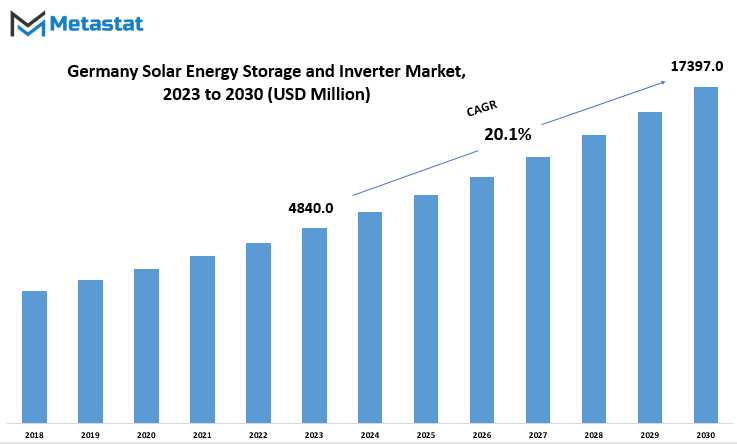
The Germany Solar Energy Storage and Inverter market is estimated to reach $17397.0 Million by 2030; growing at a CAGR of 20.1% from 2023 to 2030.
The Germany Solar Energy Storage and Inverter market represents a dynamic landscape where cutting-edge technology converges with the pressing need for sustainable energy solutions. As the world grapples with the challenges posed by climate change, Germany has emerged as a frontrunner in the adoption of solar energy technologies, with a keen focus on energy storage and inverters to optimize the efficiency of solar power systems.
In recent years, the Germany Solar Energy Storage and Inverter market has witnessed a remarkable surge in demand, fueled by the nation’s commitment to transitioning towards renewable energy sources. The role of energy storage solutions in this context is particularly noteworthy. These storage systems play a pivotal role in addressing the intermittent nature of solar power generation, ensuring a stable and reliable energy supply even during periods of low sunlight.
One of the key components driving the growth of the market is the emphasis on grid integration. Germany’s solar energy landscape is characterized by a distributed network of solar installations, ranging from residential rooftops to large-scale solar farms. Energy storage and inverters act as the linchpin in seamlessly integrating these diverse sources into the national grid, contributing to grid stability and reducing dependence on conventional energy sources.
In the Germany Solar Energy Storage and Inverter market, technological innovation is a hallmark. Advanced inverters with smart grid capabilities are enabling efficient energy conversion and distribution. Moreover, the integration of artificial intelligence and machine learning algorithms in energy storage systems enhances predictive maintenance, optimizing the overall performance of solar power installations.
The German commitment to environmental sustainability has also led to a growing emphasis on the circular economy within the solar energy sector. Efforts to develop recyclable and environmentally friendly materials for energy storage systems and inverters align with the nation’s broader goals of minimizing the ecological footprint of renewable energy infrastructure.
Government policies and incentives have played a crucial role in shaping the Germany Solar Energy Storage and Inverter market. Subsidies for solar installations, coupled with supportive regulations promoting the integration of storage solutions, have spurred investments and propelled the market forward. These policies reflect a concerted effort to create an enabling environment for the widespread adoption of solar energy technologies.
The Germany Solar Energy Storage and Inverter market epitomize the nation’s commitment to leading the way in sustainable energy practices. From harnessing solar power to integrating advanced storage solutions and inverters, Germany stands at the forefront of a green energy revolution. The ongoing innovations and policy initiatives underscore a national determination to create a resilient, eco-friendly energy landscape that serves as a model for the world.
GROWTH FACTORS
The Germany Solar Energy Storage and Inverter market exhibit growth driven by several pivotal factors. Firstly, the increasing awareness and commitment towards sustainable energy solutions have catapulted the demand for solar energy systems. As environmental consciousness becomes more prominent, individuals and businesses are embracing solar power solutions to reduce their carbon footprint.
Government initiatives also play a significant role in fostering the growth of the solar energy market in Germany. Subsidies, incentives, and favorable policies create a conducive environment for the adoption of solar energy systems, making them more accessible and attractive for consumers. These initiatives align with broader European goals of transitioning towards cleaner and renewable energy sources.
Moreover, advancements in technology contribute substantially to the market's growth. Ongoing research and innovation in solar energy storage and inverter technologies lead to more efficient and cost-effective solutions. As these technologies mature, the barriers to entry diminish, making solar energy systems increasingly feasible for a broader consumer base.
The energy transition in Germany, commonly known as the Energiewende, also propels the solar energy market forward. This national commitment to shifting from traditional energy sources to renewables emphasizes the importance of solar power in the overall energy mix. This transition is not just a policy objective but a cultural shift towards sustainable energy practices.
The growth of the solar energy market is further accelerated by increasing investments. Both public and private investments in solar infrastructure contribute to the expansion of solar energy capacity. Investors recognize the long-term potential of solar energy, considering it a viable and sustainable investment option.
Furthermore, the market benefits from the growing need for energy independence. Solar energy systems, coupled with efficient storage and inverter solutions, empower consumers to generate and manage their energy. This independence from traditional grid systems aligns with the desire for self-sufficiency and resilience, especially in the face of uncertainties in global energy markets.
The growth of the Germany Solar Energy Storage and Inverter market can be attributed to a confluence of factors – from a heightened awareness of environmental sustainability and supportive government policies to technological advancements, national energy transition initiatives, increased investments, and the growing desire for energy independence. As these factors continue to shape the landscape, the solar energy market in Germany is poised for sustained growth in the foreseeable future.
MARKET SEGMENTATION
By Component
In the expansive landscape of Germany’s solar energy sector, a critical focus is on the components that drive its functionality. The market is delineated by two key components: inverters and energy storage. These components, pivotal to the solar energy system, contribute distinct functionalities.
Inverters, a core element, serve as the technological backbone of solar energy systems. Their primary function is to convert the direct current (DC) generated by solar panels into usable alternating current (AC). This transformation is essential, as most appliances and the grid itself operate on AC power. In essence, inverters play a fundamental role in ensuring the compatibility and efficiency of solar energy systems.
Complementing the role of inverters is the equally crucial component of energy storage. As the name suggests, energy storage systems allow the capture and retention of excess energy produced by solar panels. This stored energy serves as a reservoir, available for use during periods of low sunlight or increased energy demand. Essentially, energy storage mitigates the intermittent nature of solar power, ensuring a consistent and reliable energy supply.
The segmentation of the Germany Solar Energy Storage and Inverter market into these two components reflects the strategic focus on the core elements that define the functionality and efficiency of solar energy systems. It acknowledges the symbiotic relationship between inverters and energy storage, recognizing their collaborative role in optimizing the utilization of solar energy.
The segmentation of the Germany Solar Energy Storage and Inverter market into inverters and energy storage underscores the foundational role these components play in the harnessing and utilization of solar energy. As Germany continues to advance its position in renewable energy, understanding the distinct contributions of these components becomes paramount for stakeholders aiming to navigate and contribute to the dynamic landscape of solar energy in the country.
By Inverter Type
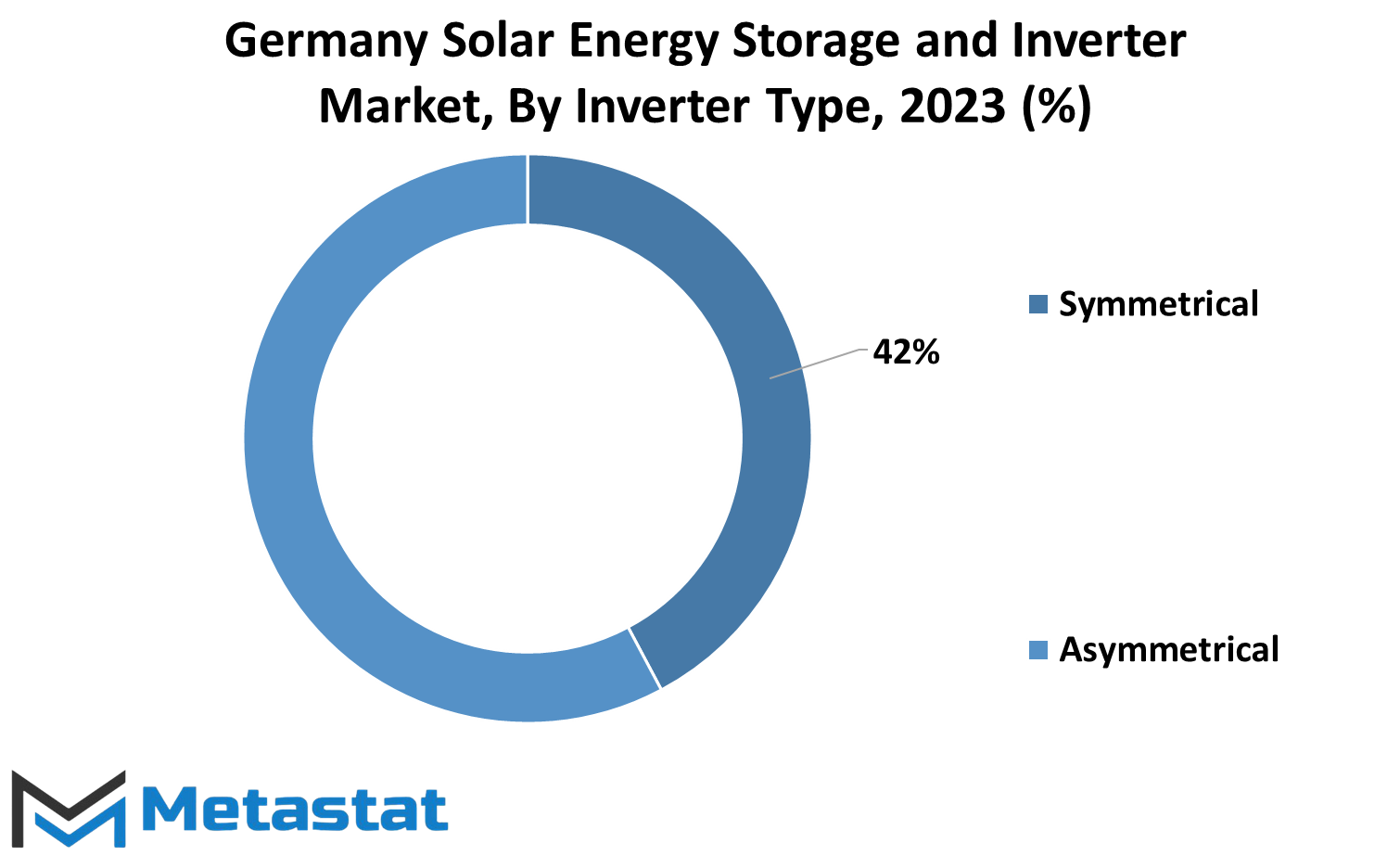
The Germany Solar Energy Storage and Inverter market exhibit a diversified landscape, notably segmented by inverter types. This segmentation is pivotal in understanding the market dynamics, with Symmetrical and Asymmetrical emerging as distinctive players in this energy ecosystem.
Symmetrical inverters, valued at 417.4 USD Million in 2022, constitute a significant component of the market. These inverters play a crucial role in converting direct current (DC) generated by solar panels into alternating current (AC) for utilization within households and industries. Their symmetrical design ensures a balanced distribution of power, contributing to stable energy conversion.
On the other hand, Asymmetrical inverters, valued at 579.8 USD Million in the same period, carve out their space in the market with a distinct approach. These inverters, characterized by an uneven distribution of power, cater to specific requirements where asymmetry in energy flow is advantageous. This asymmetry may be intentional, addressing unique energy consumption patterns or specific operational needs.
The market’s reliance on both Symmetrical and Asymmetrical inverters underscores the nuanced demands of consumers and industries alike. While Symmetrical inverters provide stability and balance in energy conversion, Asymmetrical counterparts offer a tailored solution for situations where uneven power distribution is advantageous.
The Germany Solar Energy Storage and Inverter market’s segmentation by inverter type encapsulate the market’s adaptability to diverse energy needs. Both Symmetrical and Asymmetrical inverters contribute to the intricate web of solar energy conversion, reflecting the market’s commitment to offering tailored solutions in the pursuit of sustainable and efficient energy utilization.
By Energy Storage
In the Germany’s Solar Energy Storage and Inverter market, a nuanced division emerges when we explore the realm of Energy Storage. This segment, a cornerstone of the market’s vitality, unfurls into various categories, each playing a distinctive role.
Lead Acid, a stalwart in the energy storage domain, held a considerable value of 121.3 USD Million in 2022. Its traditional yet reliable nature makes it a prominent choice, offering stability and efficiency in storing solar energy.
In contrast, the Lithium Ion segment takes the lead with a substantial valuation of 2553.2 USD Million in the same period. Its ascendancy is attributed to the technology’s efficiency and adaptability, making it a preferred choice for harnessing solar power.
The market further diversifies with the inclusion of the Flow Battery segment, valued at 82.1 USD Million in 2022. This technology, characterized by its capacity to store large amounts of energy for extended durations, contributes to the market’s robustness.
Completing the spectrum is the Others segment, bringing in a value of 36.3 USD Million in 2022. While less dominant in the market, this category encompasses various emerging technologies and solutions, contributing to the overall diversity of Germany’s Solar Energy Storage and Inverter market.
The Energy Storage segment, with its subcategories like Lead Acid, Lithium Ion, Flow Battery, and Others, paints a vivid picture of the market’s adaptability to various technologies. It reflects the German market’s commitment to embracing diverse energy storage solutions, ensuring a comprehensive approach to harnessing and utilizing solar power efficiently.
COMPETITIVE PLAYERS
The Germany Solar Energy Storage and Inverter market showcase a dynamic landscape, and at its core are key players crucial to its functioning. Among these, prominent entities like BYD Co. Ltd and Commeo GmbH stand out, steering the industry's trajectory.
BYD Co. Ltd, a significant player brings substantial influence to the solar energy storage and inverter sector. Their expertise and contributions resonate through their innovative solutions and commitment to advancing solar technology. In parallel, Commeo GmbH contributes its own distinctive footprint. As a key player, Commeo GmbH's involvement contributes not only to market competitiveness but also to the continual development of solar energy solutions in Germany.
These key players play a pivotal role in shaping the trajectory of the Germany Solar Energy Storage and Inverter market. Their contributions go beyond mere market presence; they actively influence and drive advancements in solar energy storage and inverter technologies. Their commitment to innovation, reliability, and sustainability underscores their significance in this domain.
The Germany Solar Energy Storage and Inverter market are marked by the active participation and influence of key players like BYD Co. Ltd and Commeo GmbH. Their contributions extend beyond individual market shares, impacting the industry's overall direction and fostering continuous advancements in solar energy technologies in the German landscape.
Germany Solar Energy Storage and Inverter Market Key Segments:
By Component
Inverters
Energy Storage
By Inverter Type
Symmetrical
Asymmetrical
By Energy Storage
Lead Acid
Lithium Ion
Flow Battery
Others
Key Germany Solar Energy Storage and Inverter Industry Players
Former, on-going, and projected market analysis in terms of volume and value
Assessment of niche industry developments
Market share analysis
Key strategies of major players
Emerging segments and regional growth potential
End of Report Overview
Frequently Asked Questions
Find answers to common questions about this report
Germany Solar Energy Storage and Inverter market is valued at $4840.0 million in 2023.
Germany Solar Energy Storage and Inverter market is estimated to grow with a CAGR of 20.1% from 2023 to 2030.
Germany Solar Energy Storage and Inverter market is estimated to reach $17397.0 million by 2030.
Top players operating in the Solar Energy Storage and Inverter industry includes BYD Co. Ltd, Commeo GmbH, Hager Group, Evyon, FENECON GmbH, Intilion AG, and Others.
Hydrocarbon market size is valued at USD 447.7 billion in 2025 and projected to reach USD 641.7 billion by 2033, growing at a CAGR of 4.6% from 2026 to 2033.
Hydrocarbon market, Hydrocarbon Market Size, Hydrocarbon Market Share, Hydrocarbon Market Analysis, Hydrocarbon Market Growth, Hydrocarbon Market Trends, Hydrocarbon Market Research Report, Hydrocarbon Market Forecast, Hydrocarbon, Hydrocarbon Market Research, Hydrocarbon Industry, Hydrocarbon Industry Report, Hydrocarbon Market Data, Hydrocarbon Statistics, Hydrocarbon Market Statistics, Hydrocarbon Industry Trends, Hydrocarbon Market Report, Hydrocarbon Market Trends, Hydrocarbon Market News, Hydrocarbon Forecasts, Hydrocarbon Market Intelligence Report, Hydrocarbon market 2033, Hydrocarbon market outlook, Hydrocarbon market segmentation, Hydrocarbon market drivers, Hydrocarbon market restraints, Hydrocarbon market opportunities, Hydrocarbon market CAGR, Hydrocarbon suppliers, Hydrocarbon manufacturers, Hydrocarbon market by region, North America Hydrocarbon market, Asia Pacific Hydrocarbon market, Europe Hydrocarbon market, Hydrocarbon market competitive landscape, Hydrocarbon market key players, Aliphatic Hydrocarbon market, Aromatic Hydrocarbon market, Fuel and Combustion Hydrocarbon market, Petrochemical and Chemical Feedstock Hydrocarbon market, Lubricants and Functional Fluids Hydrocarbon market, Solvents and Industrial Process Fluids Hydrocarbon market, Asphalt and Bitumen Production Hydrocarbon market, Transportation and Mobility Hydrocarbon market, Petrochemicals and Chemicals Hydrocarbon market, Power Generation and Utilities Hydrocarbon market, Industrial Manufacturing and Processing Hydrocarbon market, Construction and Infrastructure Hydrocarbon market, Mining Hydrocarbon market.
Asset Integrity Management market size is valued at USD 26.1 billion in 2025 and projected to reach USD 40.6 billion by 2033, growing at a CAGR of 5.7%.
Energy Harvesting Module Market Size, Share, Trends, 2033
Energy Harvesting Module market was valued at USD 707.9 million in 2025 and is projected to reach USD 1,727.8 million by 2033, growing at a CAGR of 11.8%.
Energy Harvesting Module market, Energy Harvesting Module Market Size, Energy Harvesting Module Market Share, Energy Harvesting Module Market Analysis, Energy Harvesting Module Market Growth, Energy Harvesting Module Market Trends, Energy Harvesting Module Market Research Report, Energy Harvesting Module Market Forecast, Energy Harvesting Module, Energy Harvesting Module Market Research, Energy Harvesting Module Industry, Energy Harvesting Module Industry Report, Energy Harvesting Module Market Data, Energy Harvesting Module Statistics, Energy Harvesting Module Market Statistics, Energy Harvesting Module Industry Trends, Energy Harvesting Module Market Report, Energy Harvesting Module Market Trends, Energy Harvesting Module Market News, Energy Harvesting Module Forecasts, Energy Harvesting Module Market Intelligence Report, Energy Harvesting Module market 2033, Energy Harvesting Module market outlook, Energy Harvesting Module market segmentation, Energy Harvesting Module market drivers, Energy Harvesting Module market restraints, Energy Harvesting Module market opportunities, Energy Harvesting Module market CAGR, Energy Harvesting Module suppliers, Energy Harvesting Module manufacturers, Energy Harvesting Module market by region, North America Energy Harvesting Module market, Asia Pacific Energy Harvesting Module market, Europe Energy Harvesting Module market, Energy Harvesting Module market competitive landscape, Energy Harvesting Module market key players, Photovoltaic and Light Energy Harvesting market, Thermoelectric and Heat Energy Harvesting market, Piezoelectric and Vibration Energy Harvesting market, Industrial IoT and Condition Monitoring market, Smart Buildings and Home Automation market
Concentrated Solar Power Market Size, Share, Trends, 2033
Concentrated Solar Power market size is valued at USD 7.5 billion in 2025 and is projected to reach USD 17.3 billion in 2033, at a CAGR of 11.1% from 2026 to 2033.
Concentrated Solar Power Market, Concentrated Solar Power Market Size, Concentrated Solar Power Market Share, Concentrated Solar Power Market Analysis, Concentrated Solar Power Market Growth, Concentrated Solar Power Market Trends, Concentrated Solar Power Market Research Report, Concentrated Solar Power Market Forecast, Concentrated Solar Power, Concentrated Solar Power Market Research, Concentrated Solar Power Industry, Concentrated Solar Power Industry Report, Concentrated Solar Power Market Data, Concentrated Solar Power Statistics, Concentrated Solar Power Market Statistics, Concentrated Solar Power Industry Trends, Concentrated Solar Power Market Report, Concentrated Solar Power Market Trends, Concentrated Solar Power Market News, Concentrated Solar Power Forecasts, Concentrated Solar Power Market Intelligence Report