
LEAD ANALYST
Utkarsh Khirodkar is a Lead Market Research Analyst at MetaStat Insight, specializing in market intelligence, technology sector assessments, and competitive strategy.

Brazil Cold Chain for Pharmaceutical Market By Type (Refrigerated Storage and Cold Chain Logistics), By Application (Pharmaceuticals, Blood Goods, and Other), Industry Analysis, Size, Share, Growth, Trends, and Forecast, 2023-2030
MSI-2560
February 8, 2026
257 Pages
Report Details
Comprehensive Market Analysis And Insights
MARKET OVERVIEW
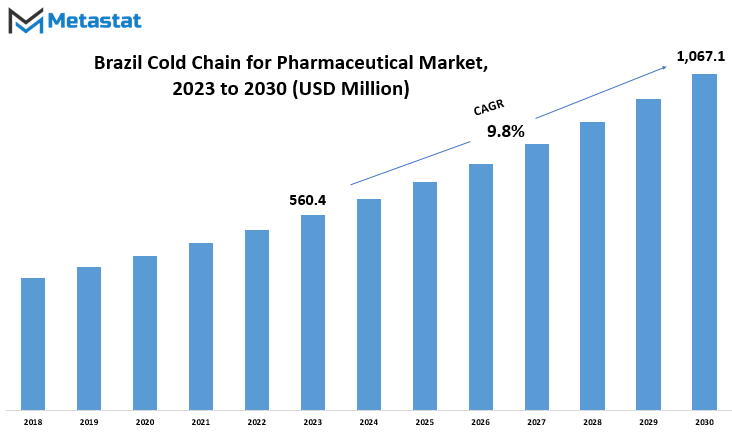
The Brazil Cold Chain for Pharmaceutical market is estimated to reach $1,067.1 Million by 2030; growing at a CAGR of 9.8% from 2023 to 2030.
The Brazil Cold Chain for Pharmaceutical Market plays a critical role in ensuring the integrity and efficacy of pharmaceutical products as they traverse the intricate logistics network within the country. This system is a complex web of temperature-controlled storage, transportation, and distribution facilities designed to maintain the required conditions for pharmaceuticals from manufacturing to the end-user.
The Brazil Cold Chain for Pharmaceutical Market is an indispensable element of the nation's healthcare infrastructure. Its primary function is to preserve the quality and potency of pharmaceuticals that are sensitive to temperature variations. Brazil, being a vast and diverse country with varying climatic conditions, presents unique challenges for the pharmaceutical supply chain. Hence, an efficient and reliable cold chain becomes imperative to overcome these challenges and ensure the safe delivery of pharmaceuticals to every corner of the nation.
The infrastructure of the Brazil Cold Chain comprises a network of cold storage facilities strategically located throughout the country. These facilities are equipped with advanced refrigeration technologies to maintain specific temperature ranges required for different categories of pharmaceutical products. The cold chain is not limited to storage; it extends to transportation as well, with refrigerated vehicles ensuring that the temperature-sensitive drugs are not compromised during transit.
In recent years, the Brazil Cold Chain for Pharmaceutical Market has witnessed significant advancements in technology and infrastructure. Modern temperature monitoring systems have been integrated into the supply chain, providing real-time data to stakeholders. This ensures transparency and allows for prompt interventions in case of temperature deviations, safeguarding the quality of pharmaceuticals.
One of the notable challenges faced by the Brazil Cold Chain is the vast geographical expanse of the country. The need for an efficient and seamless cold chain becomes even more apparent when considering the diverse climatic conditions from the Amazon rainforest to the urban landscapes of Rio de Janeiro and São Paulo. The ability to maintain the required temperature throughout the supply chain is not only a logistical necessity but also a regulatory requirement to comply with pharmaceutical quality standards.
Regulatory bodies in Brazil, such as ANVISA (National Health Surveillance Agency), play a pivotal role in ensuring the compliance of the cold chain with stringent standards. These regulations are in place to guarantee that pharmaceutical products reaching the end-users are safe, potent, and effective. Any deviation from the specified temperature ranges during storage or transportation could lead to the deterioration of the drugs, rendering them ineffective or even harmful.
GROWTH FACTORS
The expansion of the Brazil Cold Chain for Pharmaceutical market is significantly influenced by several factors driving its growth. These pivotal elements play a crucial role in shaping the market landscape. On the positive side, key growth factors propel the market forward, fostering its development and stability.
Conversely, certain challenges pose potential obstacles to the market's growth trajectory. These hindrances, though noteworthy, should be considered as part of the market dynamics. Identifying and addressing these challenges becomes imperative for stakeholders to navigate the landscape effectively.
Despite these challenges, it's essential to recognize that opportunities abound within the market. Lucrative prospects await, promising a positive outlook in the coming years. As the market evolves, stakeholders need to remain vigilant, adapting strategies to harness these opportunities and mitigate potential setbacks.
The Brazil Cold Chain for Pharmaceutical market operates within a dynamic framework, where growth factors and challenges coexist. A nuanced understanding of these dynamics is crucial for stakeholders to make informed decisions and steer the market towards sustained progress.
MARKET SEGMENTATION
By Type
In the Brazilian pharmaceutical market’s cold chain, we find a division based on types. This division brings clarity, with Refrigerated Storage and Cold Chain Logistics standing out. The Refrigerated Storage aspect, clocking in at a valuation of 120.9 USD Million in 2021, highlights the crucial role of controlled temperature storage. On the other hand, the Cold Chain Logistics segment, valued at 338.9 USD Million in the same year, signifies the broader logistics network involved in maintaining the integrity of pharmaceutical products.
The segmentation provides a comprehensive view, emphasizing the significant contributions of each type to the overall cold chain landscape. Refrigerated Storage showcases the importance of controlled environments in preserving pharmaceuticals, while Cold Chain Logistics sheds light on the intricacies of the logistical processes ensuring timely and secure transportation.
This market scenario indicates a dynamic interplay between these segments, underlining the integral role they play in the distribution and storage of pharmaceuticals within Brazil. As we delve into the specifics, it becomes evident that these segments are not isolated entities but rather interconnected components contributing to the robustness of the pharmaceutical cold chain market.
By Application
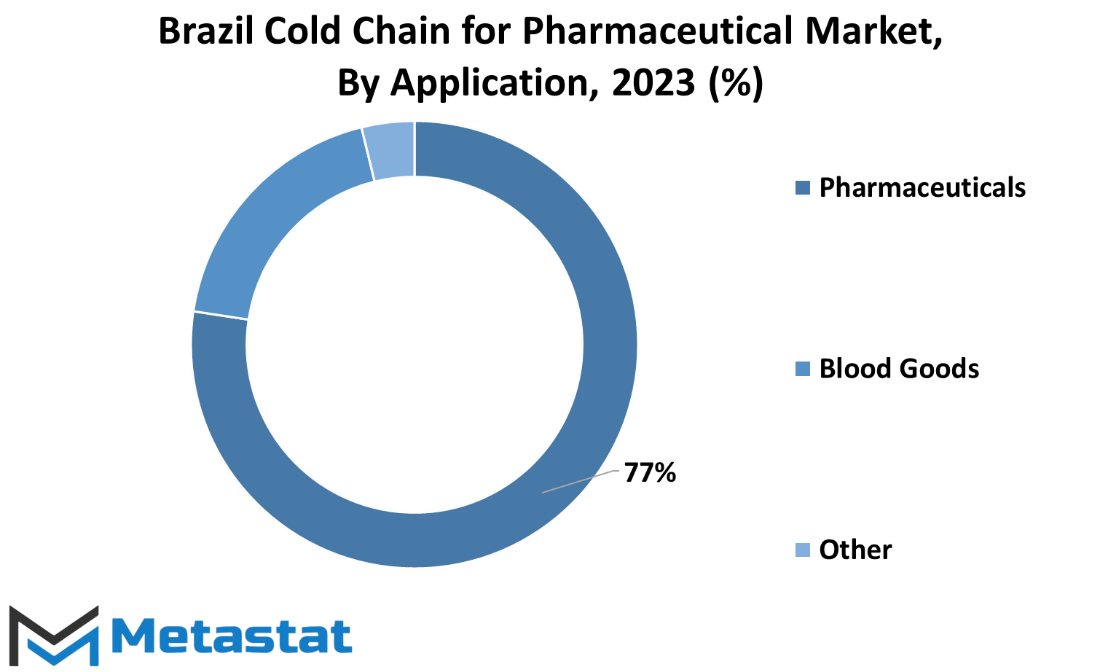
The Brazilian Cold Chain for Pharmaceutical market encompasses various applications, categorizing its use into Pharmaceuticals, Blood Goods, and Other applications. This segmentation allows for a clearer understanding of the market’s diverse functions.
In this market, the term Pharmaceuticals refers to the storage and transportation of various medicinal products requiring controlled temperature conditions. This includes a wide array of drugs, vaccines, and other pharmaceutical products essential for healthcare. The meticulous management of temperature throughout the supply chain is crucial to ensuring the effectiveness and safety of these pharmaceuticals.
Blood Goods represent another pivotal application within the Brazilian Cold Chain. This category involves the preservation and transportation of blood and its components, which are highly sensitive to temperature variations. Maintaining the appropriate temperature is critical for preserving the quality and functionality of blood products, ensuring they remain suitable for medical use.
The next application category, labeled as Other, encompasses a diverse range of products that necessitate controlled temperatures during storage and transportation. This catch-all category accommodates various temperature-sensitive items beyond pharmaceuticals and blood goods, such as certain chemicals or biological materials.
These distinct applications within the Brazilian Cold Chain market underscore its significance in preserving the integrity of temperature-sensitive products. The market's segmentation allows for a nuanced understanding of its multifaceted role in ensuring the quality, efficacy, and safety of diverse goods essential for healthcare and other sectors.
COMPETITIVE PLAYERS
The Cold Chain for Pharmaceutical market in Brazil is influenced by several key players actively participating in the industry. Notable companies include FedEx Corporation, United Parcel Service, Inc., Kerry Logistics Network Limited, Orient Overseas Container Line Limited, DHL Express, Catalent, Inc., and DSV A/S.
These players play a crucial role in shaping the dynamics of the pharmaceutical cold chain in Brazil. FedEx Corporation and United Parcel Service, Inc. are recognized logistics giants, contributing significantly to the transportation and distribution aspects of the cold chain. Kerry Logistics Network Limited and Orient Overseas Container Line Limited also play integral roles, providing essential services within the pharmaceutical supply chain.
DHL Express, a renowned logistics and courier company, stands as a key player, contributing its expertise to the efficient management of pharmaceutical products' temperature-sensitive transportation. Catalent, Inc. is another significant participant, offering solutions in packaging, storage, and distribution of pharmaceuticals.
DSV A/S rounds out the list of major players, bringing its expertise to the pharmaceutical cold chain domain. As these companies navigate the challenges and opportunities in the Brazilian market, their roles are pivotal in ensuring the integrity and reliability of the pharmaceutical cold chain.
The competitive landscape of the Cold Chain for Pharmaceutical market in Brazil is shaped by the active involvement of key players such as FedEx Corporation, United Parcel Service, Inc., Kerry Logistics Network Limited, Orient Overseas Container Line Limited, DHL Express, Catalent, Inc., and DSV A/S. Their collective contributions underscore the significance of effective logistics and supply chain management in maintaining the integrity of pharmaceutical products during transportation and storage.
Cold Chain for Pharmaceutical Market Key Segments:
By Type
By Application
Key Brazil Cold Chain for Pharmaceutical Industry Players
WHAT REPORT PROVIDES
Find answers to common questions about this report
Brazil Cold Chain for Pharmaceutical market is valued at $560.4 million in 2023.
Brazil Cold Chain for Pharmaceutical market is estimated to grow with a CAGR of 9.8% from 2023 to 2030.
Brazil Cold Chain for Pharmaceutical market is estimated to reach $1,067.1 million by 2030.
Top players operating in the Cold Chain for Pharmaceutical industry includes FedEx Corporation, United Parcel Service, Inc., Kerry Logistics Network Limited, and others.
Choose Your License
Brazil Cold Chain for Pharmaceutical Market
The analysts below cover Automotive and Transportation research at Metastat Insights.
LEAD ANALYST
Utkarsh Khirodkar is a Lead Market Research Analyst at MetaStat Insight, specializing in market intelligence, technology sector assessments, and competitive strategy.

ENERGY & INFRASTRUCTURE INDUSTRY CONSULTANT
Automotive and Transportation · Electronics and Semiconductor · Energy and Power · Machinery & Equipment
Saurabh Vasant Ganvir consults for Energy & Infrastructure Industry at MetaStat Insight, specializing in renewable energy, solar EPC, and electric vehicle (EV) infrastructure markets.
Our team was tracking whether regional recycling infrastructure could realistically absorb the growing volume of lithium iron phosphate batteries over the next decade. The report did a solid job separating announced hydrometallurgical plant capacity from active, permitted operational throughput. That distinction made the feedstock availability projections and regional recovery rate models far more credible than standard commercial overviews.
Tracking capacity expansion in single-use bioprocessing requires dependable data on raw material availability and cleanroom-grade polymer supply chains. The competitive landscape chapter gave a grounded evaluation of secondary component suppliers across North America and Asia-Pacific rather than simply reprinting press releases. Having that level of supplier benchmarking helped clarify dual-sourcing considerations for our clinical pipeline planning.
When evaluating distributed energy resource management systems, standard research summaries tend to gloss over the operational differences between front-of-the-meter utility deployments and behind-the-meter industrial sites. The MetaStat Insight report addressed those distinctions directly, especially regarding software interoperability standards and grid interconnection backlogs. The five-year market sizing across regional transmission organizations provided actionable context for our grid modernization strategy.
Explore related market intelligence reports worth reading alongside this one.
Starting from
$2950
Starting from
$2950