Biomass Energy Market Size, Share, By Feedstock Type (Wood Residues, Agricultural Residues, Animal Waste, Energy Crops, and Others), By Technology (Combustion, Gasification, Anaerobic Digestion, Torrefaction, Densification, Pyrolysis, Carbonization, and Others), By Application (Power Generation, Heat Generation, Transportation Fuels, and Others), By End-User (Residential, Commercial, Industrial, and Utilities), Industry Analysis, Growth, Trends, and Forecast, 2026-2033
Report ID
MSI-4670
Published
April 27, 2026
Pages
313 Pages
Format
Report Details
Comprehensive Market Analysis And Insights
Market Overview
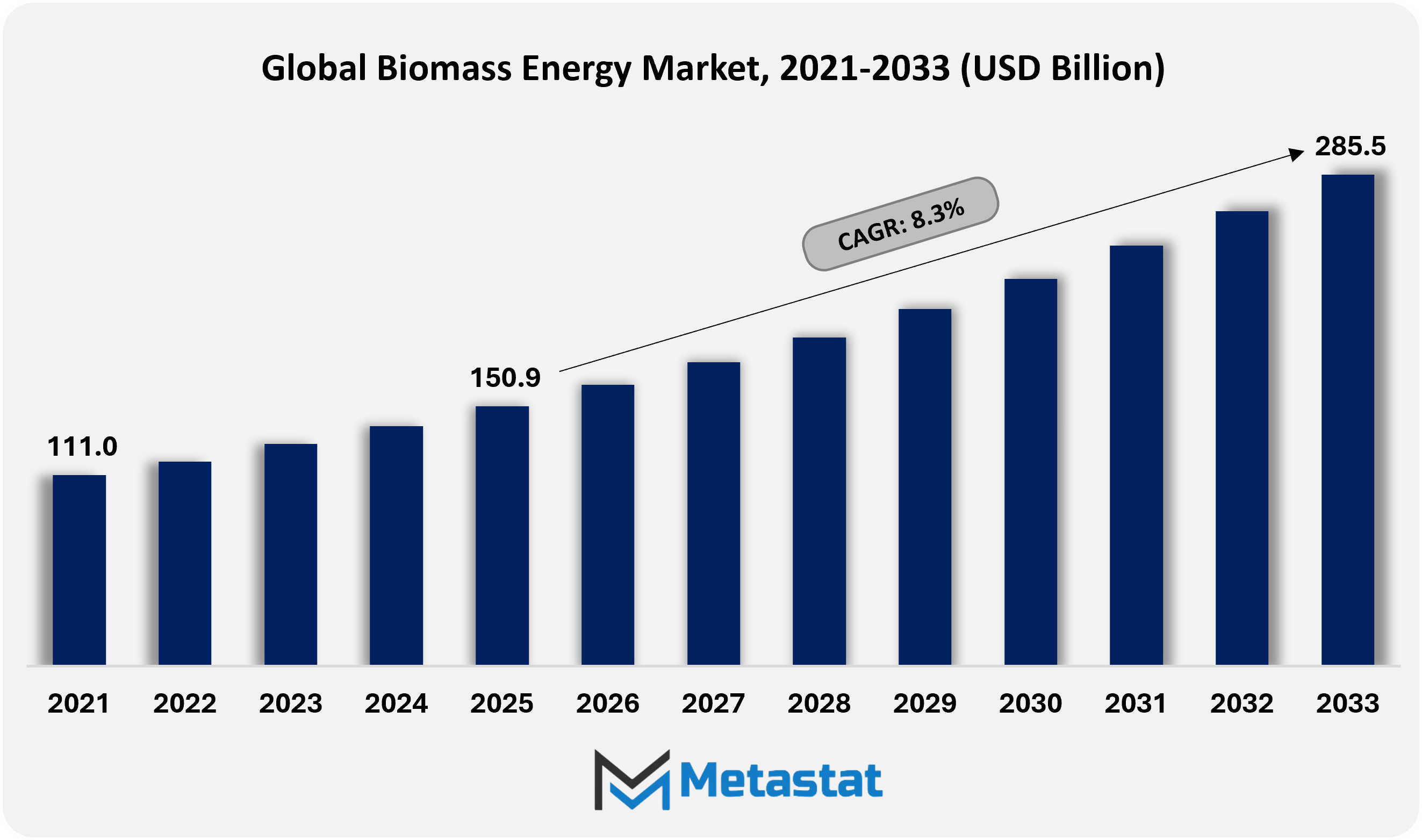
The Global Biomass Energy market size was valued at USD 150.9 billion in 2025 and projected to grow at a CAGR of 8.3% during the forecast period, reaching USD 285.5 billion by 2033.
Global Biomass Energy Market: Comprehensive Data-Driven Market Analysis and Strategic Outlook
Global Biomass Energy market valued at USD 150.9 billion in 2025, growing at a CAGR of 8.3% through 2033, with potential to exceed USD 285.5 billion.
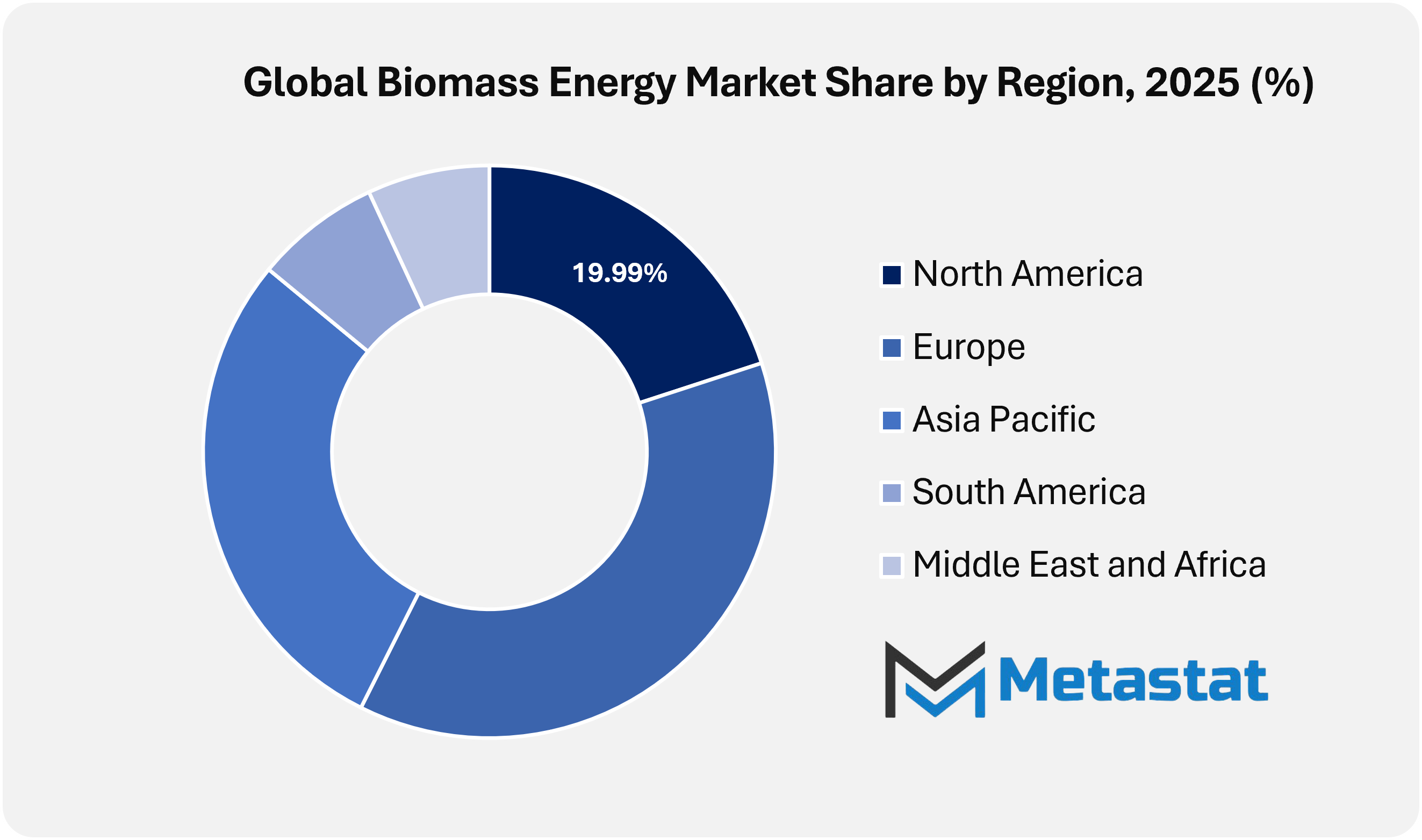
Europe holds the dominant market share in 2025, supported by established biomass power generation, district heating systems, and waste-to-energy infrastructure across key countries.
Wood and Agricultural Residues accounted for 53.8% of the Global Biomass Energy market in 2025.
Key trends driving growth include policy-led decarbonization targets, renewable heat and power obligations, and the increasing value of dispatchable renewable generation for grid reliability and industrial steam demand.
Key opportunities include bioenergy with carbon capture and storage deployment, along with biomethane scale-up across gas grid and transport applications.
Key insight: Rising decarbonization mandates and circular economy goals are strengthening long-term investment confidence in the Global Biomass Energy Market.
The Global Biomass Energy market is entering a more strategic phase within the renewable energy industry, where thermal conversion, anaerobic digestion, gasification, and advanced biorefining technologies are expanding the value of organic feedstocks. Biomass is moving beyond its traditional role as an alternative fuel source and becoming an important component of circular industrial systems. Agricultural residues, forestry by-products, municipal organic waste, and industrial effluents are increasingly being utilized as engineered feedstocks for power, heat, fuels, and value-added bio-based products.
Over the forecast period, biomass facilities are expected to operate with greater digital integration, supported by predictive maintenance, process automation, and AI-enabled combustion optimization. Utilities and grid operators are likely to view dispatchable biomass power as a balancing source that complements intermittent solar and wind generation. In parallel, advanced biofuels derived from lignocellulosic feedstocks are expected to gain traction in hard-to-abate sectors such as aviation and maritime transport, where electrification remains structurally constrained.
Market Dynamics
Growth Drivers:
Policy-led decarbonization targets and renewable heat or power obligations.
Policy-led decarbonization goals and renewable heat or power obligations will strengthen demand visibility in the Biomass Energy market. National energy transition plans, carbon pricing frameworks, and clean power mandates will encourage utilities and industrial operators to expand biomass capacity. Public funding support and compliance requirements will further accelerate the shift away from fossil fuel-based energy systems across multiple regions.
Dispatchable renewable generation value for grid reliability and industrial steam demand
Dispatchable renewable generation for grid reliability and industrial steam demand will support the growth of the Biomass Energy market. Baseload renewable output will contribute to grid stability, frequency balancing, and peak-load management in systems with rising solar and wind penetration. Industrial clusters will adopt biomass boilers and cogeneration systems to secure stable thermal energy for processing plants and district heating networks.
Restraints and Challenges:
Feedstock availability, pricing volatility, and logistics intensity
Feedstock availability, pricing volatility, and logistics intensity will remain key constraints in the Global Biomass Energy market. Seasonal variability in agricultural residues, fluctuations in forestry output, and transportation bottlenecks will affect operating margins. Higher hauling costs and storage requirements will increase the need for regional sourcing strategies, digital tracking systems, and efficient supply chain coordination.
Sustainability scrutiny, permitting complexity, and lifecycle-emissions verification burden
Sustainability scrutiny, permitting complexity, and lifecycle emissions verification requirements will increase compliance costs across the Global Biomass Energy market. Environmental impact assessments, land-use standards, and traceability audits will require rigorous documentation and monitoring. Financial institutions will demand transparent carbon accounting, while community consultation processes will extend project development timelines.
Opportunities:
Bioenergy with carbon capture and storage deployment plus biomethane scale-up
Bioenergy with carbon capture and storage deployment, along with biomethane scale-up, will unlock significant opportunities in the Global Biomass Energy market. Negative-emission energy pathways will attract climate-focused capital and long-term industrial offtake agreements. Upgraded biogas injection into gas grids will also expand renewable fuel supply for transport, chemicals, and heavy industry.
Market Segmentation Analysis
The Global Biomass Energy market is classified based on Feedstock Type, Technology, Application, and End-User.
By Feedstock Type, the market is further segmented into:
Wood and Agricultural Residues
Wood and Agricultural Residues segment is estimated at USD 87.9 billion in 2026 and is projected to reach USD 142.7 billion by 2033, at a CAGR of 7.2% during the forecast period.
Wood waste and agricultural residues will remain the largest feedstock base, supported by established collection networks, preprocessing systems, and rural aggregation infrastructure. Drying, chipping, pelletization, and moisture-control technologies will improve calorific value and handling efficiency. Sustainability standards and traceability systems will strengthen long-term feedstock security across the Global Biomass Energy market.
Animal Waste
Animal Waste segment is estimated at USD 25 billion in 2026 and is projected to reach USD 46.3 billion by 2033, at a CAGR of 9.2% during the forecast period.
Animal waste will support decentralized biogas and bioenergy systems integrated with livestock and agricultural operations. Improved anaerobic digestion efficiency and methane capture systems will reduce open waste emissions while creating additional farm-level revenue streams. Circular waste management models will strengthen environmental compliance and operational resilience.
Energy Crops
Energy Crops segment is estimated at USD 34.4 billion in 2026 and is projected to reach USD 70.4 billion by 2033, at a CAGR of 10.8% during the forecast period.
Energy crops will gain traction on marginal and low-productivity land, supported by precision farming practices and improved crop genetics. Higher yield stability, lower water intensity, and long-term offtake contracts will strengthen supply reliability. Farmer participation is expected to increase as commercial biomass value chains expand.
Others
Others segment is estimated at USD 16.1 billion in 2026 and is projected to reach USD 26 billion by 2033, at a CAGR of 7.1% during the forecast period.
Municipal solid waste, algae, and industrial organic by-products will broaden the feedstock base of the Global Biomass Energy market. Better sorting, preprocessing, and contamination-control systems will improve conversion efficiency and input consistency. Integrated waste management strategies will align urban sanitation priorities with renewable energy generation goals.
By Technology, the market is divided into:
Combustion
Combustion segment is projected to reach USD 108.2 billion by 2033, at a CAGR of 6% during the forecast period.
Combustion will remain a core biomass conversion technology, supported by high-efficiency boilers, automated combustion control, and advanced emissions treatment systems. Stricter air-quality standards will push operators toward better filtration, ash handling, and plant optimization. Grid-connected facilities will continue to rely on digital monitoring to improve load management and plant reliability.
Gasification
Gasification segment is projected to reach USD 40.1 billion by 2033, at a CAGR of 10.4% during the forecast period.
Gasification will gain relevance in applications requiring higher efficiency and flexible syngas output. Modular gasifiers and cleaner reactor designs will support deployment across industrial and distributed energy settings. Lower tar formation and improved thermal conversion performance will enhance project viability.
Anaerobic Digestion
Anaerobic Digestion segment is projected to reach USD 61.9 billion by 2033, at a CAGR of 10.8% during the forecast period.
Anaerobic digestion will expand steadily, supported by rising volumes of organic waste from farms, municipalities, and food processing facilities. Smart process monitoring across temperature, pH, and feedstock composition will improve methane yields and plant efficiency. Upgrading systems for biomethane injection will further widen commercial use cases.
Torrefaction & Densification
Torrefaction & Densification segment is projected to reach USD 25.8 billion by 2033, at a CAGR of 10% during the forecast period.
Torrefaction and densification will strengthen the production of standardized, energy-dense biomass fuels for industrial and utility applications. Improved pellet durability, storage stability, and transport efficiency will support wider trade and co-firing usage. The segment will benefit from demand for uniform fuels with better combustion characteristics.
Pyrolysis & Carbonization
Pyrolysis & Carbonization segment is projected to reach USD 26 billion by 2033, at a CAGR of 11.3% during the forecast period.
Pyrolysis and carbonization will gain momentum as producers target bio-oil, biochar, and carbon-rich co-products alongside energy generation. Reactor innovation and process control improvements will raise conversion efficiency and product consistency. Biochar applications in soil enhancement and carbon management will add strategic value to the segment.
Others
Others segment is projected to reach USD 23.5 billion by 2033, at a CAGR of 5.8% during the forecast period.
Emerging hybrid and integrated conversion systems will support multi-output biomass facilities with stronger operational flexibility. Digital twins, predictive maintenance, and advanced automation will improve uptime and process efficiency. Collaboration between technology providers, research institutions, and utilities will accelerate commercialization of next-generation biomass solutions.
By Application, the market is further divided into:
Power Generation
Power Generation segment is projected to reach USD 120 billion by 2033.
Power generation will remain the largest application, supported by the need for dispatchable renewable electricity and grid balancing capacity. Co-firing and dedicated biomass plants will continue to support utilities during periods of variable solar and wind generation. Smart grid integration will improve dispatch efficiency and plant utilization.
Heat Generation
Heat Generation segment is projected to reach USD 80.5 billion by 2033.
Heat generation will retain a strong share, particularly in district heating networks and industrial steam applications. Biomass boilers and combined heat and power systems will support decarbonization across manufacturing, food processing, and commercial heating infrastructure. Better fuel-feed automation will improve thermal efficiency and operating stability.
Transportation Fuels
Transportation Fuels segment is projected to reach USD 70.6 billion by 2033.
Transportation fuels will expand with rising interest in advanced biofuels for aviation, marine, and heavy-duty transport. Refinery integration, feedstock upgrading, and supportive fuel blending mandates will strengthen market adoption. The segment will benefit from sectors where electrification remains limited.
Others
Others segment is projected to reach USD 14.4 billion by 2033.
Other applications will widen as biomass-derived intermediates gain use in biochemicals, specialty materials, and sustainable construction inputs. Integrated biorefineries will support diversified revenue streams beyond conventional power and heat generation. Product innovation will strengthen the economic resilience of biomass-based value chains.
By End-User, the Global Biomass Energy market is divided as:
Residential
Residential segment is projected to grow at a CAGR of 5.2% during the forecast period.
Residential use will remain relevant in regions with pellet heating and small-scale biomass systems. Automated fuel feeding, improved emissions control, and government support programs will support cleaner household heating adoption. Rural and cold-climate markets are likely to remain key demand centers.
Commercial
Commercial segment is projected to grow at a CAGR of 8.4% during the forecast period.
Commercial end users will adopt medium-scale biomass systems to manage energy costs and improve sustainability performance across hotels, institutions, warehouses, and retail infrastructure. Energy management systems and reporting requirements will support broader adoption. Service-based models and long-term fuel agreements will improve implementation economics.
Industrial
Industrial segment is projected to grow at a CAGR of 9.1% during the forecast period.
Industrial end users will remain a major demand base, owing to the need for low-carbon process heat and steam generation. Biomass boilers, CHP systems, and fuel-switching initiatives will support decarbonization in pulp and paper, food processing, chemicals, and other energy-intensive sectors. Long-term supply agreements will remain critical for operational continuity.
Utilities
Utilities segment is projected to grow at a CAGR of 8.5% during the forecast period.
Utilities will continue to scale biomass power assets to diversify renewable portfolios and improve system reliability. Capacity additions will be guided by regional feedstock availability, carbon policy, and grid-balancing requirements. Public-private investment models will support larger project development across established markets.
By Region:
Based on geography, the Global Biomass Energy market is divided into North America, Europe, Asia-Pacific, South America, Middle East, and Africa.
North America Biomass Energy Market is set to expand at a CAGR of 8.3% within the forecast period, reaching a market size (TAM) of USD 51.9 billion by the end of 2033.
Strong federal incentives and renewable portfolio standards hold to boost up biomass electricity plant development throughout the US and Canada.
Growing investment in waste-to-power infrastructure strengthens biomass integration within nearby application grids.
Rapid industrialization and growing power demand create vast opportunities for biomass-based totally cogeneration initiatives throughout China, India, and Southeast Asia.
Expanding agricultural residue availability opens new opportunities for scalable biomass fuel manufacturing and rural strength packages.
Across the Middle East, Africa, and South America, biomass strength adoption advances via government diversification techniques, agricultural waste utilization, and decentralized strength initiatives supporting power access.
Competitive Landscape and Strategic Insights
The Global Biomass Energy market is strengthening its position as countries increase investment in reliable and lower-emission energy systems. Biomass energy is generated from organic feedstocks such as agricultural residues, wood waste, animal waste, and other biodegradable materials, which are converted into power, heat, and biofuels through multiple conversion technologies. Increasing policy focus on carbon reduction, waste utilization, and energy diversification is encouraging broader adoption of biomass across utilities, industries, and decentralized energy applications. Growing concern around energy security, industrial decarbonization, and circular resource management will continue to support long-term expansion of the Global Biomass Energy market.
Technology providers and engineering companies play a central role in the development of the Global Biomass Energy market. Companies such as ANDRITZ, Valmet, Babcock & Wilcox, and Sumitomo SHI FW supply biomass boilers, combustion systems, and energy conversion solutions designed for utility-scale and industrial applications. Players including Vyncke NV, DP CleanTech, Uniconfort, and Viessmann focus on combustion and heating technologies tailored for industrial facilities and district heating networks. Wärtsilä and Siemens Energy contribute through integrated energy systems that improve plant efficiency, operational flexibility, and grid support. Continuous innovation in conversion efficiency, emissions control, and feedstock adaptability remains a key competitive factor across the market.
Biogas and anaerobic digestion technologies represent an important part of the competitive landscape within the Global Biomass Energy market. Companies such as EnviTec Biogas, WELTEC BIOPOWER, BTS Biogas, PlanET Biogas Group, Ankur Scientific, Spanner Re², and Burkhardt Energy are expanding solutions that convert organic waste into biogas for power, heat, and renewable gas applications. These technologies are widely adopted in agricultural regions with strong availability of livestock waste, crop residues, and food processing by-products. Modular plant designs and scalable digestion systems are improving accessibility for farms, cooperatives, and medium-scale commercial users, while also supporting waste management efficiency and circular economy goals.
Large energy companies, biomass fuel suppliers, and infrastructure developers are also strengthening their presence across the Global Biomass Energy market. Companies such as Enviva, Drax, RWE AG, ENGIE SA, E.ON SE, Enel S.p.A., ACCIONA, Ameresco, and ITOCHU Corporation are investing in biomass generation assets, fuel supply chains, renewable gas projects, and long-term decarbonization strategies. Canadian Forest Products Ltd., Lignetics, and Yilkins B.V. support the market through pellet production and biomass fuel processing, helping secure feedstock availability for downstream applications. JFE Engineering Corporation, Forbes Marshall, and Polytechnik GmbH further contribute through engineering systems and industrial heating solutions. Supported by policy momentum, technology upgrades, and rising demand for dispatchable renewable energy, the competitive landscape of the Global Biomass Energy market is expected to remain active and strategically important over the forecast period.
Forecast and Future Outlook
Market size is forecast to rise from USD 150.9 billion in 2025 to over USD 285.5 billion by 2033.
The Biomass Energy Market will even increase into bio-based chemical compounds and poor-emission solutions. Carbon seize integration with biomass flowers will generate pathways for net carbon elimination, a characteristic on the way to affect procurement techniques of heavy industries in search of credible decarbonization frameworks. Financial institutions will verify undertaking viability thru lifecycle carbon accounting models rather than headline output metrics.
This research report categorizes the Biomass Energy market based on key segments and regions, forecasts revenue growth, and analyses trends in each submarket. The report analyses the key growth drivers, opportunities, and challenges influencing the Biomass Energy market. Recent market developments and competitive strategies such as expansion, product launch, partnership, merger, and acquisition have been included to draw the competitive landscape in the market.
The report strategically identifies and profiles the key market players and analyses their core competencies in each sub-segment of the Biomass Energy market.
Report Attributes
Details
Study Period
2021-2033
Base Year
2025
Estimated Year
2026
Forecast Period
2026-2033
Historical Period
2021-2025
Growth Rate
CAGR 8.3% from 2026 to 2033
Revenue Unit
USD billion
Segmentation
By Feedstock Type, Technology, Application, End-User, and Region
By Region
North America (By Feedstock Type, Technology, Application, End-User, and Country)
United States
Canada
Mexico
Europe (By Feedstock Type, Technology, Application, End-User, and Country)
Germany
France
UK
Italy
Spain
Russia
Rest of Europe
Asia Pacific (By Feedstock Type, Technology, Application, End-User, and Country)
China
Japan
India
South Korea
Australia
Southeast Asia
Rest of Asia Pacific
South America (By Feedstock Type, Technology, Application, End-User, and Country)
Brazil
Argentina
Rest of South America
Middle East and Africa (By Feedstock Type, Technology, Application, End-User, and Country)
Saudi Arabia
UAE
South Africa
Rest of Middle East and Africa
WHAT REPORT PROVIDES
Key Company Market Share, Revenue, and Position/Ranking
Key Market Leaders
Full In-Depth Analysis of the Parent Industry
Industry Statistics
Important Changes in Market and Its Dynamics
Segmentation Details of the Market
Historical, On-Going, and Projected Market Analysis
Assessment of Niche Industry Developments
Market Share Analysis
Key Strategies of Major Players
Company Profiles of Key Players
Unique Selling Propositions of Leading Market Players
Energy Harvesting Module Market Size, Share, Trends, 2033
Energy Harvesting Module market size is valued at USD 707.9 billion in 2025 and is projected to reach USD 1,727.8 billion by 2033, growing at a CAGR of 11.8%.
Energy Harvesting Module market, Energy Harvesting Module Market Size, Energy Harvesting Module Market Share, Energy Harvesting Module Market Analysis, Energy Harvesting Module Market Growth, Energy Harvesting Module Market Trends, Energy Harvesting Module Market Research Report, Energy Harvesting Module Market Forecast, Energy Harvesting Module, Energy Harvesting Module Market Research, Energy Harvesting Module Industry, Energy Harvesting Module Industry Report, Energy Harvesting Module Market Data, Energy Harvesting Module Statistics, Energy Harvesting Module Market Statistics, Energy Harvesting Module Industry Trends, Energy Harvesting Module Market Report, Energy Harvesting Module Market Trends, Energy Harvesting Module Market News, Energy Harvesting Module Forecasts, Energy Harvesting Module Market Intelligence Report, Energy Harvesting Module market 2033, Energy Harvesting Module market outlook, Energy Harvesting Module market segmentation, Energy Harvesting Module market drivers, Energy Harvesting Module market restraints, Energy Harvesting Module market opportunities, Energy Harvesting Module market CAGR, Energy Harvesting Module suppliers, Energy Harvesting Module manufacturers, Energy Harvesting Module market by region, North America Energy Harvesting Module market, Asia Pacific Energy Harvesting Module market, Europe Energy Harvesting Module market, Energy Harvesting Module market competitive landscape, Energy Harvesting Module market key players, Photovoltaic and Light Energy Harvesting market, Thermoelectric and Heat Energy Harvesting market, Piezoelectric and Vibration Energy Harvesting market, Industrial IoT and Condition Monitoring market, Smart Buildings and Home Automation market
Concentrated Solar Power Market Size, Share, Trends, 2033
Concentrated Solar Power market size is valued at USD 7.5 billion in 2025 and is projected to reach USD 17.3 billion in 2033, at a CAGR of 11.1% from 2026 to 2033.
Concentrated Solar Power Market, Concentrated Solar Power Market Size, Concentrated Solar Power Market Share, Concentrated Solar Power Market Analysis, Concentrated Solar Power Market Growth, Concentrated Solar Power Market Trends, Concentrated Solar Power Market Research Report, Concentrated Solar Power Market Forecast, Concentrated Solar Power, Concentrated Solar Power Market Research, Concentrated Solar Power Industry, Concentrated Solar Power Industry Report, Concentrated Solar Power Market Data, Concentrated Solar Power Statistics, Concentrated Solar Power Market Statistics, Concentrated Solar Power Industry Trends, Concentrated Solar Power Market Report, Concentrated Solar Power Market Trends, Concentrated Solar Power Market News, Concentrated Solar Power Forecasts, Concentrated Solar Power Market Intelligence Report
Global Leak Detection Software market size is valued at USD 985.8 million in 2025 and is projected to reach USD 1,713.0 million in 2033, at a CAGR of 7.1% from 2026 to 2033
Global Leak Detection Software Market, Global Leak Detection Software Market Size, Global Leak Detection Software Market Share, Global Leak Detection Software Market Analysis, Global Leak Detection Software Market Growth, Global Leak Detection Software Market Trends, Global Leak Detection Software Market Research Report, Global Leak Detection Software Market Forecast, Global Leak Detection Software, Global Leak Detection Software Market Research, Global Leak Detection Software Industry, Global Leak Detection Software Industry Report, Global Leak Detection Software Market Data, Global Leak Detection Software Statistics, Global Leak Detection Software Market Statistics, Global Leak Detection Software Industry Trends, Global Leak Detection Software Market Report, Global Leak Detection Software Market Trends, Global Leak Detection Software Market News, Global Leak Detection Software Forecasts, Global Leak Detection Software Market Intelligence Report
Renewable Energy market size is valued at USD 1,738.8 billion in 2025 and is projected to reach USD 5,698.6 billion in 2033, at a CAGR of 15.8% from 2026 to 2033.
Renewable Energy Market, Renewable Energy Market Size, Renewable Energy Market Share, Renewable Energy Market Analysis, Renewable Energy Market Growth, Renewable Energy Market Trends, Renewable Energy Market Research Report, Renewable Energy Market Forecast, Renewable Energy, Renewable Energy Market Research, Renewable Energy Industry, Renewable Energy Industry Report, Renewable Energy Market Data, Renewable Energy Statistics, Renewable Energy Market Statistics, Renewable Energy Industry Trends, Renewable Energy Market Report, Renewable Energy Market Trends, Renewable Energy Market News, Renewable Energy Forecasts, Renewable Energy Market Intelligence Report