Automotive Linear Lighting Market Size, Share, By Technology (LED-Based Linear Lighting, OLED Lighting, Fiber Optic Lighting, and Others), By Vehicle Type (Passenger Cars, Light Commercial Vehicles, Heavy Commercial Vehicles, and Others), By Application (Front Signature Lighting, Rear Signature Lighting, Grille Lighting, Daytime Running Lighting, and Others), By Sales Channel (Original Equipment Manufacturers and Automotive Aftermarket), Industry Analysis, Growth, Trends, and Forecast, 2026-2033
Report ID
MSI-4613
Published
April 14, 2026
Pages
320 Pages
Format
Report Details
Comprehensive Market Analysis And Insights
Market Overview
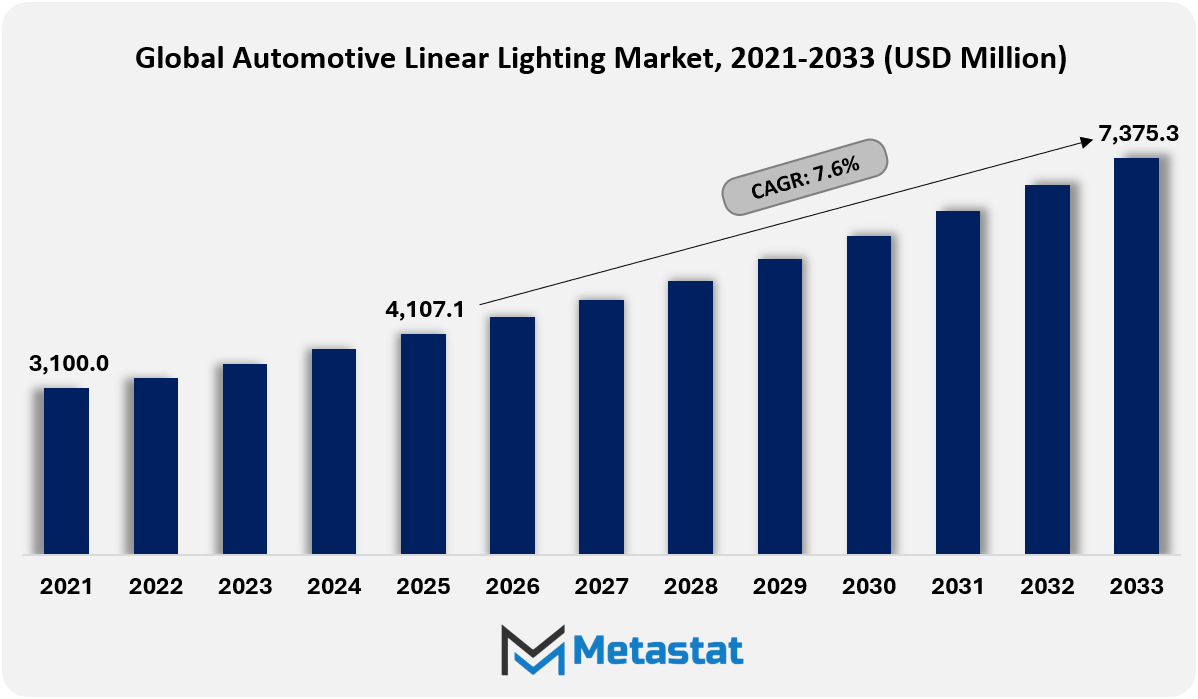
Global Automotive Linear Lighting market size is valued at USD 4,107.1 million in 2025 and projected to grow at a CAGR of 7.6% during the forecast period, reaching USD 7,375.3 million by 2033.
Global Automotive Linear Lighting Market: Comprehensive Data-Driven Market Analysis and Strategic Outlook
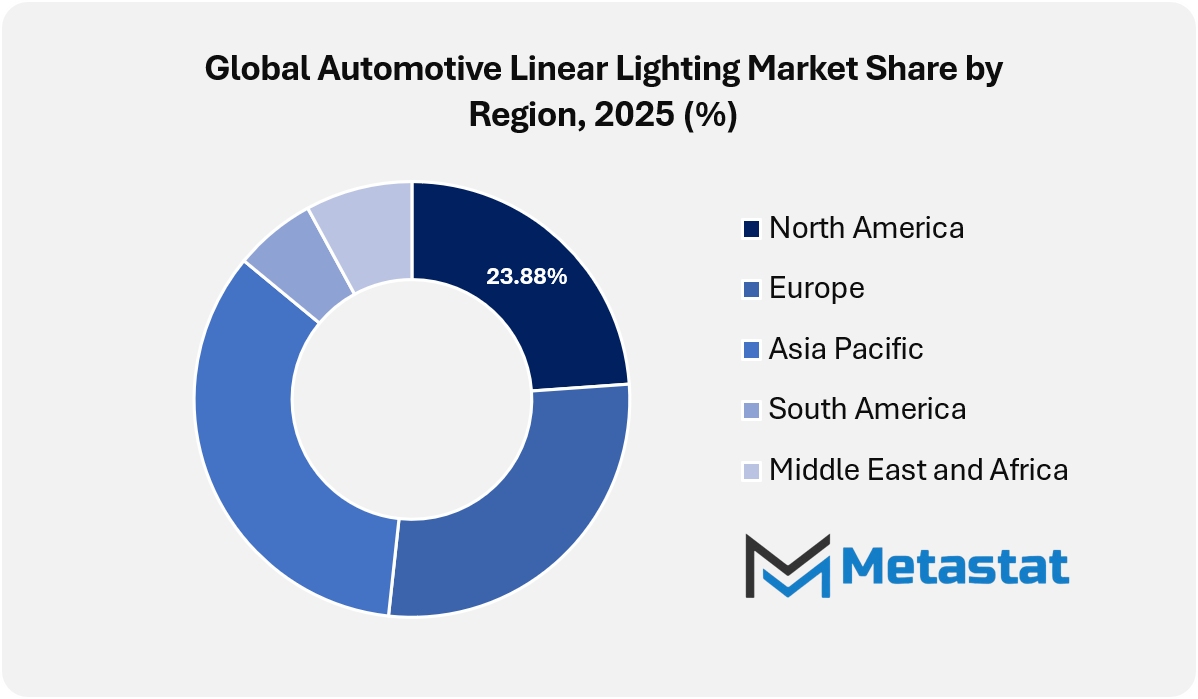
North America holds 23.9% of the global Automotive Linear Lighting market in 2025, with the U.S. leading the regional market.
LED-Based Linear Lighting segment accounts for a 72.6% market share in 2025.
Key trends driving growth: Rising Adoption of Full-Width LED Signature Lighting in EVs and Premium Vehicles, Growing Demand for Ambient and HMI-Integrated Interior Light Bars.
Opportunities include expansion of Software-Defined, Dynamic, and Personalized Cabin-to-Exterior Lighting Architectures.
Key insight: Increasing convergence of design, safety, and digital experience is transforming automotive lighting into a core element of vehicle innovation, accelerating growth across the Global Automotive Linear Lighting market.
The Global Automotive Linear Lighting market is evolving rapidly with the shift toward electric and connected vehicles. Lighting is no longer limited to visibility functions; it now plays an important role in communication, vehicle branding, and user experience. Automotive manufacturers are investing in advanced lighting systems that combine aesthetic appeal with functional performance.
Technological advancements in LED and OLED systems are enabling thinner, more flexible, and energy-efficient lighting solutions. These developments support seamless integration of lighting across vehicle surfaces, including front grilles, rear panels, and interior dashboards. As a result, linear lighting systems are becoming a defining element of modern vehicle design. Growing consumer preference for premium vehicle features is further supporting adoption. Buyers increasingly value visual appeal, personalization, and smart cabin experiences, encouraging manufacturers to incorporate advanced lighting solutions. These factors continue to support the long-term growth of the Global Automotive Linear Lighting market.
Market Dynamics
Growth Drivers:
Rising Adoption of Full-Width LED Signature Lighting in EVs and Premium Vehicles.
Rising demand for distinctive vehicle identity is supporting adoption of full-width LED signature lighting across electric vehicles and premium models. Automotive manufacturers are focusing on brand differentiation through continuous light bars that enhance visibility and design appeal. The Global Automotive Linear Lighting market is benefiting from integration of advanced LED modules with improved efficiency and durability.
Growing Demand for Ambient and HMI-Integrated Interior Light Bars
Increasing focus on enhanced in-cabin experience is driving demand for ambient lighting systems integrated with human-machine interfaces. Interior light bars provide visual feedback linked to vehicle controls, improving user interaction. The Global Automotive Linear Lighting market is gaining traction from rising consumer interest in comfort, personalization, and intuitive dashboard communication features.
Restraints and Challenges:
High Customization and Integration Cost for Light Guides, Electronics, and Software Control
A high degree of customization required for linear lighting solutions increases costs across design, electronics integration, and software programming. Automotive manufacturers face challenges in maintaining cost efficiency while meeting design expectations. The Global Automotive Linear Lighting market is constrained by complex supply chains and specialized component requirements.
Regulatory, Validation, and Functional-Safety Complexity in Exterior Lighting Systems
Strict regulatory frameworks governing automotive lighting create challenges in validation and compliance processes. Functional safety requirements demand rigorous testing for exterior lighting systems, increasing development timelines. The Global Automotive Linear Lighting market faces barriers from regional policy variations and evolving safety standards that affect product approval cycles.
Opportunities:
Expansion of Software-Defined, Dynamic, and Personalized Cabin-to-Exterior Lighting Architectures
Advancements in software-defined vehicle architecture are creating opportunities for dynamic and personalized lighting systems that connect cabin and exterior elements. Automotive manufacturers are exploring adaptive lighting patterns that respond to user preferences and driving conditions. The Global Automotive Linear Lighting market is expanding through innovation in synchronized lighting ecosystems supported by intelligent control systems.
Market Segmentation Analysis
The Global Automotive Linear Lighting market is classified based on Technology, Vehicle Type, Application, and Sales Channel.
By Technology, the market is further segmented into:
LED-Based Linear Lighting
LED-Based Linear Lighting segment is valued at USD 3,204.1 million in 2026 and is projected to reach USD 5,490.9 million by 2033, at a CAGR of 8% during the forecast period.
LED-Based Linear Lighting will maintain a dominant position in the Global Automotive Linear Lighting market owing to its energy efficiency, long lifespan, and design flexibility. Manufacturers are integrating advanced LED strips to deliver sharper illumination patterns and stronger brand differentiation. Continuous improvements in thermal management and miniaturization are further enhancing performance across premium and mass-market vehicle segments.
OLED Lighting
OLED Lighting segment is valued at USD 331.2 million in 2026 and is projected to reach USD 667.5 million by 2033, at a CAGR of 10.5% during the forecast period.
OLED Lighting is introducing thin, flexible panels that support uniform light emission and enhanced aesthetics. The Global Automotive Linear Lighting market is witnessing increased adoption in high-end vehicles, driven by demand for futuristic interior and exterior styling. Improvements in durability and cost reduction will expand usage beyond the luxury segment and support broader commercial scalability over time.
Fiber Optic Lighting
Fiber Optic Lighting segment is valued at USD 500.6 million in 2026 and is projected to reach USD 645.3 million by 2033, at a CAGR of 3.7% during the forecast period.
Fiber Optic Lighting is gaining traction owing to its ability to deliver light distribution with minimal heat generation. The Global Automotive Linear Lighting market benefits from its integration into ambient lighting and decorative elements. Advancements in material strength and cost efficiency are encouraging broader use across mid-range vehicles, enhancing interior experience and safety visibility.
Others
Others segment is valued at USD 379 million in 2026 and is projected to reach USD 571.6 million by 2033, at a CAGR of 6% during the forecast period.
Other lighting technologies include hybrid systems and emerging innovations that combine multiple light sources. The Global Automotive Linear Lighting market is evolving through experimentation in laser-assisted lighting and smart adaptive systems. Ongoing research is supporting new applications that improve vehicle personalization and functional lighting performance across multiple vehicle categories.
By Vehicle Type, the market is divided into:
Passenger Cars
Passenger Cars segment is projected to reach USD 5,849.4 million by 2033, at a CAGR of 7.8% during the forecast period.
Passenger Cars will remain the leading vehicle type in the Automotive Linear Lighting market, supported by rising focus on aesthetics, safety, and brand identity. Automakers are integrating linear lighting into both interior and exterior systems to improve user experience. Increasing adoption of electric vehicles is further accelerating demand for advanced lighting solutions across compact and premium segments.
Light Commercial Vehicles
Light Commercial Vehicles segment is projected to reach USD 868.8 million by 2033, at a CAGR of 7.8% during the forecast period.
Light Commercial Vehicles will witness steady growth in the Global Automotive Linear Lighting market, driven by fleet modernization and safety requirements. Businesses are prioritizing durable and efficient lighting systems to improve operational visibility. Integration of linear lighting also enhances vehicle identity and branding across logistics and delivery applications.
Heavy Commercial Vehicles
Heavy Commercial Vehicles segment is projected to reach USD 444.7 million by 2033, at a CAGR of 6.6% during the forecast period.
Heavy Commercial Vehicles are adopting linear lighting solutions to improve road safety and visibility under demanding operating conditions. The Global Automotive Linear Lighting market is seeing increased deployment in trucks and buses, where enhanced illumination supports long-distance operations. Regulatory focus on safety standards is further driving adoption across commercial transportation networks.
Others
Others segment is projected to reach USD 212.4 million by 2033, at a CAGR of 5.2% during the forecast period.
Other vehicle categories include specialty vehicles and emerging mobility platforms. The Global Automotive Linear Lighting market is expanding into electric scooters, autonomous shuttles, and niche vehicle formats. Innovation in compact and adaptive lighting systems is supporting integration across unconventional mobility applications, improving functionality and visual appeal.
By Application, the market is further divided into:
Front Signature Lighting
Front Signature Lighting segment is projected to reach USD 2,038.5 million by 2033.
Front Signature Lighting plays a vital role in vehicle identity and safety within the Global Automotive Linear Lighting market. Manufacturers are designing distinctive lighting patterns to strengthen brand recognition. Advancements in adaptive lighting technology are enabling dynamic illumination that improves visibility and communication with pedestrians and other road users.
Rear Signature Lighting
Rear Signature Lighting segment is projected to reach USD 2,586.5 million by 2033.
Rear Signature Lighting enhances visibility and aesthetic appeal, contributing to safer driving conditions. The Global Automotive Linear Lighting market is seeing stronger focus on dynamic rear lighting systems that respond to braking and driving situations. Continuous innovation is supporting improved energy efficiency and deeper integration with smart vehicle systems.
Grille Lighting
Grille Lighting segment is projected to reach USD 733.1 million by 2033.
Grille Lighting is becoming a design-focused application within the Global Automotive Linear Lighting market. Automakers are using illuminated grilles to create futuristic vehicle appearances, particularly in electric vehicles. Integration of programmable lighting patterns is enabling greater customization, stronger consumer engagement, and clearer brand differentiation.
Daytime Running Lighting
Daytime Running Lighting segment is projected to reach USD 1,262.7 million by 2033.
Daytime Running Lighting remains essential for improving vehicle visibility during daytime conditions. The Global Automotive Linear Lighting market is supported by energy-efficient solutions and adaptive brightness control. Regulatory mandates continue to support widespread adoption across multiple vehicle categories and regions.
Others
Others segment is projected to reach USD 754.5 million by 2033.
Other applications include interior ambient lighting and functional lighting systems. The Global Automotive Linear Lighting market is evolving through integration of smart lighting solutions that respond to driver preferences and environmental conditions. Continued development is enhancing comfort, safety, and personalization within modern automotive environments.
By Sales Channel, the Global Automotive Linear Lighting market is divided as:
Original Equipment Manufacturers
Original Equipment Manufacturers segment is projected to grow at a CAGR of 7.7% during the forecast period.
Original equipment manufacturers will hold significant share in the Global Automotive Linear Lighting market through direct integration of advanced lighting systems during vehicle production. Collaboration between automakers and lighting technology providers will drive innovation. Focus on design differentiation and regulatory compliance will support continued dominance of OEM segment.
Automotive Aftermarket
Automotive Aftermarket segment is projected to grow at a CAGR of 6% during the forecast period.
Automotive aftermarket will experience growth in the Automotive Linear Lighting market owing to rising consumer interest in customization and upgrades. Vehicle owners will seek advanced lighting solutions to enhance appearance and functionality. Expansion of e-commerce platforms and service networks will facilitate accessibility, supporting steady demand in aftermarket segment.
By Region:
Based on geography, the Global Automotive Linear Lighting market is divided into North America, Europe, Asia-Pacific, South America, Middle East, and Africa.
Asia-Pacific will lead the Automotive Linear Lighting market, supported by high vehicle production, expanding EV manufacturing, and rising adoption of advanced lighting features.
North America and Europe remain important markets owing to strong demand for premium vehicles, the presence of leading automotive OEMs and technology suppliers, and continued innovation in lighting integration.
South America and the Middle East & Africa are projected to witness steady growth, supported by improving automotive sales, infrastructure development, and gradual adoption of advanced vehicle technologies.
Competitive Landscape and Strategic Insights
The Global Automotive Linear Lighting market continues to gain strategic importance with rising focus on vehicle design, safety, and brand identity. Linear lighting, widely used in headlamps, rear lamps, and interior ambient systems, is increasingly shaping how vehicles appear and perform on the road. Automakers are investing more heavily in distinctive visual signatures, with lighting playing a central role in that effort. Growing volumes of electric vehicles and premium models are strengthening demand for smooth and continuous lighting lines, while rising consumer attention toward aesthetics is encouraging manufacturers to refine solutions that combine style with functionality.
Technology remains a core factor behind market development. LED and OLED lighting solutions are becoming more common owing to their energy efficiency, long operating life, and design flexibility. These systems support smoother light distribution, improving visibility while strengthening the overall appearance of the vehicle. Integration with smart vehicle systems is also expanding, allowing lighting to respond to driving conditions, weather, and user preferences. As vehicles move toward higher levels of automation, lighting is also emerging as a communication interface between the vehicle, the driver, and pedestrians.
The competitive landscape remains active, with established players strengthening their market positions through innovation, product development, and strategic partnerships. Companies such as Valeo SA, ZKW Group GmbH, DRÄXLMAIER Group, Yanfeng International Automotive Technology Co. Ltd., and Antolin continue to invest in advanced lighting design and integrated system capabilities. Other important participants include Automated Assembly Corporation, Marquardt Management SE, Diodes Incorporated, STMicroelectronics, and Preh GmbH.
Companies such as TactoTek, Uno Minda, SCHOTT AG, Oshino Lamps Ltd., and Stanley Electric Co., Ltd. are also playing an important role in shaping the market. Their focus on innovation, cost efficiency, and global expansion is influencing how quickly new lighting solutions reach key regions. As competition intensifies, collaboration between technology providers and automakers is becoming more common, supporting wider adoption of advanced and visually distinctive lighting systems across mainstream vehicles.
Forecast and Future Outlook
Market size is forecast to rise from USD 4,107.1 million in 2025 to over USD 7,375.3 million by 2033.
The Global Automotive Linear Lighting market is set to witness sustained growth, supported by advancements in automotive design and rising adoption of electric vehicles. Lighting systems are evolving from functional components into integral elements of vehicle identity, digital interaction, and user experience.
Automotive Linear Lighting Market Key Segments:
By Technology:
LED-Based Linear Lighting
OLED Lighting
Fiber Optic Lighting
Others
By Vehicle Type:
Passenger Cars
Light Commercial Vehicles
Heavy Commercial Vehicles
Others
By Application:
Front Signature Lighting
Rear Signature Lighting
Grille Lighting
Daytime Running Lighting
Others
By Sales Channel:
Original Equipment Manufacturers
Automotive Aftermarket
Key Global Automotive Linear Lighting Industry Players
This research report categorizes the Automotive Linear Lighting market based on key segments and regions, forecasts revenue growth, and analyses trends in each submarket. The report analyses the key growth drivers, opportunities, and challenges influencing the Automotive Linear Lighting market. Recent market developments and competitive strategies such as expansion, product launch, partnership, merger, and acquisition have been included to draw the competitive landscape in the market.
The report strategically identifies and profiles the key market players and analyses their core competencies in each sub-segment of the Automotive Linear Lighting market.
Report Attributes
Details
Study Period
2021-2033
Base Year
2025
Estimated Year
2026
Forecast Period
2026-2033
Historical Period
2021-2025
Growth Rate
CAGR 7.6% from 2026 to 2033
Revenue Unit
USD million
Sales Volume Unit
Thousand Units
Segmentation
By Technology, Vehicle Type, Application, Sales Channel, and Region
By Region
North America (By Technology, Vehicle Type, Application, Sales Channel, and Country)
United States
Canada
Mexico
Europe (By Technology, Vehicle Type, Application, Sales Channel, and Country)
Germany
France
UK
Italy
Spain
Russia
Rest of Europe
Asia Pacific (By Technology, Vehicle Type, Application, Sales Channel, and Country)
China
Japan
India
South Korea
Australia
Southeast Asia
Rest of Asia Pacific
South America (By Technology, Vehicle Type, Application, Sales Channel, and Country)
Brazil
Argentina
Rest of South America
Middle East and Africa (By Technology, Vehicle Type, Application, Sales Channel, and Country)
Saudi Arabia
UAE
South Africa
Rest of Middle East and Africa
WHAT REPORT PROVIDES
Key Company Market Share, Revenue, and Position/Ranking
Key Market Leaders
Full In-Depth Analysis of the Parent Industry
Industry Statistics
Important Changes in Market and Its Dynamics
Segmentation Details of the Market
Historical, On-Going, and Projected Market Analysis
Assessment of Niche Industry Developments
Market Share Analysis
Key Strategies of Major Players
Company Profiles of Key Players
Unique Selling Propositions of Leading Market Players
UK Bus & Coach Fleet Leasing, Rental and Finance Market Size, Share, Trends, 2033
UK Bus & Coach Fleet Leasing, Rental and Finance market size is valued at USD 886.4 million in 2025 and is projected to reach USD 1,442.8 million in 2033, at a CAGR of 6.3% from 2026 to 2033
UK Bus & Coach Fleet Leasing, Rental and Finance Market, UK Bus & Coach Fleet Leasing, Rental and Finance Market Size, UK Bus & Coach Fleet Leasing, Rental and Finance Market Share, UK Bus & Coach Fleet Leasing, Rental and Finance Market Analysis, UK Bus & Coach Fleet Leasing, Rental and Finance Market Growth, UK Bus & Coach Fleet Leasing, Rental and Finance Market Trends, UK Bus & Coach Fleet Leasing, Rental and Finance Market Research Report, UK Bus & Coach Fleet Leasing, Rental and Finance Market Forecast, UK Bus & Coach Fleet Leasing, Rental and Finance, UK Bus & Coach Fleet Leasing, Rental and Finance Market Research, UK Bus & Coach Fleet Leasing, Rental and Finance Industry, UK Bus & Coach Fleet Leasing, Rental and Finance Industry Report, UK Bus & Coach Fleet Leasing, Rental and Finance Market Data, UK Bus & Coach Fleet Leasing, Rental and Finance Statistics, UK Bus & Coach Fleet Leasing, Rental and Finance Market Statistics, UK Bus & Coach Fleet Leasing, Rental and Finance Industry Trends, UK Bus & Coach Fleet Leasing, Rental and Finance Market Report, UK Bus & Coach Fleet Leasing, Rental and Finance Market Trends, UK Bus & Coach Fleet Leasing, Rental and Finance Market News, UK Bus & Coach Fleet Leasing, Rental and Finance Forecasts, UK Bus & Coach Fleet Leasing, Rental and Finance Market Intelligence Report
USA EVSE Procurement Market Size, Share, Trends, 2033
USA EVSE Procurement market size is valued at USD 6.6 billion in 2025 and is projected to reach USD 52.1 billion in 2033, at a CAGR of 29.5% from 2026 to 2033.
USA EVSE Procurement Market, USA EVSE Procurement Market Size, USA EVSE Procurement Market Share, USA EVSE Procurement Market Analysis, USA EVSE Procurement Market Growth, USA EVSE Procurement Market Trends, USA EVSE Procurement Market Research Report, USA EVSE Procurement Market Forecast, USA EVSE Procurement, USA EVSE Procurement Market Research, USA EVSE Procurement Industry, USA EVSE Procurement Industry Report, USA EVSE Procurement Market Data, USA EVSE Procurement Statistics, USA EVSE Procurement Market Statistics, USA EVSE Procurement Industry Trends, USA EVSE Procurement Market Report, USA EVSE Procurement Market Trends, USA EVSE Procurement Market News, USA EVSE Procurement Forecasts, USA EVSE Procurement Market Intelligence Report
Inductive Loop Vehicle Detector market size is valued at USD 93.1 million in 2025 and is projected to reach USD 205.5 million in 2033, at a CAGR of 10.4% from 2026 to 2033.
Heavy Duty Truck Wash Market Size, Share, Trends, 2033
Global Heavy Duty Truck Wash market size is valued at USD 1,240.7 million in 2025 and is projected to reach USD 1,863.2 million in 2033, at a CAGR of 5.0% from 2026 to 2033
Heavy Duty Truck Wash Market, Heavy Duty Truck Wash Market Size, Heavy Duty Truck Wash Market Share, Heavy Duty Truck Wash Market Analysis, Heavy Duty Truck Wash Market Growth, Heavy Duty Truck Wash Market Trends, Heavy Duty Truck Wash Market Research Report, Heavy Duty Truck Wash Market Forecast, Heavy Duty Truck Wash, Heavy Duty Truck Wash Market Research, Heavy Duty Truck Wash Industry, Heavy Duty Truck Wash Industry Report, Heavy Duty Truck Wash Market Data, Heavy Duty Truck Wash Statistics, Heavy Duty Truck Wash Market Statistics, Heavy Duty Truck Wash Industry Trends, Heavy Duty Truck Wash Market Report, Heavy Duty Truck Wash Market Trends, Heavy Duty Truck Wash Market News, Heavy Duty Truck Wash Forecasts, Heavy Duty Truck Wash Market Intelligence Report