Audio Over IP (AoIP) Market Size, Share, By Protocol and Standard (AES67, Dante, Ravenna, Livewire, Q-LAN, AVB, Milan, and Others), By Deployment Model (On-Premise, Cloud-Managed, and Hybrid), By Application (Broadcast, Commercial, Industrial, and Residential), By End-User (Radio, TV Broadcasting, Corporate, Education, Government, Hospitality, Healthcare, Transportation, Infrastructure, and Others), Industry Analysis, Growth, Trends, and Forecast, 2026-2033
Report ID
MSI-4577
Published
April 8, 2026
Pages
320 Pages
Format
Report Details
Comprehensive Market Analysis And Insights
Market Overview
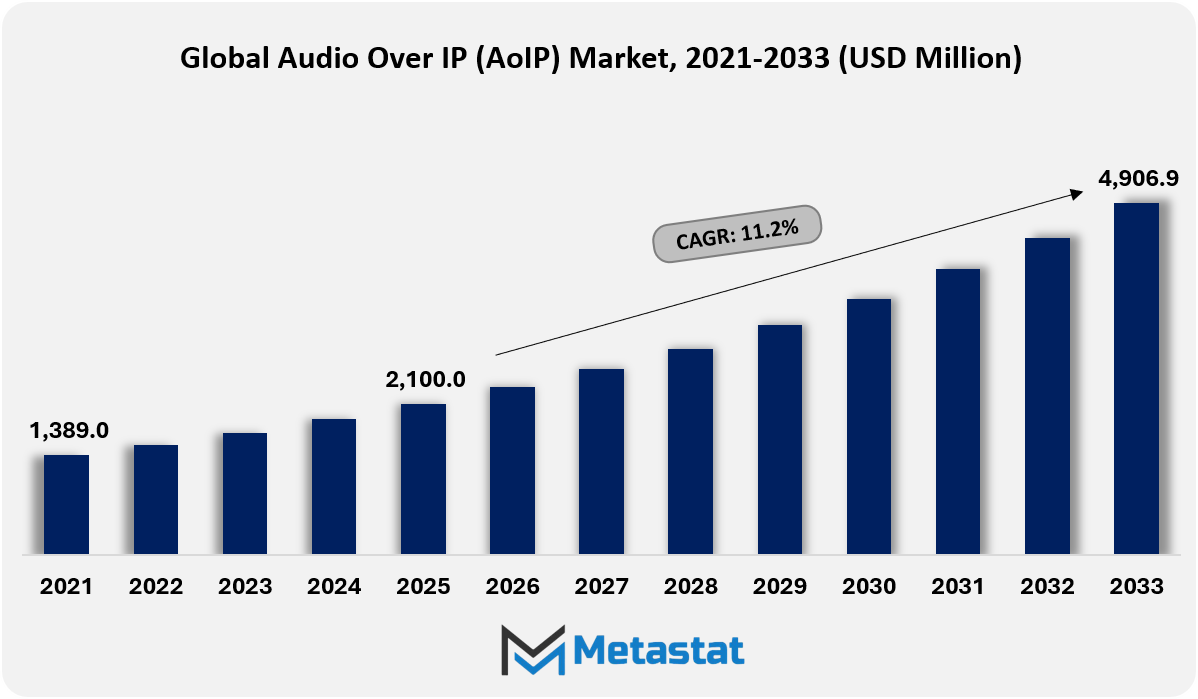
The Global Audio Over IP (AoIP) market size was valued at USD 2,100 million in 2025. The market is projected to grow from USD 2,333 million in 2026 to USD 4,906.9 million by 2033, exhibiting a CAGR of 11.2% during the forecast period.
Global Audio Over IP (AoIP) Market: Comprehensive Data-Driven Market Analysis and Strategic Outlook
Global Audio Over IP (AoIP) market valued at USD 2,100 million in 2025, growing at a CAGR of 11.2% through 2033, with potential to exceed USD 4,906.9 million.
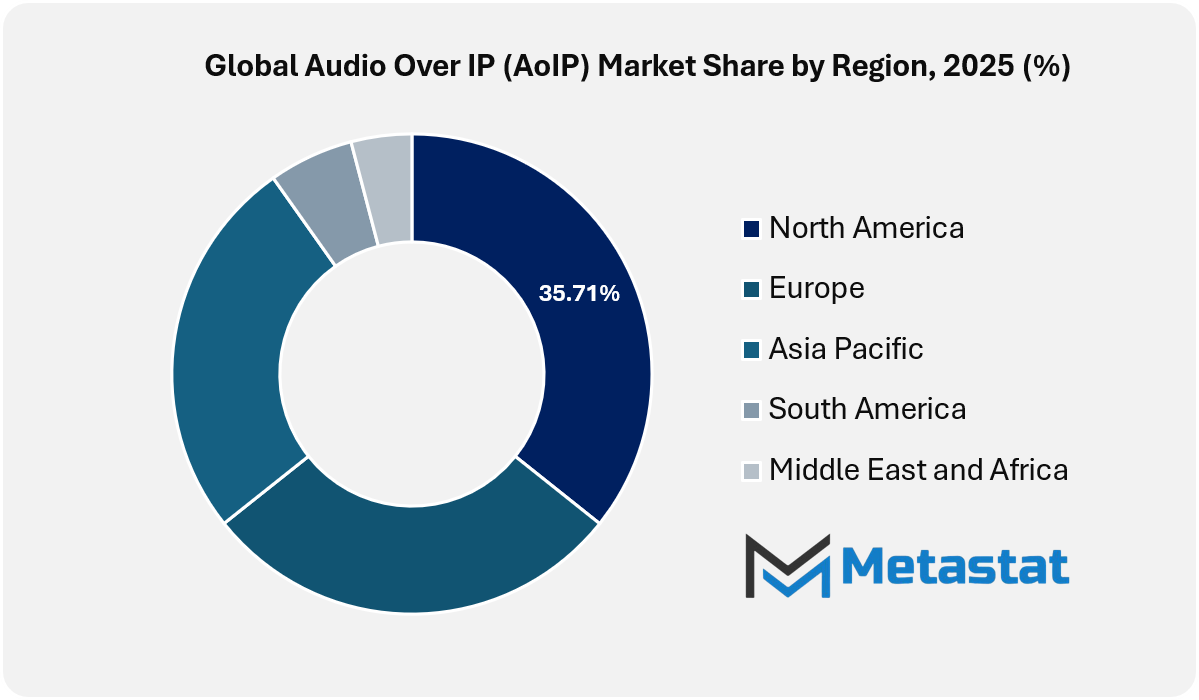
North America held 35.7% market share in 2025, with the United States leading the regional market.
AES67 segment accounted for a 20.2% market share in 2026.
Key trends include the shift from SDI and legacy audio infrastructure to IP-based production and the expansion of remote production, distributed workflows, and networked audio.
Opportunities include cloud-connected and software-defined AoIP for hybrid broadcast, AV, and large-scale venues.
Key insight: Global Audio Over IP (AoIP) market is shifting from niche broadcast adoption toward network-centric audio ecosystems supported by scalability, flexibility, and digital infrastructure modernization.
Global Audio over IP (AoIP) market within professional audio and broadcast technology is set to expand beyond traditional sound broadcasting and studio networking, establishing AoIP as a foundational layer for digital communications. Over time, AoIP adoption will reshape audio integration across cloud-native workflows, digital production environments, and decentralized content creation models. Audio signals will flow alongside data, control, and analytics streams, enabling synchronized operations across geographically dispersed facilities.
In future deployments, AoIP infrastructure will support a wide range of large-scale use cases across entertainment, corporate communications, and public infrastructure projects. Smart venues, virtual classrooms, and hybrid offices will depend on IP-based audio frameworks to maintain consistent quality across devices, platforms, and locations. Audio routing will no longer remain a backend function. Audio systems will adapt dynamically to bandwidth conditions, latency limits, and security requirements.
Market Dynamics
Growth Drivers:
Shift From SDI and Legacy Audio Infrastructure to IP-Based Production.
Global Audio over IP (AoIP) market shows strong momentum, owing to the replacement of SDI and legacy audio systems with IP-based production environments. IP architecture enables scalability, flexible routing, and cost-efficient expansion. Broadcast facilities and professional AV operators will prioritize long-term efficiency, simplified cabling and alignment with modern digital production standards.
Expansion of Remote Production, Distributed Workflows, and Networked Audio
Adoption of remote production and distributed workflows will drive demand in global Audio over IP (AoIP) market. Networked audio environments will support real-time collaboration across different locations, reducing reliance on physical infrastructure. Broadcasters, live event operators and enterprises will favor a centralized control model supported by flexible IP networks and synchronized audio delivery.
Restraints and Challenges:
Interoperability Challenges Across AoIP Protocols and Vendor Ecosystems
Global Audio over IP (AoIP) market faces friction from limited interoperability across competing AoIP protocols and proprietary vendor ecosystems. Fragmented standards will complicate system integration and restrict deployment flexibility. Buyers will face extended verification cycles, higher integration costs and cautious investment behavior during multi-vendor network planning stages.
Network Design Complexity, Latency Assurance, and Cybersecurity Risks
Complex network design requirements will challenge continued adoption in the global Audio over IP (AOIP) market. Latency assurance, clock synchronization, and traffic prioritization will require special expertise. The growing cybersecurity risks in IP-based audio networks will require advanced monitoring, encryption strategies, and governance frameworks to protect mission-critical audio operations.
Opportunities:
Cloud-Connected and Software-Defined AoIP for Hybrid Broadcast, AV, and Large-Scale Venues
Cloud-connected and software-defined architectures will create future opportunities within the global Audio over IP (AOIP) market. Hybrid broadcast environments and large-scale venues will benefit from virtualized audio processing, remote management, and elastic scalability. Integration with cloud platforms will unlock operational agility and support evolving content delivery models.
Market Segmentation Analysis
The Global Audio Over IP (AoIP) market is classified based on Protocol and Standard, Deployment Model, Application, and End-User.
By Protocol and Standard, the market is further segmented into:
AES67
AES67 segment was valued at USD 471.5 Million in 2026 and is projected to reach USD 936.7 Million by 2033, at a CAGR of 10.3% during the forecast period.
AES67 is gaining relevance due to interoperability benefits in the network audio ecosystem. Future adoption will be supported by demand for standardized audio transport across different vendor platforms. Widespread acceptance in the professional audio environment will support steady growth, especially within features that prioritize open standards and long-term compatibility planning.
Dante
Dante segment was valued at USD 1,058.8 Million in 2026 and is projected to reach USD 2,381.8 Million by 2033, at a CAGR of 12.3% during the forecast period.
Dante technology signals strong future speeds through higher channel counts and simplified network configurations. Professional audio networks are increasingly preferring solutions that offer reliability and ease of deployment. Continued innovation within the Dante-based ecosystem will support deeper penetration into live production, studio operations and enterprise-level audio infrastructure.
Ravenna
Ravenna segment was valued at USD 287.8 Million in 2026 and is projected to reach USD 609.4 Million by 2033, at a CAGR of 11.3% during the forecast period.
The adoption of the Ravenna protocol reflects the increasing emphasis on high-precision audio timing and synchronization. Broadcast-grade performance expectations will drive long-term relevance. Expansion in media production centers will be supported by demand for scalable audio networks that support uncompressed transmission and strict quality benchmarks aligned with broadcast standards.
Livewire
Livewire segment was valued at USD 226.7 Million in 2026 and is projected to reach USD 423.5 Million by 2033, at a CAGR of 9.3% during the forecast period.
Livewire maintains importance in broadcast-centric audio environments due to deterministic performance and low latency. Future use will be linked to the modernization of radio and television infrastructure. Network convergence initiatives in media facilities will maintain relevance for Livewire within mission-critical audio workflows.
Others (AVB and Milan, Q-LAN)
Others (AVB and Milan, Q-LAN) segment was valued at USD 288.3 Million in 2026 and is projected to reach USD 555.5 Million by 2033, at a CAGR of 9.8% during the forecast period.
AVB, Milan and Q-LAN technologies address specific needs within professional audio networking. Future relevance will emerge from deterministic networking demands and synchronized media delivery.
By Deployment Model, the market is divided into:
On-Premise
On-Premise segment is projected to reach USD 2,577.6 Million by 2033, at a CAGR of 9.1% during the forecast period.
On-premises deployments retain value through security controls and performance predictability. Future investment will focus on organizations managing sensitive audio operations. Organizations operating broadcast stations, industrial facilities, and critical infrastructure will favor on-premises deployments to retain control and minimize external dependencies for mission-critical audio workflows.
Cloud-Managed
Cloud-Managed segment is projected to reach USD 1,478 Million by 2033, at a CAGR of 14.7% during the forecast period.
Cloud-managed deployments reflect future-oriented audio management through centralized control and remote access. Scalability benefits will attract enterprises seeking flexible operations. Continued cloud infrastructure maturity will support adoption across geographically distributed operations requiring real-time monitoring, configuration, and performance optimization.
Hybrid
Hybrid segment is projected to reach USD 851.3 Million by 2033, at a CAGR of 12.7% during the forecast period.
Hybrid deployment combines local control with cloud-based flexibility. Future adoption will accelerate through demand for flexible audio architectures that support operational continuity. Enterprises looking to balance data security with scalability will increasingly prefer hybrid frameworks that support gradual digital transformation strategies.
By Application, the market is further divided into:
Broadcast
Broadcast segment is projected to reach USD 2,139.4 Million by 2033 with a share of 47.2% in 2025.
Broadcast applications represent a fundamental growth driver through network-based studio modernization. Future broadcast operations will prioritize IP-based audio transports that support multi-platform content delivery. Integration with automated production workflows will increase efficiency and solidify long-term adoption across global media networks.
Commercial
Commercial segment is projected to reach USD 1,723.8 Million by 2033 with a share of 32% in 2025.
Commercial applications experience growth through adoption across corporate campuses, retail environments, and event venues. Future demand will focus on centralized audio management and scalable deployment. Digital signage and integration with smart building systems will further expand business relevance.
Industrial
Industrial segment is projected to reach USD 665.4 Million by 2033 with a share of 12.5% in 2025.
Industrial application growth reflects the increasing use of network audio for security alerts and operational communications. Future facilities will prioritize real-time audio delivery across wide sites. Integration with industrial automation systems will support continued demand in the manufacturing and processing sectors.
Residential
Residential segment is projected to reach USD 378.3 Million by 2033 with a share of 8.3% in 2025.
Residential application expansion reflects smart home development and demand for integrated audio environments. Future growth will depend on simplified network management and compatibility with home automation platforms. High-quality audio streaming in connected living spaces will gradually support market expansion.
By End-User, the Global Audio Over IP (AoIP) market is divided as:
Radio & TV Broadcasting
Radio & TV Broadcasting segment is projected to grow at a CAGR of 10.2% during the forecast period.
Radio and television broadcasting remain the primary end-user segments due to ongoing infrastructure upgrades. Future investment will focus on IP-based studios supporting remote production and content syndication. Operational efficiency gains will reinforce long-term reliance on network audio systems.
Corporate
Corporate segment is projected to grow at a CAGR of 11.8% during the forecast period.
Corporate end-user adoption reflects increased focus on unified communications environments. The workplace of the future will emphasize integrated audio systems that support conferencing, collaboration, and facility-wide announcements. The adoption of network audio will align with digital workplace transformation strategies in global enterprises.
Education
Education segment is projected to grow at a CAGR of 11.3% during the forecast period.
Educational institutions are increasingly adopting network audio to support digital learning environments. Future campuses will prioritize scalable audio delivery in lecture halls and virtual classrooms. Integration with learning management platforms will increase communication quality and operational consistency.
Government
Government segment is projected to grow at a CAGR of 10% during the forecast period.
Government sector adoption reflects the need for secure and reliable communications infrastructure. Future applications will focus on emergency response systems and public address networks. Network-based audio solutions will support the modernization of civic facilities and administrative operations.
Hospitality
Hospitality segment is projected to grow at a CAGR of 11.4% during the forecast period.
Hospitality end-user growth reflects an emphasis on guest experience personalization. Hotels and resorts of the future will deploy centralized audio systems supporting adaptive sound environments. Integration with building management platforms will increase operational efficiency and brand differentiation.
Others (Healthcare, Transportation & Infrastructure) segment is projected to grow at a CAGR of 13.5% during the forecast period.
Healthcare, transportation and infrastructure sectors will adopt network audio for security, coordination and information delivery. Reliability and low-latency communications will be prioritized in future development. Smart city programs will further propel adoption across public infrastructure projects.
By Region:
Based on geography, the Global Audio Over IP (AoIP) market is divided into North America, Europe, Asia-Pacific, South America, Middle East, and Africa.
North America Audio Over IP (AoIP) Market is set to expand at a CAGR of 11.2% within the forecast period, reaching a market size (TAM) of USD 1711.5 million by the end of 2033.
North America has recorded strong AoIP demand through widespread IP-based broadcast studios, live event production and enterprise AV modernization.
North America benefits from early adoption of network audio standards, high bandwidth availability, and a strong presence of professional audio technology providers.
Asia Pacific presents major AoIP opportunities through the rapid expansion of smart cities, digital media hubs and IP-enabled public address systems.
Asia Pacific is being driven by rising investments in broadcast infrastructure, OTT content creation and large-scale sports and entertainment events.
Across the Middle East, Africa, and South America, global Audio over IP (AoIP) market is gradually expanding through IP network upgrades, broadcast digitalization, and stronger demand for cost-efficient audio delivery across commercial and government sectors.
Competitive Landscape and Strategic Insights
Global Audio Over IP (AoIP) market continues to gain traction as organizations shift toward network-based audio distribution for greater flexibility and efficiency. AoIP enables audio signals to travel over standard IP networks, reducing reliance on complex cabling and legacy systems. Broadcasters, corporate organizations, live production teams, and public infrastructure operators increasingly adopt AoIP to support scalable workflows and remote operations. Digital transformation across industries is positioning audio delivery over IP networks as a preferred approach, supported by cost control benefits and improved signal management.
Technology providers in this space are focusing on interoperability, low latency, and network reliability to meet rising performance expectations. Companies such as Audinate, Lawo, Avid Technology, Inc., Riedel Communications, Yamaha Corporation, Sony, Bosch Communications Systems, and Telos Alliance are shaping professional-grade AoIP answers a good way to serve broadcast studios, stay manufacturing environments, and agency communication systems. Their systems often integrate with existing IT infrastructure, supporting smoother transitions from traditional audio setups. Practical compatibility will continue to reinforce market confidence.
Network-focused and hardware-driven innovators also play an important role in strengthening AoIP ecosystems. Netgear, Cisco (Webex), Barix, DirectOut GmbH, and Voitel Ltd contribute switching, routing, and streaming solutions that improve network stability and audio quality. Calrec Audio, Ross Video, DiGiCo, Focusrite Pro, Stage Tec, Solid State Logic, Wheatstone, and Merging Technologies address high-end production demands where precision and control are critical. Their continued investment in IP-based workflows signals long-term commitment to audio networking requirements.
The market also benefits from specialized and regionally influential players such as Shenzhen Tendzone Intelligent Technology Co., Ltd., 2wcom Systems GmbH, Shure Inc., Clear-Com LLC, and others that expand AoIP adoption across diverse use cases. These agencies are refining answers for intercom systems, wireless audio, and massive-scale communique networks. Standards maturity and stronger user awareness will increase collaboration across vendors, reinforcing the AoIP ecosystem and supporting wider global deployment in the coming years.
Forecast and Future Outlook
Market size is forecast to rise from USD 2,100 million in 2025 to over USD 4,906.9 million by 2033.
The global audio over IP (AOIP) market will also shape regulatory and compliance conversations, particularly where public safety, emergency communications and critical broadcast services intersect. Governments and standards bodies will place greater emphasis on interoperability, data integrity and long-term network resilience. As audio becomes software-defined, intellectual property protection and signal authentication will gain greater importance within enterprise deployments.
This research report categorizes the Audio Over IP (AoIP) market based on key segments and regions, forecasts revenue growth, and analyses trends in each submarket. The report analyzes the key growth drivers, opportunities, and challenges influencing the Audio Over IP (AoIP) market. Recent market developments and competitive strategies such as expansion, product launch, development, partnership, merger, and acquisition have been included to draw the competitive landscape in the market.
The report strategically identifies and profiles the key market players and analyses their core competencies in each sub-segment of the Audio Over IP (AoIP) market.
Report Attributes
Details
Study Period
2021-2033
Base Year
2025
Estimated Year
2026
Forecast Period
2026-2033
Historical Period
2021-2025
Growth Rate
CAGR 11.2% from 2026 to 2033
Revenue Unit
USD million
Sales Volume Unit
Units
Segmentation
By Protocol and Standard, Deployment Model, Application, End-User, and Region
By Region
North America (By Protocol and Standard, Deployment Model, Application, End-User, and Country)
United States
Canada
Mexico
Europe (By Protocol and Standard, Deployment Model, Application, End-User, and Country)
Germany
France
UK
Italy
Spain
Russia
Rest of Europe
Asia Pacific (By Protocol and Standard, Deployment Model, Application, End-User, and Country)
China
Japan
India
South Korea
Australia
Southeast Asia
Rest of Asia Pacific
South America (By Protocol and Standard, Deployment Model, Application, End-User, and Country)
Brazil
Argentina
Rest of South America
Middle East and Africa (By Protocol and Standard, Deployment Model, Application, End-User, and Country)
Saudi Arabia
UAE
South Africa
Rest of Middle East and Africa
WHAT REPORT PROVIDES
Full In-Depth Analysis of the Parent Industry
Important Changes in Market and Its Dynamics
Segmentation Details of the Market
Historical, ongoing, and projected market analysis in terms of volume and value
Assessment Of Niche Industry Developments
Market Share Analysis
Key Strategies of Major Players
Company Profiles of Key Players
Unique Selling Propositions of Major Market Players
New Zealand Optical Encryption Market Size, Share, Trends, 2033
New Zealand Optical Encryption market size is valued at USD 34.5 million in 2025 and is projected to reach USD 76.9 million in 2033, at a CAGR of 10.3% from 2026 to 2033.
New Zealand Optical Encryption Market, New Zealand Optical Encryption Market Size, New Zealand Optical Encryption Market Share, New Zealand Optical Encryption Market Analysis, New Zealand Optical Encryption Market Growth, New Zealand Optical Encryption Market Trends, New Zealand Optical Encryption Market Research Report, New Zealand Optical Encryption Market Forecast, New Zealand Optical Encryption, New Zealand Optical Encryption Market Research, New Zealand Optical Encryption Industry, New Zealand Optical Encryption Industry Report, New Zealand Optical Encryption Market Data, New Zealand Optical Encryption Statistics, New Zealand Optical Encryption Market Statistics, New Zealand Optical Encryption Industry Trends, New Zealand Optical Encryption Market Report, New Zealand Optical Encryption Market Trends, New Zealand Optical Encryption Market News, New Zealand Optical Encryption Forecasts, New Zealand Optical Encryption Market Intelligence Report
Generative AI in Analytics Market Size, Share, Trends, 2033
Generative AI in Analytics market size is valued at USD 1.6 billion in 2025 and is projected to reach USD 10.9 billion in 2033, at a CAGR of 26.8% from 2026 to 2033.
Generative AI in Analytics Market, Generative AI in Analytics Market Size, Generative AI in Analytics Market Share, Generative AI in Analytics Market Analysis, Generative AI in Analytics Market Growth, Generative AI in Analytics Market Trends, Generative AI in Analytics Market Research Report, Generative AI in Analytics Market Forecast, Generative AI in Analytics, Generative AI in Analytics Market Research, Generative AI in Analytics Industry, Generative AI in Analytics Industry Report, Generative AI in Analytics Market Data, Generative AI in Analytics Statistics, Generative AI in Analytics Market Statistics, Generative AI in Analytics Industry Trends, Generative AI in Analytics Market Report, Generative AI in Analytics Market Trends, Generative AI in Analytics Market News, Generative AI in Analytics Forecasts, Generative AI in Analytics Market Intelligence Report
Retail Project Management Software market size is valued at USD 1,505.5 million in 2025 and is projected to reach USD 3,524.9 million in 2033, at a CAGR of 11.2% from 2026 to 2033.
UK Immersive Entertainment & Experiential Property Market Size, Share, Trends, 2033
UK Immersive Entertainment & Experiential Property Market size is valued at USD 6.17 billion in 2025 and is projected to reach USD 26.16 billion in 2033, at a CAGR of 19.5% from 2026 to 2033
UK Immersive Entertainment & Experiential Property Market, UK Immersive Entertainment & Experiential Property Market Size, UK Immersive Entertainment & Experiential Property Market Share, UK Immersive Entertainment & Experiential Property Market Analysis, UK Immersive Entertainment & Experiential Property Market Growth, UK Immersive Entertainment & Experiential Property Market Trends, UK Immersive Entertainment & Experiential Property Market Research Report, UK Immersive Entertainment & Experiential Property Market Forecast, UK Immersive Entertainment & Experiential Property, UK Immersive Entertainment & Experiential Property Market Research, UK Immersive Entertainment & Experiential Property Industry, UK Immersive Entertainment & Experiential Property Industry Report, UK Immersive Entertainment & Experiential Property Market Data, UK Immersive Entertainment & Experiential Property Statistics, UK Immersive Entertainment & Experiential Property Market Statistics, UK Immersive Entertainment & Experiential Property Industry Trends, UK Immersive Entertainment & Experiential Property Market Report, UK Immersive Entertainment & Experiential Property Market Trends, UK Immersive Entertainment & Experiential Property Market News, UK Immersive Entertainment & Experiential Property Forecasts, UK Immersive Entertainment & Experiential Property Market Intelligence Report