
MetaStat Insight has published its latest comprehensive market study detailing the global wearable patch sector, highlighting a major shift toward non-invasive, continuous patient monitoring. Driven by a steep rise in global health burdens, the industry is experiencing a surge in demand for non-intrusive clinical solutions that track health metrics seamlessly without interrupting everyday routines. These advanced systems boost self-monitoring compliance and directly elevate the overall standard of clinical medical attention.
Escalating Disease Statistics Spark Strong Industry Trajectory
A primary catalyst behind the market expansion is the global increase in long-term health issues. Historic institutional tracking shows massive numbers: the World Health Organization documented a 57% spike in chronic diseases by 2020, while in the European Union, these conditions represent over 86% of total fatalities. Data from the National Health Council also indicated that approximately 133 million Americans more than 45% of the country's population were managing long-term illnesses in 2018.
Geographically, North America held the leading share of the industry in 2020. This dominance is strongly tied to heavy regional disease figures. For example, the CDC logged approximately 34.2 million cases of diabetes in the United States in 2020, with Type 2 accounting for 90%, Type 1 making up 8%, and rarer forms representing 2%. Furthermore, 48% of American adults experienced cardiovascular conditions in 2019, a figure projected to climb past 130 million cases by 2035.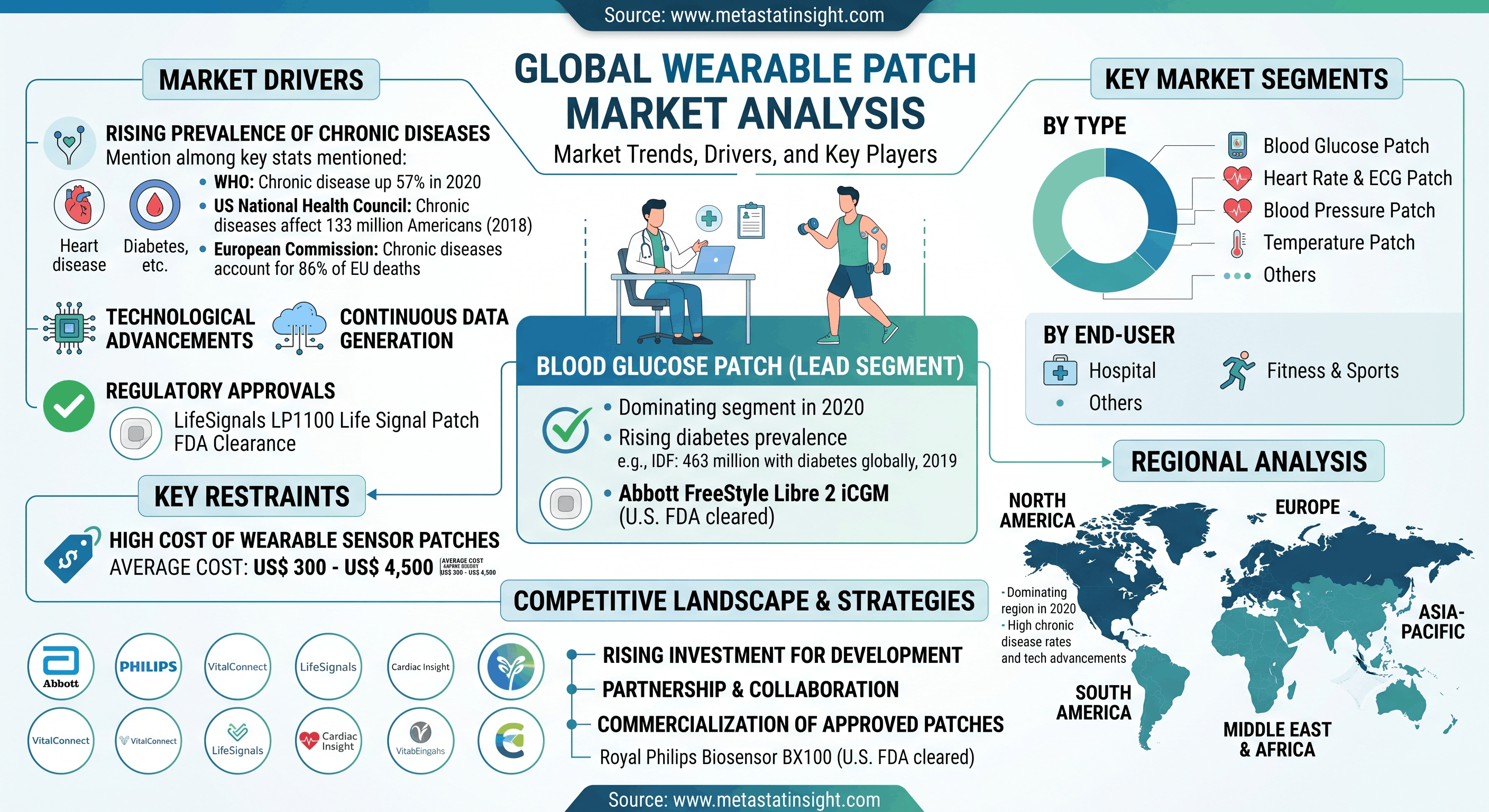
Product Segments and Key Innovations
The global industry is analyzed across distinct types and end-user spaces. By variant, the market is divided into Blood Glucose Patches, Heart Rate & ECG Patches, Blood Pressure Patches, Temperature Patches, and Others. Based on end-users, the market is split among Hospitals, Fitness and Sports settings, and Others.
Blood glucose patches held the top market position in 2020. This major share stems directly from growing global diabetes figures. The IDF Diabetes Atlas recorded roughly 463 million people living with diabetes in 2019, with expectations that this global number will expand by 48% to reach 628.6 million individuals by 2045. Regionally, groups like Diabetes UK estimate that more than five million citizens in the UK will cope with the condition by 2025.
Technological development and regulatory approvals remain critical drivers for these segments. Abbott Laboratories obtained U.S. FDA clearance for its FreeStyle Libre 2 continuous glucose monitoring system for adults and children aged four and older. The sensor tracks metrics every minute for up to 14 days without requiring fingersticks. LifeSignals, Inc. achieved FDA clearance for its wireless LP1100 Life Signal Patch, a clinical-grade, two-lead ECG and heart rate system delivering three days of data transmission via two zinc-air batteries.
Additionally, Royal Philips secured 510(k) clearance for its Biosensor BX100, designed to capture vitals and monitor suspected or confirmed hospital COVID-19 patients moving into lower-acuity care zones. Engineers at the University of California San Diego also successfully built a soft, flexible neck patch capable of tracking blood pressure and heart rate alongside lactate, glucose, alcohol, or caffeine levels.
Economic Hurdles and Competitive Landscape
Despite high growth opportunities, financial barriers present a notable constraint. High retail costs averaging from US$ 300 to US$ 4,500 per sensor patch can restrict widespread adoption. Market participants who struggle to balance these high pricing structures with premium quality standards may face growth limitations in emerging regions.
The global competitive landscape features prominent players driving market strategies through specialized partnerships, increased R&D funding, and direct commercialization of approved devices. Top industry participants include VivaLNK, Inc., Cardiac Insight Inc., VitalConnect, LifeSignals, Inc., GENTAG, Inc., Abbott Laboratories, Koninklijke Philips N.V., L’Oreal Group, Sensium Healthcare Ltd, Qualcomm Technologies, Inc., and Leaf Healthcare, Inc.