
A comprehensive study by MetaStat Insight reveals that the Switzerland Poke Food Market is experiencing steady expansion within the country's premium food landscape. Valued at USD 29.2 million in 2025, the market is projected to grow at a Compound Annual Growth Rate (CAGR) of 5.5% from 2026 to 2033, ultimately reaching USD 44.5 million.
The research highlights a shift in Swiss food culture toward fresh, balanced, and customizable meals. Poke bowls combining raw fish, grains, and vegetables have captured the attention of young professionals and health-conscious consumers in metropolitan hubs like Zurich, Geneva, and Basel.
Owing to Switzerland’s high cost of living and strict food standards, operators position poke as a high-end nutritional meal rather than mass-market fast food. This premium positioning results in higher menu pricing compared to other European markets, concentrating expansion within dense urban pockets.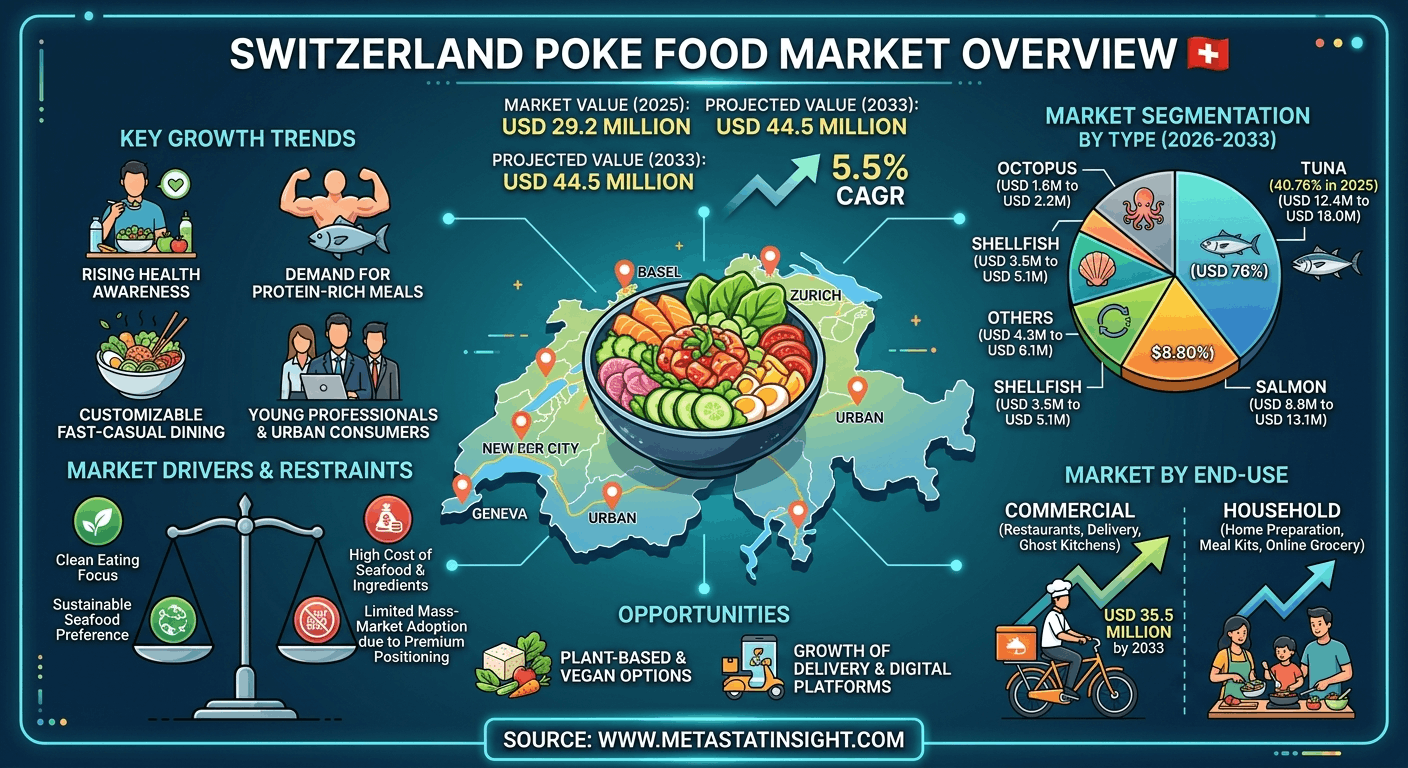
Strategic Market Segmentation
By Type:
-
Tuna: Led the market with a 40.76% share in 2025. It is valued at USD 12.4 million in 2026 and is forecasted to hit USD 18.0 million by 2033 (5.4% CAGR).
-
Salmon: Driven by immense taste appeal, this segment stands at USD 8.8 million in 2026 and is projected to reach USD 13.1 million by 2033 at a leading 5.8% CAGR.
-
Shellfish: Valued at USD 3.5 million in 2026, it is anticipated to touch USD 5.1 million by 2033 (5.6% CAGR).
-
Octopus: A developing niche segment valued at USD 1.6 million in 2026, estimated to reach USD 2.2 million by 2033 (5.3% CAGR).
-
Others (including Tofu & Alternative Proteins): Expected to rise from USD 4.3 million in 2026 to USD 6.1 million by 2033.
By End-Use:
-
Commercial: Dominating via restaurant chains, quick-service outlets, and delivery platforms, this segment is projected to reach USD 35.5 million by 2033 (5.3% CAGR).
-
Household: Driven by meal kits and online grocery sourcing, home consumption is set to experience the fastest growth at a 6.3% CAGR, reaching USD 9.0 million by 2033.
Core Market Dynamics
The sector is driven by rising urban demand for protein-dense, clean-label nutrition and the convenience of build-your-own bowl formats. However, high procurement costs and cold-chain requirements for premium seafood create pricing pressures, limiting mass-market adoption in smaller towns. Major growth opportunities lie in expanding plant-based or vegan poke alternatives (tofu, tempeh) and leveraging urban ghost kitchens.