
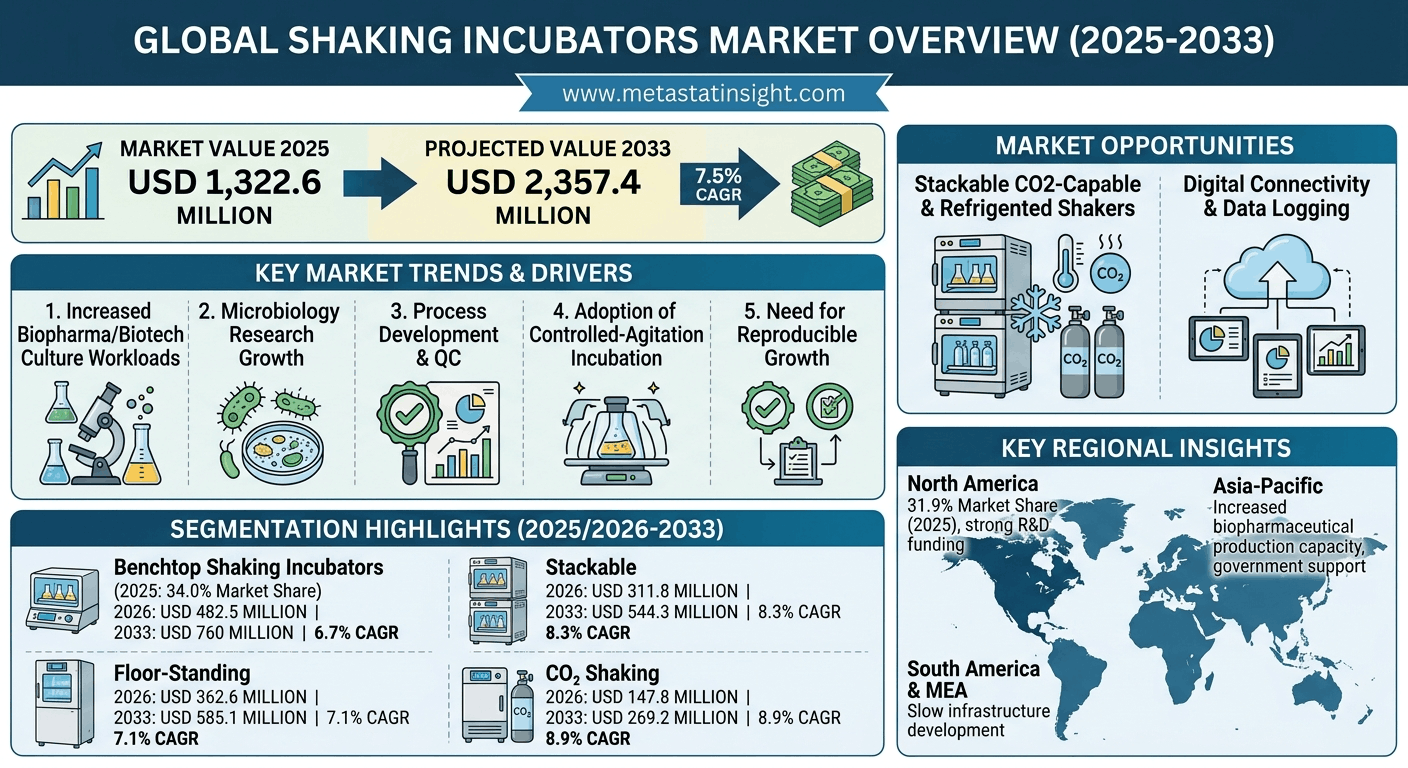
The global laboratory equipment landscape is witnessing a significant transformation as the Global Shaking Incubators Market is valued at USD 1,322.6 million in 2025. According to the latest comprehensive analysis by Metastat Insight, the market is poised for robust expansion, projected to grow at a CAGR of 7.5% during the forecast period to reach a valuation of USD 2,357.4 million by 2033.
As precision-controlled environments become the cornerstone of advanced biological and chemical research, shaking incubators are evolving beyond routine laboratory use. They are now integral to high-stakes fields such as synthetic biology, personalized medicine, and the development of cell-based therapies.
Market Dynamics: The Catalysts for Growth
The market's upward trajectory is primarily fueled by intensified workloads in biopharma, biotechnology, and microbiology. Key drivers include:
-
Expansion of Biologics and Vaccines: Rising investments in microbial research and vaccine development are necessitating large-capacity incubation systems that maintain uniform conditions for reproducible growth.
-
Technological Shift to Controlled Agitation: Modern laboratories are increasingly adopting programmable shaking incubators to ensure consistent nutrient distribution and aeration in flasks and microplates, which is critical for regulatory alignment and experimental reliability.
Segment Insights: Benchtop Models Lead While CO2 Systems Accelerate
-
Benchtop Shaking Incubators: This segment remains a dominant force, valued at USD 482.5 million in 2026 (34.0% of the 2025 market share). Their compact footprint makes them the preferred choice for academic laboratories and research institutes with limited space.
-
CO2 Shaking Incubators: Anticipated to be the fastest-growing product type, this segment is projected to reach USD 269.2 million by 2033 with a CAGR of 8.9%. The demand is driven by sensitive cell-culture applications where gas regulation and contamination management are paramount.
-
Automation Levels: The industry is moving toward "Smart" laboratories. The Fully Automated segment is expected to lead growth with a 11% CAGR, as pharmaceutical manufacturers seek integrated sensors and centralized data logging for process consistency.
Regional Leadership: North America at the Forefront
North America currently commands 31.9% of the global market revenue. This leadership is sustained by massive R&D funding and a mature life sciences infrastructure. Meanwhile, the Asia-Pacific region is emerging as a high-potential zone due to increasing government support for biotechnology innovation and expanding biopharmaceutical production capacities in research hubs.
Competitive Landscape
The report identifies key industry players who are driving innovation through digital connectivity and modular designs. Featured companies include Thermo Fisher Scientific Inc., Eppendorf SE, INFORS HT AG, Adolf Kühner AG, and Sartorius AG, among others. These leaders are focusing on vibration control and heat-rejection technologies to overcome constraints in modern, high-density lab environments.
About Metastat Insight
Metastat Insight is a premier market research firm providing data-driven strategic outlooks across global industries. Our reports offer in-depth analysis of niche industry developments, helping stakeholders identify emerging segments and regional growth potential.