
The global healthcare sector is witnessing structural advancements in lipid management as the Global Pure EPA Active Pharmaceutical Ingredient (API) Market tracks a definitive upward trajectory. According to an in-depth operational analysis released by MetaStat Insight, the industry's market valuation is positioned at USD 358.9 million in 2025 and is projected to expand at a compounding annual growth rate (CAGR) of 10.9% during the forecasted timeline, culminating in a global market volume of USD 820.8 million by 2033.
This steady market expansion highlights the critical reliance of pharmaceutical and nutraceutical supply networks on high-purity eicosapentaenoic acid (EPA). Purified EPA APIs have emerged as essential structural inputs for premium finished medical formulations due to their tightly controlled potency levels, rigid regulatory compliance, and verified safety benchmarks in clinical lipid management and triglyceride containment applications.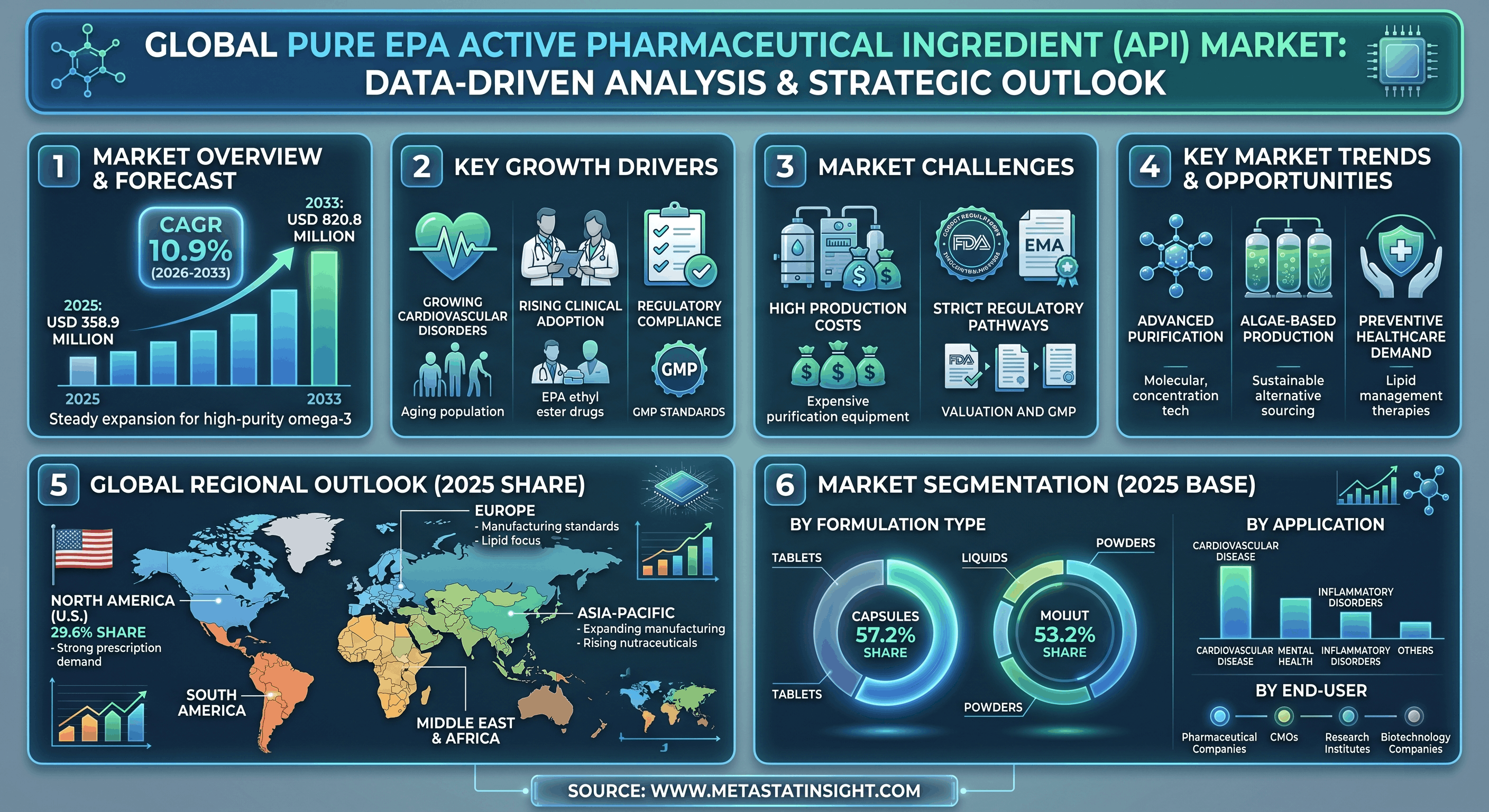
Catalysts Fueling Marketplace Expansion
Strategic growth patterns within the global marketplace are primarily driven by two foundational macro-environmental shifts:
-
Escalating Global Metabolic and Cardiovascular Challenges: The rising clinical prevalence of hypertension, chronic lipid imbalances, metabolic disorders, diabetes, and obesity exacerbated by expanding geriatric populations, highly sedentary lifestyles, and the consumption of heavily processed foods has elevated corporate and clinical procurement demands across major regional healthcare channels.
-
Accelerating Clinical Adoption of Branded Prescription Drugs: Medical practitioners are displaying heightened clinical confidence in specialized omega-3 prescription options, including advanced EPA ethyl ester therapies. Strong outcome datasets, structured post-treatment cardiac tracking systems, and broadening insurance formulary acceptance continue to sustain reliable, long-term procurement cycles for ingredient manufacturers.
To satisfy these trends, process engineers and active ingredient manufacturers are actively scaling capital investments into modern molecular distillation, concentration mechanisms, oxidation management setups, and batch-traceability infrastructure to reliably satisfy stringent regulatory mandates.
Operational Barriers and Future Horizons
Despite steady tailwinds, production entities navigate strict technical constraints. Fabricating pharmaceutical-grade purity necessitates heavy capital expenditure for complex distillation, strict oxidation monitoring, continuous contamination filtration, and cold-chain supply security. Furthermore, meeting rigid international quality benchmarks, such as the FDA and EMA GMP authorization pathways, demands continuous investments in batch traceability documentation and regular clinical facility audits.
Conversely, the industry is entering a sustainable evolution through the expansion of precision fermentation and algae-based cultivation setups. These innovations reduce raw dependence on ocean-derived fish stocks, guaranteeing consistent chemical profiles, scalable production outputs, and environmentally resilient supply configurations that match the long-term sustainability mandates of multinational corporate pharmaceutical procurers.
Geographic Architecture Overview
North America led initial baseline demand, commanding a prominent 29.6% market share in 2025, heavily sustained by mature regulatory setups and strong consumer awareness within the United States. Europe maintains an indispensable market footprint due to highly integrated pharmaceutical standards and systemic clinical emphasis on preventative lipid control. The Asia-Pacific arena emerges as a hyper-growth hub, where rising preventative wellness investments and the expansion of domestic production infrastructure across China, Japan, South Korea, and India are opening critical sourcing opportunities. Improved general healthcare access also supports steady demand growth across South America, the Middle East, and Africa.