
LEAD ANALYST
Utkarsh Khirodkar is a Lead Market Research Analyst at MetaStat Insight, specializing in market intelligence, technology sector assessments, and competitive strategy.

According to a comprehensive data-driven industry analysis published by Metastat Insight, the Netherlands F&B QA, QC, and Compliance Software Solutions market is undergoing a significant operational shift. Valued at USD 272.5 million in 2025, the market is projected to expand at a steady Compound Annual Growth Rate (CAGR) of 5.6% during the forecast period, ultimately reaching a valuation of USD 421.3 million by 2033.
The latest market evaluation emphasizes that the Dutch food and beverage ecosystem is moving away from fragmented, paper-based, or manual processes toward integrated, real-time digital environments. Modern automated ecosystems are unifying quality assurance, quality control, and regulatory compliance into a single operational interface to facilitate real-time visibility and end-to-end supply chain transparency.
The structural growth of the Netherlands food safety software domain is primarily shaped by the following factors:
Stringent Regulatory Oversight: Strict regulatory frameworks enforced by the European Union and the Netherlands (such as the NVWA) mandate uncompromising hygiene, safety, and traceability. The necessity for audit-ready documentation and optimized risk prevention acts as a heavy pressure point forcing organizations to pivot toward centralized tracking software.
Workforce Deficits and Escalating Costs: Rising compliance-related operational burdens alongside acute labor shortages across production lines are prompting businesses to seek automated efficiency. Software-driven inspection procedures optimize resource allocation and limit dependency on manual logging.
Capital and Cultural Obstacles: Despite long-term benefits, the market faces headwinds due to high initial deployment and enterprise system integration costs, creating budgetary hesitation among small and medium enterprises. Furthermore, cultural inertia and employee adaptation challenges regarding shifting away from legacy document control systems delay modernization.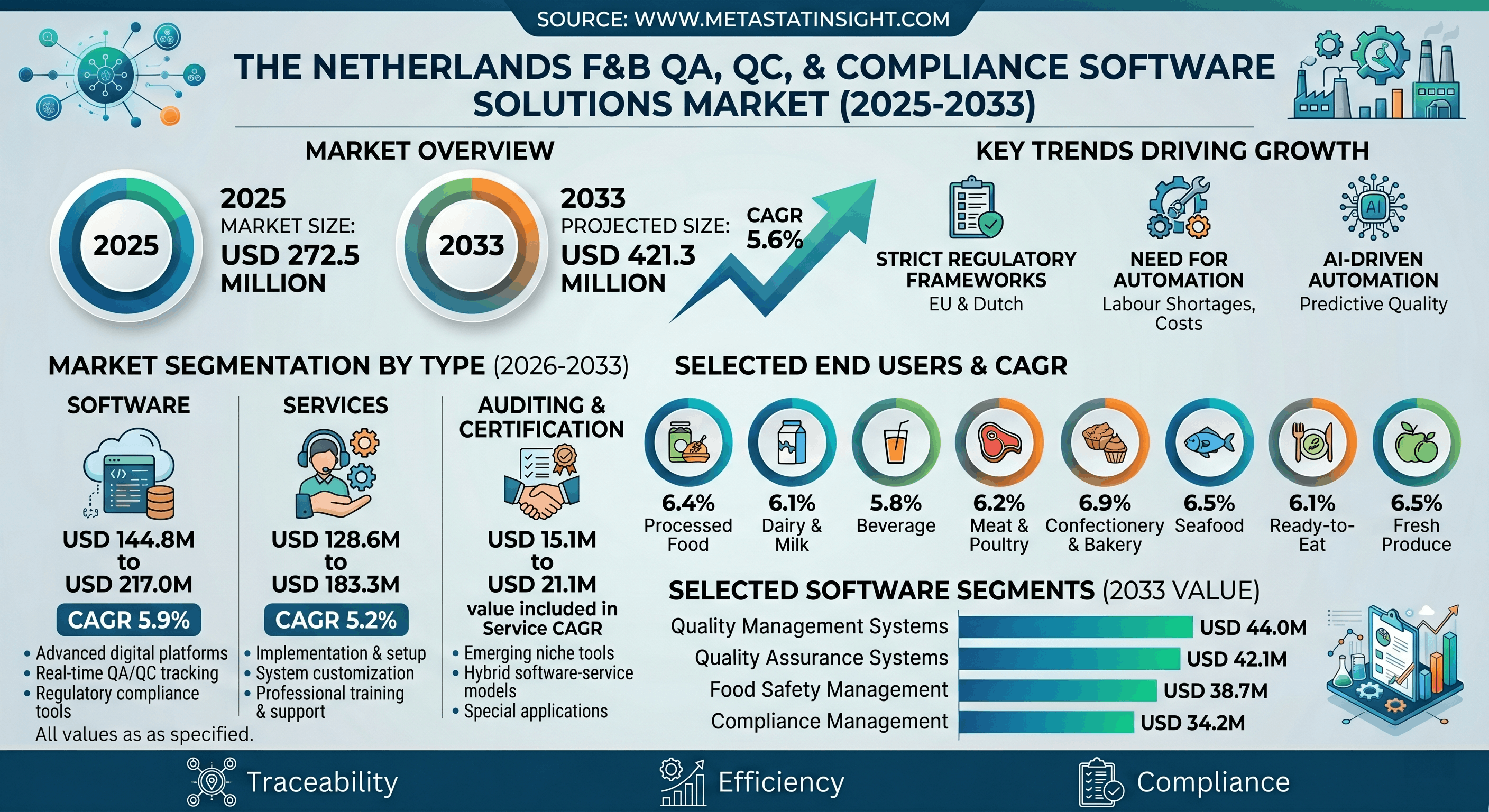
By Type: The Software segment holds a prominent space, valued at USD 144.8 million in 2026 and accelerating at a 5.9% CAGR to touch USD 217.0 million by 2033. Concurrently, the Service segment encompassing expert-led system lifecycle management and customization is valued at USD 128.6 million in 2026 and is expected to hit USD 183.3 million by 2033 at a 5.2% CAGR. Other hybrid tools constitute the remainder.
By Software Classification: Advanced cloud-based ecosystems are branching across critical functionalities. By 2033, Quality Management Systems are anticipated to lead in segment value at USD 44.0 million, followed closely by Quality Assurance Systems at USD 42.1 million, Food Safety Management Software at USD 38.7 million, and Compliance Management Software at USD 34.2 million. Specialized solutions like Supplier Quality Management (USD 23.9 million), Risk Management (USD 18.8 million), and Document Control Systems (USD 15.3 million) round out the structural divisions.
By Services: Auditing and Certification services represent a vital fraction projected to reach USD 85.6 million by 2033, as commercial entities seek validation under international trade codes. Strategic Consultancy (USD 37.0 million), Sustainability-Related Services (USD 27.9 million), Training Services (USD 20.7 million), and Labelling Services (USD 12.0 million) highlight the ongoing reliance on professional expertise.
By End User Outlook: Digital adoption is expanding across varied food networks. Confectionery & Bakery producers lead growth velocities with a projected 6.9% CAGR, followed by Processed Food Manufacturers at a 6.4% CAGR, and Seafood Processors alongside Fresh Produce operators both expanding at a 6.5% CAGR. Meat and Poultry Processors (6.2% CAGR), Dairy and Milk Product Producers (6.1% CAGR), Ready-to-Eat Meal Manufacturers (6.1% CAGR), and Beverage Companies (5.8% CAGR) reflect uniform modernization sweeps to minimize food contamination risks.
The strategic outlook identifies artificial intelligence integration, predictive quality analytics, and IoT-enabled critical control point monitoring as the primary upcoming avenues of opportunity. By transferring tracking methodologies from reactive adjustments to predictive prevention models, Dutch food producers and distributors are consolidating consumer trust, reducing post-harvest losses, and future-proofing operations against evolving international statutory demands.
About Metastat Insight:
Metastat Insight is a premier global market research and consulting firm specializing in delivering comprehensive, data-driven market analysis reports across diverse industrial landscapes. By providing precise statistics, competitive benchmarking, and actionable strategic recommendations, Metastat Insight empowers businesses worldwide to identify high-growth niches, optimize operational efficiency, and make informed data-driven investment decisions.
Related Report
View full market research reportLEAD ANALYST
Utkarsh Khirodkar is a Lead Market Research Analyst at MetaStat Insight, specializing in market intelligence, technology sector assessments, and competitive strategy.

LEAD PRINCIPAL ANALYST, PHARMA AND HEALTHCARE
Food and Beverages · Healthcare · Healthcare IT · Medical Devices
Ajay Devgire is the Lead Healthcare Analyst at MetaStat Insight, leading strategic research and market intelligence initiatives across the global healthcare domain.

SENIOR RESEARCH ANALYST
Biotechnology · Food and Beverages · Medical Devices · Packaging
Snehal Pasalkar is a Research Analyst at MetaStat Insight, operating at the intersection of life sciences research, competitive strategy, and market intelligence.