
The global landscape for treating neurological trauma and nerve damage is shifting rapidly. According to an extensive industry analysis published by Metastat Insight, the global nerve repair and regeneration market is valued at USD 9.1 billion in 2025. Fueled by a compounding annual growth rate (CAGR) of 12.9%, this specialized sector is projected to hit USD 24 billion by 2033.
The rapid market expansion is primarily anchored to the escalating global prevalence of complex neurological conditions. Data from the World Health Organization (WHO) reveals that roughly 44 million individuals worldwide live with Alzheimer’s disease, while 60 million battle epilepsy, making it one of the most prominent neurological illnesses globally. Furthermore, the Parkinson’s Foundation notes that over 10 million people are living with Parkinson’s disease globally, with roughly 60,000 Americans diagnosed annually. In addition to these conditions, the global prevalence of nervous system tumors reaches 3.6 per 100,000 in males and 2.5 per 100,000 in females, adding further diagnostic and therapeutic urgency.
Nerve regeneration technologies act to restore function to compromised peripheral nerves and assist in repairing nervous tissues, cells, or cellular products. These intricate mechanical processes include the production of fresh glia, neurons, axons, myelin, and synapses.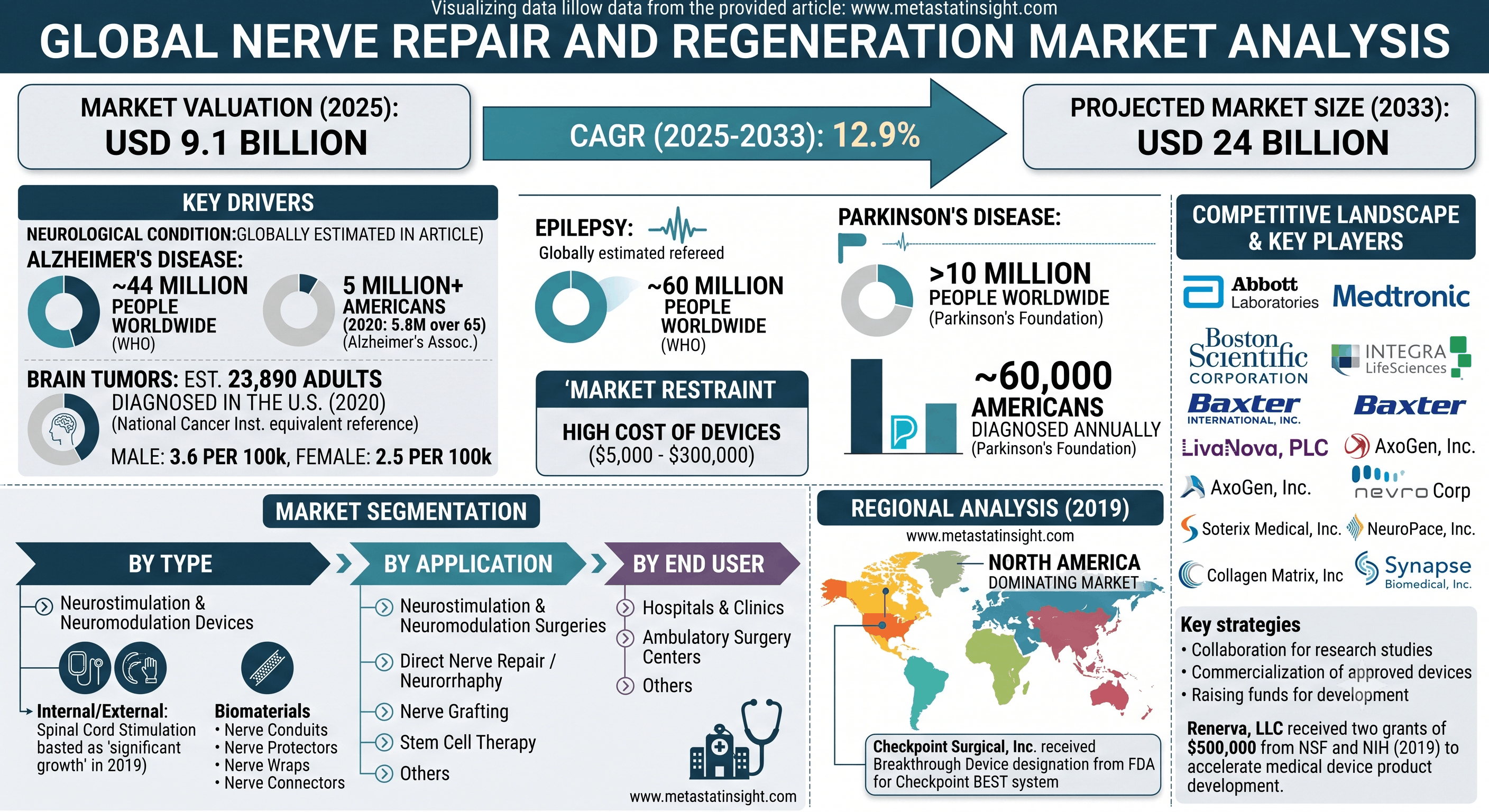
Granular Market Segmentation Insights
The industry is categorized by type, therapeutic application, and end-user facilities:
-
By Type: The market includes Biomaterials (such as nerve conduits, nerve wraps, nerve protectors, and nerve connectors) alongside dominating systems like Neurostimulation & Neuromodulation Devices.
-
By Application: Segmented into Neurostimulation and Neuromodulation Surgeries, Direct Nerve Repair/Neurorrhaphy, Stem Cell Therapy, and Nerve Grafting.
-
By End User: Primarily divided among Hospitals & Clinics, Ambulatory Surgery Centers, and related healthcare venues.
Neurostimulation and neuromodulation platforms captured the dominant market share. Internal neurostimulation systems are split into deep brain stimulation, sacral nerve stimulation, spinal cord stimulation, vagus nerve stimulation, and gastric electrical stimulation. External variants include transcranial magnetic stimulation and transcutaneous electrical nerve stimulation. Notably, spinal cord stimulation experienced significant traction due to expanding clinical trials and recent product commercialization, such as Boston's launch of the Spectra WaveWriter Spinal Cord Stimulator (SCS) System in Europe, which combines paresthesia-based and sub-perception therapies.
Regional Dominance and Competitive Frontrunners
Geographically, North America led the sector in 2019, driven by strategic corporate alliances, commercialization of advanced hardware, and progressive regulatory pathways. For example, Checkpoint Surgical, Inc. secured a Breakthrough Device designation from the U.S. FDA for its brief electrostimulation therapy (BEST) system, designed to accelerate peripheral nerve regeneration.
The competitive matrix highlights major global enterprises, including: Medtronic, PLC, Abbott Laboratories, Boston Scientific Corporation, Integra LifeSciences, Baxter International, Inc., AxoGen, Inc., LivaNova, PLC, Nevro Corp
Corporate growth strategies heavily rely on collaborative research initiatives and federal grants to scale peripheral nerve technologies. A prime example includes Renerva, LLC, which secured $500,000 in combined grant backing from the NSF and NIH to accelerate medical device product development.
For a comprehensive evaluation of the parent industry, including current market shares, emerging regional opportunities, and value-based forecasting, view the full report directory at Metastat Insight.
About Metastat Insight
Metastat Insight is a premier market research provider delivering deep-dive operational analyses, volume-value metrics, and strategic assessments of niche global industries to assist corporate decision-makers worldwide.