
The landscape of fine retail design is undergoing an extensive evolutionary shift as the global market for lab-grown diamond jewelry registers historic expansion. According to an extensive data-driven market intelligence report released by MetaStat Insight, the global lab-grown diamond jewelry market size is valued at USD 14,006.3 million in 2025. Demonstrating an impressive Compound Annual Growth Rate (CAGR) of 12.0% across the active forecast window spanning from 2026 to 2033, the overall valuation is strategically projected to culminate at USD 34,680.4 million by the end of 2033.
Modern fabrication processes that meticulously mirror the natural creation conditions of mined alternatives are generating gemstones with equivalent visual, physical, and optical metrics. This breakthrough is driving an overarching realignment toward highly affordable and ethical consumer options. This trend is swiftly turning lab-grown stones into a foundational pillar of mainstream global luxury commerce, rather than just a specialized alternative.
Dominant Structural Segments and Technology
Strategic market fragmentation underscores that High-Pressure High-Temperature (HPHT) engineering represents the largest technical share. It accounts for an established 61.0% of general market revenue in 2025. Valued at USD 9,573.3 million in 2026, the HPHT segment is on a clear path to secure a valuation of USD 21,377.1 million by 2033, progressing at an isolated CAGR of 12.2%. This growth is heavily backed by refined industrial scalability and stable production outputs that guarantee physical resilience and consistent aesthetics.
Concurrently, Chemical Vapor Deposition (CVD) methods are carving out crucial positions due to advanced crystallization technologies. The CVD diamond sector is valued at USD 6,118 million in 2026 and is anticipated to achieve USD 13,303.3 million by 2033, expanding at a CAGR of 11.7%. Designers focused on upscale design innovations are consistently drawn to CVD methods because they offer precise control over internal structures and pristine clarity configurations.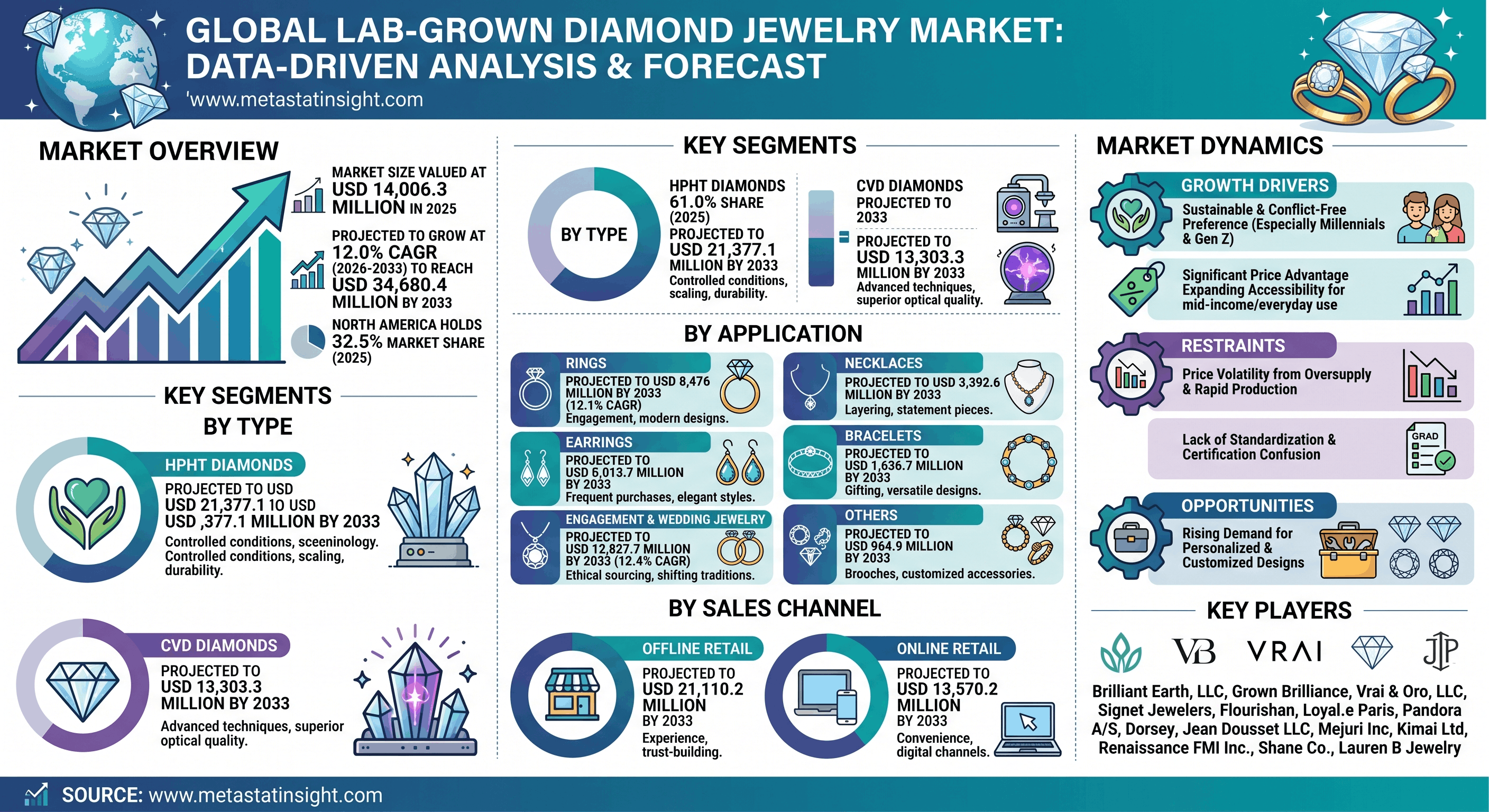
Catalyzing Trends and Market Restraints
The momentum driving the industry is fundamentally multi-layered. Ethical clarity, ecological mindfulness, and strict transparency parameters are redirecting purchase pathways. This shift is particularly evident among millennial and Gen Z buyer circles. Furthermore, significant price advantages are widening commercial boundaries, shifting fine jewelry from exclusive, occasional investments into dynamic, everyday accessories.
Conversely, the industry faces structural constraints. Rapid capacity expansion and structural oversupply issues are introducing clear pricing vulnerabilities, impacting corporate profit margins and affecting consumer resale values. Furthermore, missing industry standards regarding uniform grading protocols and certifications create customer uncertainty. Achieving a universal framework for validation remains critical to securing long-term credibility.
Product Application Profiles and Dynamic Retail Pathways
Regarding product application channels, wedding and bridal options lead the way, with the engagement & wedding jewelry segment projected to hit USD 12,827.7 million by 2033 at a 12.4% CAGR. Consumer choices are expanding rapidly across specific accessory types:
-
Rings: Expected to reach USD 8,476 million by 2033, building on a 12.1% CAGR. This segment benefits from interactive design options and rising interest in accessible, high-end rings.
-
Earrings: Forecast to expand to USD 5,013.7 million by 2033 at an 11.8% CAGR, supported by fast purchase turnarounds and evolving fashion preferences.
-
Necklaces: Anticipated to touch USD 3,392.6 million by 2033 at an 11.7% CAGR, buoyed by multi-layered fashion trends and modern craftsmanship.
-
Pendants & Bracelets: Projected to achieve USD 2,368.9 million and USD 1,636.7 million respectively by 2033, driven by customized options and gifting customs.
Retail operations show a healthy split across distribution channels. While physical brick-and-mortar experiences preserve their strong market share with offline retail projected to reach USD 21,110.2 million by 2033-digital storefronts are expanding rapidly. Online retail is projected to secure USD 13,570.2 million by 2033. E-commerce platforms are using virtual layouts, transparent certification displays, and competitive pricing strategies to continually extend their global reach.
Geographical Analysis and Competitive Environment
Geographically, North America leads global revenue distribution, holding an authoritative 32.5% market share in 2025, with the United States operating as the central regional driver. Western Europe tracks steady progress supported by dedicated ethical supply expectations. Meanwhile, the Asia-Pacific region demonstrates massive growth potential, fueled by expanding mid-income demographics across developing economies seeking affordable luxury jewelry solutions.
The competitive space features a diverse mix of market participants, including established corporations and specialized brands. Prominent market entities include Brilliant Earth, LLC, Grown Brilliance, Vrai & Oro, LLC, Signet Jewelers, Flourishan, Loyal.e Paris, Pandora A/S, Dorsey, Jean Dousset LLC, Mejuri Inc, Kimai Ltd, Renaissance FMI Inc., Shane Co., and Lauren B Jewelry. Corporate entities are expected to continuously balance unique design identities, transparent validation processes, and production innovations to secure long-term market positions.