
The global landscape for treating immunological deficiencies and dysfunctions is undergoing a massive shift. According to a comprehensive market intelligence study titled the "Global Immunology Market" published by Metastat Insights, the industry is experiencing robust expansion driven by the escalating worldwide incidence of chronic autoimmune conditions. The detailed report evaluates underlying industry dynamics, former and ongoing market indicators, and projected value and volume trends across major geographical landscapes.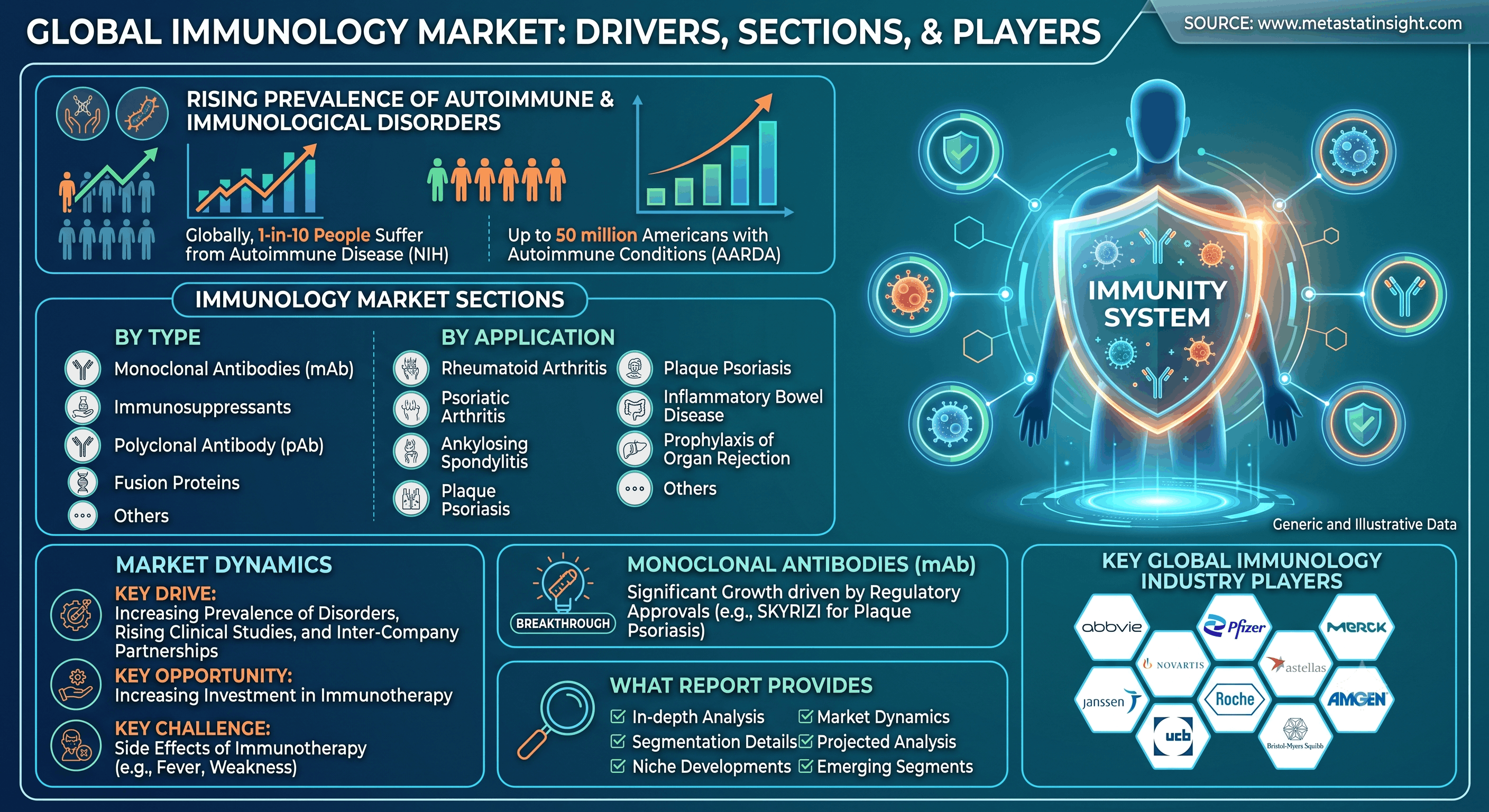
The immune system acts as the body's primary line of defense against infection. However, prolonged dysfunction within this complex biological architecture results in debilitating immunological disorders, including severe allergies, asthma, autoinflammatory syndromes, cancer, and diverse autoimmune diseases. The growing clinical necessity to manage these widespread conditions acts as the primary driver steering industry progression.
Data highlighted within the Metastat Insights report demonstrates the vast scale of this global healthcare crisis:
-
According to the National Institutes of Health (NIH), more than 700 million individuals globally—representing approximately one-tenth of the total human population—suffer from an autoimmune disease.
-
Data from the American Autoimmune Related Diseases Association (AARDA) indicates that up to 50 million citizens within the United States are currently afflicted by an autoimmune illness, with incidence rates projected to mount in the upcoming years.
-
In the United Kingdom, statistics tracked by the British Society for Immunology reveal that over four million people live with an autoimmune condition.
To address this demand, clinicians utilize sophisticated therapeutic interventions, predominantly segmenting the industry by product type into Monoclonal Antibodies (mAb), Immunosuppressants, Polyclonal Antibody (pAb), Fusion Proteins, and auxiliary alternatives. Among these, Monoclonal Antibodies (mAb) achieved highly significant growth. This clinical acceleration is directly tied to the commercialization of cutting-edge antibody therapeutics, an influx of targeted clinical studies, active inter-company developmental collaborations, and a steady cadence of regulatory milestones.
A prominent milestone highlighted in the study includes the U.S. Food and Drug Administration (FDA) approval granted to AbbVie for SKYRIZI (risankizumab-rzaa). The drug serves as a targeted interleukin-23 (IL-23) inhibitor specifically designed for adults managing moderate to severe plaque psoriasis.
From an application perspective, the research breaks down deployment across a broad spectrum of diseases, including Rheumatoid Arthritis, Psoriatic Arthritis, Ankylosing Spondylitis, Plaque Psoriasis, Inflammatory Bowel Disease, and the Prophylaxis of Organ Rejection. While clinical outcomes remain favorable, the report notes that prospective industry expansion faces minor constraints from known side effects linked to advanced immunotherapy. Typical adverse reactions observed in patient cohorts include localized skin redness, blistering, dryness, body aches, fever, weakness, vomiting, nausea, dizziness, and volatile shifts in blood pressure.
Geographically, North America commanded the dominant industry share, reinforced by rising local disease incidences, swift product commercialization, expanding partnerships, and proactive government research financing. Highlighting public sector support, the National Institute of Allergy and Infectious Diseases (NIAID)—a subsidiary of the NIH—allocated $30 million in funding across three institutions (the Harvard T.H. Chan School of Public Health, the Infectious Disease Research Institute of Seattle, and the Seattle Children's Hospital) to establish specialized centers for tuberculosis (TB) vaccine research.
Key corporate entities driving innovation in this space include industry leaders such as AbbVie Inc., F. Hoffmann-La Roche Ltd, Pfizer Inc., Astellas, Janssen, Novartis AG, Merck, UCB SA, Bristol-Myers Squibb, and Amgen Inc. To sustain market share, these players employ aggressive commercialization efforts, clinical research expansion, and regulatory submissions. Notably, Bristol-Myers Squibb secured FDA approval for ZEPOSIA (ozanimod) 0.92 mg, an oral medication representing the only approved sphingosine-1-phosphate (S1P) receptor modulator utilized for adult relapsing forms of multiple sclerosis (RMS).
The comprehensive publication delivers an in-depth parent industry analysis, changes in core dynamics, segment breakdowns, and identification of emerging high-potential regional pockets.