
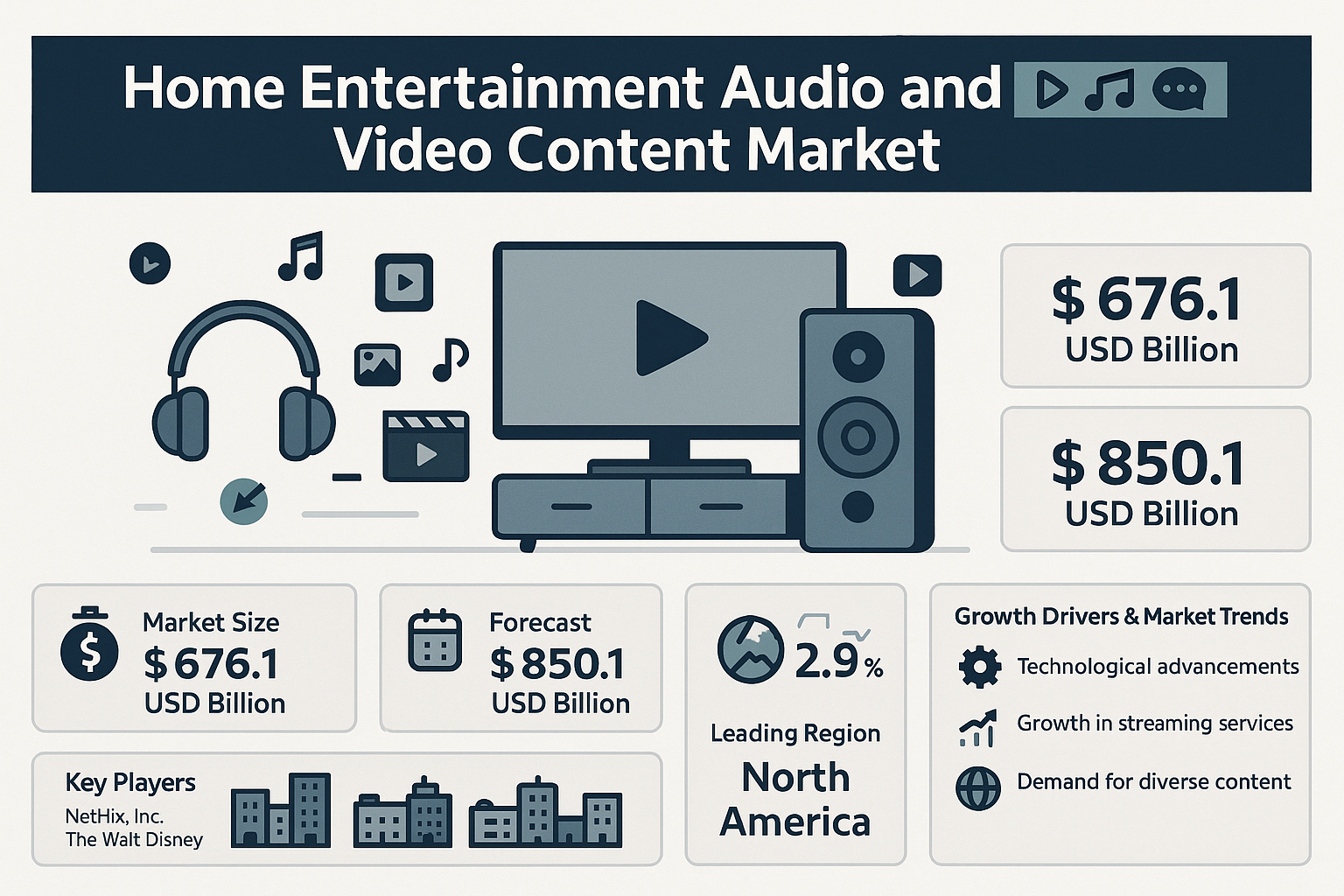
Metastat Insights has released a comprehensive report on the Home Entertainment Audio and Video Content market, revealing a projected growth from USD 676.1 billion in 2025 to USD 850.1 billion by 2033, at a CAGR of 2.9%. This report analyzes key market drivers, challenges, and segments.
Metastat Insights has published "Global Home Entertainment Audio and Video Content Market Size, Share, By Content Category (Movies and Feature Films, TV Series and Episodic Entertainment, Music and Music Videos, Sports Content, News and Current Affairs, Kids and Family Content, Documentaries and Factual Content, Podcasts and Spoken-Word Content, Others (Live Events, Lifestyle, Faith-Based and Specialty Content)), By Distribution Channel (Direct-to-Consumer OTT Platforms, Pay-TV and IPTV Operator Platforms, Connected-TV and FAST Platforms, Broadcast Network Digital Platforms, Digital Content Stores and Marketplaces, Physical Media Retail Channels, Others (Gaming Console Media Stores and Telecom Content Portals)), By Monetization Model (Subscription-Only, Advertising-Only, Transactional Rental, Electronic Sell-Through and Digital Purchase, Subscription and Advertising Hybrid, Bundled and Wholesale Content Licensing, Physical Media Sales, Others (Sponsorship-Supported and Publicly Funded Content)), Industry Analysis, Growth, Trends, and Forecast, 2026-2033", followed by the headline figures (USD 676.1 billion in 2025, USD 850.1 billion by 2033, 2.9% CAGR).
What is driving Home Entertainment Audio and Video Content demand
Increasing consumer interest in a wide array of entertainment options fuels growth in the Home Entertainment Audio and Video Content market. Improved economic conditions lead to higher disposable incomes, empowering consumers to invest in quality content. The shift towards streaming services plays a crucial role, highlighting preferences for on-demand access that aligns with contemporary lifestyles. Technological advancements, including high-definition streaming and better networking capabilities, promote access to diverse content, enhancing viewer satisfaction.
What is holding back the market
Regulatory challenges significantly impact the Home Entertainment Audio and Video Content market. Companies encounter rising compliance costs and operational difficulties, which hinder innovation and delay product releases. Macroeconomic variables, like inflation and currency fluctuations, affect production costs and pricing strategies, influencing consumer spending habits. Supply chain interruptions and geopolitical tensions complicate the procurement of necessary resources for content creation and distribution, further limiting market expansion.
Market segmentation by region and content category
The Home Entertainment Audio and Video Content market encompasses various categories, including Movies and Feature Films, TV Series and Episodic Entertainment, Music and Music Videos, Sports Content, and others. North America commands the largest market share at 37.5%, followed by Asia Pacific at 28.4% and Europe at 25.4%. While digital infrastructures improve in these regions, the demand for home entertainment solutions continues to increase. Each content category significantly influences consumer choices, with Movies and Feature Films anticipated to grow from USD 169.5 billion in 2026 to USD 195.5 billion by 2033.
Key players in the Home Entertainment Audio and Video Content market
Several key players operate within the Home Entertainment Audio and Video Content market, including Netflix, Inc., The Walt Disney Company, Amazon.com, Inc., and Apple Inc. These companies prioritize enhancing user experiences through innovative content delivery and original programming. Their strategic investments in technology and content diversification strengthen their competitive position in a rapidly evolving market. Other notable players include Warner Bros. Discovery, Inc., Comcast Corporation, and Spotify Technology S.A., all adjusting to shifting consumer demands and preferences.