
MetaStat Insight has published its latest evaluation of the Global Gas Compressors Market, outlining a major strategic trajectory across industrial equipment and energy infrastructure ecosystems. Valued at USD 5,338.2 million in 2025, this highly active market is anticipated to expand at a steady Compound Annual Growth Rate (CAGR) of 3.2% over the forecast horizon, ultimately positioning its net valuation at USD 6,863.9 million by 2033.
The market is seeing notable transformations as it steps beyond historical boundaries tied only to upstream oil and gas setups. Today, mechanical compression systems are actively positioning themselves as fundamental infrastructure across changing gas handling operations. This expansion spans modernized distributed industrial applications, cross-border carbon capture (CCUS) projects, hydrogen value chains, and specialized biogas upgrading plants. Manufacturers are engineering robust compressor setups optimized to safely manage changing gas mixes, unpredictable operating pressures, and stringent international standards regarding industrial emissions.
Geographically, North America maintained a strong position in 2025, capturing a 28.6% market share. This geographic footprint is largely driven by continuous capital investments channeled into midstream transport channels, shale development, and export infrastructures. Concurrently, the Asia-Pacific region exhibits massive prospective demand fueled by rapid municipal gas distribution initiatives and growing fuel utilization across industrial fabrication environments.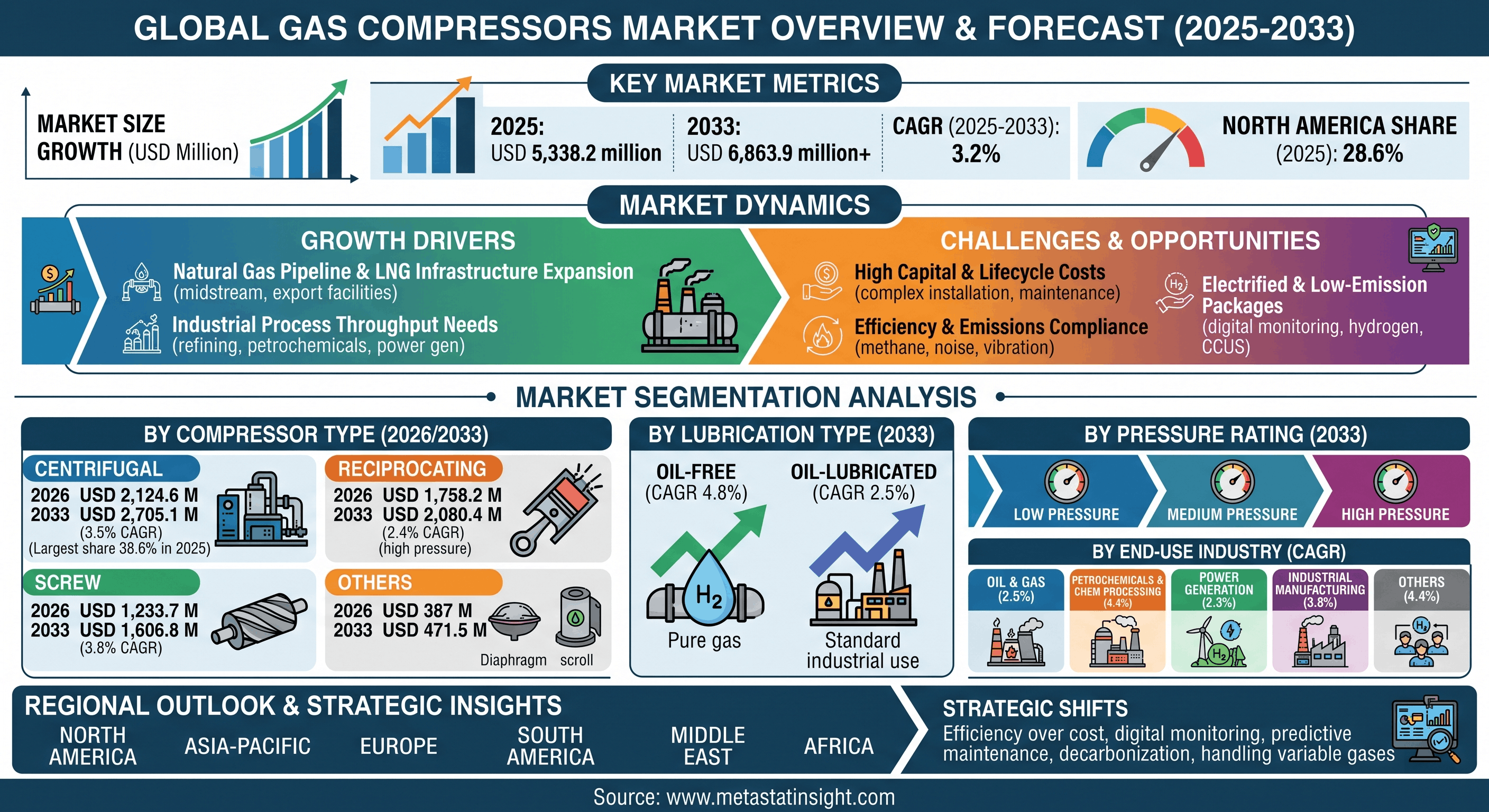
By architectural product classification, the breakdown reveals distinctive technology growth vectors:
-
Centrifugal Gas Compressors: Representing the single largest classification with a 38.6% market share in 2025, this segment is valued at USD 2,124.6 million in 2026. It is modeled to achieve USD 2,705.1 million by 2033, moving at a 3.5% CAGR, due to its critical role in heavy-flow applications.
-
Reciprocating Gas Compressors: Valued at USD 1,758.2 million in 2026, this category is projected to grow at a 2.4% CAGR to reach USD 2,080.4 million by 2033, serving operations focused on high-pressure intensity.
-
Screw Gas Compressors: Emerging as a rapidly adopting option for mid-scale settings due to package simplicity, this segment starts at USD 1,233.7 million in 2026 and heads toward USD 1,606.8 million by 2033, advancing at a 3.8% CAGR.
In terms of system lubrication profiles, Oil-lubricated Compressors retain the leading market share, on track to reach USD 4,635.9 million by 2033 due to their heavy-duty reliability. Meanwhile, the high-purity Oil-free Compressors segment is growing at a faster 4.8% CAGR, heading toward USD 2,228 million by 2033 due to strict purity rules in the pharmaceutical, electronics, and food sectors. From a system pressure standpoint, Medium Pressure configurations hold a strong position, projected to hit USD 2,965.9 million by 2033.
The marketplace features a mix of global engineering conglomerates, specialized precision manufacturers, and localized providers. Key industry participants driving engineering innovation include major organizations such as Atlas Copco AB, Siemens Energy AG, Burckhardt Compression Holding AG, Ingersoll Rand Inc., Hitachi Ltd., and Kawasaki Heavy Industries, Ltd. Future market success rests on predictive analytics integration, material resilience, and comprehensive aftermarket support structures.